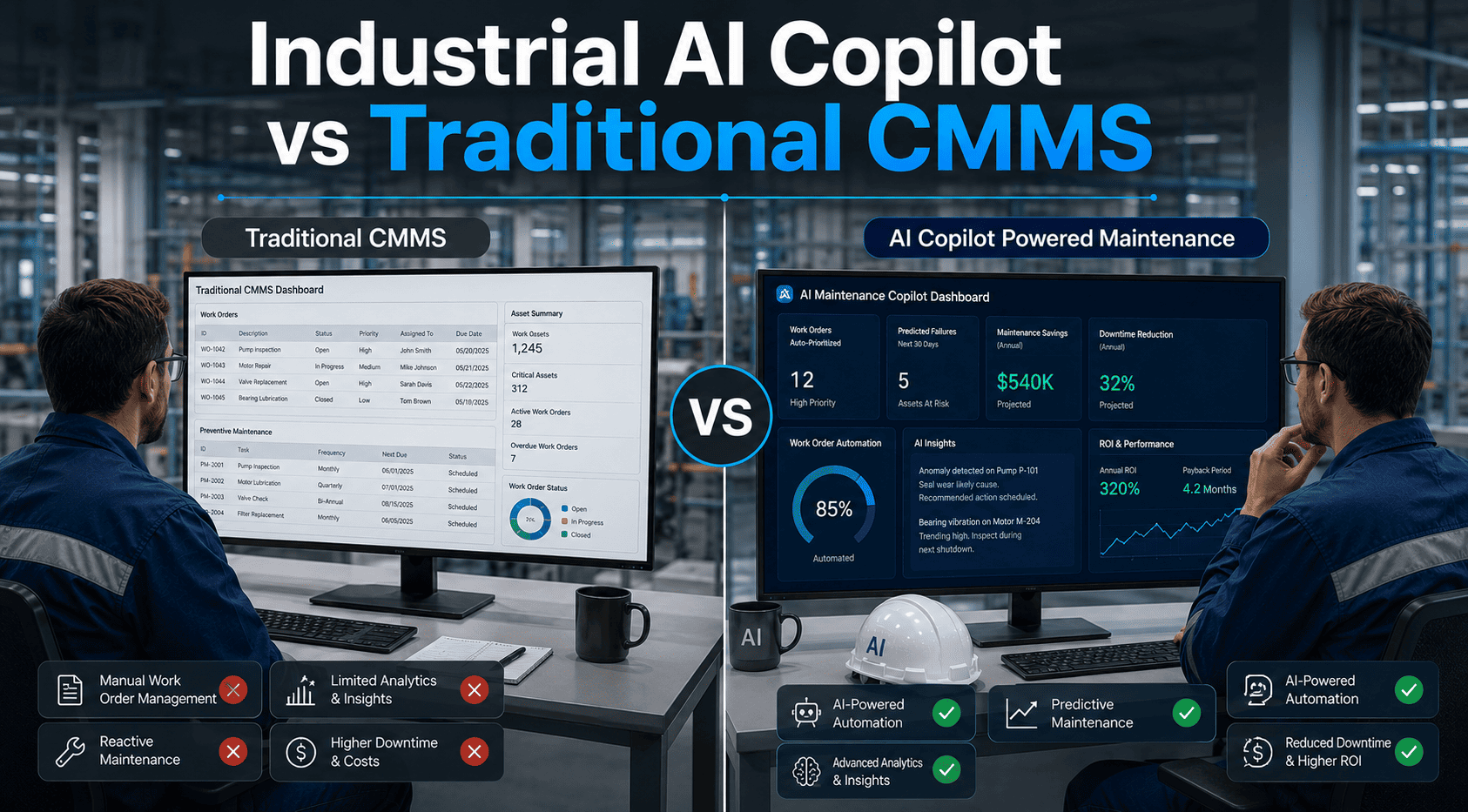
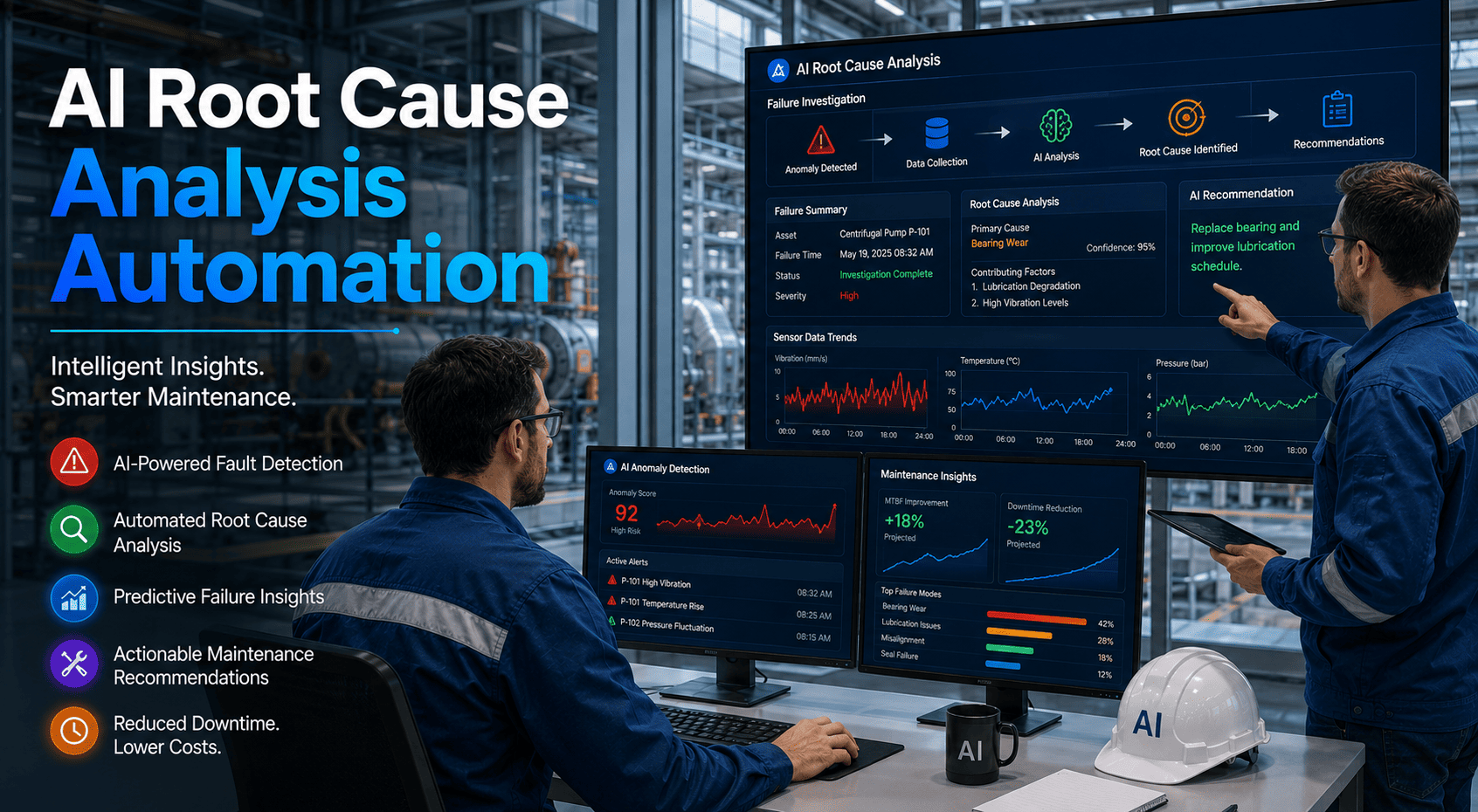
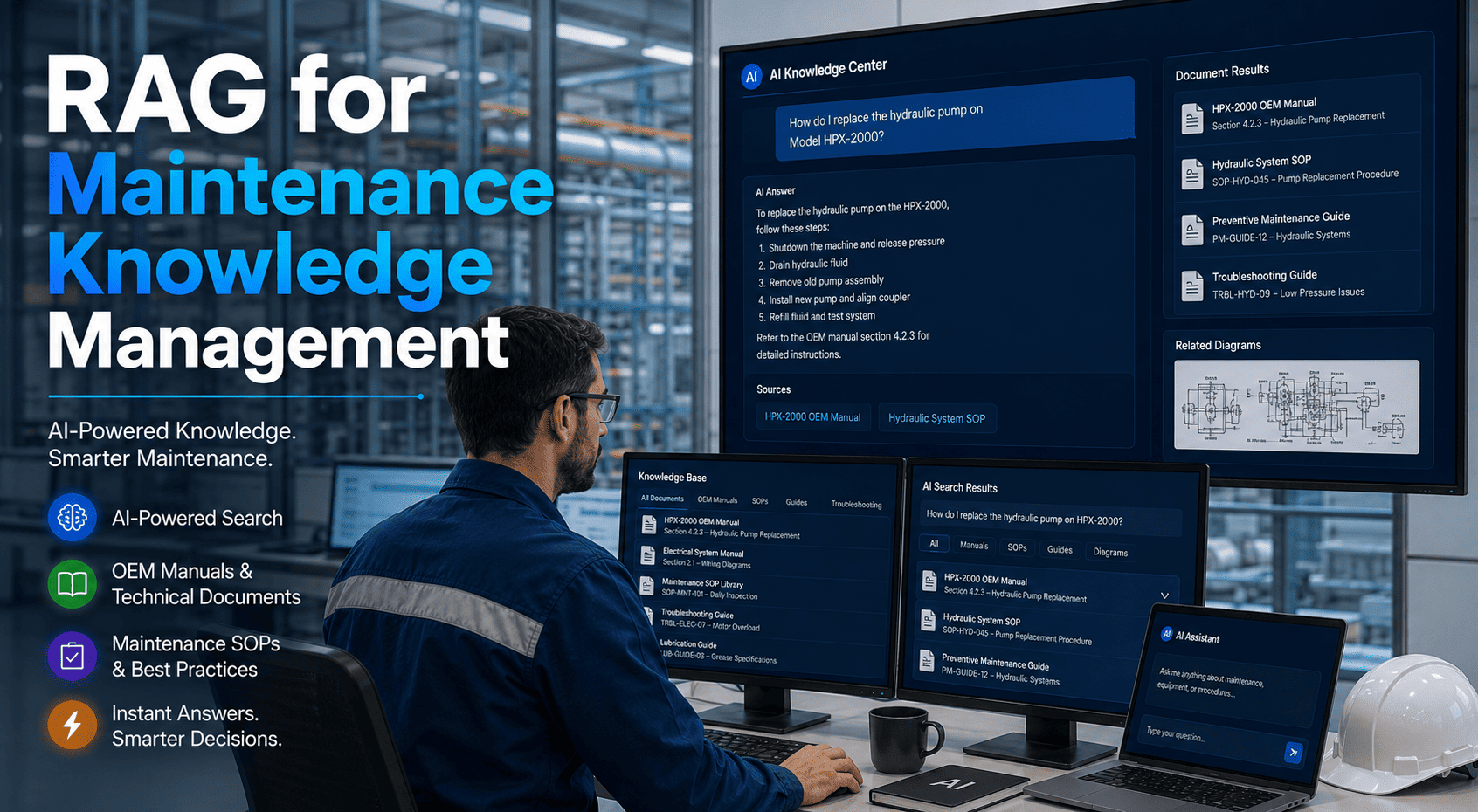
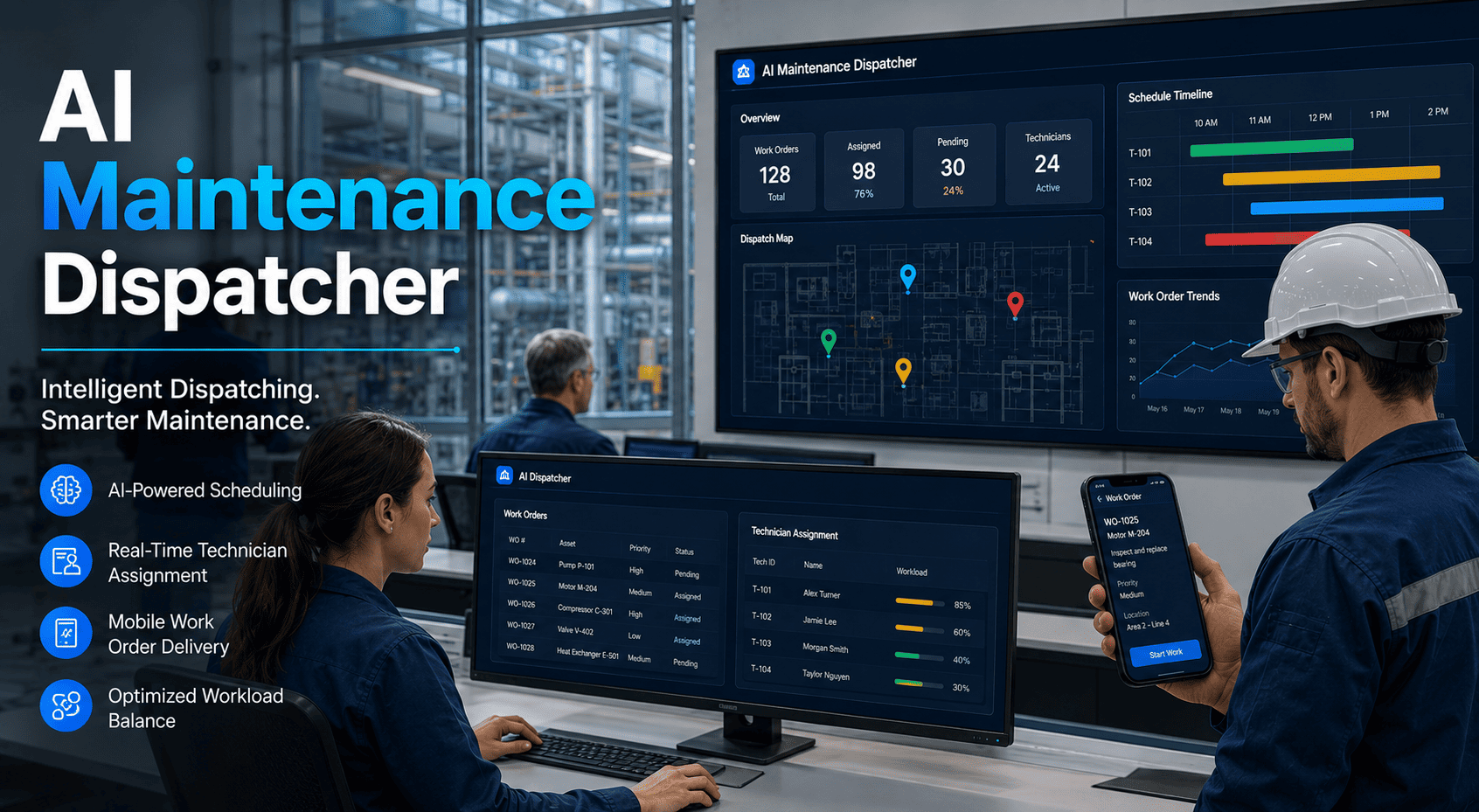
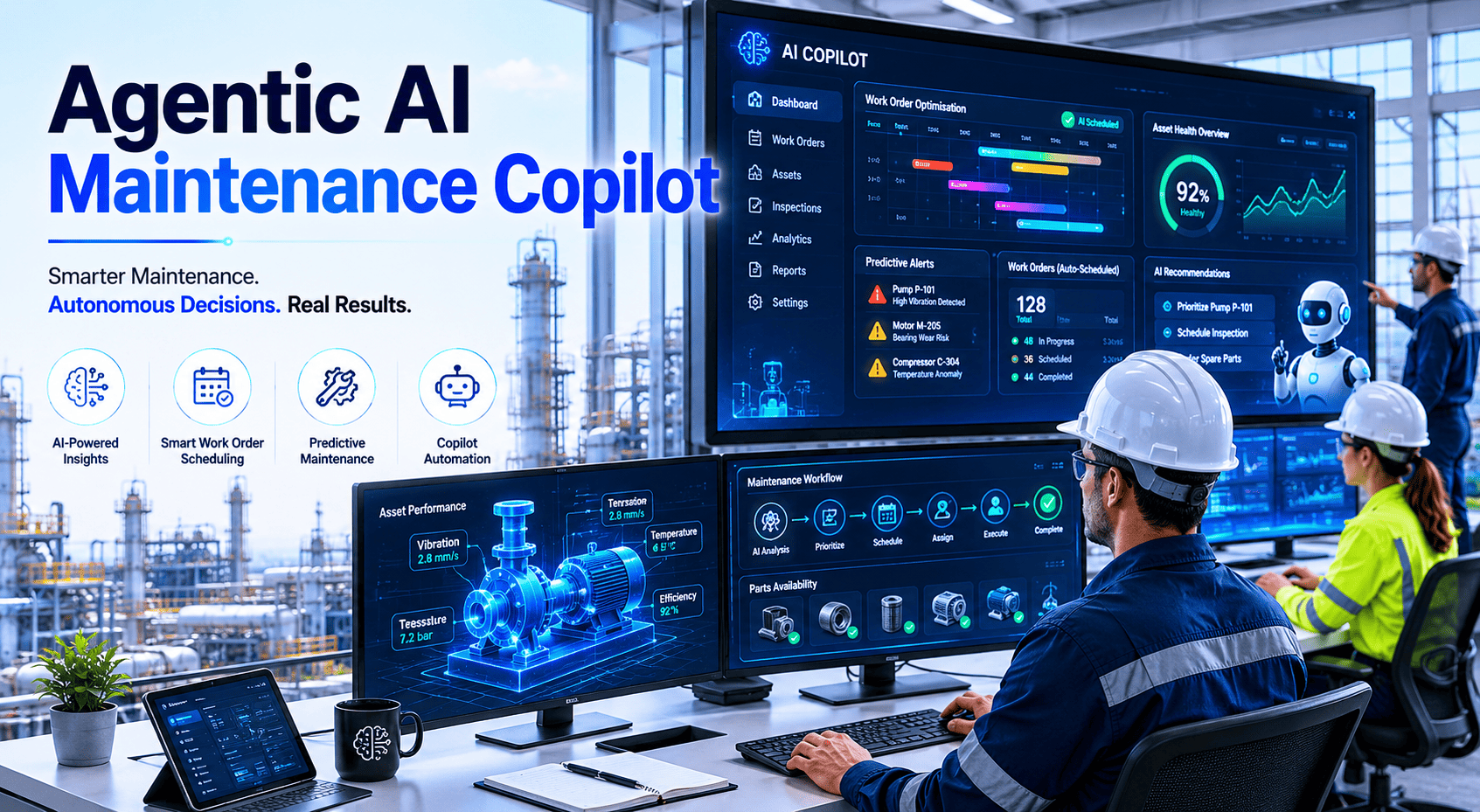
Facility maintenance teams spend up to 30% of their time searching for assets, verifying outdated floor plans, and navigating spaces with documentation that no longer reflects reality. Robotic 3D scanning eliminates this problem at its root. Autonomous robots equipped with LiDAR and SLAM sensors now traverse industrial facilities on scheduled missions, capturing millimeter-accurate point cloud data that becomes the foundation of as-built digital twins. When connected to a CMMS like Oxmaint, these spatial models transform static drawings into living maintenance ecosystems where every asset has a verified location, a real-time condition profile, and a predictive maintenance timeline. Book a demo to see how Oxmaint connects robotic 3D scanning data to intelligent maintenance workflows.
What Makes As-Built Digital Twins Critical for Maintenance
Design drawings show what a facility was supposed to look like. As-built digital twins show what it actually looks like right now. Equipment gets relocated, piping is rerouted, structural modifications happen without documentation updates, and over time the gap between paper records and physical reality grows wide enough to cause real problems — misrouted work orders, wasted technician hours, failed inspections, and costly rework during retrofits. Robotic 3D scanning closes that gap by delivering a verified, spatially accurate 3D model of your facility exactly as it exists today.
Legacy Documentation Gaps
As-Built Digital Twin + CMMS
From Physical Facility to Maintenance-Ready Digital Twin
In 2026, autonomous robotic scanning has matured from lab demonstrations to repeatable industrial operations. Quadruped robots and mobile scanning platforms capture entire facilities in days, and AI-powered reconstruction pipelines deliver simulation-ready 3D models that integrate directly with your CMMS. Here is how the end-to-end workflow operates.
Autonomous LiDAR Capture
Robots like Boston Dynamics Spot equipped with Leica BLK ARC payloads autonomously navigate your facility on pre-programmed routes. They capture millions of 3D points per second with sub-2mm accuracy — covering corridors, equipment rooms, overhead piping, and confined spaces without putting personnel at risk.
Hybrid Point Cloud Registration
Modern workflows fuse static terrestrial laser scanning (TLS) control data with mobile SLAM trajectories. Registration software automatically detects the rigid TLS anchors and snaps mobile scan paths to them, correcting positional drift and delivering a unified point cloud with consistent accuracy across the entire facility footprint.
AI-Driven 3D Reconstruction
NVIDIA GPU-accelerated pipelines and neural reconstruction algorithms (such as NKSR) process noisy point clouds into clean, detailed 3D meshes. The NVIDIA Omniverse platform enables photorealistic rendering and physics-based simulation, transforming raw scan data into an interactive digital environment your maintenance team can actually use.
Scan-to-BIM Asset Classification
AI classification engines identify and tag walls, structural steel, equipment, piping, HVAC ducts, and electrical runs within the point cloud. The result is a Building Information Model (BIM) with classified elements — reducing manual modeling time from weeks to days while maintaining engineering-grade precision.
CMMS Integration via Oxmaint
The completed digital twin links to Oxmaint CMMS. Every spatial element connects to maintenance records, work orders, condition histories, and preventive maintenance schedules. Technicians view assets in 3D space, access service history from the model, and trigger workflows directly from the spatial interface. Sign up for Oxmaint to centralize spatial asset management across your facilities.
Scanning Technologies Powering As-Built Digital Twins
The 3D scanning landscape in 2026 is defined by hybrid capture strategies that combine multiple sensor technologies on autonomous platforms. Facilities deploy different scanning modalities for different accuracy and speed requirements, all feeding into a unified digital twin that serves maintenance, engineering, and operations teams.
LiDAR Point Cloud
Time-of-flight and phase-shift LiDAR captures dense 3D data at over one million points per second. Achieves sub-2mm accuracy for engineering-grade as-built documentation.
SLAM Navigation
Visual-inertial SLAM with LiDAR odometry enables autonomous indoor navigation in GPS-denied environments. Robots map the space while simultaneously tracking their own position.
Photogrammetry Overlay
High-resolution cameras supplement LiDAR data with color texture and visual detail for photorealistic models used in condition assessment and immersive training.
NVIDIA GPU Processing
RTX GPUs and Omniverse platform libraries power real-time point cloud processing, neural mesh reconstruction, and physics-based rendering for simulation-ready digital twins.
Edge Compute on Robots
NVIDIA Jetson modules process scan data locally on the robot — performing initial registration and quality checks before uploading to the cloud, reducing bandwidth and enabling real-time validation.
4D Temporal Scanning
Robots repeat identical scan paths on weekly or monthly schedules, creating 3D-plus-time datasets. AI-powered change detection flags structural movement, equipment relocation, and condition degradation automatically.
How CMMS Turns Spatial Data into Maintenance Intelligence
A digital twin is only as valuable as the actions it enables. Without a connection to your maintenance management system, even the most accurate 3D model remains a passive visualization tool. Oxmaint bridges the gap between spatial accuracy and operational execution, turning geometric precision into automated work orders, optimized inspection routes, and predictive analytics.
Spatial Asset Registry
Every asset in the digital twin is linked to its CMMS record with verified 3D coordinates, access routes, and surrounding clearances. Technicians locate equipment instantly — eliminating the search time that consumes up to 30% of field work hours.
Condition-Based Work Orders
Temporal scan comparisons detect surface degradation, structural displacement, and corrosion progression. When deviations exceed defined thresholds, Oxmaint automatically generates work orders with spatial context — showing the technician exactly where the issue is and how to access it.
Retrofit Clash Prevention
Before ordering new equipment, overlay 3D models of proposed installations onto the as-built twin. Detect spatial conflicts with existing piping, structural steel, and electrical runs before field work begins — preventing the costly rework that plagues poorly documented facilities.
Predictive Maintenance AI
IoT sensor data overlaid on the spatial model reveals thermal patterns, vibration signatures, and operational anomalies in geographic context. AI models within Oxmaint correlate these signals with maintenance history to predict failures before they occur — cutting unplanned downtime by up to 70%. Sign up for Oxmaint to connect predictive intelligence with spatial awareness.
Optimized Inspection Routes
3D facility models with mapped access points enable optimized inspection sequences that reduce travel time between assets. Oxmaint sequences inspections by physical proximity and criticality, ensuring complete coverage with minimal technician movement. Book a demo to see inspection route optimization in action.
NVIDIA Infrastructure for Maintenance-Grade Digital Twins
Processing the massive datasets from robotic 3D scanning demands GPU-accelerated infrastructure at every stage — from the robot's onboard compute to cloud-based simulation platforms. NVIDIA's technology stack provides end-to-end acceleration that makes real-time digital twin maintenance practical at industrial scale.
NVIDIA Jetson
Onboard robot compute for real-time SLAM, point cloud preprocessing, and scan quality validation during autonomous missions
NVIDIA RTX Pro GPUs
Accelerated point cloud registration, neural mesh reconstruction, and AI-powered asset classification — with models running up to 25x faster on Blackwell architecture
NVIDIA Omniverse Platform
OpenUSD-based digital twin assembly with photorealistic visualization, physics simulation, and real-time sensor overlay. Integrates with CMMS and IoT systems for operational intelligence.
NVIDIA Isaac Sim
Plan, validate, and optimize autonomous scan paths in simulation before physical deployment. Generate synthetic training data for AI-powered asset recognition models.
NVIDIA NIM Microservices
Deploy AI models for automated condition assessment, anomaly detection, and scan-to-scan change analysis that feeds directly into Oxmaint predictive maintenance workflows
Industry Applications for Robotic Facility Scanning
Different industries face distinct spatial challenges — from dense piping networks in refineries to clean-room compliance in pharmaceuticals. The combination of autonomous 3D capture and CMMS-connected digital twins adapts to each sector's unique maintenance demands.
Deployment Roadmap
Implementing robotic 3D scanning for as-built digital twins follows a phased approach that delivers quick wins while building toward full spatial maintenance intelligence. Oxmaint supports each stage with purpose-built integration tools.
Facility Assessment and Planning
Audit existing documentation, identify high-value scan zones, map critical asset locations, and design robot mission paths for maximum coverage efficiency.
Autonomous Scan Execution
Deploy robotic scanning platforms across prioritized zones. Execute multi-pass captures combining LiDAR and photogrammetry. Run quality checks on point cloud density and registration accuracy.
Digital Twin Construction
Process point clouds through AI reconstruction pipelines. Build classified BIM models with tagged assets. Configure NVIDIA Omniverse visualization and physics simulation layers.
CMMS Go-Live and Optimization
Connect the digital twin to Oxmaint CMMS. Link spatial elements to asset records and maintenance histories. Activate predictive analytics, set up recurring scan schedules, and expand to additional facility zones.
Frequently Asked Questions
Your Facility Deserves a Digital Twin That Works
Robotic 3D scanning captures the reality. Oxmaint CMMS turns that reality into maintenance intelligence. Together, they give your team spatial awareness, predictive insights, and automated workflows that keep your facility performing at its best.