Every minute between a work order being created and the right technician arriving on-site is a minute of potential revenue loss, compliance risk, or asset deterioration — and in most facilities that interval is still measured in hours, not minutes, because dispatching is still a manual process driven by a single coordinator with a spreadsheet and a phone. AI-powered maintenance dispatching eliminates that bottleneck by automatically matching every work order to the optimal technician using real-time data on skill certification, current workload, site proximity, parts availability, and historical performance on comparable asset types — start a free trial to see how OxMaint's AI dispatcher cuts your response time by up to 40%, or book a demo and watch automated dispatch run live on your own technician and asset data.
AI Dispatch Cuts Technician Assignment Time From 47 Minutes to Under 15 — Automatically
Manual dispatching is the hidden bottleneck in maintenance operations. One coordinator, one spreadsheet, and a phone can not optimize 200 work orders a day across 50 technicians. Machine learning can — and does, continuously.
What AI Maintenance Dispatching Actually Does
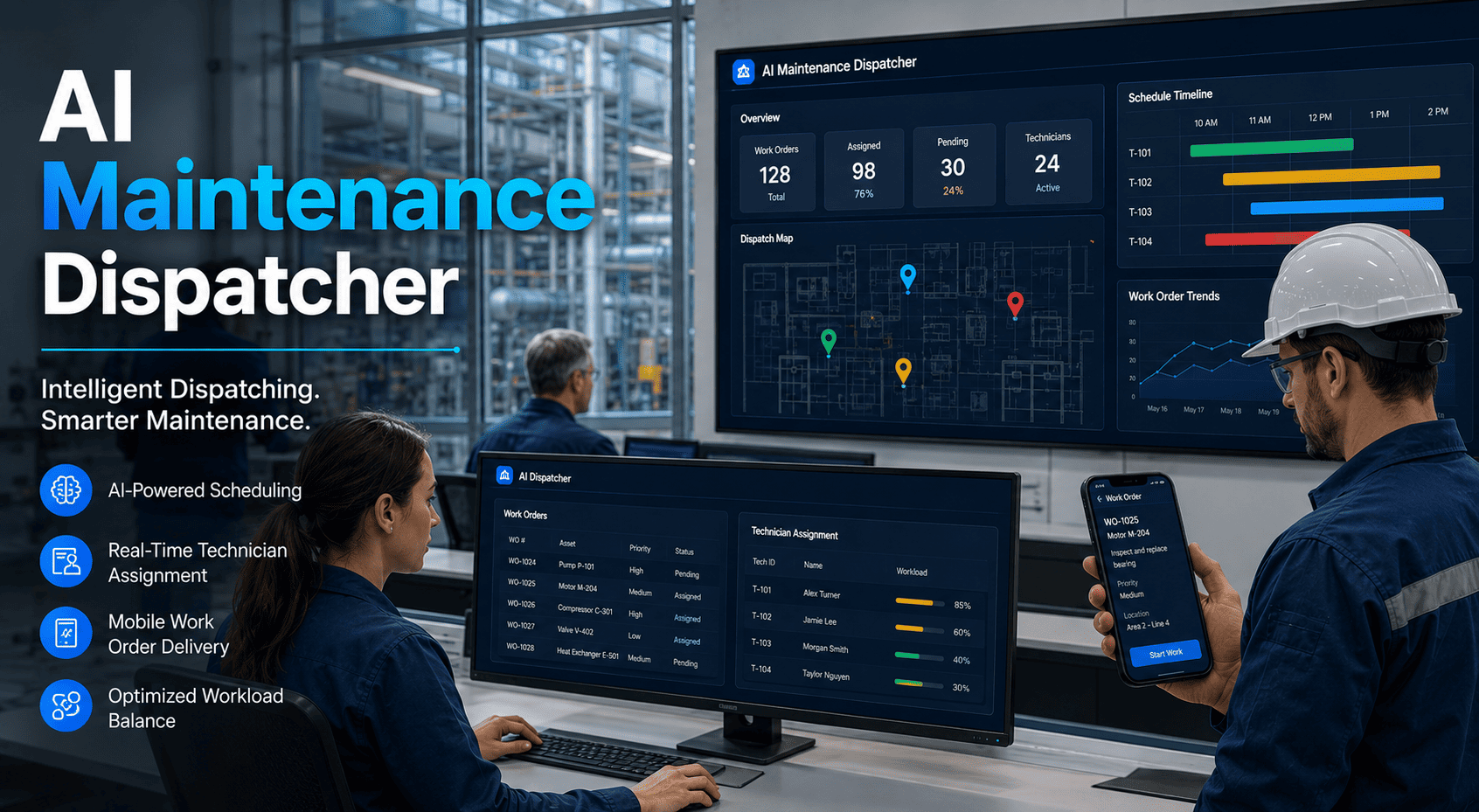
An AI maintenance dispatcher is a machine learning system that receives incoming work orders — from CMMS automation, IoT alerts, or manual submissions — and assigns them to the optimal available technician using a multi-variable optimization model. Unlike manual dispatching, which relies on a coordinator's memory and availability, the AI evaluates every relevant factor simultaneously: skill match, current queue depth, geographic proximity, parts availability, asset criticality, and historical completion performance on similar tasks.
The practical result is not just faster assignment — it is more accurate assignment. When a technician with the wrong certification handles a task because the right person was not on the dispatcher's radar, the outcome is frequently a return visit, an extended repair time, or a compliance failure. AI dispatching eliminates the information gaps that cause skill mismatches, regardless of whether the coordinator is a seasoned veteran or covering for someone on leave.
In 2026, leading maintenance organizations have moved beyond single-site AI dispatching to portfolio-level AI that coordinates technician resources across multiple locations — dynamically routing specialist technicians to the highest-priority needs across an entire facility portfolio rather than keeping them siloed by site. Start a free trial to deploy OxMaint's AI dispatcher across your maintenance operation today.
6 Variables OxMaint's AI Dispatcher Optimizes Simultaneously
Every work order carries a required skill profile. The AI only assigns technicians who hold the certifications required for that specific asset type, system, or regulatory compliance category — preventing unauthorized work assignments.
The dispatcher monitors every technician's current workload in real time and distributes new assignments to prevent queue overloading — eliminating the common pattern where some technicians are overwhelmed while others have idle time.
Travel time is factored into every assignment decision. The AI groups geographically clustered work orders to minimize transit between tasks — reducing wasted travel time that erodes technician productive hours by an average of 22%.
Work orders on production-critical or safety-critical assets are automatically elevated in the dispatch queue. The AI ensures that high-consequence failures never wait in line behind lower-priority tasks — regardless of submission order.
Technicians who have completed the same task type on the same asset model before are weighted higher for reassignment. The AI learns which technician-task combinations produce the best completion times and lowest rework rates.
When a technician calls in sick, a high-priority emergency arrives, or a task runs over its estimated duration, the AI instantly rebalances the entire day's schedule — redistributing affected work orders without dispatcher intervention.
Why Manual Dispatching Is Costing Your Operation More Than You Realize
The cost of manual dispatching is rarely a single line item — it accumulates invisibly across rework rates, extended repair times, technician overtime, and the downstream asset failures that result from delayed responses. Book a demo to see how OxMaint's AI dispatcher eliminates these specific costs in your maintenance operation.
When your dispatcher is on leave, at lunch, or overwhelmed, work order assignment slows to a crawl. AI dispatching runs 24/7 with no single point of human dependency — critical assets never wait for a coordinator to become available.
Manual dispatchers work from memory and proximity — not complete certification data. The result is a 34% higher rework rate from mismatched assignments, adding labor cost and extending asset downtime on every affected work order.
Without real-time queue visibility, manual dispatching consistently overloads a few technicians while others remain underutilized. This drives overtime costs, burnout, and quality degradation on rushed assignments.
When a critical asset failure arrives at the same time as 20 routine work orders, manual dispatching frequently fails to identify and escalate the highest-priority item fast enough — delaying the response that matters most.
Manual dispatching is inherently site-silo'd. Specialist technicians at one location are invisible to dispatchers at another — so the right expert never gets routed to the highest-priority need across the portfolio.
An absence or emergency blows up the manual schedule for hours. Rebuilding assignments manually under pressure produces suboptimal decisions that cascade into additional delays throughout the rest of the shift.
How OxMaint's AI Dispatcher Transforms Technician Assignment
OxMaint evaluates six dispatch variables simultaneously for every work order — skill, queue depth, proximity, criticality, history, and parts availability — and assigns the optimal technician in under 15 minutes from work order creation.
OxMaint's dispatch engine operates across your entire Portfolio hierarchy — routing specialist technicians from any site to the highest-priority need across all locations, not just the site where the work order was created.
Assigned technicians receive work orders directly on the OxMaint mobile app with full context: asset location, required parts, relevant maintenance history, and step-by-step procedure guidance — before they reach the asset.
OxMaint continuously monitors active work orders and technician status. When disruptions occur — absences, overruns, emergency work — the AI rebalances remaining assignments automatically without requiring dispatcher intervention.
Identify hidden cost leaks instantly
See how much labor cost, rework, and downtime you can recover by replacing manual dispatching with OxMaint's AI assignment engine — built for your technician team size and asset complexity.
- Real-time technician availability and skill-match visibility
- Automated priority escalation for critical asset failures
- 5–10 year CapEx forecasting from AI-driven asset condition data
Used by operations teams managing 10,000+ assets · Live in days, not months · Limited onboarding slots this quarter
No heavy implementation required · Works across multi-site portfolios · See results in 30 days
Manual Dispatch vs AI-Powered Assignment: Full Comparison
| Dimension | Manual Dispatching | OxMaint AI Dispatcher |
|---|---|---|
| Assignment Speed | Average 47 minutes from work order creation to technician assignment during business hours; longer on evenings and weekends | Under 15 minutes, 24/7 — including nights, weekends, and peak emergency periods |
| Skill Match Accuracy | Based on dispatcher memory and limited certification visibility; 34% rework rate from mismatches | Certification-verified match every time; rework rates drop 34% within 60 days of deployment |
| Queue Load Balancing | Some technicians chronically overloaded; others underutilized; overtime costs persist | Real-time queue monitoring distributes assignments evenly; overtime drops significantly in year one |
| Emergency Escalation | Depends on dispatcher's awareness of incoming alert; critical work orders sometimes missed in high-volume periods | Asset criticality score triggers automatic priority escalation; critical failures always dispatched within 15 minutes |
| Cross-Site Coordination | Site-silo'd; specialist technicians unavailable to other locations even when idle | Portfolio-wide visibility; specialist routing across sites based on priority and availability |
| Schedule Disruption Response | Absence or emergency requires hours of manual rebuilding under pressure | AI rebalances affected work orders automatically within minutes of disruption detection |
| After-Hours Coverage | Emergency on-call coordinator required; slow response; significant overtime cost | AI dispatch operates continuously; on-call coordinator reserved for true exceptions only |
Measurable Outcomes From AI Maintenance Dispatch Deployment
AI dispatch cuts average assignment time from 47 minutes to under 15 — directly reducing the window between work order creation and productive repair activity for every task category.
Certification-verified skill matching eliminates the most common cause of maintenance rework — the wrong technician assigned to a specialized task because the dispatcher lacked complete skill visibility.
Continuous queue balancing and geographic route optimization eliminate idle time between assignments — recovering productive labor hours that were previously lost to poor dispatch sequencing and travel inefficiency.
Faster assignment, better skill matching, and pre-staged parts delivery reduce mean time to resolution per incident — translating directly into higher asset availability and production output protection.
These outcomes compound across a multi-site portfolio. Start a free trial to measure the dispatch efficiency gap in your current operation, or book a demo to see the AI dispatcher running on your own technician and asset structure.
What Operations Teams Ask Before Automating Technician Dispatch
How does OxMaint's AI dispatcher handle situations where no technician with the required certification is available?
Can dispatchers still manually override AI assignments when they have information the system does not have?
How does OxMaint handle technician certifications that have different expiry dates and renewal requirements?
How long does it take to configure OxMaint's AI dispatcher for a facility with 50 technicians and multiple sites?
Stop Losing Hours to Manual Dispatching Every Single Day
OxMaint's AI dispatcher assigns the right technician to every work order in under 15 minutes — automatically, 24/7, across every site in your portfolio. No coordinator dependency. No skill mismatches. No schedule collapse when someone calls in sick.
- Certification-verified technician matching for every work order
- Real-time queue balancing across your full technician team
- Portfolio-wide dispatch visibility across all sites simultaneously
Used by operations teams managing 10,000+ assets · See measurable results in first 30 days · Limited onboarding slots this quarter