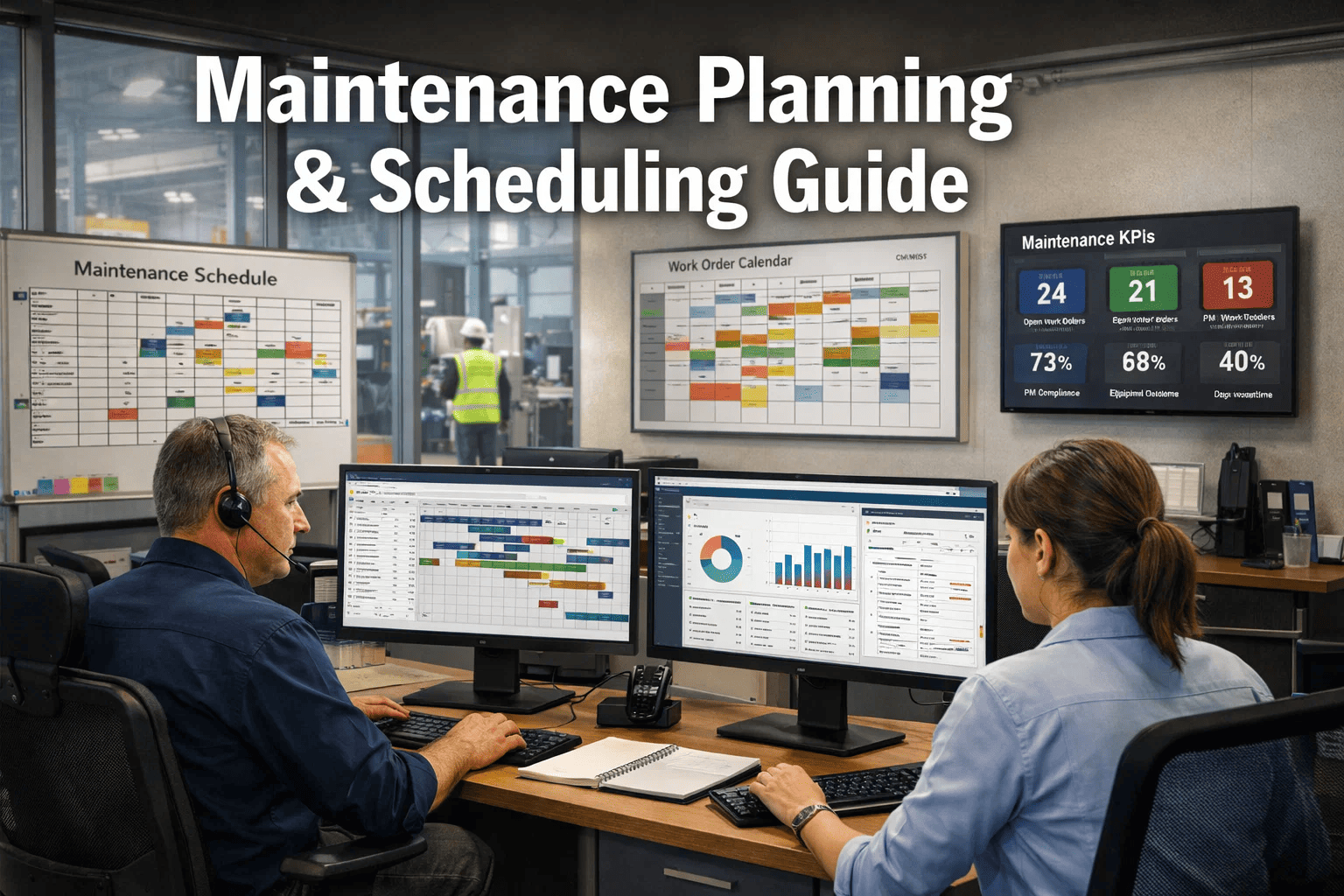
Most maintenance teams are not failing because their technicians lack skill — they are failing because work is assigned too late, parts are missing at job time, priorities shift without notice, and nobody has a live view of what is actually happening on the floor. Maintenance planning and scheduling is the discipline that closes that gap: it is the system that turns reactive chaos into coordinated, measurable work execution. If your team is spending more than 40% of its labor hours on unplanned work, or if your scheduled compliance rate sits below 80%, you are leaving serious money on the table every single month. Start a free trial for 30 days and see how structured planning and scheduling inside a purpose-built CMMS changes what your team can actually deliver — or book a demo and we will walk through your current workflow together.
Maintenance Planning · Scheduling · Work Order Management · CMMS
Maintenance Planning & Scheduling: The Complete CMMS Guide for Operations That Cannot Afford Downtime
Planning decides what gets done. Scheduling decides when and who. Together, they are the difference between a maintenance program that leads assets — and one that chases failures.
4.8x
Cost of Emergency Repairs
vs planned maintenance — industry average across commercial and industrial facilities
20–35%
Wrench Time Without Planning
Direct productive work time for techs operating without a structured planning system
22%
Still Running Reactive
of maintenance organizations have no formal planning process — reactive maintenance only
80–90%
Target Schedule Compliance
World-class maintenance teams complete 80–90% of planned work within the scheduled window
Ready to Fix Your Planning Gap?
Oxmaint gives your team the structure to plan work before it's urgent — and schedule it before it's late.
From asset hierarchy to work order execution, Oxmaint connects every step of the planning and scheduling cycle in one platform. No spreadsheets. No lost work orders. No guessing at priorities.
The Foundation
Planning vs Scheduling: Two Different Jobs That Must Work Together
Maintenance planning and scheduling are often treated as one activity. They are not. Confusing them is one of the most common reasons maintenance programs underperform despite genuine effort from the team.
Determines WHAT needs to be done and HOW
Identify scope of work from backlog and PM triggers
Document job steps, required parts, tools, and estimated hours
Ensure parts are kitted and available before job start
Attach SOPs, drawings, and safety procedures to work orders
Classify work by priority: safety, production, compliance, routine
Output: A fully ready-to-execute work order package
Determines WHEN it gets done and WHO does it
Assign planned work orders to available technicians by skill match
Align with production windows, shift patterns, and shutdowns
Load-level crew hours — target 80–90% capacity, hold buffer for emergencies
Coordinate multi-craft and contractor resource requirements
Publish weekly schedule and track compliance daily
Output: A committed weekly schedule with measurable compliance
Where Teams Break Down
8 Planning & Scheduling Failures That Are Draining Your Maintenance Budget Right Now
These are not edge cases — they are the daily reality for any team without a structured planning system. Each one compounds the others.
01
Parts Not Ready at Job Time
Technicians arrive at the asset, part is not in stock. Work order sits open, labor hours are wasted, the fault window extends. Rescheduling ripples through the week.
02
No Visibility Into Backlog Size
Nobody knows how many open work orders exist, how old they are, or which ones are safety-critical. Planning cannot happen without backlog visibility — and most teams lack it.
03
Work Assigned by Shouting, Not System
The loudest production complaint gets the next available technician. Priority is determined by who complains last — not by asset criticality, safety risk, or production impact.
04
PM Schedules Drifting from Calendar
Preventive maintenance tasks slide one week, then two, then six. Nobody tracks overdue PM percentage. Equipment ages faster than expected, and failure root cause is impossible to establish.
05
No Skill Matching on Assignment
Electrical work goes to a mechanical technician because he was available. Rework follows. Warranty claims fail. Average repair time doubles when work is mismatched to skill.
06
Emergency Work Consuming 60%+ of Capacity
When unplanned work exceeds 40% of total labor hours, scheduling becomes impossible. Every PM gets pushed. The backlog grows. The reactive cycle locks in permanently.
07
No Post-Work Feedback Loop
Work orders close with no recorded findings, no actual time logged, no failure code attached. Planning future work on the same asset becomes guesswork because the history is empty.
08
Multi-Site Work Without Coordination
Teams at different sites use different spreadsheets, different nomenclature, different prioritization logic. Portfolio managers have zero consolidated view of maintenance performance across properties.
The Planning Cycle
How World-Class Maintenance Planning Actually Works: The 6-Step Cycle
High-performing maintenance teams follow a defined planning cycle — not a reactive fire-drill. Here is the structure that separates top-quartile facilities from the rest.
1
Backlog Identification & Prioritization
All work requests enter a single backlog. Each is scored by safety impact, production risk, asset criticality, and regulatory deadline. Only then does a planner pick it up.
Target: Zero unlogged work requests — everything through the system
2
Job Scope Definition & Parts Identification
Planner walks down the asset, defines exact job scope, identifies required parts, tools, and estimated craft-hours. Parts are reserved in inventory before scheduling begins.
Target: 95% of parts available at job start time
3
Work Order Package Assembly
Work order includes job plan steps, safety instructions, reference drawings, compliance checklists, and estimated hours by trade. Technician can execute without interruption.
Target: Zero mid-job interruptions for information or parts
4
Weekly Schedule Building
Scheduler loads planned work against available technician hours — max 80% capacity, 20% buffer for emergency response. Work is assigned by skill match, not availability alone.
Target: 80–90% schedule compliance week-over-week
5
Execution & Real-Time Tracking
Technicians receive work orders on mobile. They log start time, record findings, attach photos, and close with actual hours. Supervisor tracks completion in real time against daily schedule.
Target: 100% of closed work orders with findings documented
6
Review, Feedback & Schedule Refinement
Weekly schedule compliance reviewed. Missed work orders are root-caused — was it a planning failure, a parts failure, or a scheduling failure? Plans updated for next cycle based on actual vs estimated times.
Target: Scheduled compliance improving by 2–5% per quarter
How Oxmaint Solves It
Every Step of the Planning & Scheduling Cycle — Handled Inside One Platform
Oxmaint is built for operations managers who need a planning and scheduling system that actually works at scale — across multiple sites, multiple asset types, and multiple trades. Want to see it live? Start a free trial for 30 days or book a demo with our team.
Asset Foundation
Full Asset Registry with Condition Scoring
Every asset has a complete profile — location hierarchy, maintenance history, condition score, and linked work orders. Planning starts with asset data, not guesswork. Portfolio to component level in one hierarchy.
Work Order Management
Structured Work Orders with Full Technician History
Work orders carry job steps, parts lists, safety procedures, and estimated hours. Technicians close them on mobile with findings, actual time, and photos. Every completed job adds to asset history automatically.
PM Scheduling
Preventive Maintenance Tied Directly to Asset Records
PM schedules trigger by calendar interval, production hours, cycle count, or condition threshold. Overdue PM percentage is visible in real time. No more PMs sliding without anyone noticing.
Resource Planning
Technician Scheduling with Skill-Based Assignment
Assign work orders to technicians matched by skill set and availability. Load-level across your crew. See weekly capacity utilization at a glance and hold buffer capacity for reactive work without disrupting planned schedules.
Inventory Integration
Spare Parts Linked to Work Orders Before Scheduling
Parts required for planned work orders are reserved from MRO inventory at planning time — not at job start. Reorder triggers fire automatically. Parts availability rate tracked as a planning KPI.
Portfolio Visibility
Multi-Site Dashboard for Operations & Ownership Groups
Portfolio-level view of schedule compliance, open backlog, overdue PMs, and asset condition across all sites simultaneously. Investor-grade CapEx forecasting built in — no separate reporting tool needed.
Mobile Execution
Mobile-First Work Order Execution for Field Technicians
Technicians access work orders, asset history, SOPs, and parts lists on any mobile device — online or offline. Findings, photos, and time logs recorded at the asset. No paper. No re-entry back at the office.
Compliance & Audit
Audit-Ready Documentation with Digital Signatures
Every work order closure is timestamped and signed. Compliance inspections generate structured records with findings and corrective actions attached. Full audit trail available for OSHA, building safety, and regulatory review in seconds.
Before vs After
Reactive Maintenance vs Planned Maintenance: The Operational Reality
The comparison is not theoretical. These are the operational differences that show up in your cost data, your equipment reliability, and your team's daily experience.
Work Discovery
Equipment fails — work is discovered at failure point. No warning, no preparation.
PM triggers and condition monitoring identify work before failure. Planner prepares in advance.
Parts Availability
Emergency procurement at premium price. Hours or days of additional downtime while parts are sourced.
Parts kitted and reserved at planning stage. Zero procurement delay at job start. 95%+ availability target.
Technician Productivity
20–35% wrench time. Rest is searching for information, waiting for parts, traveling without a plan.
55–65% wrench time achievable. Work order package contains everything technician needs before they leave the shop.
Repair Cost
4.8x higher than planned maintenance average. Secondary damage to adjacent components common.
Controlled cost. Scope defined in advance. No secondary damage from run-to-failure. Budget predictable.
Asset Lifespan
30–40% shorter than manufacturer design life due to unmanaged stress cycles and deferred maintenance.
Assets operate to or beyond design life. CapEx replacement deferred by 2–5 years through condition tracking.
Compliance & Audit
Documentation assembled manually before inspections. Gaps and missing records common. Fines and failed audits.
Complete audit trail in CMMS. Compliance reports generated in seconds. Every inspection signed and dated.
Team Morale
Constant firefighting. No sense of control. High technician turnover from chronic reactive stress.
Predictable workload. Technicians arrive prepared. Performance is measurable, recognized, and improvable.
Measurable Results
What Structured Planning & Scheduling Delivers — In Numbers
65%
Reduction in Unplanned Downtime
Teams with structured PM scheduling and CMMS work order management report 65% fewer unplanned production stoppages within the first 12 months of implementation.
55–65%
Achievable Wrench Time
Up from the 20–35% industry average for reactive teams. Pre-planned, pre-kitted work orders eliminate the time spent hunting for information, parts, and authorization.
35%
Lower Maintenance Cost Per Asset
Planned maintenance eliminates premium emergency procurement, reduces secondary damage repairs, and extends intervals between major interventions through condition-based scheduling.
2–5 Years
Extended Asset Useful Life
Assets managed with structured PM programs and condition scoring consistently operate 2–5 years beyond reactive-environment counterparts — deferring major CapEx replacement spend.
KPIs to Track
The 8 Maintenance Planning & Scheduling KPIs That Actually Matter
According to the MaintainX 2024 industry report, the most widely tracked KPI is PM completion rate (56%), followed by work order backlog (53%). These eight metrics give you a complete operational picture — and Oxmaint tracks all of them automatically. Book a demo to see them live, or start a free trial for 30 days and connect your own asset data today.
SC
Schedule Compliance Rate
Target: 80–90%
Percentage of scheduled work orders completed within the scheduled window. The primary indicator of whether your planning and scheduling system is functioning.
PM
PM Completion Rate
Target: 95%+
Percentage of preventive maintenance work orders completed on or before their due date. Tracks whether the PM program is actually being executed versus just being scheduled.
WT
Wrench Time
Target: 55–65%
Percentage of technician labor hours spent on direct productive maintenance work. Low wrench time reveals planning quality — are parts, information, and access available when needed?
BL
Work Order Backlog Age
Target: Under 4 weeks capacity
Total planned backlog measured in crew-weeks of available labor. Backlogs over 4 weeks signal a planning capacity or prioritization problem that will cascade into missed PM compliance.
PA
Parts Availability at Job Start
Target: 95%+
Percentage of planned work orders where all required parts are staged and available when the technician arrives. Directly measures planning quality and MRO inventory management effectiveness.
EM
Emergency Work Order Ratio
Target: Under 20%
Percentage of total work orders classified as emergency or unplanned. Above 40% signals a reactive maintenance culture. This ratio cannot improve without structured PM scheduling and condition monitoring.
MT
MTBF — Mean Time Between Failures
Target: Improving trend, asset-specific
Average operating time between unplanned failures for a specific asset. The long-term outcome metric for PM program effectiveness. Tracked per asset in Oxmaint against history baseline.
FE
First-Time Fix Rate
Target: 90%+
Percentage of corrective work orders completed successfully on the first visit without return trips for parts, additional diagnosis, or scope expansion. Reflects planning thoroughness and skill match quality.
Frequently Asked Questions
Maintenance Planning & Scheduling — What Operations Teams Ask Most
What is the difference between a maintenance planner and a maintenance scheduler?
A maintenance planner defines the scope of work — what needs to be done, what parts are required, what the estimated hours are, and what safety procedures apply. They prepare the work order package so a technician can execute without interruption. A maintenance scheduler takes those prepared work orders and assigns them to specific technicians on specific days, based on skill match, availability, production windows, and crew capacity. In smaller teams, one person often fills both roles. In larger operations — typically above 20 technicians — these are separate functions. CMMS platforms like Oxmaint support both functions: planners build and enrich work orders, schedulers drag and assign them to crew calendars. Neither role can perform effectively without visibility into asset history, backlog status, and inventory availability — all of which live in the CMMS.
How does a CMMS improve maintenance planning and scheduling compared to spreadsheets?
Spreadsheets fail at maintenance planning because they are static, siloed, and provide no connection between asset records, work orders, parts inventory, and technician schedules. A CMMS links all four. When a PM work order is created, the CMMS knows the asset's full history, the required parts (and whether they are in stock), the estimated hours by trade, and which technicians are available. Work order assignment happens with full crew visibility, not through email or phone. Completion is recorded in real time on mobile, and findings automatically update the asset record. Oxmaint goes further by connecting PM scheduling to production-based triggers — hours run, cycles completed, or condition threshold breach — so PM intervals actually match how the asset is being used, not just the calendar.
How long does it take to implement a CMMS for maintenance planning and scheduling?
Implementation timeline depends on the scope of your asset registry and the complexity of your PM program. With Oxmaint, most operations teams are running live work orders within the first week — the platform is designed for fast configuration without heavy IT involvement or implementation fees. Start with your critical assets, build PM schedules for the top 20 by production impact, and layer in full inventory and multi-site configuration over the following 30–60 days. The Oxmaint asset hierarchy (Portfolio, Property, System, Asset, Component) is structured to match how facilities teams already think about their equipment, which dramatically reduces the learning curve. There is no minimum contract and no implementation fee — you can start a free trial today and have your first PM schedule running before end of week.
What schedule compliance rate should a well-run maintenance team be targeting?
World-class maintenance teams target 80–90% schedule compliance — meaning 80–90% of work orders scheduled for a given week are completed within that week. Below 70% indicates a systemic planning or capacity problem. Teams new to structured scheduling often start at 50–60% and improve steadily as planning quality improves and the emergency work ratio declines. The key is to measure compliance honestly — a work order that slips from Monday to Friday is still compliant if it falls within the week. A work order that carries over to next week is a miss and must be root-caused. Oxmaint tracks schedule compliance automatically at the team, site, and portfolio level, and flags the specific work orders that missed so planners can investigate whether the miss was caused by a planning failure, a parts failure, or an uncontrollable emergency.
Free Trial · No Credit Card · No Implementation Fee · Multi-Site Ready
Your Maintenance Team Is Working Hard. Give Them a System That Works With Them.
Oxmaint gives operations teams the planning structure, scheduling visibility, and asset history they need to shift from reactive firefighting to measurable, controlled maintenance execution. One platform. Every site. Every asset class.