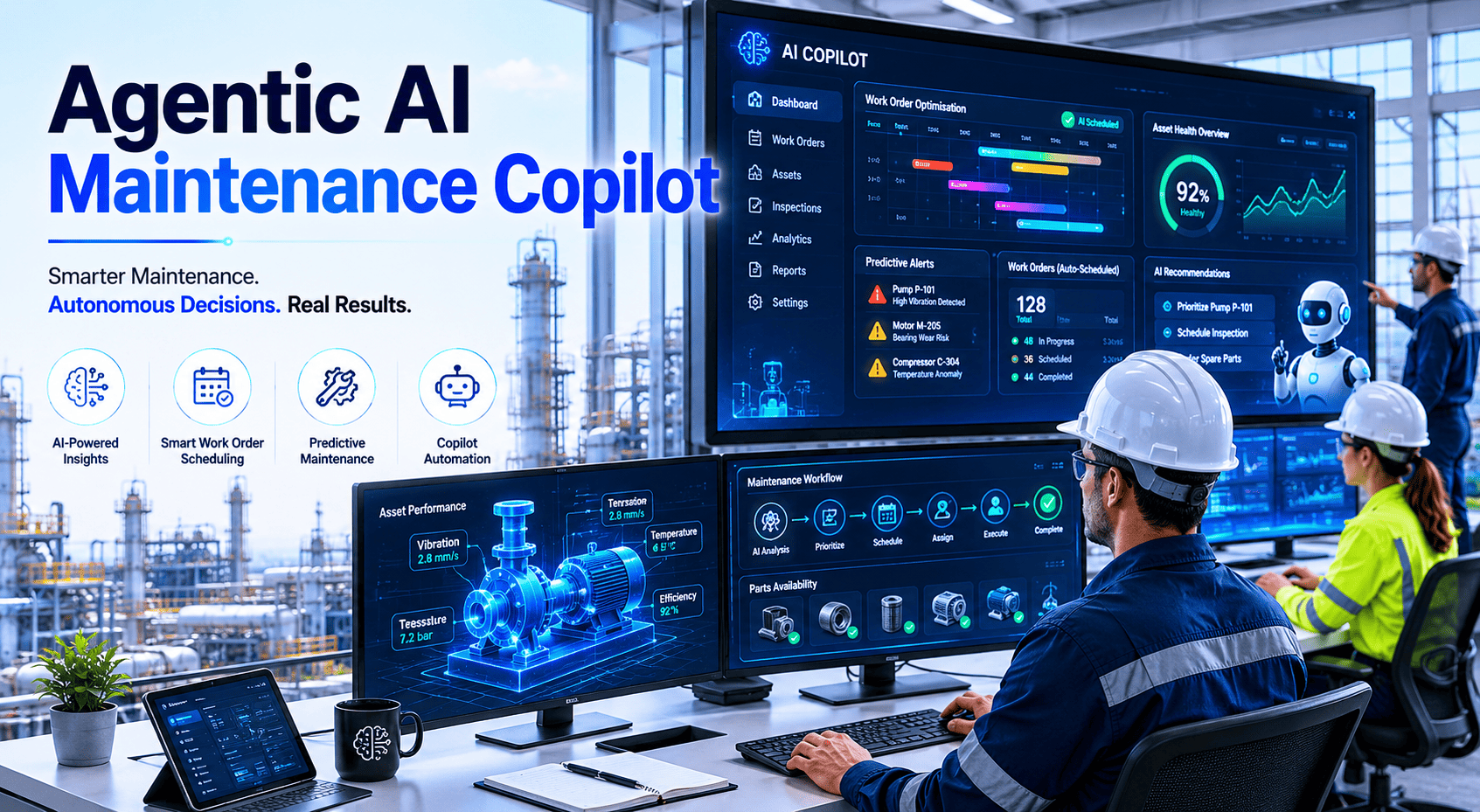
At 2:14 AM on a Thursday, a vibration sensor on Compressor C-7 at a chemical plant crossed its warning threshold. Under the old system, an alarm would fire, a control room operator would acknowledge it, call the on-call maintenance supervisor, who would review the data on a laptop, decide whether it warranted action, create a work order manually, check parts availability, and assign a technician — a process that took 45 minutes to 4 hours depending on who was awake and how quickly they could access the CMMS. Under an agentic AI system, this is what happened instead: the AI agent detected the vibration anomaly at 2:14 AM, cross-referenced it against the compressor's digital twin model, identified bearing cage fatigue as the probable failure mode with 91% confidence, checked the CMMS for maintenance history confirming no recent bearing work, verified that two replacement bearings were in the storeroom, created a Priority-2 work order with the correct asset, failure mode, parts list, and safety procedures, scheduled it for the next planned downtime window at 6 AM, and pushed a notification to the mechanical team lead's phone — all in 11 seconds, with zero human involvement. The technician arrived at 6 AM with the parts pre-staged. The repair took 3 hours. The compressor never went down unplanned. That is agentic AI in maintenance: not a chatbot that answers questions, but an autonomous system that senses, reasons, decides, and acts — closing the loop from anomaly detection to executed maintenance without waiting for a human to interpret data, navigate menus, or type a work order. Book a demo to see agentic AI work order automation running in OxMaint.
Agentic AI in maintenance is not a chatbot or a dashboard. It is an autonomous system that can sense equipment anomalies, reason about failure modes using asset history and physics models, decide on the correct maintenance action, and execute it — creating work orders, reserving parts, scheduling repairs, and assigning technicians without human intervention. Unlike rule-based automation that follows fixed scripts, agentic AI adapts to context, handles exceptions, and learns from outcomes. OxMaint is the CMMS platform where agentic AI predictions become executed maintenance actions — automatically.
From Chatbot to Agent: What Changed in Maintenance AI
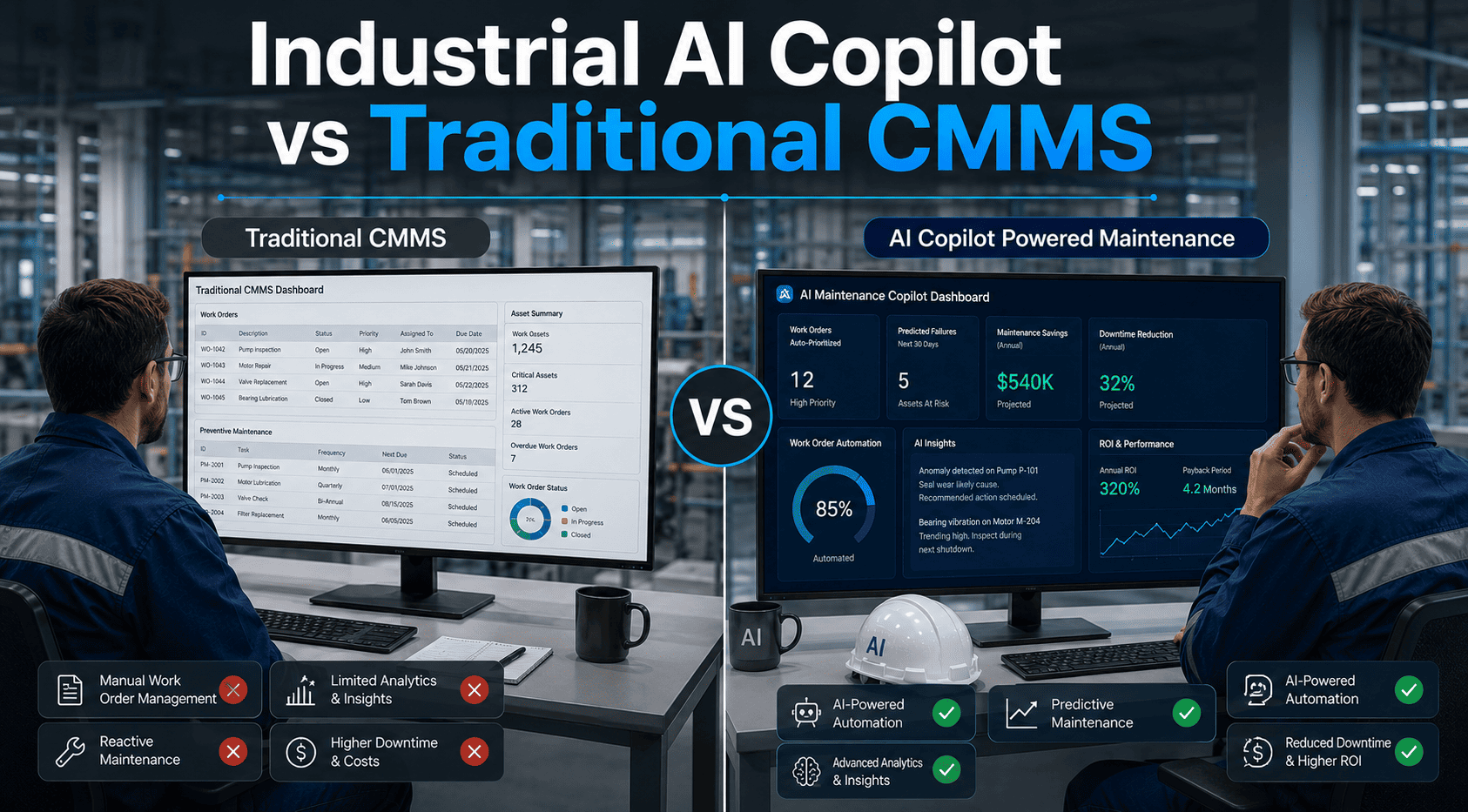
The AI evolution in maintenance has moved through three distinct generations. Most facilities are still operating in Generation 1 or 2. Agentic AI is Generation 3 — and it changes the fundamental relationship between AI and maintenance execution. Start a free trial to see Generation 3 capabilities active in OxMaint.
| Dimension | Gen 1: Rule-Based | Gen 2: Predictive AI | Gen 3: Agentic AI |
|---|---|---|---|
| How it works | IF temperature > 180F THEN alarm | ML model predicts failure probability from sensor trends | Autonomous agent reasons about context, decides, and acts |
| Human role | Human interprets alarm, creates work order, assigns technician | Human reviews prediction, decides whether to act, creates work order | Human reviews completed actions — agent handles end-to-end |
| Exception handling | Breaks when conditions change — requires reprogramming | Flags anomalies but cannot act on them autonomously | Handles exceptions dynamically — adapts to new failure modes |
| Work order creation | Manual — technician types into CMMS after interpreting alarm | Semi-automated — prediction generates alert, human creates WO | Fully autonomous — WO created with asset, parts, priority, assignment |
| Time to action | 45 minutes to 4+ hours | 15–45 minutes (human review bottleneck) | Under 15 seconds — sensor to work order to technician notification |
| Learning | Static rules — never improves | Model retrains periodically on new data | Continuous learning — every completed WO improves future decisions |
Five Agentic AI Capabilities That Eliminate Human Bottlenecks
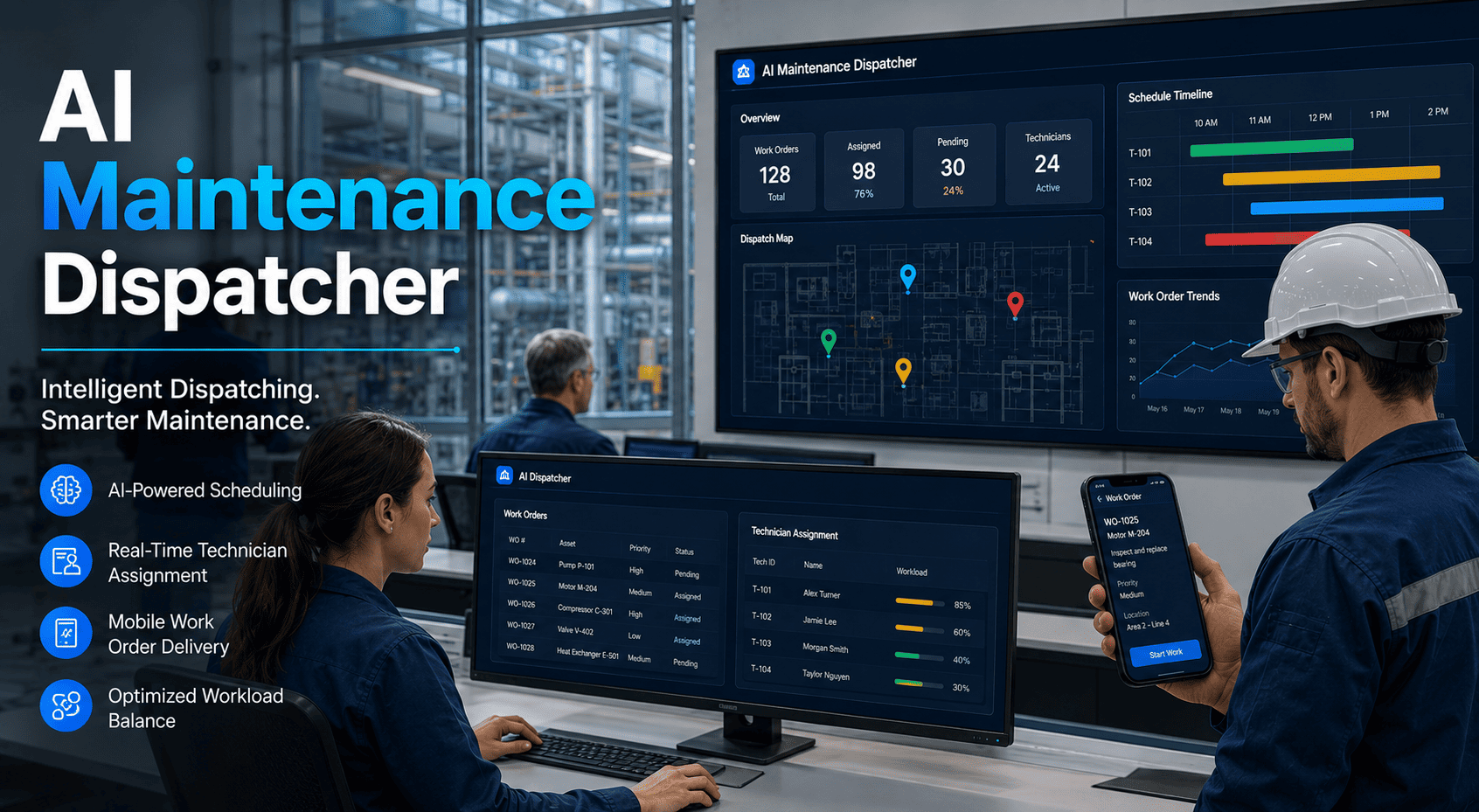
The agent detects an anomaly, cross-references asset history, identifies the failure mode, checks parts inventory, selects the optimal technician based on skill and availability, creates a fully populated work order, and schedules it within the next maintenance window — all without a human touching the CMMS. The technician receives a push notification with everything they need to execute the repair.
The agent does not just assign the next available technician. It evaluates the full backlog — priority scores, technician skills, location proximity, parts availability, production schedule constraints, and overtime implications — and generates an optimized schedule that maximizes wrench time while minimizing travel and wait time. When priorities shift, the agent re-optimizes in real time.
When the agent creates a work order, it simultaneously checks inventory for required parts. If in stock, parts are reserved automatically. If not, the agent generates a purchase requisition, selects the preferred vendor based on lead time and cost, and routes for approval — all before the technician even sees the work order. Reorder points adjust dynamically based on predicted failure rates, not static min/max levels.
Agentic AI is not a black box that runs unsupervised. When the agent encounters a situation outside its confidence threshold — a failure mode it has not seen before, a cost that exceeds authority limits, a safety-critical asset — it escalates to a human with full context: what it detected, what it considered, what it recommends, and why it is not acting autonomously. The human makes the decision. The agent learns from the outcome.
85–95% of Maintenance Decisions Can Be Made Autonomously. The Agent Handles Them. You Handle the Rest.
OxMaint's agentic AI engine creates work orders, schedules technicians, reserves parts, and escalates exceptions — autonomously and with full audit trail. Start free to activate agentic workflows on your maintenance operation.
The Multi-Agent Architecture: How It Works Inside OxMaint
Agentic AI in maintenance is not one monolithic system. It is a coordinated squad of specialized agents — each responsible for a specific domain — orchestrated by a manager agent that breaks complex maintenance scenarios into specialized tasks and consolidates results.
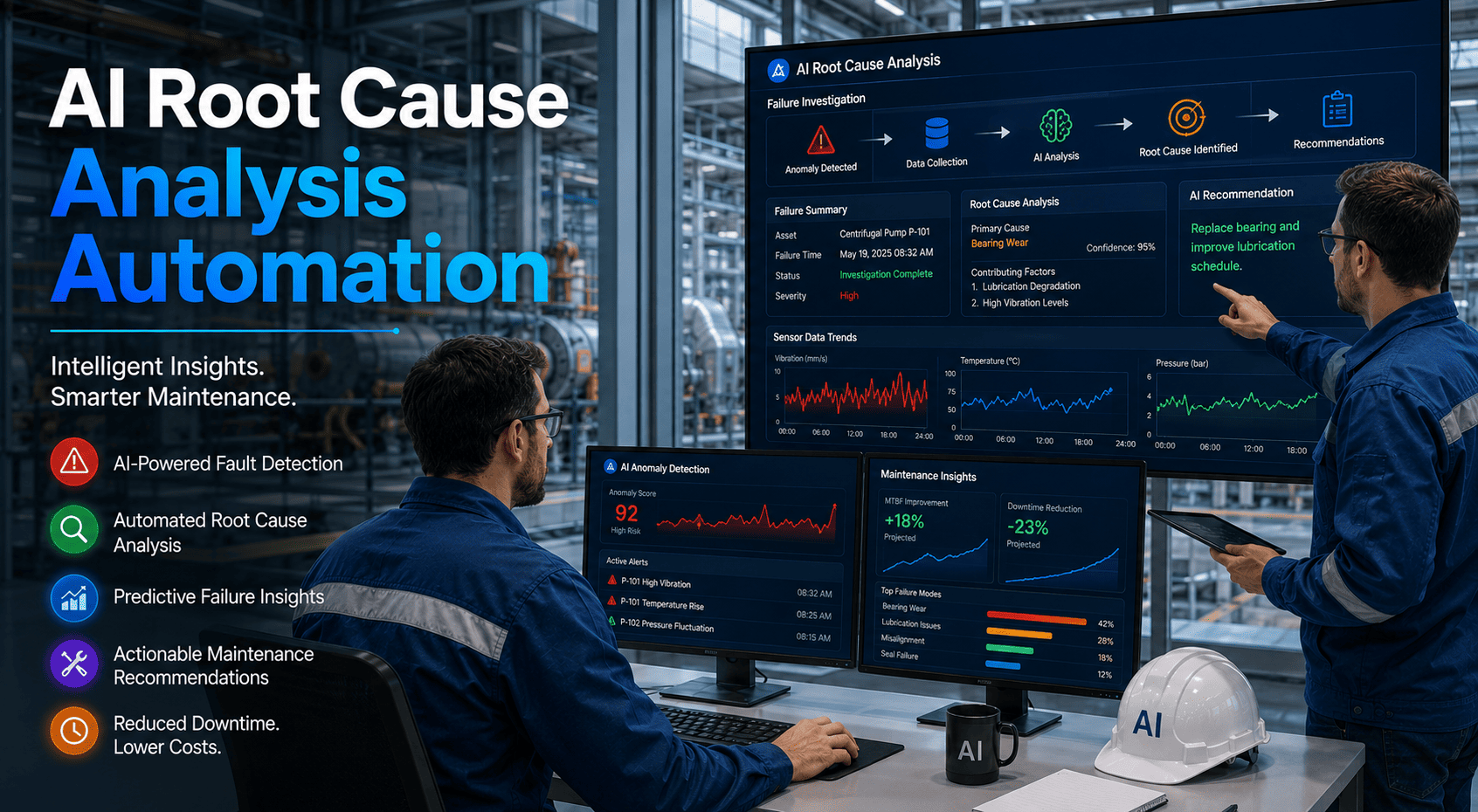
Continuously monitors IoT sensor streams — vibration, temperature, pressure, current, acoustic signatures. Compares real-time readings against digital twin predictions and historical baselines. When a multi-parameter anomaly exceeds confidence thresholds, it classifies the failure mode and passes the finding to the Decision Agent with full context.
Receives the classified anomaly and reasons about the correct response. Checks asset criticality, maintenance history, remaining useful life estimate, production schedule, and available resources. Determines: create work order now? Schedule for next window? Escalate to human? The decision is logged with full reasoning trace for audit.
Takes the action plan and creates a fully populated work order in OxMaint — correct asset ID, failure mode classification, priority score, required parts (with inventory check and auto-reservation), safety procedures, estimated labor hours, and assigned technician based on skill match and availability. Push notification sent to technician's mobile device.
When the technician completes the work order — documenting actual findings, parts used, time spent, and repair outcome — the Feedback Agent ingests this data and updates the prediction models. Was the failure mode correctly identified? Was the RUL estimate accurate? Was the priority appropriate? Every completed work order makes every future prediction more accurate.
Before and After Agentic AI in Maintenance Operations
| Maintenance Process | Before Agentic AI | With Agentic AI + OxMaint |
|---|---|---|
| Anomaly-to-work-order time | 45 minutes to 4+ hours — depends on who is awake and available | Under 15 seconds — autonomous end-to-end, 24/7, no human bottleneck |
| Scheduling optimization | Planner spends 2 hrs/day manually juggling backlog, skills, and availability | Continuous real-time optimization — re-prioritizes dynamically as conditions change |
| Parts availability at repair | Technician discovers parts are out of stock after arriving at the job | Parts checked, reserved, or reordered at work order creation — before tech dispatched |
| Night and weekend coverage | On-call supervisor must wake up, log in, review data, and decide | Agent operates 24/7 — creates and schedules work orders while everyone sleeps |
| Exception handling | Unusual failures sit in queue until an experienced person reviews them | Agent escalates with full context — human sees what was detected, considered, and recommended |
| Decision audit trail | Why was this prioritized? Who decided? No documented reasoning | Every decision logged: data analyzed, rules applied, alternatives considered, outcome tracked |
Measured Impact of Agentic AI in Maintenance
The Sensor Detects. The Agent Reasons. The CMMS Executes. The Failure Never Happens.
OxMaint's agentic AI architecture turns sensor anomalies into fully autonomous maintenance actions — work orders created, parts reserved, technicians assigned, and schedules optimized without human bottlenecks. Deploy in weeks. ROI from the first prevented failure.