Packaging and pick-pack lines lose between 18% and 32% of available production time to unplanned downtime — and in most facilities, less than 40% of that lost time has a documented root cause. For a mid-sized FMCG plant running two pick-pack lines at $4,200 per hour of throughput, that adds up to roughly $2.1M in annual revenue leakage from stoppages that nobody systematically tracked. The fix is not a faster conveyor or a new packer — it is a downtime tracking system that captures every micro-stop, every changeover overrun, and every operator-reported fault in real time, then routes the root cause back to maintenance, engineering, and operations in a single workflow. Start a free trial to see your real downtime breakdown by line, shift, and fault code, or book a demo and we will walk through your specific packaging operation.
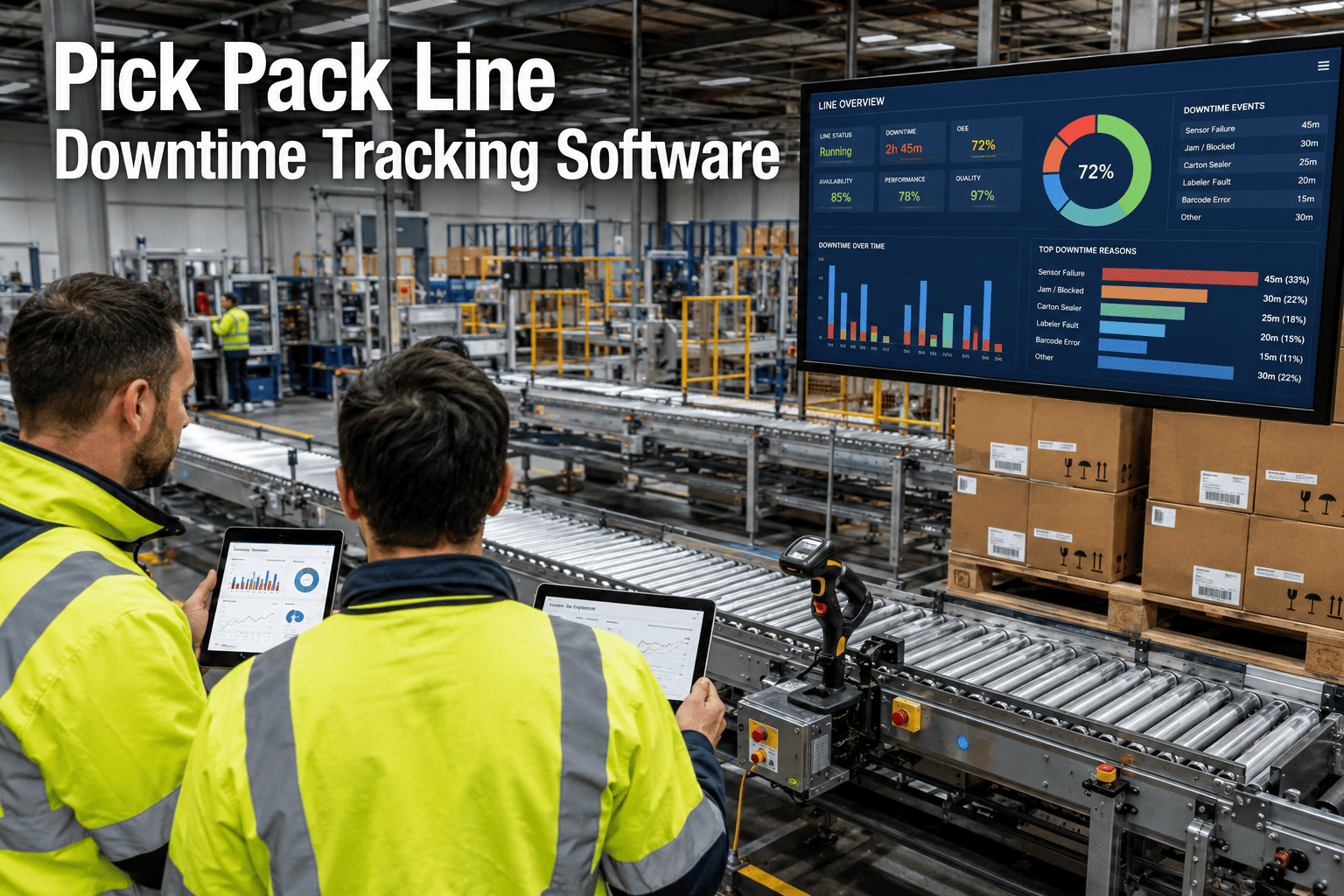
Pick Pack Line Downtime Tracking Software
Stop Guessing Why Your Packaging Lines Stop
Real-time downtime capture, root-cause coding, and automated work order routing across every pick-pack line, shift, and SKU changeover.
18-32%
Production time lost to unplanned line stoppages in typical FMCG plants
$4,200/hr
Average throughput value of a single pick-pack line in mid-sized facilities
62%
Of micro-stops under 5 minutes go completely unrecorded without digital tracking
23%
Average OEE lift after 90 days of structured downtime capture and root-cause workflows
See your real downtime cost in 30 minutes
Identify Hidden Cost Leaks on Every Packaging Line
See how much throughput you are losing to micro-stops, changeover overruns, and untracked operator faults — across every pick-pack line and shift.
- Real-time line stoppage visibility
- Automatic root-cause fault coding
- OEE and MTBF dashboards by line and SKU
What Is Pick Pack Line Downtime Tracking?
Pick pack line downtime tracking is the systematic capture, classification, and analysis of every minute a packaging or pick-pack line is not producing at its rated throughput. It covers planned downtime such as changeovers, sanitation, and scheduled maintenance — and unplanned downtime including jams, sensor faults, conveyor stalls, label misfeeds, operator-reported issues, and upstream or downstream starvation events.
The objective is not to log stoppages for compliance — it is to surface the 20% of failure modes that cause 80% of lost throughput, then drive those failure modes to zero through targeted maintenance, engineering, and process changes. Modern tracking pulls signals from PLCs, sensors, and operator HMIs into a single CMMS workflow so every stop generates a coded record, a root cause, and where appropriate, a work order. Teams that move from manual paper logs to automated digital downtime tracking typically see hidden losses surface within the first two weeks, or book a demo to map this onto your specific line topology.
The Six Pillars of Effective Downtime Tracking
01
Automatic Stop Detection
PLC and sensor-driven signals capture every line stop in real time without operator intervention or paper logs.
02
Root-Cause Fault Coding
Standardized fault code library ensures every stop is categorized consistently across operators, shifts, and lines.
03
Operator Annotation Layer
Tablet-based prompts let operators add context, photos, and corrective notes within seconds of the stop.
04
Automated Work Order Generation
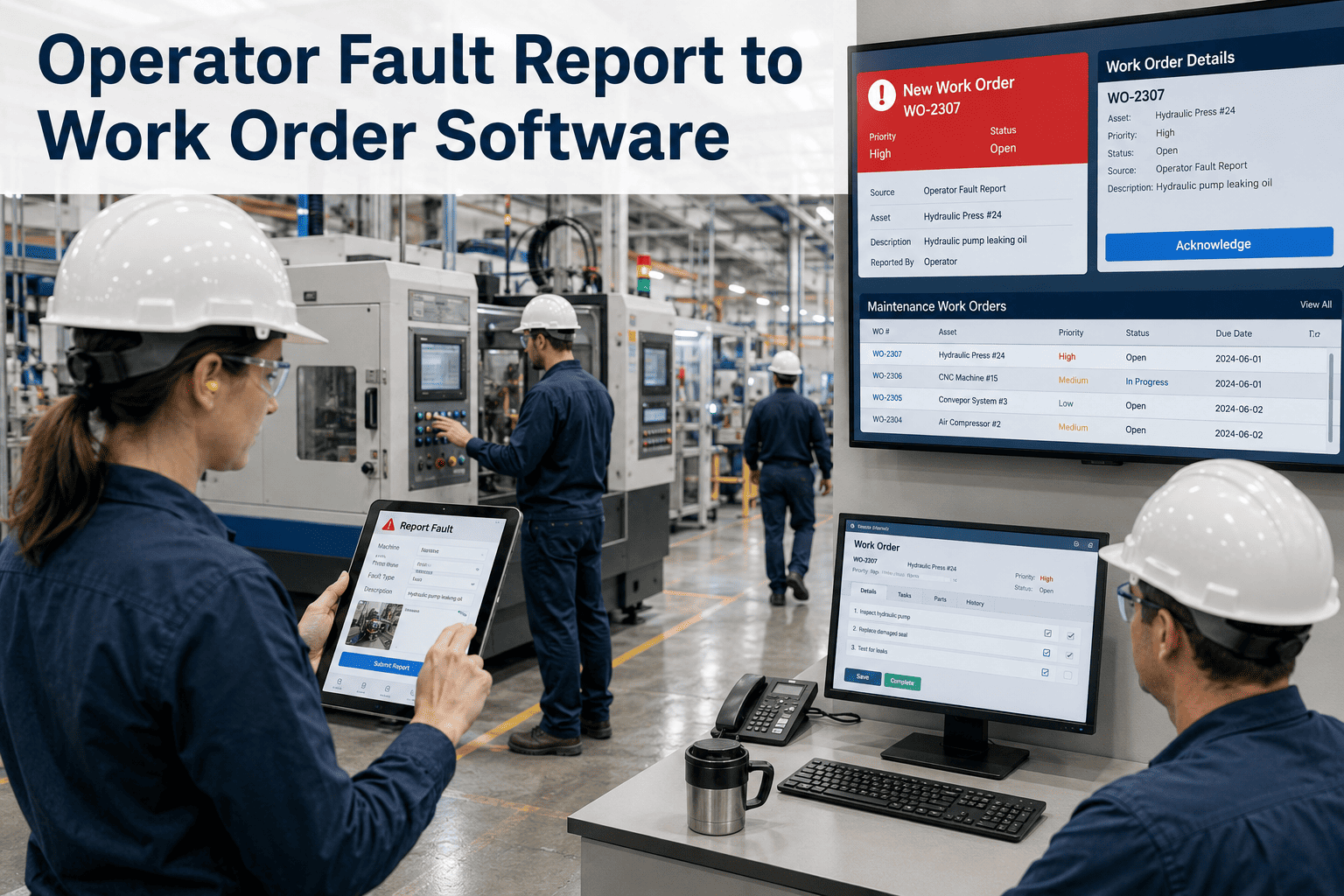
Critical faults trigger CMMS work orders to maintenance automatically, eliminating reporting lag.
05
OEE and MTBF Analytics
Live dashboards show availability, performance, quality, and mean time between failures by line and asset.
06
Pareto and Trend Reporting
Top-loss reports rank fault codes by lost minutes and cost, guiding maintenance and CapEx priorities.
Most pick-pack facilities lose 20-40% of their packaging budget to untracked micro-stops and undocumented root causes.
The Pain Points Hiding in Every Packaging Operation
Most facility and operations leaders know their lines are losing time — they just cannot prove where, when, or why with the precision needed to justify corrective action. These pain points compound silently across shifts and sites until they show up as missed customer orders, blown CapEx forecasts, and emergency repairs costing 4.8 times more than planned work. The teams that act on this data first are the ones taking market share. Want to surface your hidden losses? Book a demo and we will show you a fault-code Pareto built on your own line data.
!
Micro-Stops Disappear
Stops under 5 minutes are rarely logged on paper, yet they account for 35-55% of total unplanned downtime in packaging operations.
!
Operators Blame the Equipment, Equipment Blames the SKU
Without coded fault data, every shift handover becomes a debate instead of an action plan, and root causes never get fixed.
!
Changeover Overruns Get Buried in Planned Time
SKU changeovers run 20-40% over standard with no visibility, distorting OEE and hiding real performance gaps.
!
Maintenance Is Reactive, Not Predictive
Without trend data on MTBF and fault frequency, teams chase failures instead of preventing the top 5 recurring causes.
!
CapEx Decisions Made on Anecdotes
VPs replace equipment based on operator complaints instead of documented downtime data, leading to wrong investments worth millions.
!
Compliance Gaps in Audited Facilities
Food, pharma, and FDA-regulated lines need documented downtime and corrective action trails — paper logs fail audit scrutiny.
How Oxmaint Solves Pick Pack Line Downtime
Oxmaint connects directly to your line PLCs, sensors, and operator HMIs to capture every stop event automatically, then routes that event through a fault-code library and CMMS workflow your team controls. Unlike heavy MES platforms, Oxmaint is mobile-first, deploys in days not months, and works across multi-site portfolios without custom integration. The result is one platform that turns every line stoppage into a tracked, coded, actionable record. Operations leaders managing 10,000+ packaging assets use Oxmaint to drive measurable OEE lift in the first 30 days. Start a free trial and connect your first line in under a day.
Real-Time Line Monitoring
Live dashboards show every pick-pack line status, current fault code, and minutes-since-last-stop across all sites.
PLC and Sensor Integration
Pull stop signals from Allen-Bradley, Siemens, and OPC-UA sources directly into the downtime log with zero operator effort.
Operator Fault Annotation
Mobile-first tablets at every line let operators tag stops with photos, notes, and standardized cause codes in seconds.
Automated Work Order Routing
Critical fault codes auto-generate maintenance work orders with priority, parts list, and asset history attached.
OEE and MTBF Dashboards
Drill into availability, performance, and quality by line, shift, SKU, and operator with one click from any portfolio view.
Pareto and CapEx Reports
Investor-grade reporting ranks loss drivers by cost, supporting 5-10 year CapEx forecasting and replacement decisions.
Lines using structured downtime tracking see up to 23% OEE lift within 90 days — start a free trial to see this on your data.
Reactive Tracking vs Planned Downtime Management
| Dimension |
Reactive Paper Tracking |
Planned Digital Downtime System |
| Micro-stop capture (under 5 min) |
Less than 15% logged |
100% automatic via PLC signal |
| Root-cause coding |
Free-text, inconsistent |
Standardized fault library |
| Reporting lag |
24-72 hours after shift |
Real-time dashboard |
| Work order generation |
Manual, often forgotten |
Auto-triggered by fault code |
| OEE accuracy |
Estimated, ±15% drift |
Measured, ±1% accuracy |
| MTBF visibility by asset |
None available |
Live by line and component |
| Audit and compliance trail |
Manual reconstruction |
Time-stamped digital record |
| CapEx justification quality |
Anecdotal |
Data-backed Pareto |
| Annual hidden loss exposure |
$1.8M-$2.4M per line |
Reduced 25-45% in year one |
ROI and Measurable Results
The financial case for digital downtime tracking is rarely about software cost — it is about the throughput recovered, the emergency repairs avoided, and the CapEx decisions made on data instead of guesswork. Facilities deploying Oxmaint across pick-pack operations consistently report results in the first quarter, with full payback inside 90 days for most mid-sized plants. Used by operations teams managing 10,000+ assets, measurable in the first 30 days.
23%
Average OEE Lift
Within first 90 days of structured downtime capture
$680K
Annual Throughput Recovered
Per pick-pack line at typical $4,200/hr value
4.8x
Emergency Repair Cost Avoided
Reactive failures cost 4.8x more than planned work
38%
Reduction in Micro-Stops
Through top-loss Pareto and root-cause workflows
67 days
Average Payback Period
For mid-sized FMCG plants deploying Oxmaint
$2.1M
Annual Loss Exposure Eliminated
Per two-line facility, year-one measurable impact
Frequently Asked Questions
How long does it take to deploy Oxmaint on a pick-pack line?
Most single-line deployments are live within 3-5 business days. PLC integration, fault code library setup, and operator tablet configuration are completed in parallel. Multi-site portfolio rollouts typically complete in 4-8 weeks across all locations.
Does Oxmaint work with our existing PLCs and HMIs?
Yes. Oxmaint connects to Allen-Bradley, Siemens, Mitsubishi, and OPC-UA compatible controllers, plus standard Modbus and MQTT sources. No rip-and-replace of existing automation is required.
Can we customize fault codes by line or SKU?
Absolutely. The fault code library is fully configurable per line, asset, or SKU family, with hierarchy support so plant-level Pareto reports still roll up consistently across the portfolio.
What does pricing look like for a multi-site portfolio?
Pricing is per-asset and scales with portfolio size. Multi-site customers typically pay 30-50% less per asset than single-site deployments. Book a demo for a tailored quote based on your line count and site footprint.
Decision Point — Limited onboarding slots this quarter
Stop Losing Millions to Untracked Line Stoppages
Turn every pick-pack line stop into a coded, trackable, actionable record. See measurable OEE lift in the first 30 days — works across multi-site portfolios, live in days not months.