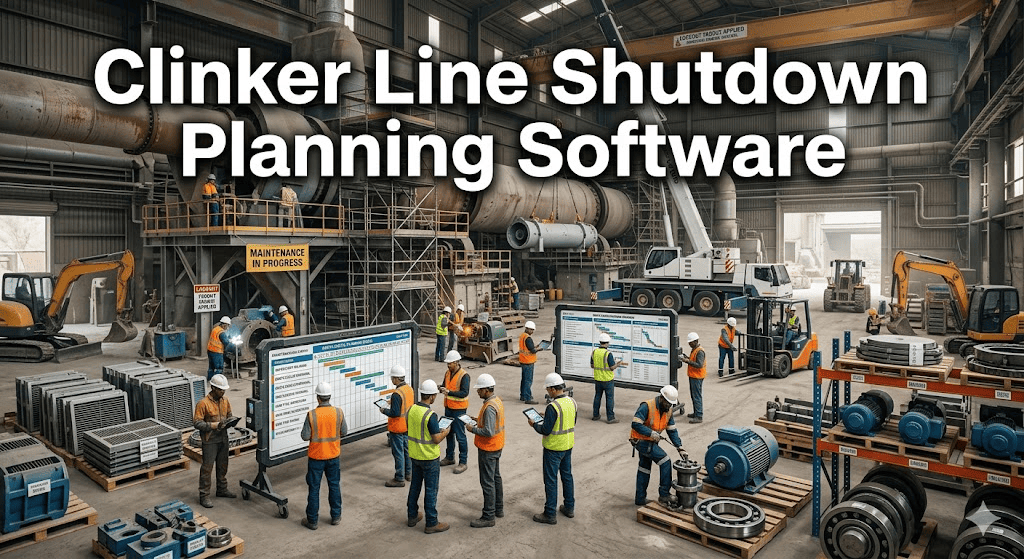
A typical cement clinker line shutdown involves 1,800 to 4,500 discrete maintenance tasks, 12 to 28 specialized vendor crews, $4M to $11M in spare parts and consumables, and a critical-path window where every hour of overrun costs $145,000 to $310,000 in lost clinker production. Yet most plants still plan major outages with spreadsheets, paper sequencing boards, and email threads — which is why 64% of cement shutdowns overrun their plan, and 38% finish with critical scope deferred to the next campaign because crews and parts collided on the critical path. Modern shutdown planning software fixes the math: every task sequenced, every crew assigned, every part staged, every dependency tracked in a single workflow. Start a free trial to plan your next shutdown with full task-crew-parts visibility, or book a demo for a walkthrough on your next outage scope.
Clinker Line Shutdown Planning Software
Bring Your Next Cement Plant Outage in On Time and On Budget
Coordinated task sequencing, crew assignment, spare parts staging, and critical-path tracking across every shutdown phase.
64%
Of cement clinker shutdowns overrun their original plan
$145K-$310K
Lost production cost per hour of overrun for a 5,000 TPD line
38%
Of planned scope deferred due to crew or parts conflicts
22%
Average outage duration reduction with structured planning software
See your shutdown critical path in 30 minutes
Get Your Custom Shutdown Plan in Real Time
See exactly where your next shutdown will collide on resources, crews, and parts — and how much you can save by resequencing now.
- Full task sequencing with dependencies
- Real-time crew and vendor coordination
- 5-10 year CapEx integration for major scope
What Is Clinker Line Shutdown Planning?
Clinker line shutdown planning is the coordinated management of every task, crew, spare part, permit, and dependency required to take a cement clinker production line offline, execute scheduled maintenance scope, and return it to production within the planned outage window. It covers preheater inspection and replacement, kiln refractory campaigns, cooler grate maintenance, mill liner replacement, fan rotor overhauls, electrical and instrumentation work, and the hundreds of smaller jobs that pile up between campaigns.
The discipline is part construction project management and part live maintenance operation. Modern planning software replaces spreadsheets and paper boards with a digital outage workspace where every task is sequenced, every crew is assigned, every part is staged in advance, and every dependency triggers a downstream alert if it slips. Start a free trial to scope your next campaign, or book a demo with a cement turnaround specialist.
The 8 Pillars of Effective Shutdown Planning
Pillar 01
Scope Definition and Lockdown
Every approved task locked in 8-12 weeks before outage with clear ownership and acceptance criteria.
Pillar 02
Task Sequencing with Dependencies
Critical-path mapping reveals which tasks block downstream work and which can run in parallel.
Pillar 03
Crew Assignment and Skill Match
Each task gets the right crew with verified skills, certifications, and equipment availability.
Pillar 04
Spare Parts Staging
Every major component verified on-site and staged before outage start — no last-minute logistics chaos.
Pillar 05
Permit and Isolation Management
LOTO, confined-space, hot-work, and height permits scheduled and tracked digitally.
Pillar 06
Real-Time Progress Tracking
Live shutdown dashboard shows task completion, slip risk, and critical-path drift hour by hour.
Pillar 07
Cost and Variance Tracking
Budget consumed vs scope completed visible in real time so overruns are addressed immediately.
Pillar 08
Post-Outage Lessons Learned
Every outage closes with structured lessons captured into the next campaign's plan.
Clinker shutdowns lose 20-40% of their budget to crew collisions, parts shortages, and untracked scope creep.
The Pain Points Every Cement Turnaround Manager Faces
Turnaround managers across cement operations consistently describe four recurring pains that cost the industry billions each year. Each one has a clear root cause and a clear fix — and the plants that act first reduce outage duration by more than 20%. Book a demo to see how each is addressed in Oxmaint.
!
Crews Show Up Without Work-Front Ready
Vendor crews arrive on day one to find scaffolding incomplete, permits not signed, or upstream task not closed — burning $80K-$200K per day in idle labor.
!
Critical Spare Parts Missing at the Critical Moment
Refractory brick, mill liners, or fan blades found short on day 3 of outage — emergency procurement costs 3.2x planned and slips critical path 18-48 hours.
!
Scope Creep with No Visibility
"While we are in here" jobs added during outage with no formal change control — costing 12-25% budget overrun and pushing critical path.
!
Post-Outage Wrap-Up Takes Weeks
No structured lessons-learned process means the same crew-conflict, parts-shortage, or sequencing error repeats next campaign — wasting recurring CapEx.
How Oxmaint Solves Clinker Shutdown Planning
Oxmaint provides a full digital outage workspace that replaces spreadsheets, paper boards, and email chains with structured task management, crew coordination, parts staging, and live progress tracking. Multi-site portfolio focus means turnaround managers running concurrent campaigns across multiple plants see everything in one view. Used by operations teams managing 10,000+ assets across multi-site cement portfolios. Start a free trial to scope your first campaign.
Outage Workspace and Scoping
Centralized scope library with every approved task, owner, duration estimate, and acceptance criteria locked before outage start.
Critical-Path Sequencing
Drag-and-drop sequencing with dependency rules — system flags conflicts before they reach the field.
Crew and Vendor Coordination
Each crew sees their daily task list with location, prerequisites, and parts staging confirmation on tablets or kiosks.
Spare Parts and Materials Staging
Every major component tracked from PO through staging — workshop kits prepared and verified before outage day one.
Live Outage Dashboard
Turnaround leaders see task completion, critical-path slip risk, crew utilization, and cost variance hour by hour.
Lessons-Learned Capture
Post-outage close-out captures structured lessons that feed directly into the next campaign's planning template.
Plants using structured shutdown software see 22% outage duration reduction — start a free trial to scope your next campaign.
Reactive vs Planned Shutdown Comparison
| Dimension |
Reactive — Spreadsheet Planning |
Planned — Structured Software |
| Scope lockdown |
Last-minute additions |
Frozen 8-12 weeks pre-outage |
| Task sequencing |
Manual on paper boards |
Critical-path digital |
| Crew availability conflicts |
Discovered on day 1 |
Flagged 4 weeks ahead |
| Spare parts visibility |
Spreadsheet, often stale |
Live staging dashboard |
| Progress reporting |
Daily standup, manual |
Hourly live dashboard |
| Scope creep control |
None — added verbally |
Formal change request |
| Average overrun |
14-36 hours |
Under 4 hours |
| Scope deferred to next |
38% average |
Under 8% |
| Lessons captured |
Anecdotal, lost between campaigns |
Structured digital record |
The Measurable ROI of Structured Shutdown Planning
Cement plants deploying Oxmaint for clinker shutdown planning see results in the first campaign. The numbers below reflect typical outcomes across 3,000-12,000 TPD operations. Limited onboarding slots available this quarter.
22%
Outage Duration Reduction
From elimination of crew and parts collisions
$3.2M
Production Recovered
Per major outage from earlier restart
38%
Fewer Deferred Scope Items
From under 8% deferral vs 38% baseline
3.2x
Emergency Procurement Avoided
From pre-outage parts staging
12%
Lower Total Outage Cost
Through better scope and crew control
2 outages
Average Payback
Most plants recoup investment in year one
Frequently Asked Questions
Can Oxmaint plan multiple concurrent shutdowns across plants?
Yes. Multi-site portfolio support lets turnaround managers plan and run shutdowns concurrently across multiple plants from one workspace, with shared resource pools.
Does Oxmaint integrate with our ERP for parts and procurement?
Yes. Oxmaint connects to SAP, Oracle, and other enterprise ERPs for purchase orders, materials tracking, and spare parts inventory visibility.
Can vendor crews access Oxmaint without full user licenses?
Yes. Vendor crews access task lists, prerequisites, and parts staging info via a limited-access portal or kiosk — no full user license required per crew member.
How long does it take to deploy Oxmaint before our next outage?
Most plants deploy and scope their first outage in Oxmaint within 4-6 weeks. The platform is live in days, not months, with structured templates for cement turnarounds.
Decision Point — Plan Your Next Outage in Oxmaint
Stop Losing Millions to Overrun Shutdowns
Bring your next clinker line outage in on time, on budget, with full scope completed. Multi-site portfolio support. No heavy implementation. Live in days, not months.