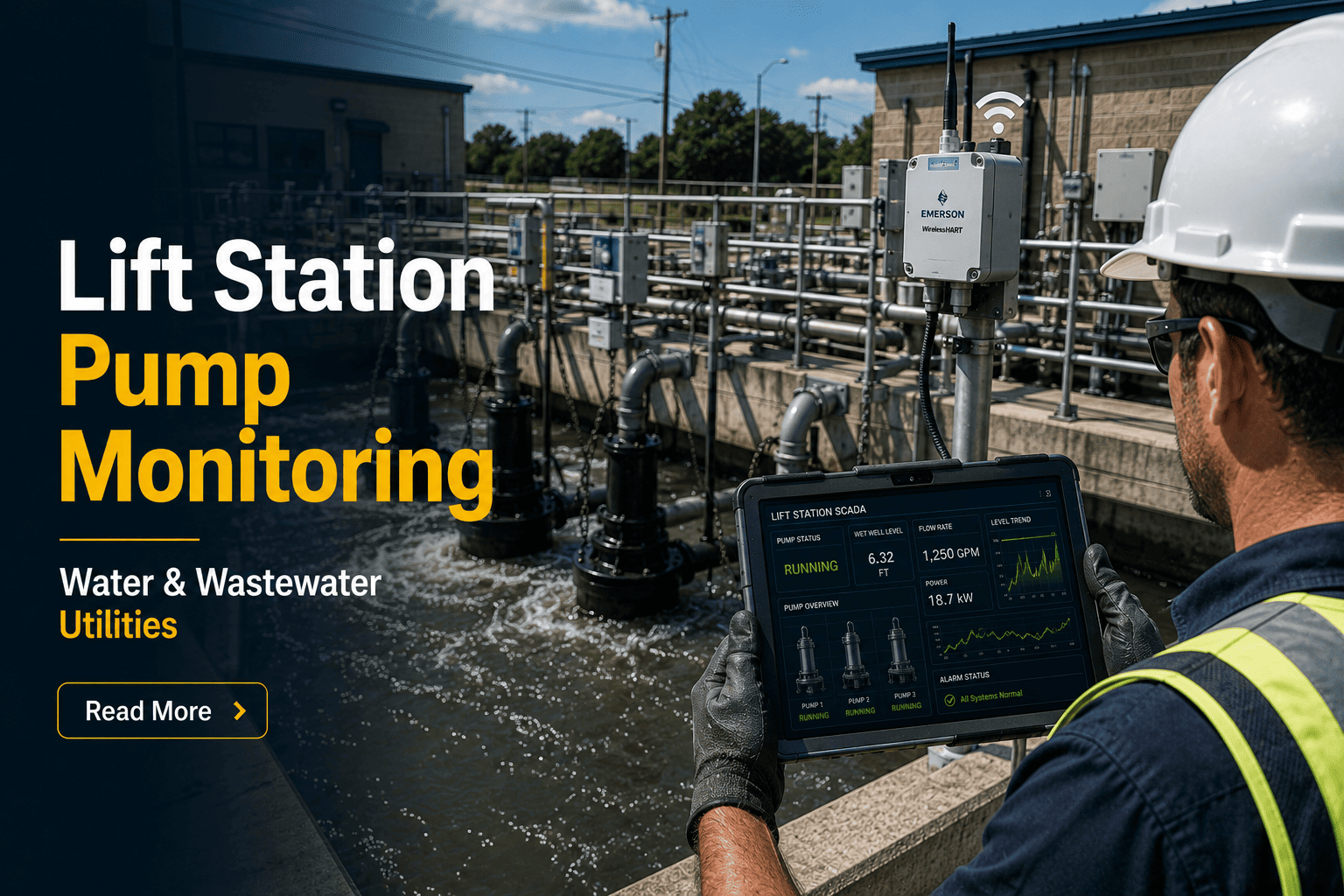
A lift station failure is never just a maintenance problem. When a submersible pump goes down in a municipal wastewater system, the consequence is a sanitary sewer overflow — sewage reaching waterways, public health risk, EPA enforcement action, and fines that dwarf the cost of the repair that would have prevented it. Yet most lift stations across water and wastewater utilities are still running on manual inspection cycles, reactive SCADA alarms, and maintenance crews dispatched after the failure is already in progress. Wireless lift station monitoring with mobile CMMS work orders changes that operational model fundamentally — detecting pump degradation weeks before failure, automatically generating work orders with pre-staged parts and procedures, and keeping EPA compliance documentation current without manual effort. Start a free trial to connect your lift station assets to OxMaint's predictive monitoring platform, or book a demo and see how municipal utilities are eliminating sanitary sewer overflows with condition-based maintenance.
Water and wastewater utilities operating 500+ lift stations use OxMaint to maintain regulatory compliance and eliminate unplanned overflows.
Live in days, not months • No heavy implementation required • Multi-site portfolio support
What Is Lift Station Pump Monitoring
Lift station pump monitoring is the continuous measurement of key health indicators — vibration, motor current, run cycles, runtime hours, discharge pressure, and wet well level — on submersible and dry pit pumps that move wastewater from lower to higher elevation in municipal and industrial collection systems. Unlike periodic manual inspections, continuous monitoring creates a real-time health record for each pump that enables AI anomaly detection to identify bearing wear, impeller clogging, motor degradation, and seal failure weeks before the failure that causes an overflow event.
Modern CMMS-integrated lift station monitoring goes beyond alerting. When OxMaint's AI detects a developing pump anomaly, it automatically creates a work order with the specific fault classification, recommended corrective action, required parts reservation, and technician assignment — ensuring the problem is addressed in a planned maintenance window, not during an emergency response. The entire cycle from detection to dispatched technician completes in under 60 seconds.
For water and wastewater utilities, this capability is not just an operational efficiency — it is the primary mechanism for maintaining EPA compliance and preventing the SSO enforcement actions that carry six-figure fine exposure. Book a demo to see how OxMaint maps lift station monitoring to your EPA compliance requirements.
Eight Critical Health Signals for Lift Station Pumps
The Four Operational Failures Draining Utility Maintenance Budgets
A lift station visited twice weekly leaves 84 hours of unmonitored operation per cycle. Pump degradation, rainstorm surges, and rag accumulation that develops over those 84 hours becomes an overflow event before the next scheduled inspection. Continuous wireless monitoring eliminates the blind window entirely.
Traditional SCADA alarm thresholds are set at failure — high wet well level, pump failure alarm, high discharge pressure. By the time these alarms fire, the failure is in progress. OxMaint's AI detects the trend deviations that precede the alarm: the current creeping up, the vibration signature shifting, the cycle time changing over days — not hours.
Utility maintenance crews spending 40–60% of their time on emergency lift station callouts have no capacity for planned preventive work. Emergency-dominated schedules create a vicious cycle: deferred PMs accumulate, creating more failures, generating more emergency calls. Condition-based monitoring breaks this cycle by shifting work to planned windows.
EPA NPDES permits and state regulations require documented inspection records, overflow reporting, and corrective action logs for every lift station in the system. Manual assembly of these records before audits or post-SSO reporting consumes days of staff time and carries the transcription error risk that triggers additional regulatory scrutiny.
These failures are structural — they cannot be fixed by working harder on the current system. The system itself needs to change. Start your free trial to begin the transition from reactive to predictive lift station maintenance this week.
How OxMaint Protects Lift Stations and Utility Compliance
OxMaint's AI models analyze vibration, current, run cycles, and temperature data together to calculate a live health score for each lift station pump. Scores update continuously — not at the next scheduled inspection — so developing failures are visible days before they become emergencies.
When AI detects an anomaly, OxMaint dispatches a mobile work order to the field technician with fault details, recommended action, required parts, and the asset's full maintenance history — before the failure occurs. Field crews arrive prepared, not searching for information on site.
OxMaint connects to existing SCADA infrastructure via standard industrial protocols. The platform adds predictive intelligence and CMMS work order automation on top of what you already have — no rip-and-replace, no new SCADA system required.
Every sensor reading, inspection visit, anomaly event, and corrective action is automatically logged in OxMaint's asset records with timestamp and technician signature. EPA inspection documentation and SSO reporting is generated from this continuous trail — not assembled from paper logs after the fact.
Utilities managing dozens to hundreds of lift stations across a service territory see every station's health, maintenance status, and compliance standing in a single OxMaint dashboard. Route optimization and crew dispatch is built in — eliminating unnecessary site visits to stations running normally.
Pump degradation trends feed OxMaint's 5–10 year capital planning model. When a submersible pump's health score trajectory signals end-of-life within 24 months, OxMaint surfaces the replacement in your capital forecast — with enough lead time for procurement, budget approval, and planned installation.
Reactive Maintenance vs OxMaint Predictive: Side-by-Side
| Scenario | Reactive Calendar Maintenance | OxMaint Predictive Monitoring |
|---|---|---|
| Bearing wear detected | At pump failure — emergency dispatch, overflow risk | 14–21 days before failure — planned repair in maintenance window |
| Work order creation | After emergency call, manual 30–60 min process | Automatic in under 60 seconds, mobile dispatch to technician |
| Parts availability | Emergency order, premium shipping, 2–5 day delay | Pre-ordered weeks ahead, staged at station or depot |
| EPA documentation | Manual log assembly, audit preparation days | Continuous automated trail, one-click compliance report |
| SSO risk | High — failure during uninspected 84-hour window | Minimal — continuous monitoring with 2–3 week advance warning |
| Maintenance cost profile | Emergency-dominated, 4.8× planned cost multiplier | Planned-dominant, 25–40% total maintenance cost reduction |
ROI From Predictive Lift Station Monitoring
For water and wastewater utilities, the financial case for predictive monitoring is clear — but the regulatory case is even stronger. A single prevented SSO event avoids fine exposure that exceeds an entire year of monitoring costs. Book a demo to see how OxMaint calculates your specific SSO risk reduction and maintenance cost savings based on your lift station inventory.
Frequently Asked Questions
Can OxMaint integrate with our existing SCADA system without replacing it?
How does OxMaint help utilities meet EPA NPDES permit requirements for lift stations?
How far in advance can OxMaint detect a developing pump failure?
Can OxMaint manage multiple lift stations across a large service territory from one platform?
OxMaint connects continuous lift station monitoring to automated CMMS work orders — detecting pump failures 14–90 days ahead, pre-staging parts, dispatching mobile work orders, and keeping EPA documentation current without manual effort.
See measurable overflow risk reduction in the first 30 days. Works across multi-site utility portfolios.