OSHA recordable incidents cost US manufacturers an average of $40,000 per case in direct costs — and the indirect costs in lost productivity, investigation time, and insurance impact multiply that figure by 4 to 10 times. Yet 80% of industrial safety violations are not discovered in real time: they are found in post-incident investigations, audit walkthroughs, and near-miss reports that arrive days after the exposure occurred. AI PPE detection running on NVIDIA Jetson hardware changes that entirely — detecting missing hard hats, safety vests, gloves, and eye protection the moment a worker enters a monitored zone, triggering instant alerts, and logging every violation event automatically into your CMMS as an EHS corrective action. Start a free trial to see how OxMaint turns AI safety monitoring into a closed-loop EHS management system that prevents incidents before they become recordable events.
AI Safety · PPE Detection · EHS Management
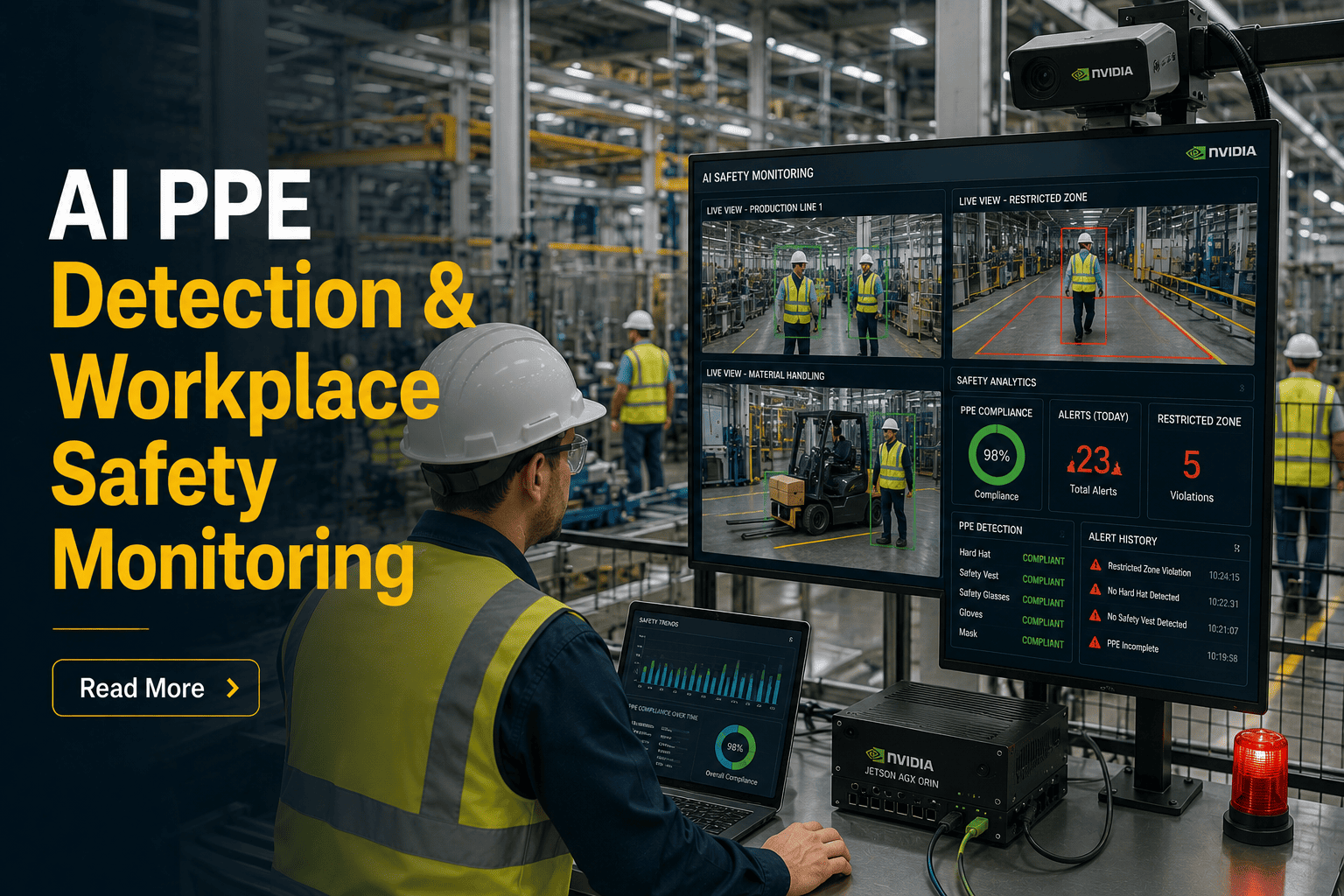
AI PPE Detection and Workplace Safety Monitoring
Hardhat · Vest · Gloves · Eye Protection · Restricted Zones · Behavior-Based Safety
Computer vision running on NVIDIA Jetson detects PPE compliance violations and unsafe behavior in real time — and feeds every safety event into OxMaint as an EHS incident or corrective action automatically, no manual reporting required.
Real-time PPE violation detection with instant supervisor alert
Restricted zone and unsafe behavior monitoring — auto-generated EHS incidents
OSHA-compliant safety records with full visual evidence trail in OxMaint
No heavy implementation · OSHA-compliant audit trails · Measurable results in 30 days
OxMaint · Safety Monitoring Dashboard
● Monitoring
Recent Safety Events — Auto-Logged
Missing Hard Hat
Press Area · Zone 4
Alert Sent · EHS-1124
Restricted Zone Entry
Conveyor Perimeter
Alert Sent · EHS-1121
No Safety Vest
Loading Dock · Bay 2
Logged · EHS-1119
PPE Compliance by Zone — This Week
$40,000
Per OSHA Recordable — Direct Cost
Indirect costs multiply 4–10× — lost productivity, investigation, insurance, and regulatory penalties (OSHA, 2024)
80%
Violations Not Caught in Real Time
Found in post-incident investigation and audits — days after the exposure occurred. AI monitoring detects at the moment of violation (NSC, 2023)
35–60%
Incident Rate Reduction
Plants deploying AI-based behavior safety monitoring report within 12 months of deployment (Verdantix Safety Report, 2024)
$6 : $1
Safety Investment ROI
Every $1 invested in workplace safety returns $6 in avoided incident costs, compensation, and productivity loss (Liberty Mutual, 2023)
Turn Every Safety Violation Into a Corrective Action — Automatically
OxMaint connects AI PPE detection alerts to EHS incident management, corrective action tracking, and OSHA-compliant safety records — closing the loop between what the camera sees and what the safety team acts on. If your safety team still relies on manual observation and end-of-shift incident reports, start a free trial or book a demo to see the full integration on your facility layout.
What Is AI PPE Detection and Workplace Safety Monitoring?
AI PPE detection uses computer vision models trained to recognize personal protective equipment — hard hats, safety vests, safety glasses, gloves, steel-toed boots, and respirators — on workers in camera feeds. The models run on NVIDIA Jetson edge hardware, analyzing every frame of every camera in real time without cloud latency, classifying each detected person's PPE compliance status within milliseconds. When a worker enters a monitored zone without required PPE, the system triggers an immediate alert — to the supervisor, to a zone-entry warning system, or to a digital signage display — before a hazard exposure accumulates.
Beyond PPE, modern AI safety monitoring detects unsafe behaviors: unauthorized entry into restricted machinery zones, workers in proximity to moving equipment during operation, ladder misuse, improper manual handling postures, and proximity violations between pedestrians and forklift travel paths. Each detected event generates a timestamped record with the camera frame, detected violation type, zone identifier, and shift context — which OxMaint converts into an EHS incident or corrective action record automatically, with no manual reporting step.
The strategic value goes beyond compliance. Safety data from AI monitoring reveals systemic patterns: which zones generate the highest PPE violation rates, which shifts show the worst compliance, which equipment areas correlate with the most near-miss events. OxMaint aggregates this data into safety trend analysis that drives targeted training, zone redesign, and equipment guarding improvements — replacing reactive incident management with evidence-based injury prevention. Teams that implement AI safety monitoring with integrated EHS management report 35–60% incident rate reduction within 12 months. To see how this integration works for your specific facility layout, book a demo and we will walk through zone mapping and alert configuration for your site.
PPE Types AI Vision Detects
Hard hats and bump caps
High-visibility safety vests
Safety glasses and face shields
Work gloves and cut-resistant gloves
Steel-toed and slip-resistant footwear
Respirators and dust masks
Hearing protection (ear muffs, plugs)
Fall harnesses and lanyards
Unsafe Behaviors Detected
Restricted zone unauthorized entry
Pedestrian-forklift proximity violations
Machine operation without guarding
Ladder misuse and unsafe positioning
Improper manual handling posture
Slip and trip hazard proximity
Every 3.7 seconds, a worker is injured on the job in the United States. AI safety monitoring detects the conditions that precede those injuries — in real time, before they occur.
8 Core Capabilities of AI Safety Monitoring
01
Multi-PPE Simultaneous Detection
A single camera frame analyzes all required PPE simultaneously for each detected worker — hard hat, vest, gloves, and eye protection classified in one inference pass. Detection works at 5–15 meter range, in variable lighting, and with partial occlusion.
02
Restricted Zone Monitoring
Virtual perimeters defined around machinery, chemical storage, confined spaces, and high-voltage equipment. When a worker enters a restricted zone — authorized or unauthorized — the system logs the entry, verifies zone-specific PPE requirements, and triggers the appropriate alert level automatically.
03
Real-Time Supervisor Alert
PPE violations and zone breaches trigger instant notifications to supervisor mobile devices, control room screens, and zone-entry warning systems. Alert escalation logic — first occurrence warning, repeat offense escalation — configures per zone and violation type in OxMaint.
04
Automatic EHS Incident Creation
Every safety event creates an OxMaint EHS record automatically — violation type, zone, timestamp, camera frame, shift, and severity classification. No manual incident reporting, no paper forms, no end-of-shift data entry. The EHS record exists the moment the violation occurs.
05
Behavior-Based Safety Analytics
Safety violation trends by zone, shift, violation type, and time of day surface in OxMaint dashboards. Zones with persistent PPE non-compliance or unsafe behavior patterns drive targeted training, corrective signage, and zone redesign — not reactive discipline after an incident.
06
Near-Miss Detection and Logging
AI models classify near-miss events — worker proximity to moving equipment, slip hazard exposure, and unsafe posture during lifting — and log them as leading indicator safety records. Near-miss tracking in OxMaint provides the early warning signal that predicts recordable incidents 4–8 weeks before they occur.
07
Corrective Action Workflow Management
Safety incidents and near-miss events in OxMaint generate corrective action tasks automatically — with assigned owner, due date, and verification step. Corrective action completion rates track against safety KPIs, ensuring that identified hazards receive documented intervention within required timeframes.
08
OSHA and ISO 45001 Compliant Records
OxMaint safety records include all data elements required for OSHA 300 log entries, ISO 45001 incident investigation, and workers' compensation documentation — with timestamped visual evidence attached. Regulatory audit preparation reduces from days to hours when safety records are complete and searchable.
6 Safety Management Pain Points AI Monitoring Eliminates
!
PPE Violations Caught Only After Injury Occurs
Supervisor walkthrough frequency cannot match the 8-hour window of every shift. A worker who removes a hard hat in a designated zone for 20 minutes exposes to real risk — and that exposure is never documented, never investigated, and never corrected. AI monitoring detects the violation in the first 10 seconds, not in the post-incident report three days later.
!
Manual Incident Reporting Is Incomplete and Delayed
Workers underreport near-misses and minor PPE violations — not out of dishonesty, but because manual reporting takes time and feels disproportionate for a brief exposure. Studies show that for every OSHA recordable incident, 29 near-miss events went unreported. AI monitoring captures all of them automatically, building the leading indicator data that predicts and prevents recordable incidents.
!
Restricted Zone Breaches Invisible Without Dedicated Personnel
Physical barriers prevent accidental entry but do not monitor authorized-but-unsafe behavior inside restricted zones. A maintenance technician performing a task inside a conveyor perimeter without a lockout/tagout verification creates an incident waiting to happen — AI monitoring detects the zone occupancy status and verifies required safety procedures are observed before machinery restarts.
!
Safety Data Siloed from Maintenance and Operations
Safety incidents live in the EHS system. Near-miss events live in paper logbooks. Equipment guards and interlocks are tracked in the CMMS. None of these systems talk to each other. When a safety incident involves equipment failure — a missing guard, a failed interlock, a worn anti-slip surface — connecting the safety event to the maintenance work order requires manual investigation that often reveals the connection too late to prevent recurrence.
!
Compliance Evidence Insufficient for OSHA Inspections
When an OSHA inspector asks for evidence that PPE requirements were enforced in a specific work area during the past 30 days, the answer should not be supervisor attestation and training sign-in sheets. AI monitoring provides timestamped, camera-verified compliance records for every monitored zone on every shift — the gold standard for demonstrating proactive safety enforcement.
!
High-Cost Areas of Repeated Violation Unidentified
Without AI analytics, safety managers rely on incident history to identify high-risk zones — which means waiting for injuries before seeing patterns. AI safety monitoring reveals that Loading Dock Bay 2 generates 40% of all PPE violations, that night shift shows 3× the compliance violations of day shift, and that forklift Zone C has the highest near-miss frequency — before any of those patterns produce a recordable incident.
Safety teams that shift from reactive incident management to AI-driven violation prevention report 35–60% incident rate reduction within 12 months — start a free trial to see how OxMaint tracks safety violations, corrective actions, and compliance trends across your entire facility, or book a demo to walk through zone configuration for your specific site layout.
How OxMaint Manages the Complete Safety Event Lifecycle
01
AI Vision Detects Violation
NVIDIA Jetson runs PPE classification on every camera frame in under 15ms. Missing PPE or unsafe behavior detected. Camera frame captured with bounding boxes and confidence score. Zone, timestamp, and shift context recorded.
↓
02
Instant Alert Triggers
Supervisor mobile alert, control room display, and zone warning system activate simultaneously. Alert content: violation type, zone, image, and recommended response. Escalation timer starts — if violation persists, alert escalates to next tier.
↓
03
EHS Incident Auto-Created in OxMaint
OxMaint EHS record created automatically with all required fields: violation type, severity, zone, shift, visual evidence, and AI confidence score. Record classified per OSHA 300 log categories for immediate regulatory compliance.
↓
04
Corrective Action Assigned and Tracked
Corrective action task generated with owner, due date, and verification requirement. Supervisor acknowledges violation, documents intervention, and closes the corrective action loop in OxMaint. Completion tracked against safety KPI targets.
↓
05
Safety Trends Drive Prevention Programs
OxMaint aggregates violation data by zone, shift, type, and time period. High-violation zones trigger targeted training, signage upgrades, or zone redesign. Leading indicator trends predict and prevent recordable incidents before they occur.
Manual Safety Management vs AI Vision + OxMaint EHS
| Safety Capability |
Traditional / Manual Approach |
AI Vision + OxMaint EHS |
| PPE violation detection |
Supervisor walkthroughs 2–4× per shift — violations persist between rounds |
Continuous — every camera zone monitored every frame, every shift |
| Incident reporting |
Manual forms, end-of-shift entry — 29 unreported near-misses per recordable |
Automatic EHS record created at violation moment — 100% capture rate |
| Response time |
Next supervisor walkthrough — 30–120 minutes after exposure |
Instant alert in under 15 seconds of violation detection |
| Restricted zone monitoring |
Physical barriers only — no real-time zone occupancy visibility |
Virtual perimeter monitoring with entry logging and PPE verification |
| Evidence quality |
Witness statements and supervisor notes — challenged in regulatory review |
Timestamped camera evidence with AI classification — audit-ready |
| Corrective actions |
Identified at periodic safety audits — 30–90 days after hazard exists |
Generated immediately at incident — tracked to closure in OxMaint |
| Safety analytics |
Monthly incident reports — reactive, backward-looking |
Live violation trends by zone and shift — predictive leading indicators |
| OSHA compliance evidence |
Training records and supervisor attestation — incomplete for inspections |
Per-shift compliance records for every zone — searchable, exportable |
ROI and Results — Safety Outcomes That Justify Deployment
$40,000
Direct Cost Per OSHA Recordable
Indirect costs (productivity loss, investigation, insurance) multiply total impact 4–10× — meaning a single prevented recordable typically justifies one year of AI safety monitoring operating cost
35–60%
Incident Rate Reduction
Plants deploying AI-based behavior safety monitoring with integrated EHS management achieve within 12 months — driven by real-time violation detection and corrective action closure before incidents accumulate
6:1
Safety Investment Return
Every $1 invested in proactive workplace safety returns $6 in avoided incident costs — Liberty Mutual Safety Index, the most widely cited safety ROI benchmark in industrial risk management
29:1
Near-Miss to Recordable Ratio
For every OSHA recordable incident, 29 near-miss events preceded it. AI monitoring captures near-miss events that manual reporting misses — turning leading indicator data into incident prevention
100%
Shift Coverage
AI monitoring maintains identical detection accuracy across day, evening, and night shifts — versus human supervision that degrades on extended shifts and is reduced at night due to staffing constraints
$500K+
Insurance Premium Reduction
Facilities demonstrating AI-powered proactive safety programs report workers' compensation and general liability premium reductions of $500K+ annually — driven by documented incident rate improvement and compliance evidence
The ROI case for AI safety monitoring is one of the clearest in industrial operations — one prevented serious injury covers years of system operating cost. Start a free trial to model prevention ROI for your facility, or book a demo to see OxMaint's EHS dashboard configured for your zone layout and PPE requirements.
Frequently Asked Questions
Does AI PPE detection require individual worker identification or biometric data?
No. OxMaint's AI safety monitoring operates on detected worker positions and PPE classification without individual identification — no facial recognition, no biometric data collection, and no individually attributed violation records. The system logs violation events by zone, camera, and timestamp — not by worker identity. This design protects worker privacy, eliminates GDPR and BIPA compliance concerns, and keeps the system focused on environmental and behavioral safety patterns rather than individual surveillance. Zone-level compliance data provides all the analytical value needed for safety improvement programs without privacy risk. For operations that require individual tracking for high-risk zone access control, OxMaint integrates with badge-based access systems that handle identification separately from the AI vision layer. To discuss your specific privacy requirements,
book a demo and we will walk through the data architecture for your region and regulatory environment.
How does AI safety monitoring work in low-light, high-dust, or outdoor environments?
NVIDIA Jetson vision models trained with environmental augmentation — low-light conditions, dust occlusion, glare, rain, and fog — maintain detection accuracy across challenging industrial environments. For true low-light conditions (below 10 lux), near-infrared cameras with IR illumination provide the camera feed rather than visible spectrum cameras — and the AI model is trained on NIR imagery. High-dust environments benefit from IP67-rated camera enclosures and periodic lens cleaning protocols. Outdoor deployments for construction sites, yard operations, and loading docks require weatherproof camera housings and models trained on outdoor lighting variation. OxMaint's deployment team assesses environmental conditions during the site survey and specifies appropriate hardware configuration for each zone. Detection accuracy in properly specified harsh-environment deployments typically reaches 92–96% — slightly below ideal indoor performance but well above human inspection consistency.
Start a free trial to see how environmental factors affect system specification for your facility.
How do AI safety records integrate with our existing OSHA 300 log and incident management system?
OxMaint EHS records include all fields required for OSHA 300, 300A, and 301 log entries — injury type, body part, days away, job transfer, and restriction data — and generate the OSHA 300 log export automatically from incident records. For organizations with existing incident management systems — Intelex, Cority, SAP EHS, or similar — OxMaint integrates via REST API to push safety events and corrective actions to the existing platform while maintaining the AI-generated evidence trail. This dual-system configuration is common during initial deployment: AI safety events flow into OxMaint for equipment-linked corrective action tracking, while regulatory records maintain in the existing system. Full migration to OxMaint as the primary EHS platform is also supported. To map the integration path for your current systems,
book a demo and we will review your existing system stack.
What is the typical timeline from decision to first live safety alerts?
For a standard facility deployment — up to 20 cameras across 5–8 zones — the timeline from purchase order to first live alerts is typically 3–5 weeks. Week 1: site survey, zone mapping, camera placement specification, and NVIDIA hardware ordering. Week 2–3: hardware delivery, camera installation, network configuration, and NVIDIA Jetson setup. Week 4: model deployment and zone configuration in OxMaint — PPE requirements per zone, alert escalation rules, supervisor assignment. Week 5: go-live with supervisor training and 30-day performance review scheduled. The fastest deployments — single facility, well-defined zones, standard PPE requirements — go live in under 3 weeks. For multi-site rollouts, OxMaint's deployment team stages sites in parallel to compress the portfolio-wide timeline. See measurable results in the first 30 days — start a free trial or
book a demo for a deployment timeline specific to your facility size and zone complexity.
AI PPE Detection · OxMaint EHS Management
Stop Losing Workers and Budget to Incidents That AI Would Have Prevented Weeks Earlier.
Every safety violation your camera misses today is a leading indicator of the recordable incident you will investigate next month. OxMaint connects AI PPE detection to EHS incident management, corrective action tracking, and OSHA-compliant safety records — so your safety team acts on real-time data, not retrospective reports.
35–60% incident rate reduction within 12 months of deployment
Automatic EHS records on every violation — no manual reporting gaps
OSHA-compliant visual evidence trail across every monitored zone
Used by operations teams managing 10,000+ assets · Limited onboarding slots available this quarter · Live in 3–5 weeks
No heavy implementation required · Works across multi-site portfolios · No individually identifiable biometric data