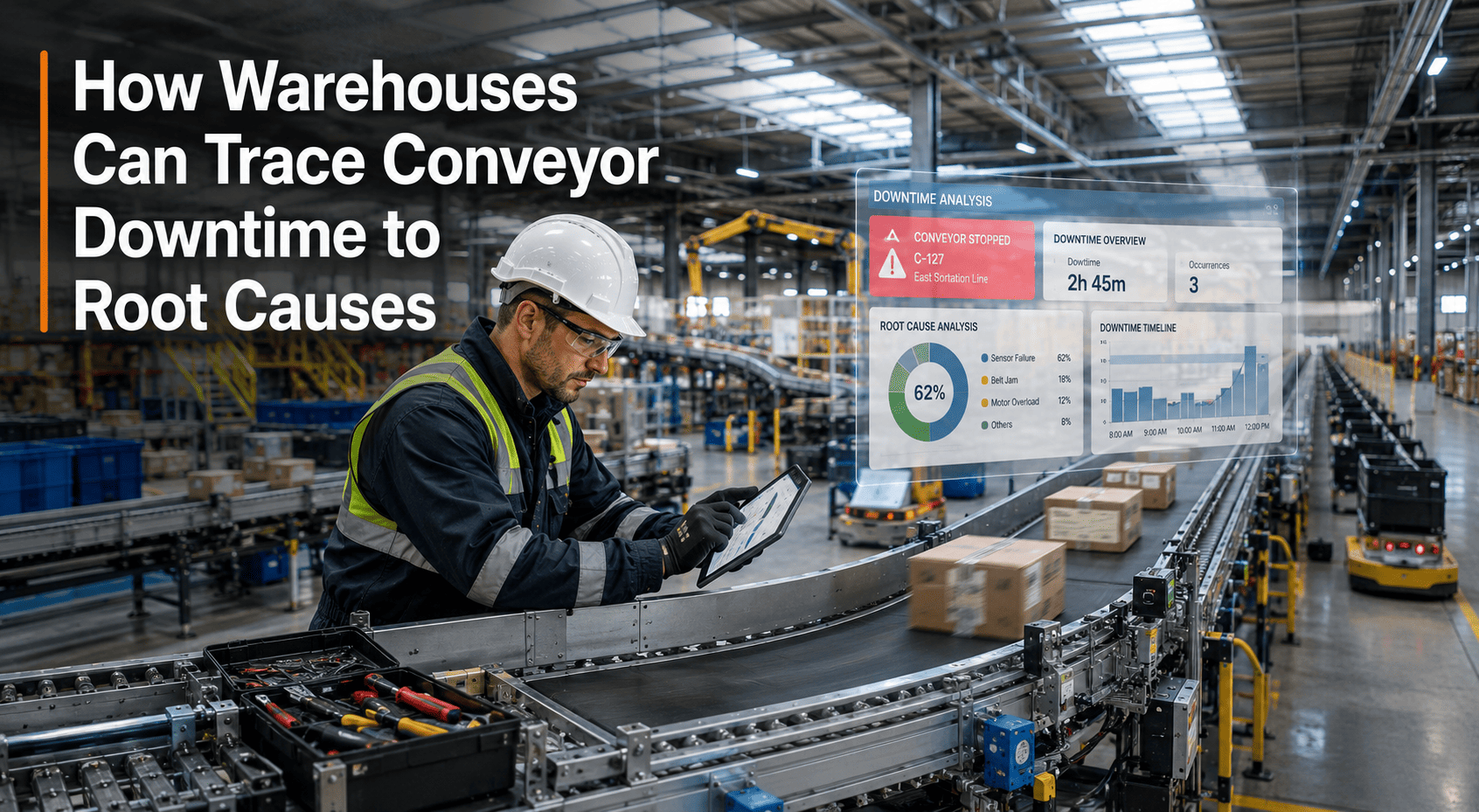
Warehouse and fulfillment center operations live on conveyor uptime. A single sortation line stalled for 12 minutes during a peak wave can push thousands of orders past the carrier cutoff and trigger SLA penalties the operation never recovers in the same shift. OSHA 29 CFR 1910.212 covers machine guarding on conveyors, ANSI/CEMA B20.1 governs conveyor safety standards in North America, ISO 5006 and EN 619 cover continuous mechanical handling equipment in the EU, and the operation's own DC Service Level Agreement with brand partners dictates the financial cost of every downtime minute. Warehouse maintenance leaders who run a structured root-cause analysis program on conveyor downtime against this stack start a free trial on the highest-throughput line first, validate the asset model and failure code library, then extend the CMMS across induct, merge, sortation, and pack lines.
Warehouse Conveyor Operations Brief
Tracing Warehouse Conveyor Downtime to Root Causes with CMMS-Driven Failure Analysis
Failure code libraries, downtime event capture at the line, root cause analysis on every event, PM cadence adjustment from failure history, and CMMS-tracked reliability data that drives throughput and SLA performance.
OSHA 1910.212
ANSI/CEMA B20.1
EN 619
ISO 5006
SLA Performance
$50K+
Average financial cost of a single peak-wave conveyor downtime event in a major DC
62%
Conveyor downtime events traced to causes that earlier PM cycles would have prevented
12 min
Average downtime window per stall before package backlog forces wave abort
79%
Reduction in repeat downtime events reported by DCs on structured RCA programs
What is Conveyor Downtime Root Cause Tracing
Conveyor downtime root cause tracing is the integrated CMMS program that captures every downtime event at the line with a coded failure mode, links it to the asset and the work order that resolved it, runs root cause analysis on the recurring failures, adjusts PM cadence and parts policy from the analysis, and holds the reliability trail that drives SLA performance and capital planning. It covers four conveyor classes — induct, merge, sortation, and pack — and four event types — mechanical fault, controls fault, jam, and operator-induced stop.
Done well, it removes recurring downtime from the SLA risk register — no repeat failures, no wave aborts on known issues, no capital surprises on aging conveyor sections. Done badly, it sits at the top of the operations cost line and dictates carrier cutoff performance week after week. Warehouse leaders ready to take recurring downtime off the SLA list book a demo and see the failure code model built on their own conveyor hierarchy.
A conveyor downtime event without a coded failure mode is a downtime event that will repeat in the next wave, the next shift, and the next quarter.
The Six Disciplines That Define Conveyor Reliability
A warehouse conveyor reliability program is not one task — it is six interlocking disciplines that together produce uptime, throughput, and SLA performance. Map them all into the CMMS as separate cadences and trails against each conveyor section, and the line becomes a tracked, auditable, predictable system instead of a black box that breaks and recovers without anyone learning from it.
01
Failure Code Library Tied to Every Event
A standardized failure code library — drive motor, gearbox, belt tracking, photoeye, jam, e-stop activation, controls fault, operator-induced — gets applied to every downtime event at the line. The library is the foundation of every downstream RCA, PM adjustment, and capital plan.
02
Downtime Event Capture at the Line
Every downtime event captured on mobile at the conveyor section — duration, failure code, resolving action, parts consumed, operator and tech involved. No more downtime logged in a shift report that gets summarized away by morning standup.
03
Root Cause Analysis on Recurring Failure Modes
When the same failure code repeats three times on the same conveyor section within a defined window, the CMMS triggers an RCA work order. Reliability engineering investigates, finds the root cause — belt tension, sprocket wear, controls timing, operator practice — and the fix lands as a PM, training, or capital change.
04
PM Cadence Adjustment from Failure History
PM cycles are not fixed forever. When the failure code library shows that drive belts are failing 30% below their assumed life, the CMMS recommends a tighter PM cadence on belt inspection and replacement. The PM program evolves from the data instead of from the OEM manual written ten years ago.
05
Spare Parts Policy Driven by Failure Data
Photoeyes that fail 18 times a quarter need different stocking than gearboxes that fail twice a year. The CMMS consumption history drives the parts policy on each class. Fast movers stay on the shelf, long-leads stay in justified safety stock, and the warehouse stops carrying parts for failure modes that no longer happen.
06
SLA and Throughput Performance Reporting
Conveyor downtime rolls up to the operation's SLA scorecard — orders per hour, wave completion rate, carrier cutoff achievement. The CMMS dashboard ties maintenance performance to the throughput metric the GM cares about and the brand partner penalizes against.
A conveyor reliability program running all six disciplines on one CMMS is one ready for any review — the GM's weekly throughput, the brand partner's SLA audit, the capital planning cycle, the insurance walk-through. Warehouse leaders building toward that level of readiness start a free trial on the highest-throughput line and validate the failure code library before scaling.
Where Warehouse Conveyor Reliability Programs Break Down
When DCs take a recurring conveyor downtime hit, the trace-back almost always lands in one of six places. None of them are surprises — they are the failures that show up in SLA penalty reports and capital request packets across the warehouse industry.
Downtime logged without a failure code
The conveyor went down, the tech fixed it, the shift moved on. There is no code, no asset reference, no root cause path. The same failure will happen again next week and the operation will lose the same SLA points without ever learning from it.
Recurring failures invisible across shifts
The day shift fixes a belt tracking issue and clears it. The night shift fixes the same issue four hours later. The morning shift fixes it again. Each fix is fast, none of them is permanent, and the underlying root cause never surfaces because no one is looking at the pattern.
PM cadence frozen on OEM manual recommendations
The OEM manual says inspect drive belts annually. The actual failure data shows belts failing at month seven. The PM cadence never moves because no one is connecting the failure history to the PM library, and the unplanned failures keep happening on schedule.
Photoeye and sensor failures absorbed as operator stops
When a photoeye flutters and the line jams, the operator clears the jam and presses run. The downtime gets coded as operator-induced instead of as a sensor failure. The sensor degrades for six more months until it dies completely during peak wave and takes the line down hard.
Capital planning built without failure data
The capital request for a sortation refit goes to corporate without a defensible reliability case. Corporate funds the lower-risk asks and the conveyor section runs another year, accumulating more downtime, more SLA penalties, more emergency rebuilds.
Maintenance and operations report from different data
Maintenance reports downtime from work orders. Operations reports downtime from WMS standstills. The numbers never match. The GM cannot tell where the throughput hit really came from and the operation argues about data instead of fixing the conveyor.
Each one of these is a problem the CMMS removes from the SLA register by holding cadence, evidence, and reliability data on a single asset record — and DC operations ready to take these off their downtime cost line book a demo to map their conveyor hierarchy into the system.
The same conveyor failure happening on three consecutive shifts is not bad luck — it is a CMMS failure that an RCA work order would have closed by shift two.
How OxMaint Solves Conveyor Downtime Root Cause Tracing
OxMaint maps the warehouse conveyor system into the same Portfolio > Property > System > Asset > Component hierarchy used across the rest of the DC. Induct, merge, sortation, pack, drive units, belts, photoeyes, controls panels, and gearboxes all live as tracked assets with their own failure history, PM cadence, and reliability trail.
A
Standardized Failure Code Library
Failure codes loaded against the asset class with operator and tech selection at downtime capture. Library evolves as new failure modes surface. Every event lands with a code, an asset, and a duration.
B
Mobile Downtime Event Capture
Tech captures the event on mobile at the conveyor section with code, duration, resolving action, and parts consumed. Photo evidence attaches to the record. No more shift-end summarization that loses the detail.
C
Auto-Triggered RCA Work Orders
Three repeats of the same failure code on the same asset within a defined window trigger an RCA work order. Reliability engineering owns the investigation, the fix lands as a PM, training, or capital change.
D
PM Cadence Tuning from Failure History
PM recommendations adjust from real failure data. Belt inspection moves from annual to quarterly when belts are failing at month seven. Sensor cleaning moves to bi-weekly when photoeyes are causing more jams than mechanical faults.
E
Parts Policy from Consumption Data
Fast-moving photoeyes stay on the shelf at higher safety stock. Long-lead gearboxes stay in justified critical spare. Slow movers retire from the warehouse on quarterly review.
F
SLA Dashboard from Maintenance Data
Conveyor downtime rolls up to the GM's SLA scorecard — orders per hour, wave completion, carrier cutoff. Maintenance and operations report from one shared dataset instead of arguing about which downtime is real.
For warehouse and DC operations directors in the USA under OSHA and ANSI/CEMA, in Canada under provincial OHS acts, in the UK under HSE and PUWER, in the EU under EN 619 and CE marking, in Australia under WHS, or in the UAE under MOHRE — the CMMS structure is the same and the reliability trail travels with it. Start a free trial and connect conveyor reliability to the rest of the DC.
Reactive vs RCA-Driven Conveyor Maintenance — Side by Side
The difference between a reactive conveyor maintenance program and an RCA-driven one is not opinion — it is SLA penalty cost, it is throughput per shift, it is capital plan defensibility. The table maps the differences across the six disciplines that define a warehouse conveyor reliability program.
| Reliability Discipline | Reactive Conveyor Program | RCA-Driven CMMS Program |
|---|
| Failure code library |
No coding, downtime described in free text on shift reports |
Standardized codes applied at every event by tech and operator |
| Downtime event capture |
Logged at shift end, summarized away, detail lost |
Captured on mobile at the conveyor section with code, duration, parts, photo |
| Recurring failure detection |
Same failure repeats across shifts without anyone connecting them |
Three repeats within window auto-trigger RCA work order to reliability engineering |
| PM cadence |
Frozen on OEM manual from years ago |
Tuned from real failure data as the conveyor section ages |
| Parts policy |
Same min-max across photoeyes and gearboxes |
Class-driven from consumption history and lead time |
| Capital plan defensibility |
Request without reliability data, gets cut at corporate review |
Built from failure history and downtime cost, funded on the data |
| SLA reporting |
Maintenance and operations argue about which downtime is real |
One dataset feeds the GM's scorecard and the brand partner's audit |
| Reliability engineering |
No data to work from, reactive firefighting only |
Pattern analysis on coded events, structural fixes through PM and capital |
The CMMS is what moves a conveyor program from the left column to the right — and the warehouse operations leaders ready to make that shift book a demo to see the model built on their own conveyor hierarchy.
ROI and SLA Outcomes Reported on CMMS-Driven Conveyor Programs
These are the numbers warehouse and DC operations report after their first full year of CMMS-driven conveyor downtime root cause tracing. Variance comes from facility scale and starting condition, but the direction is consistent across e-commerce fulfillment, retail DC, parcel sortation, and 3PL operations.
79%
Reduction in repeat downtime events within 12 months of RCA work order automation
34%
Improvement in wave completion rate during peak periods on RCA-tuned PM cadence
$280K
Average annual SLA penalty reduction at a mid-size DC after CMMS deployment
5 mo
Typical payback period on CMMS conveyor reliability module for fulfillment operations
100%
Downtime event coverage with failure code once mobile capture is deployed at the line
22%
Reduction in conveyor capital spend through PM-extended asset life on tuned cadence
Warehouse directors stacking these gains across multiple DCs in their portfolio start a free trial on the highest-throughput line and use the first-year results to fund rollout across the network.
Frequently Asked Questions on Conveyor Downtime Root Cause Tracing
How does OxMaint handle failure code libraries across different conveyor OEMs
OxMaint loads a master failure code library that maps to each conveyor OEM — Honeywell Intelligrated, Dematic, Vanderlande, BEUMER, Bastian, KION — with OEM-specific extensions where the failure mode is unique to the platform. The library evolves as new failure modes surface and reliability engineering refines the taxonomy. Every event captures against the same library across the DC, regardless of OEM.
Can the CMMS auto-trigger root cause analysis work orders on recurring failures
Yes. When the same failure code repeats three times on the same conveyor section within a defined window — typically 30 days, configurable per asset class — the CMMS opens an RCA work order to reliability engineering. The investigation closes when the root cause is identified and the fix is implemented as a PM update, a training change, or a capital request with cost justification.
Does OxMaint integrate with WMS to reconcile maintenance downtime against throughput
Yes. The CMMS exports downtime events with asset, code, and duration that the WMS or warehouse control system can ingest for throughput reconciliation. Conversely, WMS standstill events can be imported and matched to maintenance work orders so the gap between maintenance-reported downtime and operations-experienced downtime is closed. The GM sees one dataset for the SLA scorecard.
How does the CMMS support capital planning for conveyor refits and replacements
Failure history, downtime cost, parts consumption, and asset age roll into the capital plan dashboard. A sortation refit request goes to corporate with the reliability case — events per year, hours of downtime, SLA penalty cost, parts consumed, and projected ROI on replacement. The capital plan is defensible at corporate review instead of being cut for lack of supporting data.
Recurring Downtime Off the SLA Register
Stop Letting the Same Conveyor Failure Cost Your DC the Same SLA Points Every Week
Every DC operations director knows recurring conveyor downtime is the single biggest controllable SLA risk on the floor. OxMaint takes it off the risk register by holding failure codes, RCA work orders, tuned PM cadence, parts policy, and SLA reporting on one asset hierarchy that drives throughput and capital defensibility. Build the failure code library first, then scale across the rest of the DC.
OSHA, ANSI/CEMA, EN 619 audit trail in one asset hierarchy
Auto-triggered RCA work orders on three-repeat failure modes
Maintenance and operations reporting from one shared SLA dataset
Used across multi-DC fulfillment portfolios
Live in days, not months
Mobile capture at the line
WMS-compatible export