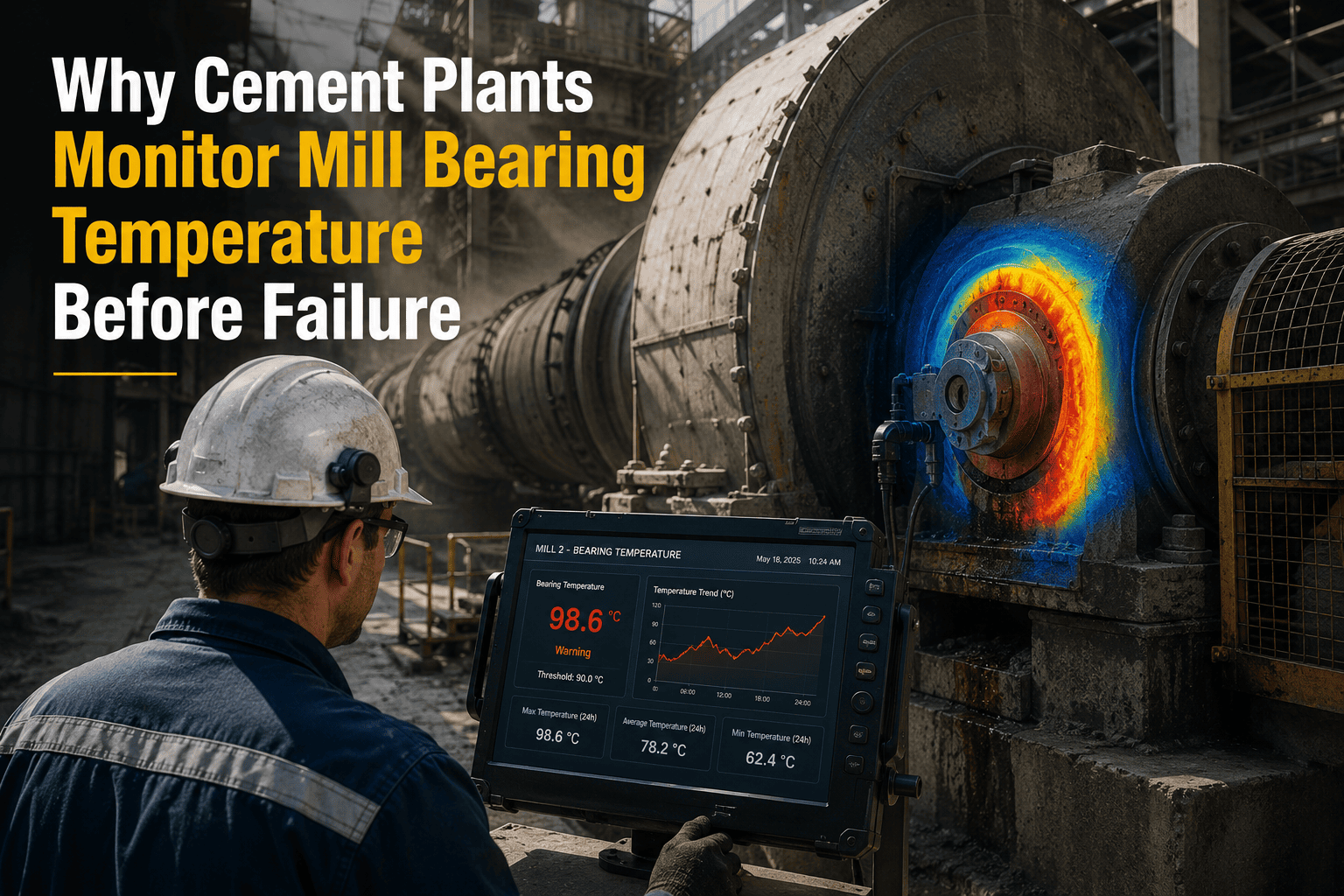
Trunnion bearing failure is the most expensive unplanned event in cement ball mill operations. A seized white-metal bearing can take a 5,000-tonne-per-day mill offline for 10 to 21 days, with total losses — emergency repairs, expedited freight, lost clinker production — routinely exceeding $2 million per incident. What makes this damaging is that nearly every failure that reaches seizure was preventable. White-metal degradation, oil-film collapse under load, and shaft misalignment each leave measurable signatures in bearing temperature and vibration weeks before the point of no return. The plants closing the gap between warning and action are the ones with sensor data flowing into a CMMS that triggers intervention automatically when thresholds are crossed — not the ones waiting for the night-shift operator to notice something "sounds different" at 3 a.m. Start a free trial to see threshold-based work-order automation, or book a demo for a walkthrough on your mill data.
Cement Operations · Predictive Maintenance 2026
Why Cement Plants Monitor Mill Bearing Temperature Before Failure
Trunnion and slide-shoe bearings give 3 to 6 weeks of advance warning through temperature drift — long before vibration alarms trip or audible damage appears. Oxmaint turns that early signal into a work order before the mill turns into a $2M outage.
$2M+
Average total loss per trunnion bearing seizure on a 5,000 TPD mill — including parts, freight, and lost clinker production.
10–21
days of unplanned mill downtime caused by a single seized trunnion bearing failure
3–6
weeks of advance warning available through bearing temperature trending before catastrophic failure
3–5x
faster white-metal fatigue progression once misalignment concentrates load on one edge of the bearing pad
30–40%
of total ball mill maintenance cost driven by bearing, liner, and gear failures combined
What Is Mill Bearing Temperature Monitoring?
Mill bearing temperature monitoring is the continuous measurement of trunnion or slide-shoe bearing temperature against a defined operating envelope — typically 32°C to 52°C for healthy trunnion bearings under normal load. Sensors mounted on the bearing pad, oil reservoir, and return line feed data to a control system or CMMS. The objective is not just to alarm at trip thresholds; it is to detect the slow upward drift that precedes oil-film breakdown, shaft misalignment, or white-metal fatigue by weeks.
A 3°C to 5°C rise sustained over several days is a far more reliable failure predictor than a single high-temperature spike — and it is invisible to operators reading rounds sheets. CMMS-based trend tracking catches this signature far earlier than visual inspection alone. Book a demo to see how Oxmaint plots bearing temperature against rolling baselines and triggers maintenance before the trip threshold is reached.
Bearing Temperature Threshold Framework
| Zone | Trunnion Temperature | Operational State | Recommended Action |
|---|
| Zone A — Healthy | 32°C – 45°C | Normal operating envelope. Stable thermal equilibrium. | Routine weekly trend review. No intervention required. |
| Zone B — Watch | 45°C – 52°C | Upper end of normal range. Monitor for sustained drift. | Daily trend check. Verify oil cooler performance and ambient load. |
| Zone C — Alert | 52°C – 60°C | Active degradation likely. Oil-film thinning or misalignment. | Auto-generate inspection work order. Sample oil, check alignment. |
| Zone D — Trip | Above 60°C | Imminent failure risk. Bearing damage progressing rapidly. | Controlled shutdown. Full bearing inspection before restart. |
These zones align with typical cement plant OEM guidance and ISO 10816 vibration thresholds. The key is the rate of change, not the absolute number — a bearing drifting 0.3°C per day for two weeks is in far worse shape than one running steadily at 50°C. Start a free trial to see drift-based alerting on your own historical data.
Most cement plants discover bearing damage by sound or vibration — three weeks after temperature trending would have caught it.
Six Failure Modes Bearing Temperature Reveals First
M1
Oil-Film Collapse
Hydrodynamic film thins under load loss or contamination. Temperature climbs 5°C to 10°C above baseline before metal-to-metal contact begins.
M2
Trunnion Misalignment
Foundation settling or thermal growth concentrates load on one bearing edge. Temperature differential between drive and non-drive end widens steadily.
M3
White-Metal Fatigue
Babbitt material softens under repeated overload cycles. Local hotspots appear 3 to 6 weeks before crack propagation reaches the bearing surface.
M4
Oil Cooler Degradation
Fouled tubes or weak pump output raise reservoir temperature. Bearing temperature follows oil-in temperature with a 4-to-8-hour lag — visible in trend data.
M5
Lubrication System Fault
High-pressure lift pump failure during start-up or low-pressure flood pump dropout creates rapid temperature spikes within minutes — needs trip-level alerting.
M6
Liner Wear Imbalance
Uneven liner wear shifts mill load distribution, increasing pressure on one trunnion. Slow temperature drift over weeks signals the need for a liner survey.
Why Manual Bearing Monitoring Fails
Sparse Round Frequency
Operator rounds capture temperature once every 4 to 8 hours. A 3°C drift over 14 days produces 84 data points that no human will plot manually — so the trend is invisible.
Single-Point Threshold Logic
DCS alarms trip at fixed setpoints with no rate-of-change logic. A bearing climbing slowly toward trip generates zero alerts until it crosses — losing 3 to 6 weeks of warning.
Paper Logs No One Reviews
Bearing temperatures recorded on shift sheets get filed and forgotten. Nobody plots drift across weeks — so the warning signature exists in the data but never reaches a planner.
No Work Order Linkage
Even when sensors detect rising temperature, the alert is acknowledged on the DCS and dies there. No automatic work order, no technician dispatched, no inspection scheduled.
Lost Oil Sample History
Quarterly oil analysis reports arrive as PDFs and disappear into inboxes. Iron and copper trend lines across 4 to 6 samples — which predict bearing wear — never get plotted together.
Reactive Shutdowns
Mills run until the bearing trips on high temperature or seizes outright. Reactive shutdowns cost 4 to 8 times more than a planned 24-hour bearing inspection during a scheduled stop.
Plants that move from manual rounds to continuous trend-based monitoring typically catch 70 to 85 percent of bearing issues before they cause unplanned downtime — which is why mills shifting to threshold-driven CMMS workflows see dramatic reductions in forced outages. Start a free trial and connect your first temperature sensor in under an hour.
A single seized trunnion bearing costs more than 5 years of predictive monitoring across the entire mill house.
How Oxmaint Catches Bearing Failure Early
01
Continuous Sensor Ingestion
Pull bearing temperature, oil pressure, and oil-in temperature directly from your DCS, PLC, or IoT gateway. Data sampled every 5 to 60 seconds and stored against the asset record.
02
Drift-Based Threshold Alerts
Rule engine flags sustained drift — for example, +3°C over 7 days against a 30-day baseline — and auto-creates an inspection work order with bearing location and recommended checks.
03
Asset-Linked Oil Analysis
Upload quarterly oil sample results against each bearing. Trend iron, copper, and viscosity across all historical samples in one chart — surfacing wear signatures invisible in any single report.
04
Vibration Cross-Reference
Combine temperature drift with vibration RMS readings against ISO 10816 zones. When both indicators move together, the system escalates priority and routes to senior reliability staff.
05
Bearing-Specific PM Templates
Pre-built preventive maintenance routines for trunnion and slide-shoe bearings — lubrication checks, thrust gap measurement, oil flow verification — assigned to the correct trade with parts lists ready.
06
Failure History per Bearing
Every inspection, oil sample, temperature alert, and repair logged against the individual bearing asset. MTBF and failure-mode analysis ready for monthly reliability reviews.
Manual Rounds vs Sensor-Driven CMMS Monitoring
| Capability | Manual Operator Rounds | Oxmaint Sensor-Driven Workflow |
|---|
| Data Frequency | Once per 4–8 hour shift | Continuous, every 5–60 seconds |
| Trend Detection | Manual plotting, rarely done | Auto rolling-baseline comparison |
| Alert Logic | Fixed high-temperature trip only | Drift rate + absolute thresholds combined |
| Work Order Trigger | Manual entry after shift report | Automatic on threshold breach |
| Oil Sample Correlation | PDF reports filed separately | Wear-metal trends linked to bearing record |
| Average Warning Lead Time | 2 to 5 days before failure | 3 to 6 weeks before failure |
| Reactive Failure Rate | 1 to 3 events per year per mill | Near zero with sustained monitoring |
| Inspection Cost per Event | $280K – $2.1M unplanned | $15K – $40K planned during stop |
The economic case for sensor-driven bearing monitoring is overwhelming — even a single avoided trunnion failure pays for years of monitoring infrastructure. Book a demo to see the ROI math against your own mill downtime history.
ROI of Predictive Bearing Monitoring
82%
reduction in unplanned mill outages when bearing temperature and vibration are continuously trended in a CMMS
$1.6M
average savings per avoided trunnion bearing seizure when failure is detected during the early drift window
4.8x
cost difference between reactive emergency repair and a planned 24-hour bearing inspection during a scheduled stop
6–10
weeks of advance failure warning achievable when vibration and temperature data are analyzed together
Frequently Asked Questions
What is the normal operating temperature range for cement mill trunnion bearings?
Healthy trunnion bearings typically stabilize between 32°C (90°F) and 52°C (125°F) under steady load. Each bearing finds its own equilibrium based on geometry, load distribution, oil temperature, and ambient conditions, so the more important number is the bearing's individual baseline. A sustained drift of 3°C to 5°C above that baseline — even while still inside the absolute envelope — is the earliest reliable warning of degradation.
How does Oxmaint detect bearing failure earlier than the DCS alarm system?
A standard DCS alarm trips at a single fixed setpoint — for example, 60°C — providing no warning until the bearing is already in trouble. Oxmaint applies rate-of-change logic against a rolling 30-day baseline, flagging sustained drift weeks before any fixed threshold is crossed. The system also correlates temperature drift with vibration RMS readings and oil sample wear metals, surfacing failure signatures that any single instrument would miss.
Can Oxmaint integrate with existing DCS, PLC, and IoT sensor networks?
Yes. Oxmaint ingests sensor data through standard OPC UA, MQTT, Modbus, and REST API connections — supporting integration with Honeywell, Siemens, ABB, Rockwell, and most industrial control systems used in cement plants. Most plants connect their first asset feed within a week, with no rip-and-replace of existing instrumentation required.
How frequently should trunnion bearing oil samples be analyzed?
Quarterly sampling is the industry standard, with monthly sampling during the first six months after a bearing rebuild or in mills running near their thermal limit. The value comes from trending — iron, copper, and silicon levels across multiple samples reveal bearing wear, contamination ingress, and additive depletion patterns that any single sample cannot. Oxmaint stores each result against the bearing asset and plots wear-metal trends automatically.
Stop Reactive Mill Outages
Turn Every Bearing into a Predictable, Trackable Asset
Oxmaint connects your bearing temperature, vibration, and oil pressure readings to automatic work-order generation — so the right technician gets the right task within minutes of threshold breach, not the next morning at the team meeting.
Continuous trend-based alerting
Automatic work order dispatch
Live in days, not months
Used by operations teams managing 10,000+ assets — see measurable results in the first 30 days.