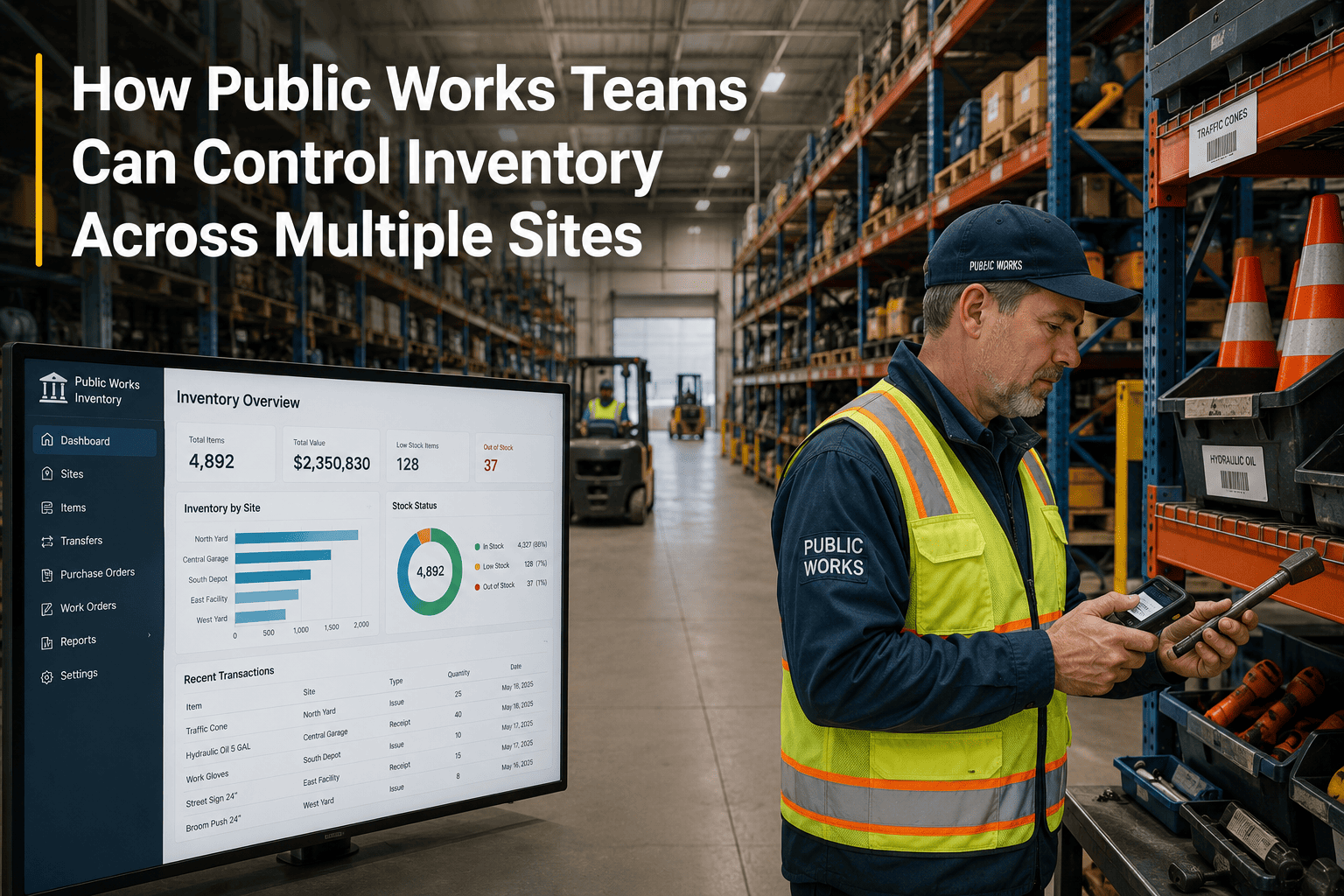
Public works teams manage some of the most fragmented inventory in any sector — fleet parts in the depot, signage hardware in the streets yard, water utility fittings in the wastewater shop, snow plow blades at three separate winter storage sites. Most municipalities run this on a mix of paper requisition slips, departmental spreadsheets, and tribal knowledge held by one storekeeper per facility. The result is predictable: 20 to 30 percent of holding cost is wasted on duplicate purchases across departments, critical-spare stockouts happen at the worst possible time, and audit-ready inventory counts require weeks of manual reconciliation. The fix is not more spreadsheets — it is a single inventory backbone that spans every site, department, and asset class. Start a free trial to centralize your parts data across departments, or book a demo to map your current site structure into Oxmaint.
Government Operations · Multi-Site Inventory 2026
How Public Works Teams Can Control Inventory Across Multiple Sites
From streets and signs to water, fleet, parks, and facilities — the path to defensible inventory data, lower carrying cost, and audit-ready reporting runs through a single multi-site CMMS. Here is the practical playbook for getting there.
reduction in parts holding cost achievable when public works inventory is centralized in a single CMMS
15–25%
extension in asset lifecycle when proper maintenance is linked to verified parts availability
$1T+
in US state-level deferred infrastructure maintenance — much of it traceable to parts and asset record gaps
5–7
separate inventory spreadsheets typically running in parallel across a mid-sized public works department
What Is Multi-Site Public Works Inventory Control?
Multi-site inventory control is the structured process of tracking parts, tools, consumables, and small assets across every public works depot, yard, shop, and storage location from a single system of record. It covers the full lifecycle — requisition, purchase order, receipt, storage location, issue to work order, return, write-off, and audit. In government operations, it must also satisfy GASB 34 asset reporting, FEMA reimbursement evidence, and internal-control audit requirements that private-sector inventory systems rarely encounter.
The defining challenge is jurisdictional. Streets, water, wastewater, fleet, parks, signs, and facilities each guard their own inventory because nobody trusts another department's count. A CMMS-based inventory backbone solves this not by forcing consolidation, but by giving each department its own bin locations while exposing real-time stock levels across all sites. Book a demo to see how Oxmaint preserves departmental autonomy while eliminating duplicate purchasing.
The Six-Layer Public Works Inventory Stack
L1
Critical Spares
Long-lead pumps, motors, controllers, and specialty parts where stockout means days of service outage. Tracked by criticality score and lead-time risk.
L2
Routine Repair Parts
Filters, belts, bearings, hose, and consumables used in everyday PM and corrective work. Reorder points based on monthly burn rate and supplier lead time.
L3
Fleet Inventory
Vehicle-specific parts — brake pads, hydraulic fittings, snow plow cutting edges, salt spreader components — keyed to equipment numbers and VIN data.
L4
Tools and Equipment
Serialized tools, test instruments, and portable equipment with check-in / check-out logs, calibration dates, and location tracking across crews.
L5
Site Consumables
Sand, salt, asphalt cold patch, mulch, herbicide, and other bulk consumables tracked by site, season, and budget code.
L6
Emergency Stockpiles
Hurricane response kits, water main repair clamps, generator parts, and disaster recovery supplies — separated for FEMA reporting and rapid mobilization.
Most public works departments overspend their parts budget by 15 to 25 percent simply because no one knows what is already on the shelves.
Where Public Works Inventory Control Breaks Down
Siloed Department Spreadsheets
Streets, water, fleet, and facilities each maintain their own parts list. The same valve assembly appears in three spreadsheets with three part numbers and three different on-hand counts.
No Multi-Site Visibility
A part needed urgently at the north yard sits unused at the south depot. Without a unified bin location system, crews order new parts rather than transferring existing stock.
Manual Reorder Decisions
Reorder triggers based on a storekeeper's gut feel rather than burn-rate analysis. Critical parts run out during peak season, while slow-moving stock accumulates for years.
Audit-Failure Risk
GASB 34 and FEMA reimbursement audits require defensible inventory records with timestamped transactions. Paper requisition slips and shared spreadsheets fail this test every time.
Stock Loss and Shrinkage
Without check-in / check-out controls, small parts and tools disappear quietly. Annual physical inventories surface 5 to 10 percent variance with no way to investigate root causes.
Emergency Response Friction
During storms or main breaks, crews waste 30 to 90 minutes hunting for emergency stock. The data exists somewhere — but not in any system the field supervisor can access at 2 a.m.
Public works teams that switch from spreadsheets to a structured multi-site CMMS routinely cut parts overspend by a quarter and shrink physical inventory variance to under 2 percent — which is why budget-constrained municipalities are prioritizing this shift in their 2026 capital plans. Start a free trial and import your first department's parts list in under 30 minutes.
A single unified parts database pays for itself in the first audit cycle — before a single work order is ever printed.
How Oxmaint Builds the Inventory Backbone
Multi-Site Bin Locations
Every part has a defined bin at every site — streets yard, water depot, fleet shop, signs storage — with live stock counts visible from any field device. Transfers between sites are one-click.
Department-Scoped Permissions
Water department staff see and manage water inventory; fleet staff see fleet stock. Cross-department visibility is read-only by default, with controlled transfer requests for exceptions.
Burn-Rate Reorder Points
Reorder thresholds calculated automatically from work order consumption history. Seasonal adjustments built in — salt and plow parts ramp before winter, herbicide before growing season.
Work Order to Parts Linkage
Every part issued is logged against a specific work order, asset, and crew member. Audit trail from purchase to installation, ready for GASB 34 and FEMA reimbursement evidence.
Barcode and Mobile Scanning
Storekeepers and crews scan parts in and out via mobile devices. Cycle counts take hours instead of weeks, and shrinkage variance drops below 2 percent within the first quarter.
Procurement Integration
Reorder alerts flow into purchase requisitions matched to municipal procurement codes and approved vendor contracts — preserving compliance with state purchasing rules.
Spreadsheet Reality vs CMMS Reality
Inventory Function
Spreadsheet-Based
Oxmaint CMMS-Based
Parts master list
5–7 conflicting spreadsheets
Single source of truth
Stock visibility across sites
Phone calls between depots
Real-time multi-site dashboard
Reorder trigger
Manual judgment
Burn-rate driven, seasonal-aware
Issue-to-work-order tracking
Paper requisition slips
Mobile barcode scan, instant log
Annual physical count
2–4 weeks of manual effort
Cycle counts in hours
Variance vs book value
5–10% routinely
Under 2% achievable
FEMA / GASB audit evidence
Reconstructed after the fact
Built-in audit trail
Emergency stock mobilization
30–90 minutes per crew
Under 5 minutes via mobile
The shift is structural, not technological — what changes is the unit of trust. With spreadsheets, every department defends its own count. With a CMMS, the count is shared because everyone can see the same data update in real time. Book a demo to see the multi-site dashboard against your actual depot layout.
ROI of Centralized Inventory Control
25%
average reduction in annual parts spend when duplicate purchases across departments are eliminated
3.5x
faster emergency parts mobilization when bin locations are accessible from any field mobile device
90%
reduction in physical count time when cycle counting replaces annual wall-to-wall inventory events
2%
target shrinkage variance achievable with barcode scanning and check-in / check-out controls
Frequently Asked Questions
Can Oxmaint integrate with our existing municipal ERP and procurement system?
Yes. Oxmaint connects via standard APIs to common municipal ERP and procurement platforms — including Tyler, Munis, Workday, SAP, and Oracle. Purchase requisitions flow from inventory reorder alerts into the procurement system, and asset cost data flows back into financial reporting. Most integrations are configured in days, not months.
How does Oxmaint preserve each department's autonomy over its own parts inventory?
Permissions are scoped at the department level. Water staff manage water inventory, fleet staff manage fleet inventory, and so on. Cross-department visibility defaults to read-only — useful for spotting shared stock — and any transfer requires controlled approval. The system unifies data without forcing a reorganization of operational responsibility.
What inventory evidence does Oxmaint produce for GASB 34 and FEMA audits?
Every transaction — receipt, issue, transfer, write-off, cycle count — is timestamped with user, location, and work order or purchase order reference. The audit log is exportable in formats accepted by state auditors and FEMA Public Assistance program reviewers. This eliminates the after-the-fact reconstruction that paper-based systems require.
How long does it take to roll out Oxmaint across multiple public works sites?
Most municipalities pilot with a single department — typically fleet or signs — within two weeks of account creation. A full rollout across streets, water, parks, and facilities takes 60 to 120 days depending on the parts master cleanup required. Bulk import tools accept existing spreadsheet data and flag duplicates during the import.
One System. Every Site. Every Department.
Stop Losing Budget to Spreadsheet Inventory
Oxmaint gives public works teams the tools to control parts, tools, and consumables across every depot, shop, and yard from a single platform — with the audit trail, mobile access, and budget visibility your governing board expects.
Multi-site bin locations
GASB and FEMA-ready audit trail
Works across multi-site portfolios
No heavy implementation required — live in days, not months.