Refrigerant compliance is no longer a low-stakes paperwork exercise. Under EPA Section 608 in the US, the EU F-Gas Regulation 2024/573 (which fully replaced 517/2014 with stricter quotas and reporting from 2024 onward), and the UK F-Gas Regulations 2015 (as amended), HVAC operators must document every kilogram of refrigerant added or recovered, every leak check (with frequencies tied to CO2-equivalent thresholds), every certified technician involved, and every disposal event — and produce this record on demand to regulators for a minimum of five years. Yet the average commercial HVAC contractor still runs refrigerant logs on paper, in disconnected Excel files, or in a binder in the maintenance office that nobody can find when the auditor arrives. The EPA can impose civil penalties of up to $51,796 per day per violation under Section 608 — and most violations cited are not refrigerant venting, they are documentation failures. Most HVAC teams lose 20-40% of compliance budget chasing paper trails they cannot reconstruct — start a free trial to put every refrigerant entry into an audit-ready digital logbook, or book a demo to see how Oxmaint handles a multi-site refrigerant register.
HVAC · Refrigerant Compliance · 2026
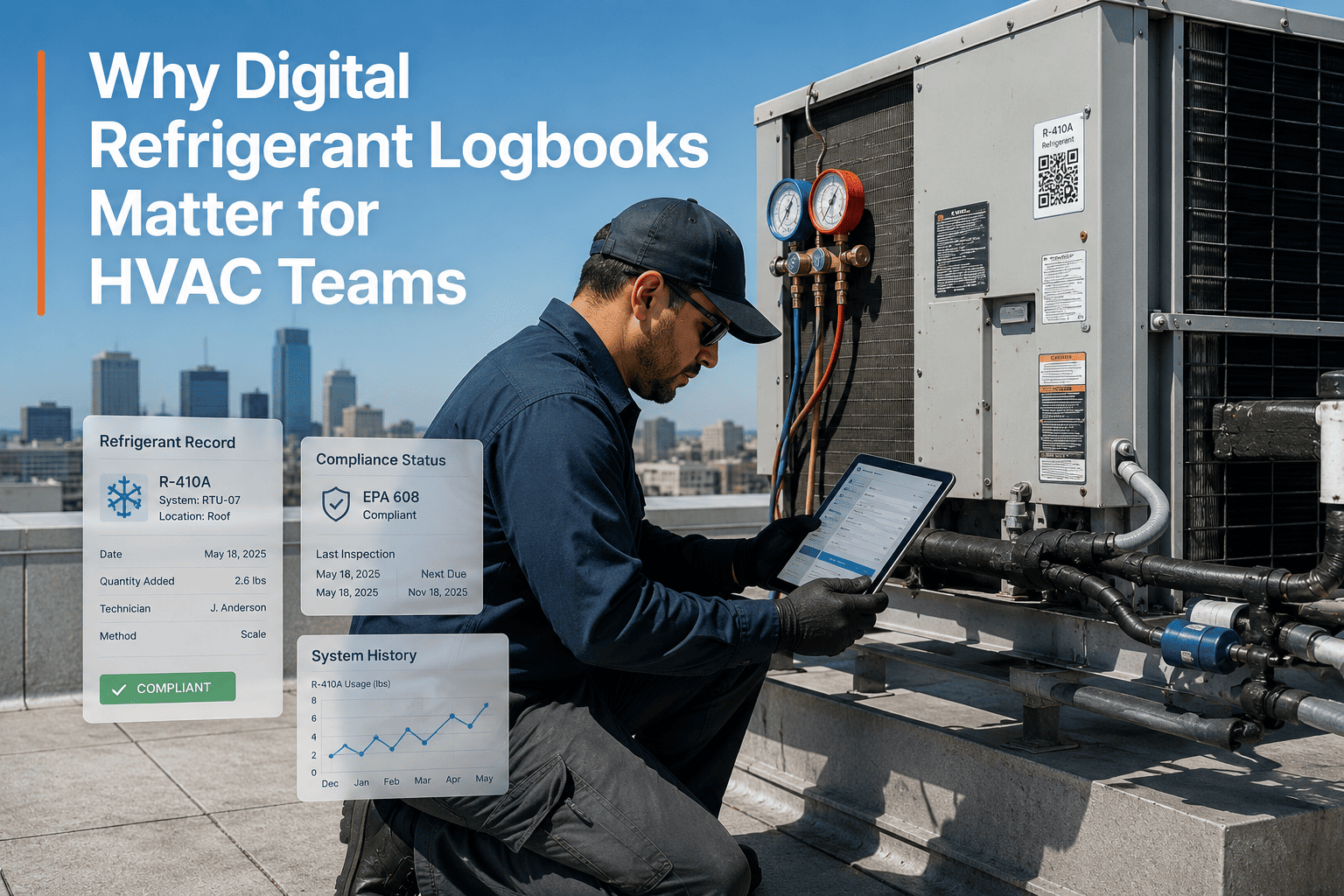
Why Digital Refrigerant Logbooks Matter for HVAC Teams
Replace paper refrigerant records with audit-ready digital logbooks that survive EPA, F-Gas, and DEFRA inspections without a scramble.
EPA 608 ready
F-Gas auto leak-check schedule
Technician certification tracking
See how your refrigerant register would survive an unannounced audit tomorrow.
$51,796
maximum daily EPA Section 608 civil penalty per violation, including documentation failures
5 years
minimum refrigerant record retention requirement under EPA and EU F-Gas regulations
63%
of cited F-Gas violations in EU audits stem from incomplete or missing leak check records
40%
refrigerant cost reduction typically achieved when leak rates are tracked digitally per asset
What a digital refrigerant logbook actually contains
A digital refrigerant logbook is more than a spreadsheet with a charge column. It is a structured, time-stamped, technician-attributed record per piece of refrigerant-containing equipment, capturing every regulated event in the asset's lifecycle. That includes initial commissioning charge, every top-up and recovery in kilograms, every scheduled leak check, every detected leak with location and repair date, every retrofit or refrigerant swap, every certified technician (with their EPA 608 or F-Gas Cat I-IV credentials), and every end-of-life recovery. Regulators are not interested in stories — they want timestamps, signatures, certificate numbers, and a defensible chain of custody.
Paper logbooks fail this test for a simple structural reason: they cannot be queried, validated, or reconstructed. When an auditor asks for the leak check history of three rooftop units across two sites for the last 18 months, a paper system means an afternoon of binder hunting. A digital register produces the report in 15 seconds — with technician credentials attached. Try Oxmaint free and import your existing refrigerant register in under an hour.
What the regulations actually require
United States
EPA Section 608
Technician certification, recovery equipment certification, leak rate thresholds (10% commercial, 20% industrial), 30-day repair window, and 3-year record retention minimum (5-year best practice).
European Union
F-Gas Regulation 2024/573
Leak check frequency tied to CO2-equivalent (5/50/500 t CO2e thresholds), mandatory certified personnel, leak detection systems above 500 t CO2e, and 5-year retention.
United Kingdom
UK F-Gas Regulations 2015
Mirrors EU framework post-Brexit with retained requirements — leak checks tied to CO2e tonnage, City & Guilds 2079 certification, and full equipment register obligation.
Canada
ODS & HFC Regulations (SOR/2016-137)
Federal HFC management rules with provincial overlays — record-keeping, certified technician requirements, and prohibited release provisions enforced by Environment Canada.
Australia
Ozone and SGG Management Act
ARC technician licensing, refrigerant trading authorisation, and full activity record-keeping for end users handling more than 100 kg per annum.
UAE
Kigali Amendment implementation
Phased HFC reduction targets aligned with Vision 2030 sustainability commitments — Dubai Municipality and ADQCC inspections require digital-grade documentation.
63% of cited F-Gas violations in EU audits stem from incomplete or missing leak check records — not from refrigerant venting itself.
Why paper refrigerant logbooks fail compliance audits
No Time-Stamped Audit Trail
Paper entries can be backdated, altered, or written after the fact. Regulators routinely reject paper logs as evidence when timestamps cannot be independently verified.
Missed Leak Check Cycles
F-Gas check frequencies (3, 6, or 12 months depending on CO2e) require automated scheduling. Manual calendar tracking misses cycles, which becomes the most common citation type.
Expired Technician Certifications
A refrigerant entry signed by a technician whose EPA 608 or F-Gas Cat I certification lapsed last month invalidates the entire record — and paper systems never flag the lapse.
No Cross-Site Visibility
Multi-site contractors managing 200+ units of refrigerant equipment cannot aggregate paper logs into the portfolio-wide register the regulator increasingly expects.
Lost Records on Staff Turnover
When the maintenance lead retires, the binder location, the filing logic, and the institutional knowledge of which unit has which log all walk out the door together.
Leak Pattern Blindness
A unit that loses 8% of charge annually is hiding a slow leak. Paper logs make this trend invisible until the leak hits the 10% threshold — and the citation arrives.
HVAC contractors that migrate to digital refrigerant logbooks typically pass their next regulatory inspection in under 30 minutes — versus a half-day scramble on paper. The transition also surfaces leak patterns that cut refrigerant costs by 30-40% in year one. Book a demo to see how Oxmaint structures a refrigerant register that satisfies an EPA inspector on first request.
How Oxmaint runs digital refrigerant logbooks
Equipment-level refrigerant register
Every refrigerant-containing asset tracked with refrigerant type, charge, CO2e tonnage, leak check frequency, and full event history — a regulator-ready record from day one.
Auto-scheduled leak checks
Leak check intervals tied automatically to CO2e — 3, 6, or 12 months as required — with work orders generated, assigned, and closed against the asset record.
Technician certification validation
EPA 608, F-Gas Cat I-IV, ARC, City & Guilds 2079 certifications stored with expiry alerts. Refrigerant entries from uncertified or lapsed technicians are blocked automatically.
Refrigerant top-up and recovery tracking
Every kg added or recovered logged against the asset with cylinder serial, technician signature, and timestamp. Cumulative leak rate calculated automatically.
Multi-site portfolio reporting
Aggregate refrigerant register across 200+ sites with one-click regulator export — F-Gas annual report, EPA inventory, or DEFRA submission templates supported.
5-year audit-ready retention
Records retained, immutable, and exportable for the full regulatory window. Cloud backup ensures no record loss on staff turnover or hardware failure.
A single Section 608 documentation citation can run $51,796 per day — and most cited operators were one digital logbook away from compliance.
Paper refrigerant logs vs digital register
| Compliance Capability |
Paper / Excel Logbook |
Oxmaint Digital Register |
| Time-stamping | Manual, often retrospective | System-generated, immutable |
| Leak check scheduling | Manual calendar reminders | Auto-scheduled by CO2e threshold |
| Technician validation | Visual check, often skipped | Cert expiry blocks invalid entries |
| Leak rate calculation | Manual, infrequent | Continuous, per asset |
| Multi-site aggregation | Hours of compilation | One-click portfolio view |
| Regulator export | Photocopy and PDF scan | Native EPA / F-Gas templates |
| Audit prep time | 4-8 hours per audit | Under 30 minutes |
| Record survival on turnover | Dependent on binder location | Cloud-permanent |
ROI of moving to digital refrigerant logbooks
30-40%
refrigerant cost reduction when leak patterns are detected digitally and repaired within the 30-day window
87%
reduction in audit preparation time when records are queryable instead of binder-bound
100%
elimination of expired-certification entries when technician credentials are validated at logbook entry
5-year
audit-defensible retention without paper storage costs or risk of binder loss
Refrigerant regulation is tightening every year — F-Gas quotas are stepping down, HFCs are being phased out under Kigali, and audit frequency is rising across all major jurisdictions. The contractors that stay competitive in 2026 and beyond are the ones whose refrigerant register can answer a regulator's question in seconds, not hours. Start a free trial and migrate your refrigerant logs to a system that survives the next audit.
Frequently Asked Questions
Will a digital logbook be accepted by EPA or F-Gas inspectors
Yes. Both EPA Section 608 and EU F-Gas Regulation 2024/573 explicitly accept electronic records, provided they are time-stamped, attributable to a certified technician, retained for the regulatory minimum, and producible on request. Oxmaint refrigerant records meet all four criteria and export directly to native regulator submission templates.
How does Oxmaint set leak check frequencies for F-Gas equipment
Frequencies are calculated automatically from CO2-equivalent tonnage per F-Gas thresholds — 5 t CO2e (12-month checks), 50 t CO2e (6-month checks), 500 t CO2e (3-month checks plus mandatory leak detection systems). The equipment record contains charge and refrigerant type, so the schedule adapts automatically to retrofits and refrigerant swaps.
Can we import our existing paper or Excel refrigerant records
Yes. Oxmaint imports historical refrigerant records via Excel template upload — equipment register, charge events, leak checks, and technician records can be migrated in bulk. Most contractors complete historical import within the first week of implementation.
Does Oxmaint handle multiple jurisdictions for portfolio contractors
Yes. The platform supports US, UK, EU, Canadian, Australian, and UAE refrigerant frameworks within the same account. Each property can be tagged to its applicable regulation and the system applies the correct leak check frequency, retention rule, and technician certification standard automatically.
Decision Point
Survive your next refrigerant audit in 30 minutes, not 30 hours
EPA, F-Gas, and DEFRA are tightening enforcement every year. The contractors that keep operating are the ones whose refrigerant register is digital, time-stamped, and audit-ready by default. Used by HVAC teams managing 10,000+ refrigerant assets. Live in days, not months.
Real-time asset visibility
EPA & F-Gas-aligned records
Multi-site portfolio reporting
No heavy implementation required.