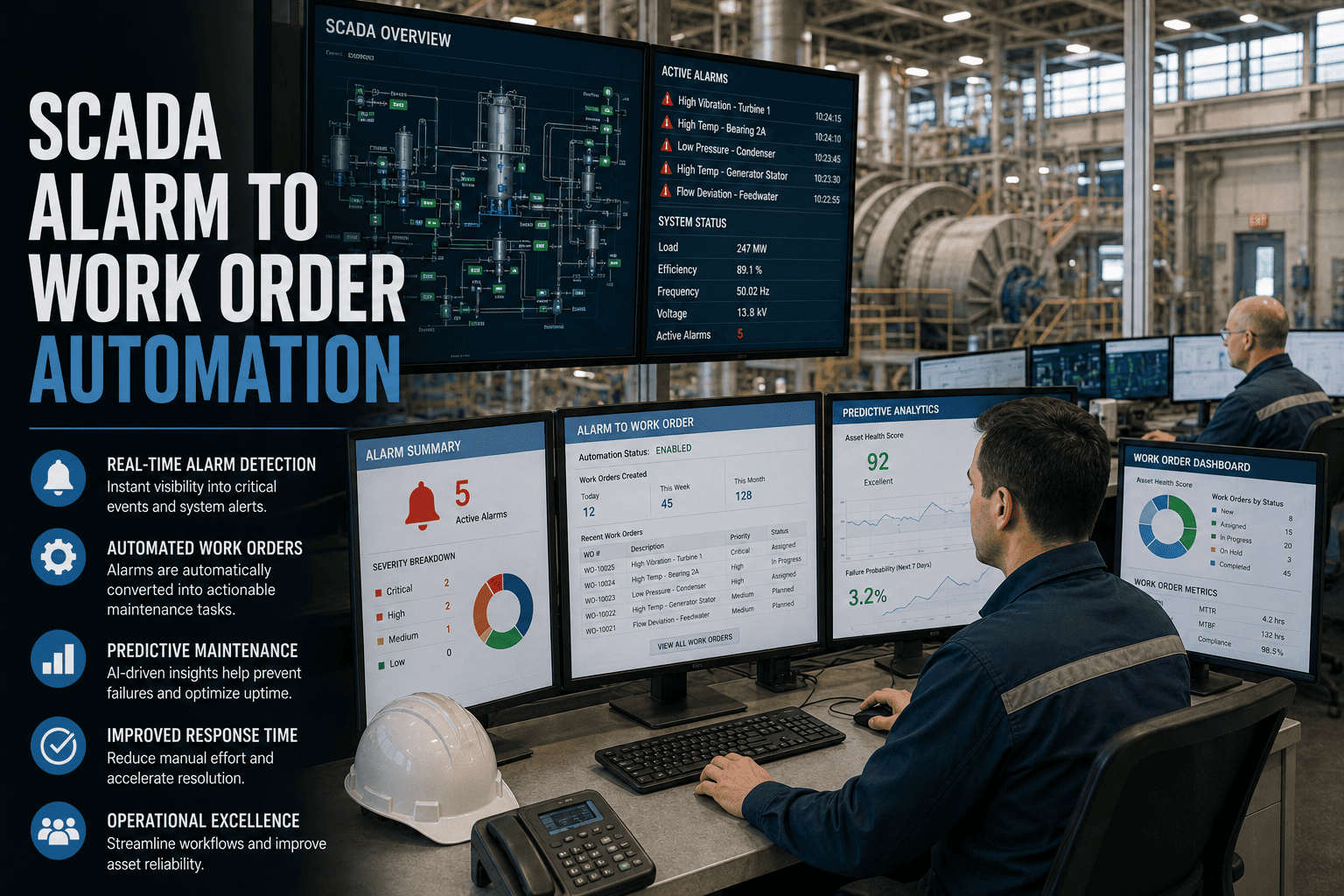
SCADA-driven manufacturing and utility operations generate thousands of alarms per shift across PLCs, RTUs, distributed control systems, and operator HMIs — and most of those alarms never become structured maintenance work because no system bridges the gap between the alarm source and the CMMS. Industry benchmarking shows structured alarm-to-work-order programs cut response time 68 percent, prevent $1.5 million peak-load and outage events through 15-minute first-response windows, drop repeat alarm-driven incidents 47 percent within twelve months, and integrate cleanly with OPC UA, MQTT, Modbus, IEC 61850, and REST API standards that modern industrial automation already speaks. Operations directors building structured alarm-to-work-order programs across SCADA-driven plant footprints start a free trial on the highest-alarm-volume system first and validate the routing model before extending it across the plant.
scada-alarm-monitor : production_line_03
SCADA ALARM-TO-WORK-ORDER PLATFORM
Convert SCADA Alarms Into Structured Maintenance Work Orders
Route alarms from PLCs, RTUs, DCS, and HMI sources into one CMMS workflow with severity classification, technician dispatch, escalation engine, and audit trail — no more lost alarms, no more reactive scrambling, no more disconnect between control room and maintenance shop.
Drop in repeat alarm incidents within twelve months
$1.5M
Average outage cost preventable through faster routing
What SCADA Alarm-to-Work-Order Integration Actually Means
SCADA alarm-to-work-order integration is the structured discipline of converting every alarm fired by a PLC, RTU, DCS, HMI, or building automation source into a routed maintenance work order with severity classification, asset attribution, SLA timer, technician dispatch, and audit trail. It is the opposite of the control-room model where alarms pile up on operator screens, escalations happen via phone call, and maintenance learns about the issue when the operator finally tells them at shift change.
The CMMS that holds the alarm taxonomy, the routing rules, the dispatch logic, the escalation engine, and the audit trail in one structured workflow converts SCADA-driven operations from reactive alarm chaos into managed maintenance discipline. Operations directors ready to install the integration book a demo and walk through the routing model on the highest-volume alarm source.
Most SCADA-driven plants generate thousands of alarms per shift — and most never become structured maintenance work without the routing layer.
Five Protocol Integrations Built In
OxMaint speaks every protocol modern industrial automation deploys. The alarm-to-work-order routing layer integrates against the data source directly, without bespoke integration projects for each system.
OPC UA
Modern PLC and DCS standard
Open Platform Communications Unified Architecture, the dominant protocol for modern PLC, DCS, and historian integration across discrete and process manufacturing.
MQTT
IoT and edge device standard
Message Queuing Telemetry Transport, the dominant lightweight publish-subscribe protocol for IoT sensors, edge devices, and modern smart-factory deployments.
Modbus
Legacy PLC and field device
Modbus TCP and RTU, the legacy protocol still ubiquitous across older PLCs, drives, sensors, and field instrumentation across most operating plants.
IEC 61850
Power utility substation standard
IEC 61850, the dominant protocol for electrical substations, power plant control, and utility-grade industrial automation across transmission and distribution.
REST API
Modern application integration
REST API integration for modern application sources including building automation, asset performance management platforms, and custom industrial software.
Custom
Bespoke source bridges
Custom bridge connectors for legacy DCS systems, proprietary SCADA platforms, and niche industrial sources where standard protocols are not available.
Why SCADA Alarms Never Become Structured Maintenance Work
Six structural failures account for the majority of SCADA-driven alarms that never become structured maintenance work orders. Each one closes when the routing layer runs against a structured CMMS with alarm taxonomy, severity classification, and dispatch logic built in.
STEP 01
Alarms Pile Up on Operator HMI
Hundreds of alarms per shift display on the operator screen. Operator acknowledges to clear the display, no work order ever opens against the alarm source.
STEP 02
Escalations Happen Via Phone Call
Operator phones the maintenance supervisor. Supervisor is on another call, in a meeting, or out of the plant. The alarm dies in voicemail.
STEP 03
No Severity Taxonomy
Every alarm gets the same treatment. The critical pump trip and the routine setpoint deviation get the same operator attention.
STEP 04
No Asset Attribution
The alarm fires from a tag name the maintenance team does not recognize. No mapping exists between SCADA tag and CMMS asset. The work order never opens against the right asset.
STEP 05
No Audit Trail
The reliability engineer needs to know which alarms fired, how they were handled, and how long they took to close. The audit trail does not exist outside operator log books.
STEP 06
No Repeat Alarm Detection
The same alarm fires fifteen times in a week. Each instance gets handled as a fresh event. The pattern that would trigger root cause analysis never surfaces.
All six failures collapse when the alarm-to-work-order program runs against a structured CMMS — and the operations directors ready to remove them book a demo and walk through the alarm audit on their own system.
The control room and the maintenance shop need to operate against the same alarm — and the routing layer is what bridges them.
How OxMaint Holds Alarm-to-Work-Order Routing
OxMaint loads every alarm source, every severity taxonomy, every asset tag mapping, every routing rule, and every audit trail action into one structured workflow. Alarms convert to work orders with severity attached, asset linked, technician dispatched, escalation armed, and audit captured — without operator intervention beyond initial acknowledgment.
F1
Alarm Source Integration
PLC, RTU, DCS, HMI, building automation, and IoT alarms route into OxMaint through OPC UA, MQTT, Modbus, IEC 61850, REST API, and custom bridges.
F2
Severity Taxonomy
Critical, high, standard, and informational severity classes route to different SLA, dispatch, and escalation chains automatically.
F3
Asset Tag Mapping
SCADA tag names map to CMMS asset records. Every alarm work order opens against the right asset with full service history attached.
F4
Mobile Dispatch Engine
Critical alarms dispatch to on-call technicians via mobile within seconds of alarm. ETA tracking and crew confirmation close the dispatch loop.
F5
Escalation Engine
Time-windowed escalation routes to supervisor, plant manager, and executive layers if response window breaches. No more verbal escalation that dies in voicemail.
F6
Repeat Alarm Detection
Same alarm firing across rolling windows surfaces for root cause review. The pattern triggers analysis before the fifteenth occurrence.
For operations directors managing SCADA-driven plants in the USA under OSHA and EPA, in Canada under provincial workplace and environment standards, in the UK under HSE and the Environment Agency, in the UAE under Vision 2030 industrial modernization, in Australia under WorkSafe and AEMO for utility operations, or in Germany under BetrSichV and Energiewende standards — the alarm routing model is the same and the integration travels across control system vendors. Start a free trial on the highest-alarm-volume system first.
Manual Alarm Routing Versus Structured Integration
Alarm Discipline
Manual Routing Operation
Structured Integration Operation
Source integration
Operator screen, phone call, voicemail
OPC UA, MQTT, Modbus, IEC 61850, REST
Severity classification
All alarms treated equally
Critical, high, standard, info routing
Asset attribution
SCADA tag never maps to CMMS asset
Tag mapping with service history attached
Dispatch
Phone call to maintenance supervisor
Mobile dispatch within seconds
Escalation
Verbal chain that dies in voicemail
Automatic time-windowed escalation
Audit trail
Operator log book, gaps everywhere
Immutable log on every alarm and action
Repeat detection
Pattern never surfaces
Rolling-window detection across asset
Outage outcome
$1.5M average outage cost when alarms missed
15-minute first-response window protected
Operations directors moving the alarm-to-work-order program from the left column to the right book a demo and walk through the routing model on their own system.
ROI Reported on Structured Alarm-to-Work-Order Programs
68%
Reduction in alarm-to-response cycle time on structured integration
47%
Drop in repeat alarm incidents within twelve months of structured operations
$1.5M
Average outage cost preventable through 15-minute first-response
100%
Audit trail coverage on alarm-to-work-order routing
15 min
Achievable first-response window on critical alarm classes
4-6 wk
Typical integration deployment cycle for SCADA alarm routing
Operations directors stacking these returns across multi-system, multi-plant portfolios start a free trial on the highest-alarm-volume system first and use first-year results to fund the wider rollout.
Frequently Asked Questions on SCADA Alarm-to-Work-Order
Which industrial protocols does OxMaint integrate with
OxMaint integrates with OPC UA, MQTT, Modbus TCP and RTU, IEC 61850, and REST API as standard protocols. Custom bridge connectors are available for legacy DCS systems, proprietary SCADA platforms, and niche industrial sources where standard protocols are not available. Most modern PLC, DCS, and HMI environments integrate out of the box.
How does the severity taxonomy configure to plant requirements
Severity taxonomy configures against plant-specific requirements with critical, high, standard, and informational classes as the baseline framework. Each severity routes to different SLA, dispatch logic, and escalation chains. Plant reliability engineers and maintenance leadership define the taxonomy during deployment, and the routing rules apply automatically thereafter.
How does the asset tag mapping handle thousands of SCADA tags
Asset tag mapping bulk-imports from existing SCADA tag databases or asset registers. Most deployments handle thousands of tags in the initial mapping cycle. Tag-to-asset relationships persist on the CMMS asset record, and ongoing tag additions map through the same workflow without rebuilding the integration layer.
How long does a typical SCADA alarm-to-work-order integration take to deploy
Most SCADA alarm-to-work-order integrations deploy within 4 to 6 weeks for a single plant. Multi-plant rollouts typically follow a phased pattern with the highest-alarm-volume system going first and subsequent systems leveraging the established integration patterns. First measurable response improvement typically lands within 30 days of go-live.
From Operator Screen to Mobile Dispatch in Seconds
Convert SCADA Alarms Into Structured Work Orders on One CMMS
Multi-protocol alarm source integration, severity taxonomy, asset tag mapping, mobile dispatch engine, escalation engine, and repeat alarm detection unified on one CMMS. Control room and maintenance shop finally operate against the same alarm with the same response cycle.
OPC UA, MQTT, Modbus, IEC 61850, REST API integration built in
15-minute first-response window on critical alarm classes
100 percent audit trail coverage on every alarm-to-work-order routing