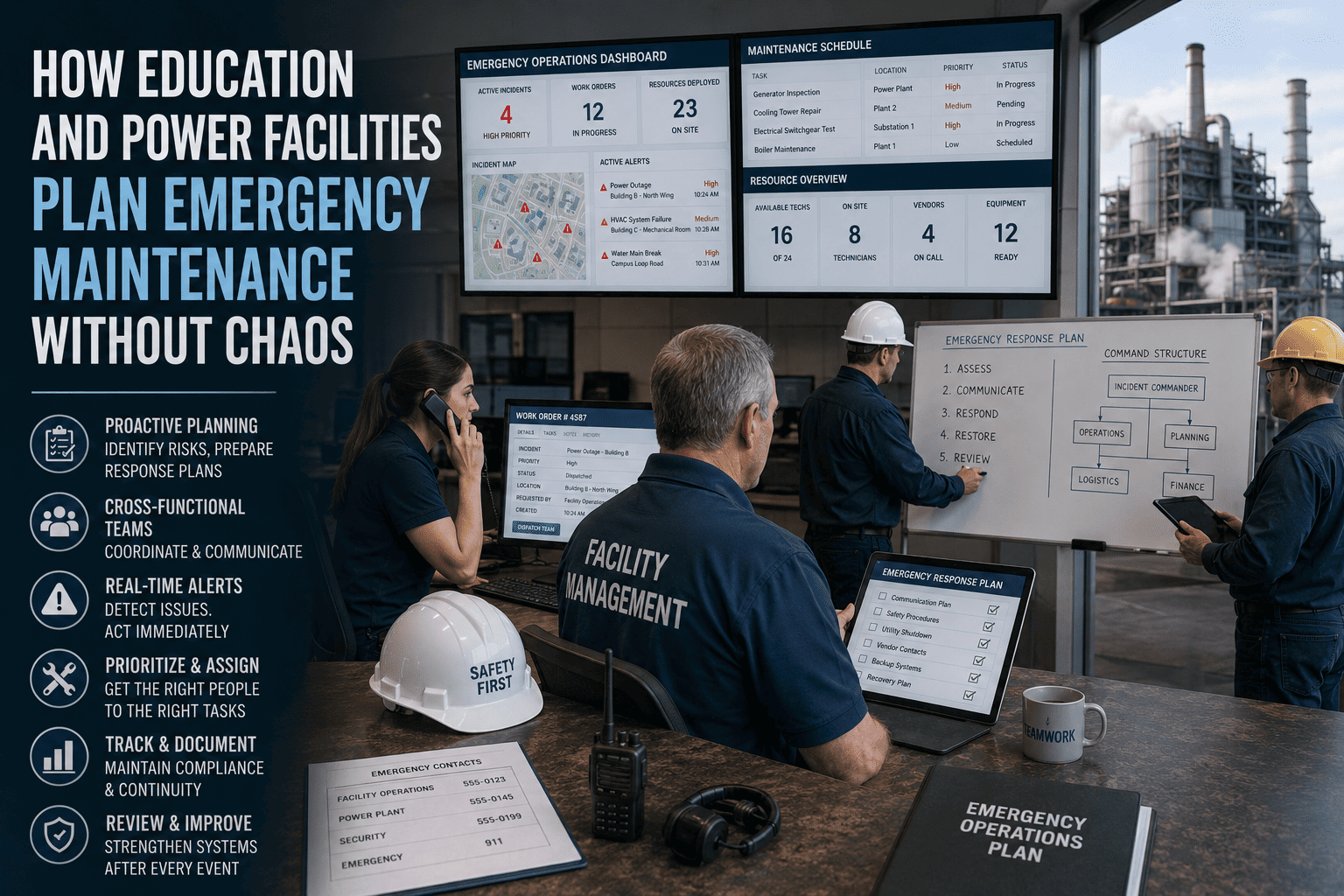
University campuses and power campus operations carry an emergency maintenance reality that most operating playbooks ignore — a critical chiller failure during finals week, a transformer hit during winter peak load, a steam line rupture in a residence hall at 2 AM, and a power plant generator trip during a regulatory dispatch window. Industry benchmarking shows structured emergency planning programs cut response time 68 percent, prevent $1.5 million peak-load cost events through faster recovery, drop repeat incidents 47 percent within twelve months, and pay back the investment within 5 months on most mid-size campuses. Facilities directors building structured emergency response across education and power campus footprints start a free trial on the highest-criticality system first and validate the response model before extending it across the campus.
CAMPUS EMERGENCY MAINTENANCE BRIEF
Education and Power Campus Emergency Maintenance Planning
Structure emergency response across campus utilities, residence halls, academic buildings, lab facilities, and power generation assets — with documented playbooks, escalation chains, and audit-ready closure on every event.
68%
Response cycle reduction on structured campus emergency programs
$1.5M
Average cost of a peak-load event preventable through faster emergency recovery
47%
Reduction in repeat emergency incidents within twelve months of structured operations
15 min
Achievable first-response window on critical campus utility events
Campus Emergency Response Timeline
T0
Event Detection and Intake
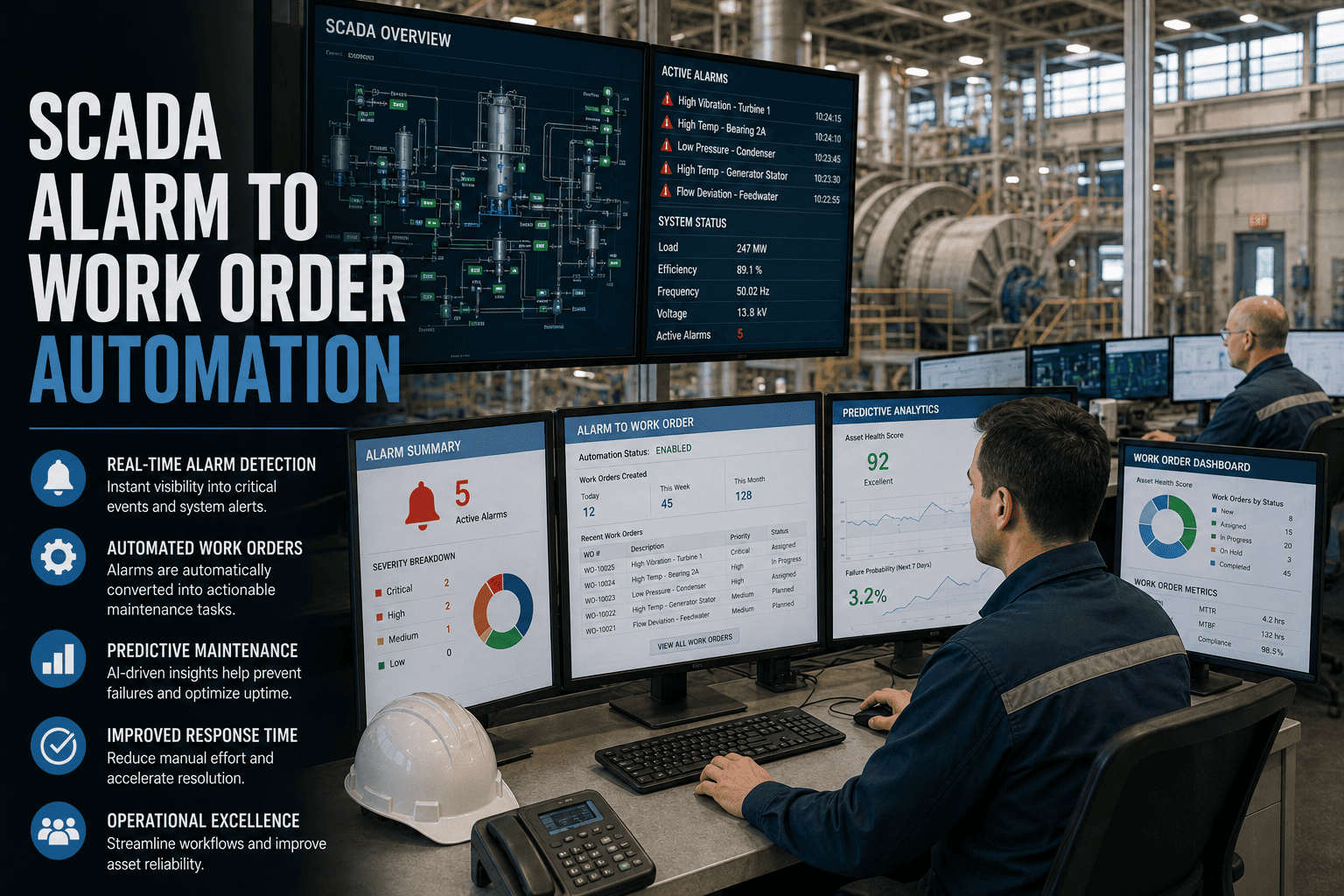
SCADA alarm, building automation alert, occupant 911 call, or operator observation enters the CMMS within seconds. Event classification triggers based on asset criticality, occupant exposure, and regulatory implication.
T+5
First Responder Dispatch
On-call crew receives mobile work order with asset history, response playbook, occupant access details, and the regulatory reporting clock attached. Discovery time on arrival drops to near zero.
T+15
Stabilization and Escalation Decision
Crew confirms stabilization or escalates to subject matter expert, facility director, or executive contact. Automatic escalation fires on breach windows without human intervention.
T+60
Restoration and Occupant Communication
Restoration completes against documented playbook. Occupant notification, regulatory submission preparation, and incident report drafting all run from the same work order record.
T+24h
Root Cause and Pattern Review
Post-event root cause analysis opens automatically. Asset trend updates, repeat-incident detection runs, and CapEx planning picks up signals for the next quarterly review.
What Campus Emergency Maintenance Planning Actually Means
Campus emergency maintenance planning is the structured discipline of treating every utility failure, every life-safety event, every regulatory-clock event, and every occupant-impact event against a documented playbook with measurable response, defined escalation, and audit-ready closure. It applies across university campuses, power generation campuses, hospital campuses, government complexes, and research facilities.
The CMMS that holds the playbook library, the asset criticality classification, the response SLA, and the regulatory reporting clock in one workflow converts campus emergency response from chaos into managed operational discipline. Facilities directors ready to install the structure book a demo and walk through the planning model on a real critical system.
A single critical chiller failure during finals week can cost more than a full year of structured emergency planning across the entire campus footprint.
Campus Zone Coverage Matrix
Power Plant
Turbine fault
Aux feed loss
Routine alarm
Academic
Lab gas leak
HVAC failure
Lighting fault
Residence
Steam rupture
No hot water
Fixture repair
Utility
Transformer hit
Distribution loss
Meter fault
The Six Disciplines of Structured Emergency Planning
A campus that converts emergency events from chaos into managed response runs on six interlocking disciplines. Each one lives on the CMMS, and each one closes a measurable response gap when the playbook fires automatically.
D1
Asset Criticality Classification
Every campus asset carries critical, high, or standard tier based on occupant impact, regulatory implication, and continuity-of-operations risk. SLA, escalation, and playbook apply at the asset level automatically.
D2
Response Playbook Library
Documented playbooks for chiller failure, transformer hit, steam rupture, lab incident, and dozens of other event classes. Crews dispatch with the playbook attached, not searching for it.
D3
Multi-Tier Escalation Engine
Time-windowed escalation routes to supervisor, facility director, dean, plant manager, and executive layers based on tier and elapsed time. No more relief-supervisor confusion at 2 AM.
D4
Regulatory Reporting Clock
FERC, NERC, EPA, DOE, OSHA, and state utility commission reporting windows attach to the relevant event class. The clock starts at detection, not at memory recovery.
D5
Live Incident Documentation
Photos, readings, actions, and decisions log against the work order in real time. Regulatory submission packs assemble in seconds rather than 48-hour reconstruction projects.
D6
Post-Event Root Cause Workflow
Every emergency closure triggers a root cause workflow with asset trend update, repeat-incident detection, and CapEx planning input. Pattern surfaces before the third event.
Why Campus Emergency Response Fails Without Structure
Reasons campus emergency response fails are consistent across university operations, power generation campuses, hospital systems, and research facilities. Six structural gaps account for the majority of preventable escalation and regulatory exposure.
A
No Asset Criticality Tiering
Every asset gets treated as equivalent priority. The turbine alarm and the dorm light fixture sit in the same queue. The 2 AM crew picks based on what they see first, not on what carries the campus risk.
B
Response Playbooks Live in Binders
The chiller emergency procedure is in a binder on a shelf in the plant office. The on-call crew at 2 AM does not have the binder. The playbook never makes it to the field, and the response runs on memory.
C
Escalation Chains Verbal
The escalation chain depends on supervisor memory and personal cell phone numbers. The supervisor is on leave, the relief calls the wrong director, and the dean learns about the residence hall event from a student.
D
Regulatory Clock Starts on Recollection
The FERC reporting window opens at event detection. The team starts the clock when someone remembers to start it three hours later. The reportable filing exposure compounds on a slow start.
E
Incident Documentation Reconstructed Later
The reporting body asks for the event report on Monday. The team reconstructs it from memory on Tuesday. Gaps in the documentation surface in the post-event audit and damage credibility for the next inspection cycle.
F
Repeat Events Treated as Independent Incidents
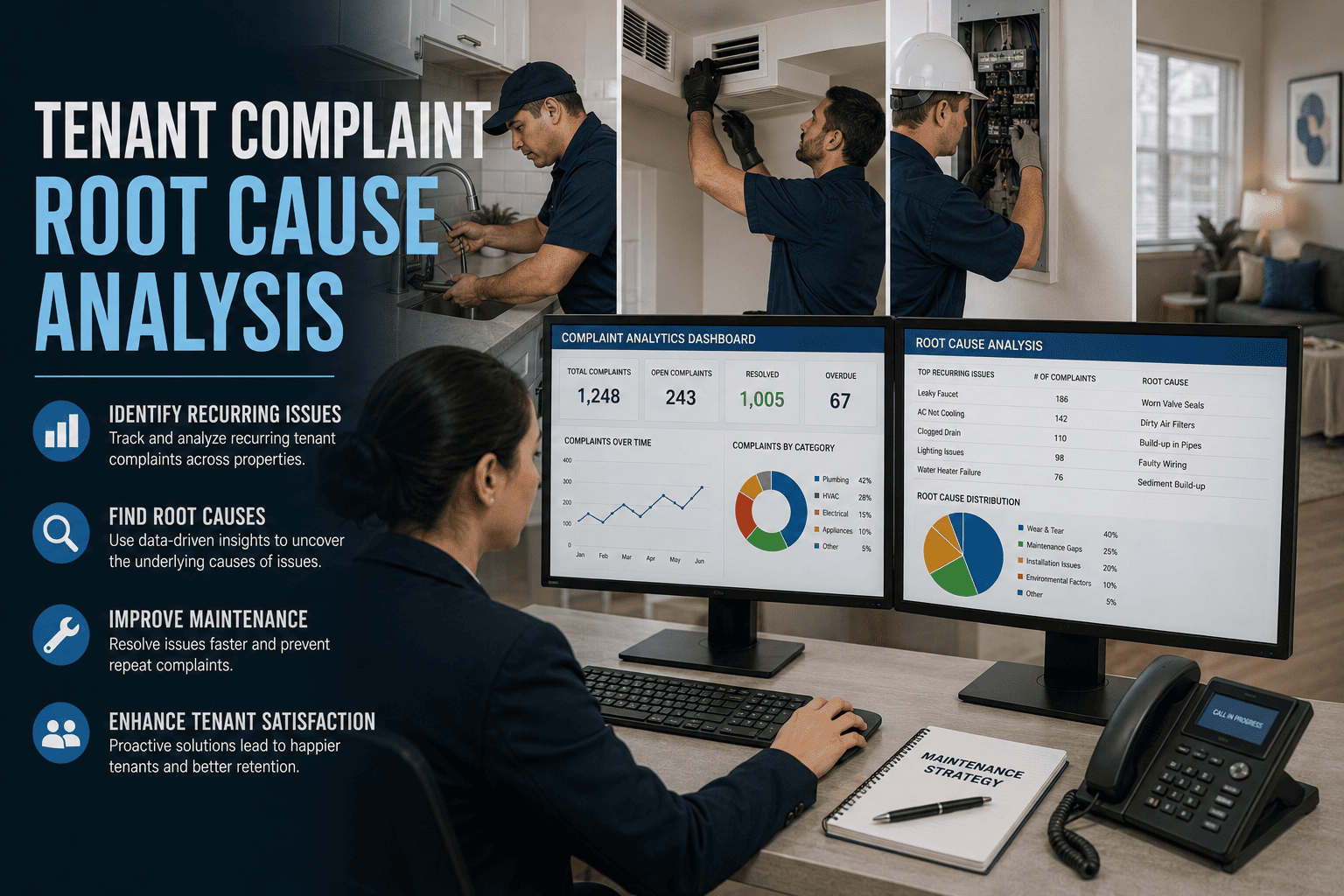
The same chiller has tripped three times in 90 days. Each event was logged as a fresh incident. The root cause pattern never opened, and the fourth event hits during finals week.
All six failures collapse when the emergency response program runs against a structured CMMS — and the facilities directors ready to remove them book a demo and walk through the response audit on their own campus footprint.
Campus emergency response is decided in the first 15 minutes — and the structured playbook library is what carries it.
How OxMaint Runs Campus Emergency Planning
OxMaint loads every campus asset, every criticality tier, every response playbook, every escalation chain, and every regulatory clock into one structured workflow. Emergency events convert to work orders with full context, crews dispatch on mobile with playbooks attached, escalation fires automatically, regulatory clocks start at detection, and post-event root cause closes the loop.
F1
Criticality Tier Library
Every campus asset carries a structured criticality tier with SLA, escalation, and playbook attached. Power plant turbine and dorm light fixture never share the same response queue.
F2
Mobile Playbook Library
Response playbooks live on the asset record. Crews dispatch with the playbook on their phone, not searching for the binder in the plant office at 2 AM.
F3
Automatic Multi-Tier Escalation
Time-windowed escalation to supervisor, director, dean, plant manager, and executive layers fires automatically. Verbal escalation chains stop being a single point of failure.
F4
Regulatory Clock Engine
FERC, NERC, EPA, DOE, OSHA, and state utility reporting clocks start at event detection. Filing exposure window protected by design.
F5
Live Documentation Capture
Photos, readings, actions, and decisions log against the work order in real time. Regulatory submission packs assemble in seconds, not days.
F6
Root Cause and Pattern Engine
Post-event workflow opens automatically. Repeat-incident detection runs on rolling windows, and pattern surfaces before the third event hits during finals or peak load.
For facilities directors managing campus operations in the USA under FERC, NERC, EPA, DOE, OSHA, and state utility regulators, in Canada under provincial energy and education ministries, in the UK under OFGEM, HSE, and the Building Safety Act, in the UAE under Vision 2030 campus modernization, in Australia under AEMO and state work safety legislation, or in Germany under BetrSichV and Energiewende regulations — the response model is the same and the regulatory trail travels across jurisdictions. Start a free trial on the highest-criticality system first.
Reactive Campus Response Versus Structured Emergency Planning
| Response Discipline | Reactive Campus Operation | Structured Emergency Planning |
|---|
| Criticality classification | Every asset treated as equivalent priority | Criticality tier library on every asset |
| Playbook access | Binder in plant office, never on the field | Mobile playbook attached to dispatch |
| Escalation chain | Verbal, personal cell numbers, fails on leave | Automatic time-windowed escalation engine |
| Regulatory clock | Starts when someone remembers to start it | Starts at event detection automatically |
| Documentation | Reconstructed 48 hours after the event | Captured live, packs assemble in seconds |
| Repeat detection | Pattern surfaces after fourth event | Rolling-window detection across asset |
| Executive visibility | Dean learns from student or regulator | Dashboards visible at breach window |
| Regulatory outcome | Late filings, gap documentation, audit findings | Continuous compliance with defensible record |
Facilities directors moving the response program from the left column to the right book a demo and walk through the planning model on their own asset class.
Outcomes Reported on Structured Campus Emergency Programs
68%
Reduction in emergency response time across structured campus operations
47%
Drop in repeat emergency incidents within twelve months of structured operations
$1.5M
Average peak-load cost preventable through faster emergency recovery
15 min
First-response window achievable on critical campus utility events
90%
Reduction in regulatory submission pack assembly hours
5 mo
Typical payback period on CMMS campus emergency investment
Facilities directors stacking these returns across multi-campus portfolios start a free trial on the highest-criticality system first and use first-year results to fund the wider rollout.
Frequently Asked Questions on Campus Emergency Maintenance Planning
Does OxMaint support multi-tier asset criticality classification
Yes. Every campus asset carries a structured criticality tier — critical, high, or standard — based on occupant impact, regulatory implication, and continuity-of-operations risk. SLA, escalation chain, response playbook, and regulatory reporting clock all apply at the asset level automatically. Power plant turbine and dorm light fixture never share the same response queue.
How do response playbooks deliver to the crew on the field
Response playbooks live on the asset record in OxMaint. When an emergency work order dispatches, the crew receives the playbook on their mobile device along with asset history, occupant access details, and the regulatory reporting clock. The 2 AM responder works from the same documented playbook the day-shift expert would, not from memory.
Can the system support FERC, NERC, EPA, and DOE reporting windows
Yes. Regulatory reporting clocks attach to the relevant event classes — FERC and NERC for power plant events, EPA for environmental events, DOE for federal compliance, OSHA for worker safety, and state utility commissions for local events. The clock starts at event detection automatically, not at memory recovery, and the filing exposure window stays protected by design.
How quickly can a campus emergency program deploy and start delivering results
Most campus operations see measurable response improvement within 30 to 60 days of CMMS go-live. The fastest wins come from criticality tier classification and mobile playbook deployment, both of which deploy within the first 30 days. Full payback on CMMS investment typically lands within 5 months on mid-size campus portfolios.
From Reactive Chaos to Managed Discipline
Run Campus Emergency Response Against Structured Playbooks and Documented SLAs
Asset criticality tiering, mobile playbook library, multi-tier escalation engine, regulatory reporting clocks, live documentation capture, and post-event root cause workflow unified on one CMMS. Campus emergency response moves from 2 AM chaos to managed operating discipline.
Asset criticality tier library with SLA and playbook attached
Mobile playbook delivery to the dispatched crew on every event
Automatic regulatory clock from detection on FERC, NERC, EPA, DOE windows
Live in days, not months
FERC, NERC, EPA, DOE ready
Used across education and power campuses
No binder migration required