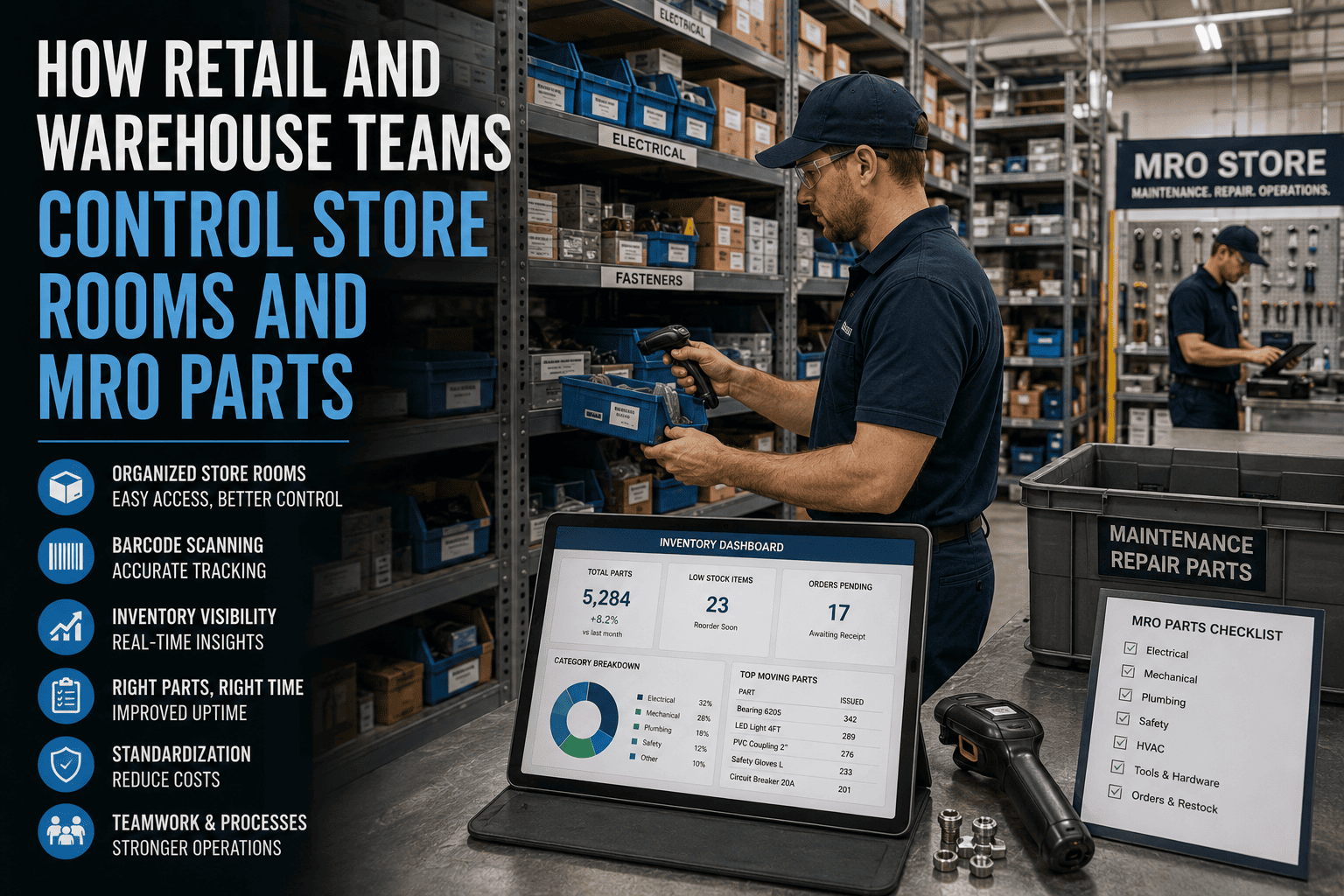
Retail and warehouse store-room operations carry a hidden cost that rarely makes the operating review — 30 to 40 percent of total MRO budget locked in slow-moving or dead inventory, 30 to 50 percent of stocked SKUs that haven't moved in 12 months, and stockout events that cost $50,000 to $150,000 per hour on critical production or distribution assets. The same store room that looks orderly on a Tuesday walk-through is bleeding working capital, stocking duplicate parts under three different vendor codes, and missing the one critical bearing that will shut a line down on Friday. Operations directors building structured MRO inventory control start a free trial on the highest-volume store room first and validate the control model before extending it across the network.
MRO INVENTORY CONTROL BRIEF
Retail and Warehouse Store-Room MRO Control
Convert reactive parts management into structured inventory control — eliminate dead stock, prevent stockouts, consolidate duplicate SKUs, and tie every parts movement to a work order with full audit trail.
MRO Category
Industry Benchmark
CMMS Outcome
Total MRO budget tied up in stock
30-40%
Reduced 20-35%
Dead stock share of SKUs
30-50%
Cleared on first review cycle
Service level target
95-97%
Achievable on structured PM
Critical asset stockout cost
$50-150K/hr
Prevented by reorder automation
01
30-40%
MRO budget locked in slow-moving or dead inventory across typical operations
02
30-50%
Stocked SKUs with no movement in the past 12 months across most store rooms
03
20-35%
Carrying cost reduction reported on structured CMMS inventory control programs
04
95-97%
Service level target achievable on PM-driven reorder automation
What Store-Room MRO Control Actually Means
Store-room MRO control is the discipline of managing every part, every bin, every reorder point, and every consumption pattern against the assets the parts serve. It is the opposite of the spreadsheet inventory list, the manual reorder checklist, and the three-vendor parts catalog that lives in the warehouse manager's drawer. Structured control treats the store room as a working capital asset with measured turn rate, service level performance, and tight coupling to the maintenance work order system.
Retail and warehouse operations carry MRO inventory for the same reasons heavy industry does — to keep the production line, the distribution conveyor, the refrigeration plant, and the building services equipment running. The CMMS that ties parts to assets to work orders to consumption history produces inventory control that protects uptime without bleeding working capital. Operations directors ready to install the discipline book a demo and walk through the inventory model on a real store room.
Thirty to fifty percent of stocked MRO SKUs have not moved in twelve months — and the operations director is paying carrying cost on every one of them.
Four Pillars of Structured Store-Room Control
01
SKU Consolidation
Same part stocked under three vendor codes consolidates into one master SKU with cross-reference table.
02
Min-Max Reorder Logic
Reorder points calculated against consumption rate and lead time, refreshed quarterly against actual usage.
03
Dead Stock Detection
SKUs with no movement in configurable windows flag for review and disposition decision.
04
Work-Order Coupling
Every parts issue tied to a work order, every consumption tagged to an asset, every reorder traceable to a PM.
Why MRO Inventory Bleeds Working Capital Without Structure
The reasons store rooms accumulate dead stock, run stockouts, and bleed working capital are predictable and consistent across retail distribution centers, warehouse fulfillment operations, manufacturing plants, and food processing facilities. Six structural gaps account for the majority of inventory cost that the operations director cannot see on a balance sheet line.
Same Part Stocked Under Multiple SKU Codes
Vendor A sends the bearing under SKU 4471, Vendor B under SKU BR-447-1, Vendor C under part number PB4471-MFG. The store room holds three units of the same part under three records. Carrying cost triples, dead stock multiplies, and the manager never knows the actual on-hand quantity.
Min-Max Set Once and Never Refreshed
Reorder points configured at go-live and never updated against actual consumption. Slow movers stay overstocked, fast movers run stockouts, and the manager never has the right level on the right part at the right time.
Dead Stock Never Identified or Cleared
SKUs from a decommissioned asset still occupy bin space three years after the asset was retired. Nobody runs the no-movement report, nobody dispositions the dead stock, and the store room slowly fills with capital tied to value that no longer exists.
Parts Issued Without Work-Order Linkage
Technician walks to the store room, takes the part, leaves a paper slip. The slip gets lost, the consumption never ties to an asset, and the asset PM history never reflects the actual parts used. Root cause analysis loses the data it needs to surface patterns.
Critical Spares Not Identified as Critical
The single bearing that will shut a critical production line for 6 hours sits in the same min-max bucket as a generic shop towel. When the stockout hits the critical part, the cost lands at $50,000 to $150,000 per hour while the manager wonders why the reorder system did not protect it.
Multi-Site Sourcing Stays Manual
Site 3 has the part Site 7 needs urgently. Site 7 places an overnight order from the vendor at expedite cost while Site 3's stock continues to gather dust. The portfolio sourcing decision never gets made because no system shows cross-site stock visibility.
All six gaps collapse when the MRO inventory program runs against the asset registry on a structured CMMS — and the operations directors ready to remove them book a demo and walk through the inventory audit on their own store room.
A single stockout on a critical production part can cost more than the entire MRO inventory carrying cost the program was supposed to save.
How OxMaint Controls the Store-Room MRO Program
OxMaint runs the MRO program against the asset registry. Every part lives against the assets it serves, every consumption ties to a work order, every reorder fires against measured consumption, and every dead-stock SKU surfaces in the no-movement report.
01
SKU Master and Cross-Reference
Master SKU record with vendor cross-reference table eliminates duplicate stock across vendor codes. One part, one bin, one accurate on-hand count.
02
Dynamic Min-Max Engine
Reorder points calculated against rolling consumption rate and vendor lead time, refreshed quarterly without manual review. Service level target holds without manual recalibration.
03
No-Movement Dead Stock Report
Configurable window flags SKUs with no movement for review. Decommissioned-asset parts surface for disposition, and bin space recovers for active inventory.
04
Mandatory Work-Order Issue
Every parts issue ties to a work order against an asset. Consumption history feeds asset PM, root cause analysis, and capital planning automatically.
05
Critical Spare Designation
High-impact assets carry designated critical spares with tighter reorder logic and protected stock levels. Stockouts on critical parts become exceptions, not regular events.
06
Multi-Site Stock Visibility
Cross-site stock view shows where parts are across the portfolio. Inter-site transfer happens before overnight expedite, and portfolio inventory holds at lower total cost.
For operations directors managing retail distribution, warehouse fulfillment, manufacturing, or food processing across the USA under OSHA and FDA, in Canada under provincial workplace standards, in the UK under HSE, in the UAE under Vision 2030, in Australia under WorkSafe, or in Germany under BetrSichV — the inventory control model is the same and the working capital savings travel across the portfolio. Start a free trial on the highest-volume store room first.
Reactive Inventory Versus Structured MRO Operation
| Inventory Discipline | Reactive Operation | Structured CMMS Operation |
|---|
| SKU consolidation | Same part under multiple vendor codes | Master SKU with cross-reference table |
| Min-max management | Set once and never refreshed | Dynamic engine against rolling consumption |
| Dead stock detection | No structured no-movement review | Configurable window flag and disposition |
| Parts issue linkage | Paper slip, no work-order tie | Mandatory work-order linkage at issue |
| Critical spare protection | Same logic as generic shop supplies | Designated critical with protected levels |
| Multi-site stock view | Each site sees only its own stock | Portfolio visibility with transfer workflow |
| Carrying cost outcome | 30 to 40 percent of MRO budget tied up | 20 to 35 percent reduction documented |
| Service level outcome | Stockouts hit critical parts at expedite cost | 95 to 97 percent service level achievable |
Operations directors moving the MRO program from the left column to the right book a demo and walk through the inventory audit on their own store room.
ROI Reported on Structured MRO Inventory Programs
20-35%
Carrying cost reduction on structured MRO control across mid-size store rooms
95-97%
Service level achievable on PM-driven reorder automation
30-50%
Dead stock share typically cleared on first structured review cycle
$50-150K
Per-hour stockout cost preventable through critical spare designation
100%
Parts issue traceability to work order and asset on mandatory linkage
5 mo
Typical payback period on CMMS MRO inventory investment for mid-size operations
Operations directors stacking these returns across multi-site portfolios start a free trial on the highest-volume store room and use first-year results to fund the wider rollout.
Frequently Asked Questions on Store-Room MRO Control
How does OxMaint consolidate duplicate SKUs across vendor codes
Master SKU records hold one part definition with a cross-reference table linking every vendor code, every alternate part number, and every internal designation. The store room operates on one logical SKU regardless of how many vendor codes the part carries. On-hand quantities, reorder logic, and consumption history all run against the master record.
Does the min-max engine update reorder points automatically
Yes. The dynamic min-max engine recalculates reorder points quarterly against rolling consumption rate and current vendor lead time. Slow-moving SKUs drop their reorder points without manual review, fast movers tighten without stockout risk, and the manager never has to run a manual recalibration cycle.
How does the system handle critical spare protection
High-impact assets carry designated critical spares flagged on the SKU master. Critical spares operate on tighter reorder logic with protected minimum stock levels that do not drop into the depletion zone even when general MRO budget tightens. Stockouts on critical parts become exceptions surfaced to leadership rather than routine occurrences.
How quickly do MRO inventory improvements show measurable savings
Most operations see measurable carrying cost reduction within 60 to 90 days of structured MRO go-live. First wins come from dead stock identification and SKU consolidation, both of which deploy in the first 30 days. Service level improvements follow as the min-max engine accumulates enough consumption data to refresh reorder points against actual usage patterns.
From Working Capital Drain to Managed Asset
Control Store-Room MRO Inventory Without Bleeding Capital or Risking Stockouts
SKU consolidation, dynamic min-max logic, dead stock detection, mandatory work-order linkage, critical spare protection, and multi-site stock visibility unified on one CMMS. Working capital releases, service levels rise, and stockout exposure on critical parts disappears.
Master SKU with vendor cross-reference eliminating duplicate stock
Dynamic min-max engine refreshed against rolling consumption
Critical spare designation protecting high-impact assets
Live in days, not months
Master SKU and cross-reference built in
Multi-site stock visibility
Used across retail and warehouse portfolios