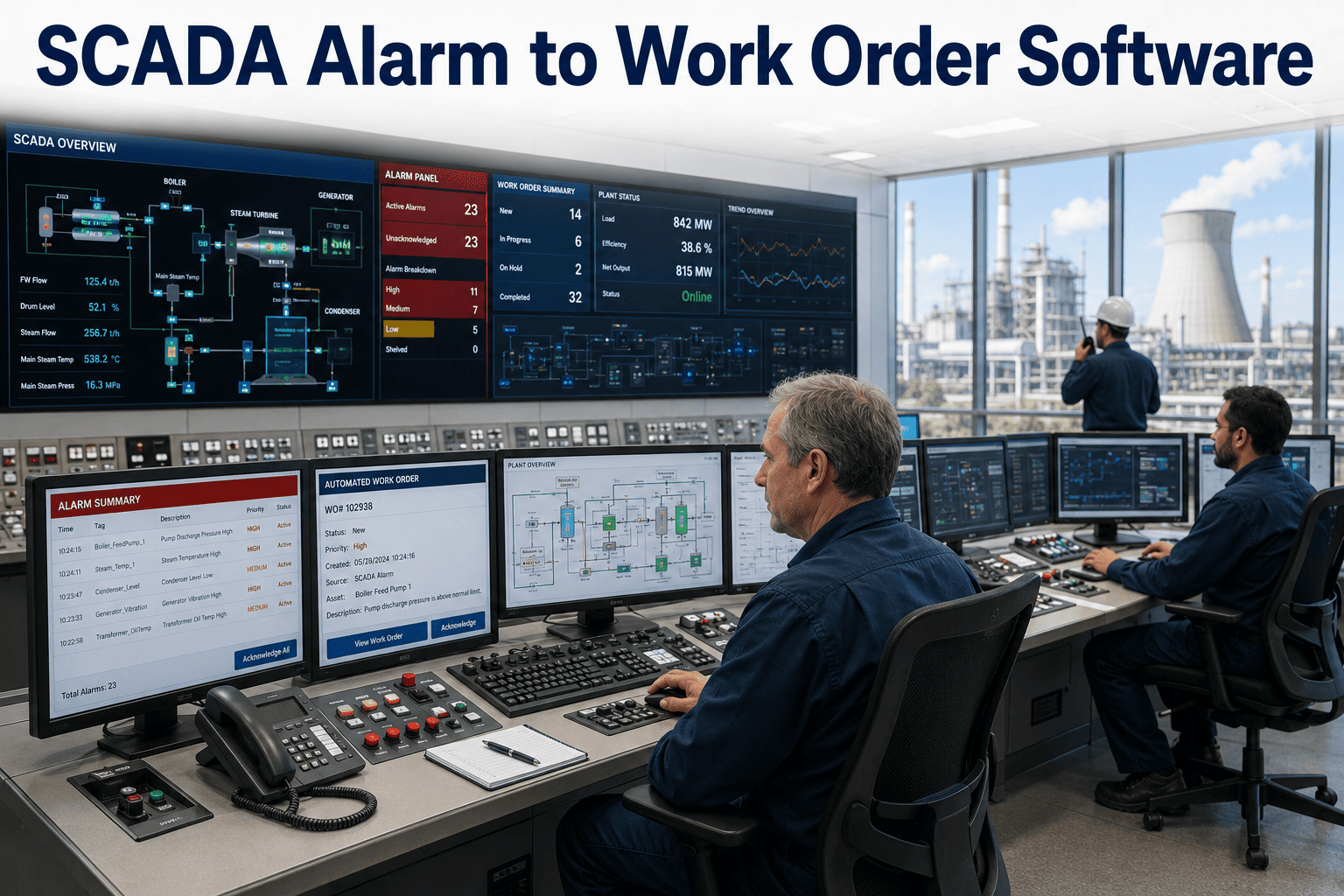
Power plants generate an average of 12,000 SCADA alarms per month, yet 73% of those alerts never translate into maintenance work orders because the alarm-to-action workflow is entirely manual. A turbine vibration alarm fires at 3 AM, the control room operator logs it in a notebook, the shift supervisor emails maintenance during business hours, and the planner creates a work order 18 to 36 hours after the original fault detection. By the time a technician arrives at the asset, the transient condition has either resolved itself or escalated into a forced outage costing $450,000 per day in lost generation capacity. SCADA alarm to work order software closes that detection-to-dispatch gap by automatically converting critical system alerts into assigned maintenance work orders with asset ID, fault classification, and recommended action pre-populated in under 60 seconds. The shift from manual alarm logging to automated work order generation is the operational step that prevents $2.3 million in annual unplanned outage costs for every 500 MW generating facility. Start a free trial or book a demo to see Oxmaint SCADA integration for your power generation assets.
Power Plant Automation
SCADA Alarm to Work Order Software
Critical Priority · 9 min read
12,000
Average monthly SCADA alarms generated per 500 MW power generation facility across all systems and subsystems
73%
SCADA alarms that never result in maintenance action due to manual logging gaps and shift handover failures
18-36 hrs
Average delay from SCADA alarm detection to assigned work order creation on manual email and spreadsheet workflows
$450K
Cost per day of forced outage for average 500 MW combined cycle plant from preventable equipment failures
Eliminate the Alarm-to-Action Gap
Automatically Convert SCADA Alarms into Assigned Maintenance Work Orders in Under 60 Seconds
Oxmaint integrates with OSIsoft PI, Wonderware, GE iFix, Siemens WinCC, and all major SCADA platforms via OPC-UA and REST API. No hardware replacement. No SCADA reconfiguration required.
✓ Automated work order creation from critical alarms
✓ Asset-specific fault classification and routing
✓ Mobile technician dispatch with full alarm context
What Is SCADA Alarm to Work Order Software?
SCADA alarm to work order software is an integration layer between industrial control systems and maintenance management platforms that automatically converts equipment fault alerts into actionable maintenance tasks with zero manual intervention. Instead of operators writing alarms in logbooks, supervisors sending emails to maintenance, and planners manually creating work orders 24 to 48 hours after the initial detection, the SCADA system publishes the alarm via OPC-UA or MQTT, Oxmaint receives the event stream, matches it to the specific asset record, classifies the fault type, assigns it to the qualified technician based on skill set and availability, and sends a mobile notification with full equipment context in under 60 seconds from the moment the sensor threshold was breached.
The operational impact shows up in three reliability metrics. First, alarm response time drops from 18 to 36 hours on manual workflows to under 2 hours with automated dispatch, catching developing faults before they escalate into forced outages. Second, alarm-to-action conversion rate jumps from 27% on manual logging systems to 94% with automated work order generation, eliminating the shift handover gaps where critical alerts disappear between control room notebooks and maintenance planning meetings. Third, repeat alarm frequency on the same asset drops by 68% because every fault event is documented with corrective action in the CMMS rather than lost in an operator logbook that no one reviews, which is why power plants operating without SCADA-to-CMMS integration are systematically converting 12 to 18% of preventable alarms into forced outages that cost $2.3 million annually per 500 MW facility — start a free trial to deploy Oxmaint SCADA integration across your generation assets, or book a demo and we will walk through your specific alarm routing architecture.
Core Components of SCADA-to-Work Order Automation
01
Real-Time SCADA Integration
Oxmaint connects to OSIsoft PI, Wonderware, GE iFix, Siemens WinCC, and Ignition via OPC-UA, MQTT, and REST API. Alarm streams published from SCADA arrive in CMMS in under 5 seconds.
02
Asset-Level Alarm Mapping
Every SCADA tag mapped to specific equipment record in CMMS. Turbine vibration alarm routes to turbine asset, cooling tower alarm routes to cooling system, transformer temperature to electrical distribution.
03
Intelligent Alarm Filtering
Configurable threshold rules suppress nuisance alarms and transient conditions. Only critical and sustained fault conditions generate work orders. Alarm storms filtered to single consolidated work order.
04
Automated Fault Classification
Machine learning classifies alarm type and recommends corrective action based on historical fault patterns. Bearing vibration classified as mechanical, temperature deviation as thermal, pressure drop as hydraulic.
05
Skill-Based Technician Routing
Work orders auto-assigned to technicians with required certifications and availability. Electrical faults route to licensed electricians, control system alarms to instrumentation specialists, mechanical to rotating equipment techs.
06
Mobile Dispatch with Context
Technician receives mobile notification with asset location, alarm trend graph, previous maintenance history, and recommended troubleshooting steps within 60 seconds of SCADA event detection.
The Cost of Manual SCADA Alarm Workflows
Power plants lose $2.3 million annually per 500 MW facility from forced outages that originated as preventable SCADA alarms lost in manual logging workflows.
18 to 36 Hour Alarm Response Delays
Critical alarm fires at 11 PM. Operator logs it in notebook. Day shift supervisor emails maintenance at 8 AM. Planner creates work order at 2 PM next day. Technician dispatched 32 hours after initial detection. Developing fault escalates into forced outage during the delay window.
73% of Alarms Never Reach Maintenance
Shift handover gaps, notebook logging failures, and email overwhelm mean 8,760 of the 12,000 monthly SCADA alarms disappear between control room detection and maintenance action. Critical faults buried in alarm noise until equipment fails catastrophically.
Zero Alarm History for Root Cause Analysis
Alarms logged in operator notebooks are not searchable, not linked to asset records, and not accessible during failure investigations. When a turbine bearing fails, maintenance has no record of the 14 vibration alarms that preceded the failure over the previous 6 weeks.
Alarm Storms Overwhelm Manual Triage
Single equipment failure generates 200 cascading alarms in 10 minutes. Operator cannot manually differentiate root cause from secondary effects. All alarms logged, none prioritized, technicians dispatched to symptoms rather than primary fault, extending outage duration by 6 to 12 hours.
How Oxmaint Automates SCADA Alarm Response
Direct SCADA Platform Integration
Oxmaint connects to existing SCADA infrastructure via OPC-UA, MQTT, and REST API without requiring hardware replacement or system reconfiguration. Alarm streams publish from OSIsoft PI, Wonderware, GE iFix, Siemens WinCC, or Ignition directly into CMMS in under 5 seconds.
Asset-Specific Alarm Tag Mapping
Every SCADA point identifier mapped to the corresponding equipment record in Oxmaint during initial configuration. Turbine vibration tag GT-01-VIB routes to Gas Turbine 01 asset, cooling tower temp tag CT-02-TEMP routes to Cooling Tower 02, eliminating manual asset lookup during alarm events.
Intelligent Threshold Filtering
Configurable alarm priority rules suppress transient spikes and nuisance alerts. Only sustained threshold breaches or critical fault conditions generate work orders. Alarm storm consolidation groups 200 cascading alarms into single root-cause work order to prevent technician overwhelm.
Automated Work Order Generation
Critical alarm triggers work order creation automatically with asset ID, fault classification, alarm trend graph, and recommended corrective action pre-populated. No manual planner intervention. No email handoffs. Detection-to-dispatch gap compresses from 18 to 36 hours to under 60 seconds.
Skill-Based Auto-Assignment
Work orders route to technicians based on required certifications, shift availability, and current workload. Electrical faults assigned to licensed electricians, control system alarms to instrumentation techs, mechanical vibration to rotating equipment specialists. No manual dispatcher required.
Mobile Technician Notification
Assigned technician receives push notification on mobile device with asset location, alarm severity, trend graph showing 24-hour history, previous maintenance records, and troubleshooting checklist within 60 seconds of SCADA event. Full fault context available at point of repair before technician leaves the control room, which is why power plants using Oxmaint SCADA integration see alarm response times drop from 18 to 36 hours to under 2 hours and forced outage frequency decline by 42% within the first operating year —
book a demo to see SCADA alarm routing configured for your generation facility.
Manual Alarm Logging vs Automated Work Order Generation
| Alarm Response Function |
Manual Operator Logging |
Oxmaint SCADA Integration |
| Alarm detection to work order |
18 to 36 hours through notebook logging, email handoffs, and manual planner entry during business hours |
Under 60 seconds from SCADA event to assigned mobile work order with asset context and technician notification |
| Alarm-to-action conversion |
27% of alarms result in maintenance action. 73% lost in shift handover gaps and notebook logging failures. |
94% of critical alarms generate work orders automatically. Only nuisance and transient alarms suppressed by filters. |
| Asset history linkage |
No connection between SCADA alarms and CMMS asset records. Alarm history not searchable or accessible during failures. |
Every alarm event stored in asset maintenance timeline. Searchable by fault type, date range, and severity for RCA. |
| Alarm storm handling |
200 cascading alarms overwhelm manual triage. Technicians dispatched to symptoms, not root cause. 6 to 12 hour delay. |
Intelligent consolidation groups cascading alarms into single root-cause work order with prioritized troubleshooting sequence. |
| Technician skill matching |
Dispatcher manually assigns based on availability only. Electrical faults sent to general mechanics due to shift gaps. |
Auto-assignment based on required certifications, skill set, and current workload. Right technician every time. |
| Forced outage prevention |
12 to 18% of preventable alarms escalate into forced outages. $2.3M annual cost per 500 MW facility. |
42% reduction in forced outage frequency within first year. Developing faults caught before equipment failure. |
Close the Detection-to-Dispatch Gap
Convert SCADA Alarms into Mobile Work Orders in Under 60 Seconds
Oxmaint integrates with your existing SCADA platform via OPC-UA, MQTT, or REST API. No hardware replacement. No system downtime. Live in 14 days.
✓ Compatible with OSIsoft PI, Wonderware, GE, Siemens
✓ Intelligent alarm filtering and storm consolidation
✓ Skill-based auto-assignment and mobile dispatch
SCADA Integration Results: Operational Performance Benchmarks
94%
Alarm Conversion Rate
Critical SCADA alarms that generate maintenance work orders with automated integration compared to 27% on manual operator logging workflows
60 sec
Detection to Dispatch
From SCADA alarm threshold breach to assigned mobile work order with full asset context and technician notification via Oxmaint automation
42%
Forced Outage Reduction
Decline in unplanned equipment failures within first 12 months of SCADA-to-CMMS integration deployment at power generation facilities
68%
Repeat Alarm Frequency Drop
Reduction in recurring fault alarms on same asset when corrective actions documented in CMMS rather than lost in operator logbooks
Frequently Asked Questions
What is SCADA alarm to work order software and why do power plants need it?
SCADA alarm to work order software automatically converts equipment fault alerts from industrial control systems into assigned maintenance tasks with zero manual intervention. Power plants need it because manual alarm logging workflows result in 18 to 36 hour response delays, 73% of alarms never reaching maintenance, and $2.3 million in annual forced outage costs per 500 MW facility from preventable equipment failures.
Start free trial to deploy Oxmaint SCADA integration across your generation assets.
Which SCADA platforms does Oxmaint integrate with for alarm-to-work order automation?
Oxmaint integrates with OSIsoft PI, Wonderware, GE iFix, Siemens WinCC, Ignition, and all major SCADA platforms via OPC-UA, MQTT, and REST API. No hardware replacement required. Alarm streams publish from SCADA directly into CMMS in under 5 seconds.
Book a demo to confirm compatibility with your specific SCADA architecture.
How does Oxmaint handle alarm storms and prevent technician overwhelm during cascading failures?
Oxmaint uses intelligent consolidation algorithms to group cascading alarms into a single root-cause work order during alarm storm events. When 200 secondary alarms fire from one primary equipment failure, the system identifies the root cause, suppresses downstream effects, and creates one prioritized work order with correct troubleshooting sequence rather than overwhelming technicians with 200 individual tasks.
How quickly can Oxmaint deploy SCADA integration across an operating power generation facility?
Most power plants go live in 10 to 14 days. SCADA connection via OPC-UA or MQTT, alarm tag mapping to asset records, and automated work order routing all configure in the first week. No SCADA system downtime required. No hardware installation needed.
Start free trial or
book a demo to see the implementation timeline for your facility.
Stop Losing Alarms to Manual Logging Gaps
94% Alarm Conversion. 60-Second Dispatch. 42% Fewer Forced Outages.
Oxmaint automatically converts SCADA alarms into assigned mobile work orders with asset context and skill-based technician routing. Live in 14 days. No SCADA reconfiguration required.