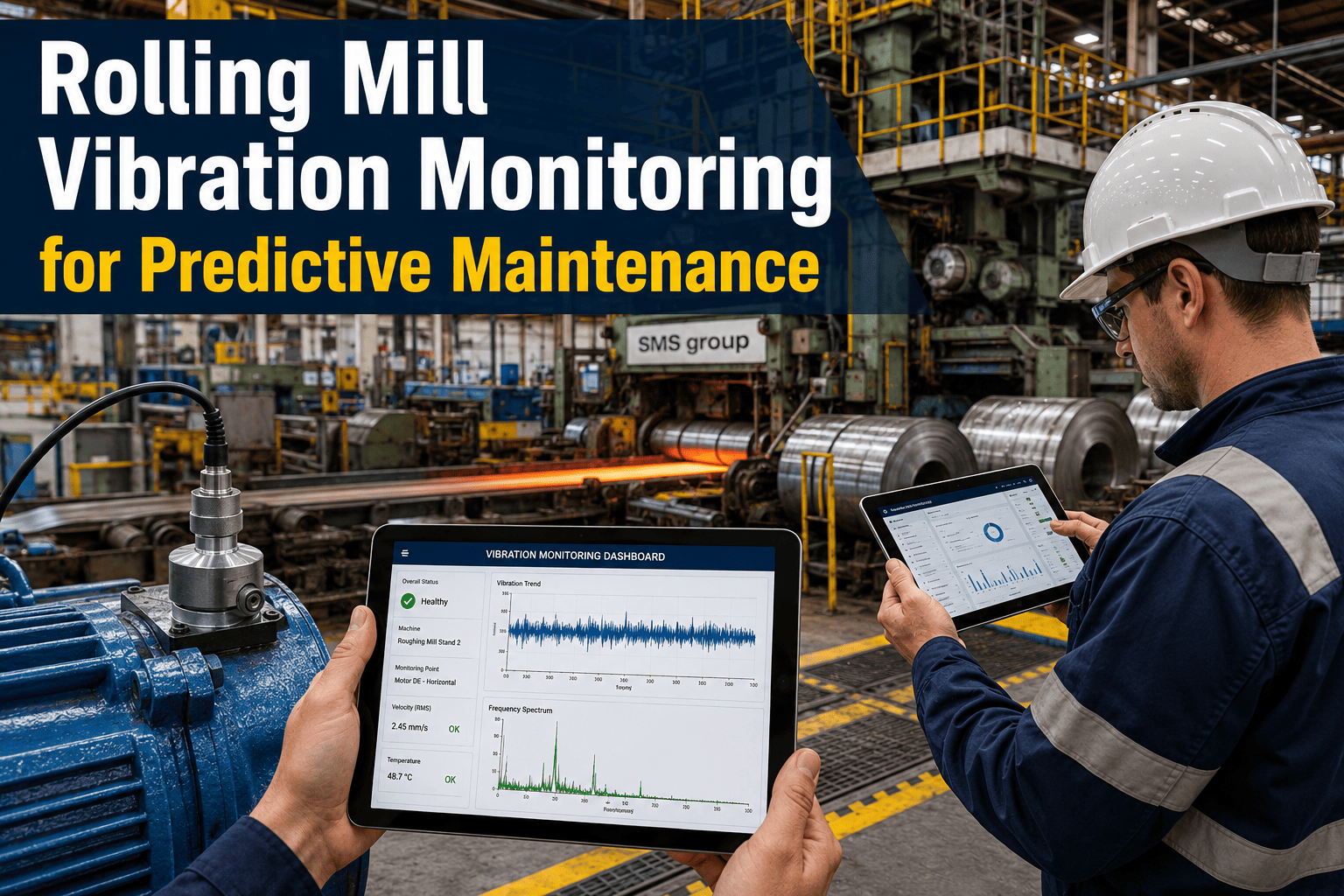
Rolling mills run 24 hours a day under extreme mechanical stress — and when they fail, they fail expensively. A single unplanned rolling mill breakdown costs $80,000 to $300,000 per incident in downtime, emergency repairs, and scrap losses. The failure modes are well understood: bearing fatigue, gear mesh degradation, roll neck wear, spindle coupling failure. What's less well understood is that every one of these failure modes produces measurable vibration signatures weeks before catastrophic breakdown. Vibration monitoring systems connected to CMMS platforms detect these signatures early — converting $300,000 emergency events into $30,000 planned maintenance windows. Start a free trial on Oxmaint to see how vibration monitoring integrates with your rolling mill maintenance workflow, or book a demo to review your specific mill configuration.
Catch Rolling Mill Failures Weeks Early
See how Oxmaint connects vibration monitoring data to predictive maintenance workflows — before your next unplanned shutdown.
Rolling mills running vibration-based predictive maintenance report 45–65% fewer unplanned breakdowns and 60% lower emergency repair costs.
- Vibration anomaly detection with 4–12 week advance warning
- Automatic work order generation from sensor threshold alerts
- Full rolling mill asset history linked to condition data
Used by operations teams managing 10,000+ assets — live in days, not months
What Is Rolling Mill Vibration Monitoring?
Condition Monitoring for High-Stakes Rolling Equipment
Rolling mill vibration monitoring is the continuous measurement and analysis of mechanical vibration signals from critical rolling mill components — roll bearings, drive gears, spindles, pinch roll assemblies, and motor drive systems. By tracking vibration frequency spectra, amplitude trends, and spectral anomalies over time, condition monitoring systems detect the early-stage mechanical defects that precede major failures.
The diagnostic technique is grounded in the physics of rotating equipment failure. Bearing defects generate specific frequency signatures at predictable multiples of shaft rotation speed. Gear tooth damage creates sidebands around mesh frequencies. Misalignment produces characteristic 1× and 2× running speed amplitudes. Vibration analysis software identifies these patterns — often 4 to 12 weeks before the defect reaches failure — and routes alerts to the CMMS for work order generation and repair planning. Start a free trial to see how sensor-to-work-order automation works in Oxmaint.
The integration gap that most steel plants haven't closed is between vibration monitoring systems and maintenance management workflows. Vibration data that lives only in an analyst's laptop or a standalone monitoring system doesn't generate maintenance action fast enough. When vibration alerts flow directly into CMMS work orders with asset linkage, parts requirements, and technician assignment, the detection-to-repair cycle shrinks from weeks to days — which is where the financial benefit is realized.
Key Monitoring Capabilities
8 Vibration Monitoring Parameters for Rolling Mill Health
01
Bearing Defect Detection
BPFO, BPFI, BSF, and FTF bearing fault frequencies monitored against baseline. Detects inner race, outer race, and rolling element defects 6–10 weeks before failure.
02
Gear Mesh Analysis
Track gear mesh frequency amplitude and sideband patterns for roll drive gearboxes. Gear tooth damage generates distinct spectral signatures detectable 4–8 weeks early.
03
Imbalance and Misalignment
1× and 2× running speed amplitude trending identifies roll neck imbalance and coupling misalignment — often introduced after maintenance events — before they cause secondary damage.
04
Structural Resonance Tracking
Monitor mill housing natural frequencies for resonance shifts that indicate structural looseness, foundation deterioration, or chock bearing degradation affecting mill rigidity.
05
Roll Force and Chatter Analysis
High-frequency vibration analysis detects roll chatter and cross-mixing phenomena that affect product surface quality — enabling roll schedule optimization before quality defects appear on strip.
06
Motor and Drive System Health
Main drive motor bearing conditions, shaft eccentricity, and electrical rotor frequency analysis monitors drive system health separate from mechanical rolling equipment.
07
Online vs Route-Based Monitoring
Critical assets run continuous online monitoring with automated alarming. Intermediate assets use scheduled route-based data collection — both feed into the same CMMS alert and work order workflow.
08
Trending and Baseline Management
Rolling mill vibration signatures shift with product mix, roll campaign age, and seasonal temperature variation. Dynamic baseline management eliminates false positives from operational variable changes.
Industry Pain Points
Why Rolling Mill Predictive Maintenance Fails Without Integration
The most common reason rolling mill predictive maintenance programs underperform is the gap between vibration data and maintenance action. Start a free trial to see how integrated CMMS workflows close this gap in your mill.
Vibration Data Siloed From Maintenance
Vibration analysts report bearing defects in monitoring software, but the finding doesn't reach the maintenance planner for days. By the time the work order is created, the window for planned repair has closed.
Fixed-Threshold Alarms Miss Early Defects
ISO 10816 alarm levels catch severity at dangerous stages. Statistical baseline comparison methods detect defects when they're still weeks from criticality — but require analysis capability most mills don't have in-house.
No Spare Parts Pre-Positioning
When vibration analysis indicates bearing replacement is needed in 6 weeks, the parts should be ordered immediately. Without CMMS integration, the parts request doesn't happen until emergency repair — at premium cost and lead time.
No Maintenance History Context
Vibration analysts interpreting a new anomaly need to know what work was last done — bearing replacement, shaft realignment, coupling change. Without CMMS integration, that context doesn't exist in the monitoring system.
Rolling mills that integrate vibration monitoring with CMMS close 65% more defects before failure than plants running monitoring and maintenance as separate systems.
How Oxmaint Connects Monitoring to Maintenance
How Oxmaint Integrates Vibration Data Into Mill Maintenance
Sensor-to-Work-Order Automation
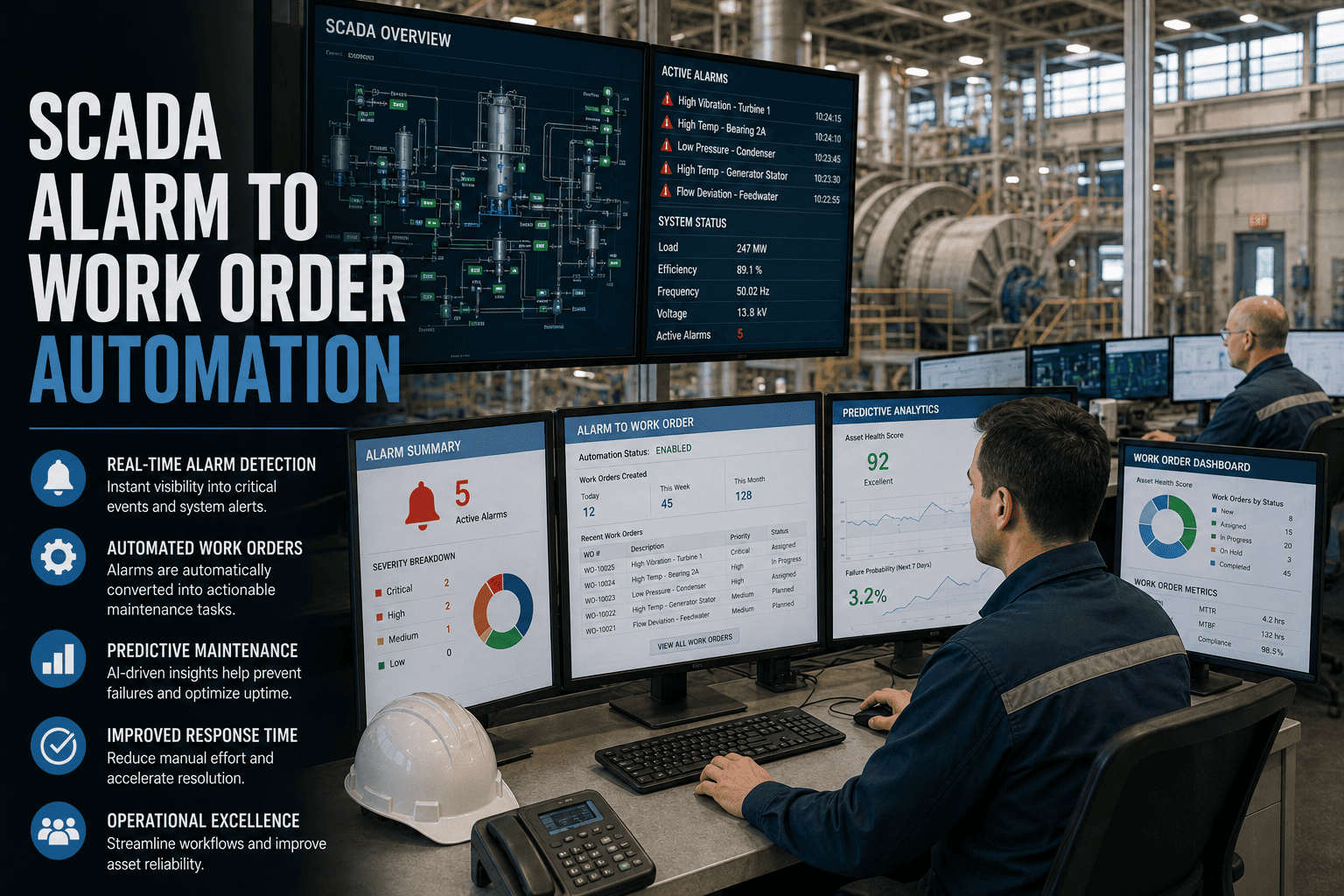
Vibration threshold breach events from monitoring systems generate Oxmaint work orders automatically via API integration. Bearing condition alerts include asset ID, defect classification, severity, and recommended action — pre-populated in the work order.
Rolling Mill Asset Hierarchy
Every rolling stand, bearing housing, gear unit, and drive motor is a tracked asset with condition score, vibration baseline history, maintenance records, and remaining life estimate. Full traceability from roll campaign to bearing replacement.
Predictive Parts Reservation
When a vibration alert indicates bearing replacement within 4–8 weeks, Oxmaint checks spare parts inventory and auto-generates a purchase request if stock is insufficient — before the repair is urgent.
Planned Outage Scheduling
Bearing replacement and gear service work is scheduled into planned production windows based on remaining life estimates. Rolling mill maintenance coordinators see the full repair backlog alongside production schedules in one view.
SCADA and OSIsoft PI Integration
Pull rolling mill vibration data from OSIsoft PI Historian, GE Predix, and other industrial data platforms directly into Oxmaint asset records. No duplicate data entry across monitoring and maintenance systems.
Reliability Engineer Dashboard
Fleet-level view of vibration health across all rolling stands — worst actors, trend directions, scheduled interventions, and equipment at risk. Reliability engineers see the full picture, not stand-by-stand reports.
Reactive vs Predictive Comparison
Reactive vs Vibration-Predictive Rolling Mill Maintenance
| Maintenance Dimension | Reactive Approach | Vibration-Based Predictive |
|---|
| Bearing failure detection | Detected at failure — $80K–$300K per event | 4–10 weeks early — planned replacement at $15K–$40K |
| Unplanned shutdown rate | 8–15 events per year on active rolling mill fleet | 2–4 events per year after 12-month program maturity |
| Spare parts availability | Emergency procurement — 2–3× standard cost, 3–7 day lead time | Pre-positioned from condition alert — standard cost, same-day availability |
| Secondary damage risk | High — bearing failure damages shaft, housing, and adjacent components | Minimal — planned replacement before failure prevents secondary damage |
| Product quality impact | Chatter and imbalance degrade surface quality — scrap and customer rejections | Early chatter detection corrects roll schedule before quality defects appear |
| Maintenance cost per year | $1.2M–$3.5M per integrated mill — driven by emergency repair premiums | $450K–$1.2M — 60–65% reduction in rolling maintenance spend |
ROI and Results
What Rolling Mills Report After Vibration-Based Predictive Maintenance
Rolling mills that integrate vibration monitoring with CMMS-driven maintenance workflows report consistent financial and operational improvements within the first 12 months. Teams making this shift see up to 65% reduction in unplanned rolling mill downtime — start a free trial to model the impact on your specific mill fleet.
65%
Reduction in Unplanned Downtime
Rolling mills with integrated vibration monitoring and CMMS vs reactive approach
4–10 Wks
Average Early Warning Lead Time
Vibration anomaly detection to planned maintenance window on bearing and gear defects
60%
Lower Emergency Repair Cost
Planned vs reactive repair cost comparison on equivalent rolling mill bearing failures
10–20×
ROI on Monitoring Investment
Single prevented $200K+ emergency event covers full annual monitoring and CMMS platform cost
FAQ
Rolling Mill Vibration Monitoring: Technical Questions
Can Oxmaint integrate with our existing vibration monitoring hardware?
Oxmaint integrates with monitoring data from Emerson CSI, SKF IMx, Pruftechnik Vibcode, Commtest, and other major vibration monitoring platforms via standard APIs, OPC-UA, and CSV data import. For plants running OSIsoft PI Historian, native PI connector pulls vibration trend data directly.
Book a demo to review your specific monitoring hardware configuration.
How do you handle vibration data from high-speed rolling mill drives?
High-speed rolling mill applications require sampling rates and analysis methods appropriate to the running speed range — typically 200–3000 RPM for main drives. Oxmaint stores trend data from monitoring systems calibrated for these speed ranges, with baseline management that accounts for speed-dependent vibration characteristics across different product schedules.
Start a free trial to configure your mill's monitoring parameters.
What is the typical ROI timeframe for rolling mill vibration-based predictive maintenance?
Most rolling mills see positive ROI within the first 6 months — typically after the first major bearing failure is prevented through early vibration detection. A single prevented emergency bearing replacement on a main drive stand ($100K–$300K avoided) covers the full annual cost of monitoring hardware, software, and analysis. The program typically reaches full maturity — 60–65% downtime reduction — within 12–18 months as baselines stabilize and analyst expertise develops.
Can Oxmaint help manage roll campaign length optimization using vibration data?
Yes. By tracking vibration trends across roll campaigns, Oxmaint helps reliability engineers correlate campaign length with bearing degradation rates, allowing data-driven roll change scheduling that optimizes campaign length versus bearing life. This reduces unnecessary roll changes while preventing the bearing failures that occur when campaigns run too long — typically extending roll campaign life by 15–25% while maintaining reliability targets.
Your Rolling Mills Are Telling You When They'll Fail
Connect Vibration Monitoring to Predictive Maintenance — Before the Next Breakdown
See measurable results in the first 30 days. No heavy implementation. Works across multi-site mill portfolios. Live in days, not months.
- Vibration anomaly detection with 4–12 week advance warning
- Automatic work order generation from sensor threshold alerts
- Full rolling mill asset history linked to condition data
Used by operations teams managing 10,000+ assets — limited onboarding slots available this quarter