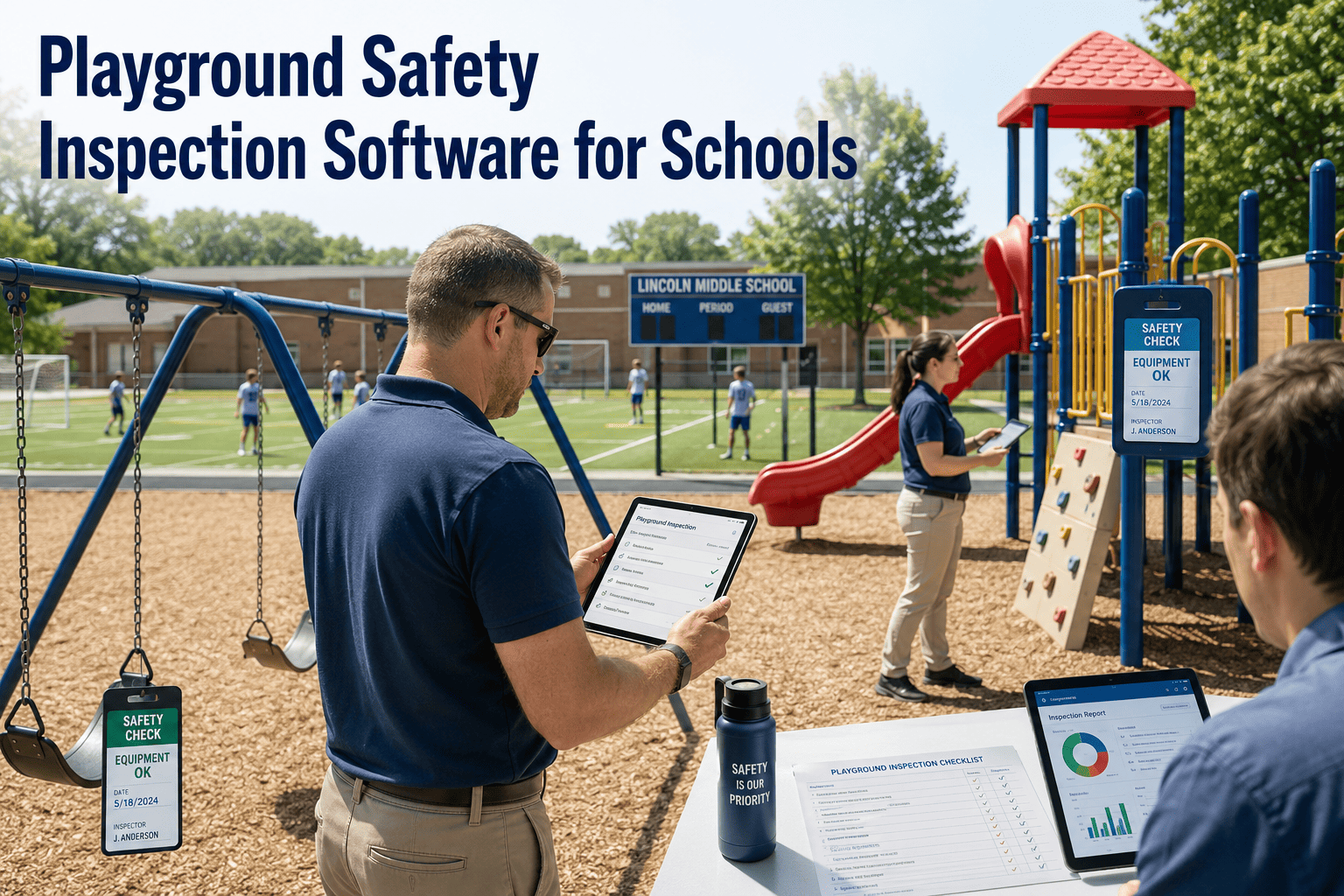
Every year, more than 200,000 children are treated in emergency rooms for playground-related injuries — and a significant portion of those incidents involve hazards that a structured inspection program would have identified and resolved weeks earlier. Schools and districts that rely on informal visual checks, paper checklists, and memory-dependent inspection cycles are not just inefficient — they are exposed. ASTM F1487 and CPSC Handbook guidance have established clear standards for what playground inspections must document, how frequently, and by whom. Yet most school facilities teams still manage this process with paper forms that live in a filing cabinet until a parent complaint or legal claim surfaces. Start a free trial on Oxmaint or book a demo to see how your district can digitize playground safety from day one.
See how Oxmaint digitizes your playground inspection workflow — with compliance records ready on demand.
No heavy implementation required | Live in days | Works across multi-campus districts
What Is Playground Safety Inspection Software?
Playground safety inspection software is a digital platform that replaces paper-based inspection logs with structured mobile checklists, automated defect tracking, and compliance-ready reporting. Rather than relying on individual inspectors to remember what to check, when to check it, and where to file the results, a software-driven approach standardizes every inspection across every piece of equipment — and generates an auditable record in real time.
For schools, playground inspections fall into three categories: routine visual checks (typically daily or weekly), operational inspections (monthly, by trained staff), and comprehensive annual inspections (by a Certified Playground Safety Inspector or equivalent). Each type requires a different level of documentation, different equipment focus areas, and different follow-up workflows when defects are found. Managing these three tracks manually across multiple playgrounds and athletic areas creates gaps that paper systems cannot close.
Software-based inspection platforms close those gaps by delivering checklists to mobile devices, enforcing photo evidence requirements for identified defects, and automatically generating maintenance work orders when hazards are logged — ensuring that a flagged broken bolt does not sit in a paper form for two weeks before anyone acts on it. Schools using digital inspection software report a 45% reduction in unresolved safety defects at any given time — start a free trial to see how Oxmaint builds that discipline into your inspection cycle, or book a demo and we will walk through your playground portfolio live.
8 Key Elements of a Defensible Playground Inspection Program
A legally defensible and truly protective playground safety program is built on these core components — each of which must be documented, not just performed.
Separate daily visual checks, monthly operational reviews, and annual comprehensive inspections — each with distinct checklists, required documentation, and personnel qualifications.
Checklists map directly to ASTM F1487 standard requirements — fall zones, entrapment hazards, protrusions, surface resilience, and age-appropriate design elements.
Impact-attenuating surfacing degrades over time. Inspections must document depth, compaction, drainage, and coverage under and around all equipment — the leading cause of severe injuries.
Not all defects are equal. A classification system distinguishes immediate hazards (close equipment now) from maintenance items (schedule within 30 days) from informational observations.
Photo documentation of every identified defect creates a timestamped, geolocated record that protects the district in liability situations and confirms resolution after repairs.
Flagged defects automatically generate maintenance work orders assigned to the correct crew — eliminating the gap between defect identification and repair initiation that paper systems cannot close.
Safety inspection protocols extend to basketball courts, running tracks, bleachers, goal post footings, and field drainage — areas with similar liability exposure but often excluded from playground-specific programs.
Complete inspection history, defect resolution timelines, and open item lists exportable on demand — for insurance reviews, legal defense, regulatory audits, and school board reporting.
4 Playground Inspection Failures Exposing Schools to Liability
These are the documentation and process gaps that leave school districts exposed — financially, legally, and operationally. Teams moving to structured digital inspection close most of these gaps in the first month — start a free trial to see how quickly Oxmaint addresses your specific gaps.
When a child is injured and parents or attorneys request inspection records, districts with paper systems often cannot produce complete, chronological documentation. A gap in the paper record is treated as a gap in the inspection program — regardless of what actually happened. A single lawsuit costs a district an average of $150,000–$500,000 in legal fees and settlement alone.
Paper inspection forms identify hazards but lack the workflow connection to actually fix them. A broken bracket noted on a Monday inspection form may sit unrepaired for three weeks because there is no automatic handoff to the maintenance team — and no follow-up mechanism to confirm resolution.
When the custodian who "always does the playground check" is absent, the inspection often does not happen at all — because it lives in that person's routine rather than in a structured, tracked schedule. Gaps in coverage are invisible until an incident reveals them.
Post-winter inspections, pre-season athletic equipment checks, and surfacing assessments after heavy rainfall require triggered, non-routine inspection workflows that paper systems simply cannot schedule reliably. These situational gaps account for a disproportionate share of serious incidents.
6 Ways Oxmaint Digitizes Playground Safety for Schools
Oxmaint replaces paper-based inspection systems with a mobile-first, compliance-ready platform built for education facility teams — from a single school to a multi-campus district.
ASTM F1487-aligned checklists delivered to inspectors' mobile devices. Each item includes guided prompts, photo requirements, and severity classification — ensuring consistent, complete inspections every time regardless of who performs them.
Daily, monthly, and annual inspections are pre-scheduled and auto-assigned to designated staff. Missed inspections trigger escalation alerts — no more relying on individual memory or printed schedules.
Every flagged defect automatically generates a maintenance work order with photo evidence, severity classification, and equipment location pre-populated. The maintenance team receives it immediately — no manual handoff required.
Immediate-hazard defects trigger an automatic equipment closure notification to the principal and facilities manager — with a documented, timestamped record of when the hazard was identified and when the area was secured.
Complete inspection history, open defect lists, resolution timelines, and inspector sign-offs — exported in seconds for insurance reviews, legal defense, or regulatory audits. No filing cabinet required.
District facilities directors see inspection completion status, open defects, and overdue items across all schools simultaneously — from a single dashboard with drill-down to individual equipment records.
Paper-Based Inspections vs. Digital Safety Management
This comparison shows what changes — operationally and legally — when schools replace paper inspection programs with Oxmaint's digital platform.
| Inspection Dimension | Paper-Based Program | Oxmaint Digital Platform | Outcome |
|---|---|---|---|
| Checklist consistency | Varies by inspector — memory-dependent | Standardized mobile checklist — same every time | Zero inspection gaps |
| Defect documentation | Written description, no photo standard | Photo + severity classification required per defect | Defensible legal record |
| Defect-to-repair time | 3–21 days (manual handoff) | Same-day work order auto-generated | 3x faster resolution |
| Missed inspection rate | 15–25% without substitute protocols | Tracked, escalated, reassigned automatically | Near-zero gaps in coverage |
| Compliance reporting | Hours of manual document assembly | Single export — complete history | Audit-ready in seconds |
| District-wide visibility | None — each school manages independently | Consolidated dashboard across all campuses | Portfolio-level risk management |
What Schools Measure After Digitizing Playground Safety
These outcomes come from districts that have replaced paper inspection programs with structured digital platforms. The financial impact of a single prevented serious incident often exceeds years of platform cost — start a free trial and begin building your inspection record from day one.
Automatic work order generation means defects are acted on the same day they are identified — not weeks later when a paper form is reviewed.
Legal fees and settlements from a single serious playground incident. Complete digital inspection records are the primary defense in these cases.
CDC data. The majority involve fall-related injuries and equipment defects — both preventable with a consistent, documented inspection program.
Digital inspection-to-work-order workflows resolve identified hazards three times faster than paper-based programs with manual maintenance handoffs.
Playground Safety Inspection Software — Answered
Does Oxmaint's inspection platform align with ASTM F1487 and CPSC Handbook requirements?
Can Oxmaint track both playground and athletic area inspections on the same platform?
What happens when a custodian identifies a critical hazard during a routine inspection?
How does Oxmaint handle districts with 10 or more school campuses?
Stop Managing Playground Safety on Paper
Turn every inspection into a traceable, defensible, actionable record with Oxmaint — purpose-built for education facility compliance.
Used by facility teams managing 10,000+ assets | See measurable results in the first 30 days
No heavy implementation required | Live in days, not months | Works across multi-site campuses