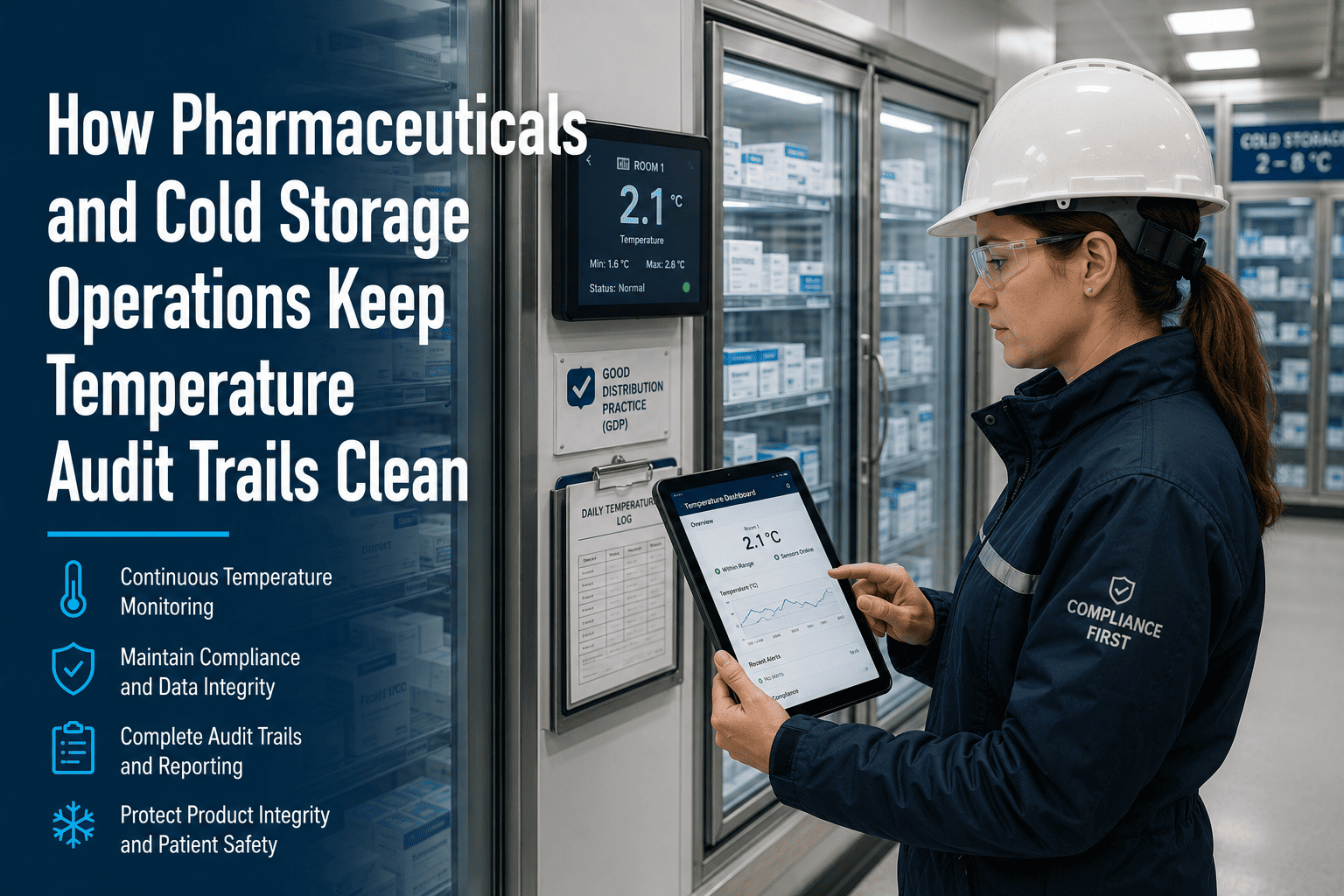
How Pharmaceuticals and Cold Storage Operations Keep Temperature Audit Trails Clean

Connect with Industry Experts, Share Solutions, and Grow Together!

Join Discussion Forum
pharmaceutical-cold-storage-temperature-audit-trail

The audit trail is the only part of the pharmaceutical cold chain a regulator actually inspects in real time. The product is gone, the shipment delivered, the warehouse cycle closed — what remains is the record. From January 2026, FDA enforcement under DSCSA and 21 CFR Part 211 tightens further: temperature must be tracked at every storage, transfer, and cross-dock node, records retained for at least two years, and a complete audit-trail export delivered to the inspector within 24–48 hours of request. WHO Good Distribution Practice now applies as a parallel layer in roughly 78 countries — the same continuous monitoring, the same retention, the same retrieval window. Cold-chain operations that still rely on chart recorders, manual logs, or consumer-grade data loggers fail that retrieval test routinely. The fix is not better thermometers. It is a 21 CFR Part 11-compliant electronic record system where every reading, alarm, acknowledgement, and sensor calibration is tamper-evident from the moment of capture. Start a free trial to digitise your cold-chain audit trail — or book a demo to see how Oxmaint produces inspector-ready exports in seconds.

Pharmaceutical & Cold Storage · Audit Trail · 2026

How Pharmaceuticals and Cold Storage Operations Keep Temperature Audit Trails Clean

A compliance-first guide for cold-chain assets, inspections, and audit-ready maintenance history. See how QA, engineering, and warehouse teams build temperature records that satisfy FDA, WHO GDP, EMA, and DSCSA on first request.

Live in 4–8 weeks with 21 CFR Part 11-aligned records — audit-ready from day one, no chart-recorder migration headache.
24–48hFDA window for delivering temperature audit trail records after a regulator request (effective 2026)
$34.5BProjected global pharmaceutical cold storage market size by 2035, growing at 6.9% annually
78Countries with WHO GDP adopted as national pharmaceutical distribution standard
5 yrMinimum electronic record retention period required under 21 CFR Part 11 for cold-chain data

What a Clean Temperature Audit Trail Looks Like

A clean temperature audit trail is a continuous, tamper-evident record of every sensor reading, every alarm, every acknowledgement, and every sensor calibration across every storage and transit node a regulated pharmaceutical product touches. It begins at the point of manufacture, runs through every controlled-environment store room, refrigerator, freezer, and reefer trailer, and closes at the final delivery point — all in a single 21 CFR Part 11-aligned electronic record that produces inspector-ready exports filtered by product lot, by storage node, or by date range.

The model matters because the regulator no longer asks for the temperature record alone — they ask for the audit trail behind it. Who acknowledged the alarm at 3:14am? Was the sensor in calibration at the time? Was the deviation investigated? What CAPA followed? Cold-chain operations that move from chart-recorder-plus-spreadsheet to a validated electronic system typically reduce inspector retrieval time from days to seconds and eliminate the documentation gaps that drive most warning letters — start a free trial to see what that workflow looks like on your warehouse.

Six Pillars of an Inspector-Ready Cold Chain

Six concepts separate cold-chain operations that pass FDA, WHO GDP, and EMA inspection cleanly from those that produce 483 observations on first request. Every one is something the inspector will specifically look for — and every one has to live in the system, not on a clipboard or a chart strip.

01
Continuous Sensor Logging
Every storage location instrumented with calibrated sensors logging at defined intervals — no manual reads, no gaps.
02
Sensor Calibration Trail
Each sensor carries its own calibration certificate and interval — the system blocks data acceptance from expired sensors.
03
Excursion Workflow
Temperature out-of-range auto-creates an event with acknowledgement, root-cause investigation, and CAPA assignment.
04
21 CFR Part 11 Audit Trail
Every create/edit/delete logged with user, timestamp, reason — tamper-evident from the moment of capture.
05
Mapped Storage Zones
Temperature mapping per zone with documented hot spots, cold spots, and validated sensor placement — required for GDP.
06
Lot-Level Export
Inspector asks for product Lot X's storage history — system returns the full timeline in seconds, not days.
From 2026 FDA expects 24–48 hour delivery of full temperature audit trail records — paper and spreadsheets cannot meet that window.

Where Cold-Chain Audit Trails Fail Inspection

Cold-chain inspection findings repeat across pharmaceutical manufacturing, third-party logistics, and hospital pharmacy distribution in the same six patterns. Every Form 483 traces back to two or three of them combined. Operators that close even two of these gaps typically pass the next regulator request without scrambling — start a free trial to map your current state against these.

Paper Chart Recorders
Strip charts in a binder — no audit trail, no tamper-evidence, no realistic 24-hour retrieval for inspector requests.
Consumer-Grade Loggers
USB data loggers where records can be deleted or overwritten — fails Part 11 data-integrity tests on first review.
Unacknowledged Excursions
Alarm logged, no one signed off, no investigation, no CAPA — inspector finds the orphaned event before the QA team does.
Expired Sensor Calibrations
Sensor data accepted while its own calibration certificate has lapsed — invalidates every reading dependent on it.
No Temperature Mapping
Sensors placed by convenience, not by mapping study — GDP inspectors flag the missing validation evidence first.
Slow Inspector Retrieval
Auditor asks for Lot X's storage record — manual binder compilation takes days, the 24–48 hour window is already gone.

How Oxmaint Builds a Validated Temperature Audit Trail

Oxmaint integrates with calibrated IoT sensors and existing BMS / SCADA systems to capture every reading directly into a 21 CFR Part 11-aligned electronic record. Every excursion auto-creates an event with acknowledgement workflow, root-cause investigation, and CAPA assignment. Sensor calibration is tracked alongside the data — the system rejects readings from an out-of-cal sensor. Inspector exports are filtered by product lot, storage node, or date range and produced in seconds. Start a free trial to see the workflow on your warehouse layout.

IoT Sensor Integration
Bluetooth, LoRa, NB-IoT, and existing BMS sensors push readings directly — no manual transcription anywhere.
Excursion Auto-Event
Out-of-range readings trigger an event with mandatory acknowledgement, investigation, and CAPA assignment.
Sensor Calibration Lockout
System blocks data acceptance from any sensor whose calibration certificate has expired — closing a common audit gap.
Lot-Level Audit Export
Filter by lot, by node, by date range — the inspector's request becomes a filtered PDF or CSV in seconds.
21 CFR Part 11 Audit Trail
Tamper-evident audit trail on every record — user, timestamp, and reason for every create, edit, or delete.
Temperature Mapping Records
Storage zone mapping studies, hot-spot/cold-spot reports, and sensor placement evidence all live in the same system.
A single failed cold-chain audit can trigger product recall, Warning Letter, and remediation costs that exceed the lifetime cost of any monitoring platform.

Chart Recorder vs Validated Electronic Audit Trail — Side by Side

The gap between chart-recorder-plus-spreadsheet and a validated electronic audit trail is widest in the four moments inspectors specifically test — record retrieval, audit trail integrity, excursion handling, and sensor calibration evidence. The comparison below is built from pharma manufacturers and cold-storage operators that completed the transition under FDA, EMA, and WHO GDP scope.

Audit Trail DimensionChart Recorder / SpreadsheetValidated Electronic Trail
Audit trail integrityFails 21 CFR Part 11Tamper-evident, attributed, timestamped
Retrieval windowDays to weeksSeconds — filtered export
Excursion acknowledgementManual, often orphanedMandatory workflow with CAPA
Sensor calibration linkageTracked separately, often missedSystem blocks expired-cert sensors
Lot-level traceabilityManual compilationOne filter click — full timeline
WHO GDP / FDA readinessScramble per inspectionAlways inspection-ready
Retention guaranteePaper degrades, files lost5+ years tamper-evident

ROI After Validated Audit Trail Rollout

The numbers below come from pharmaceutical manufacturers and cold-storage operators that completed a 6–12 week move from chart recorders and spreadsheets to a validated electronic audit trail. The pattern is consistent — inspector retrieval times drop from days to seconds, excursion CAPAs close faster, and compliance findings tied to documentation gaps drop sharply. The payback is typically the first avoided recall or Warning Letter.

24h
FDA retrieval window for cold-chain audit-trail records — always met by validated electronic systems
Filtered lot or date-range export replaces the binder compilation that produces most missed-window findings.
87%
Reduction in temperature excursions reported with predictive monitoring (industry benchmark)
Machine learning models flag equipment failure patterns 72 hours before incident across the cold chain.
5 yr
Tamper-evident retention satisfied by validated electronic record from the moment of capture
No paper degradation, no spreadsheet drift, no lost backups across regulatory retention period.
$4.2M
Typical remediation cost of a single FDA validation finding tied to documentation
One avoided observation typically pays back the audit-trail platform many times over in the first year.
Three Outcomes QA and Cold-Chain Leaders See in 90 Days
Every temperature reading is captured into a 21 CFR Part 11-aligned tamper-evident record
Excursions auto-trigger investigation and CAPA — no orphaned alarms left for the inspector to find
Inspector lot-level retrieval is a filter, not a binder hunt — always inside the 24–48 hour window

Frequently Asked Questions

Does Oxmaint integrate with our existing IoT sensors and BMS
Yes — the platform integrates with major Bluetooth, LoRa, NB-IoT, and wired sensor families and with common building management systems. Existing chart-recorder networks can also be migrated; readings flow into the validated electronic record without requiring a sensor rip-and-replace.
How does the system handle FDA, WHO GDP, and EMA at the same time
The same 21 CFR Part 11-aligned audit trail satisfies the documentation requirements of all three frameworks. Lot-level and node-level exports support FDA DSCSA, WHO GDP retention, and EMA chain-of-custody questions from a single record store.
What happens when a temperature excursion occurs in the middle of the night
An out-of-range reading triggers immediate alerts to the on-call QA contact, opens an event record requiring acknowledgement, and initiates a CAPA workflow that survives the shift change. The full timeline — alarm, ack, investigation, root cause, action — is captured in the audit trail.
How fast can a multi-site pharma or cold-storage operation deploy
Most multi-site deployments run 4–8 weeks. Asset registry import, sensor mapping, integration with existing BMS or IoT networks, and validation package supply are templated. Validation typically completes alongside deployment rather than after.
Decision Point

Stop Scrambling for Records the Inspector Already Asked For

Turn every temperature reading into a 21 CFR Part 11-aligned, lot-traceable, inspector-ready record — and answer any audit question in seconds.

Used by pharmaceutical manufacturers and cold-storage operators — live in 4–8 weeks, audit-ready on day one.
By Jack Edwards

Experience
Oxmaint's
Power

Take a personalized tour with our product expert to see how OXmaint can help you streamline your maintenance operations and minimize downtime.

Book a Tour

Share This Story, Choose Your Platform!

Connect all your field staff and maintenance teams in real time.

Report, track and coordinate repairs. Awesome for asset, equipment & asset repair management.

Schedule a demo or start your free trial right away.

iphone

Get Oxmaint App
Most Affordable Maintenance Management Software

Download Our App