Calibration is the function that decides whether a regulated facility passes or fails its next audit — and the function most likely to be running on a spreadsheet, a binder, and a senior technician's memory. A single undocumented or out-of-tolerance instrument in a chemical plant or pharmaceutical lab can trigger an FDA Form 483 observation, delay batch release, or force a recall, with average remediation costs exceeding $4.2 million for a mid-size manufacturer. Industry research shows 61% of FDA warning letters cite data integrity failures traced back to inadequate maintenance and calibration documentation — the SOPs existed, the calibration was performed, but the record could not be retrieved in the inspection window. Chemical plants and analytical labs share the same root problem: every instrument has a calibration interval, every interval has a tolerance, every calibration generates evidence that has to survive a 21 CFR Part 11 audit five years later. Start a free trial to digitise calibration workflows — or book a demo to see how Oxmaint closes the gap between what happened on the floor and what is retrievable for the inspector.
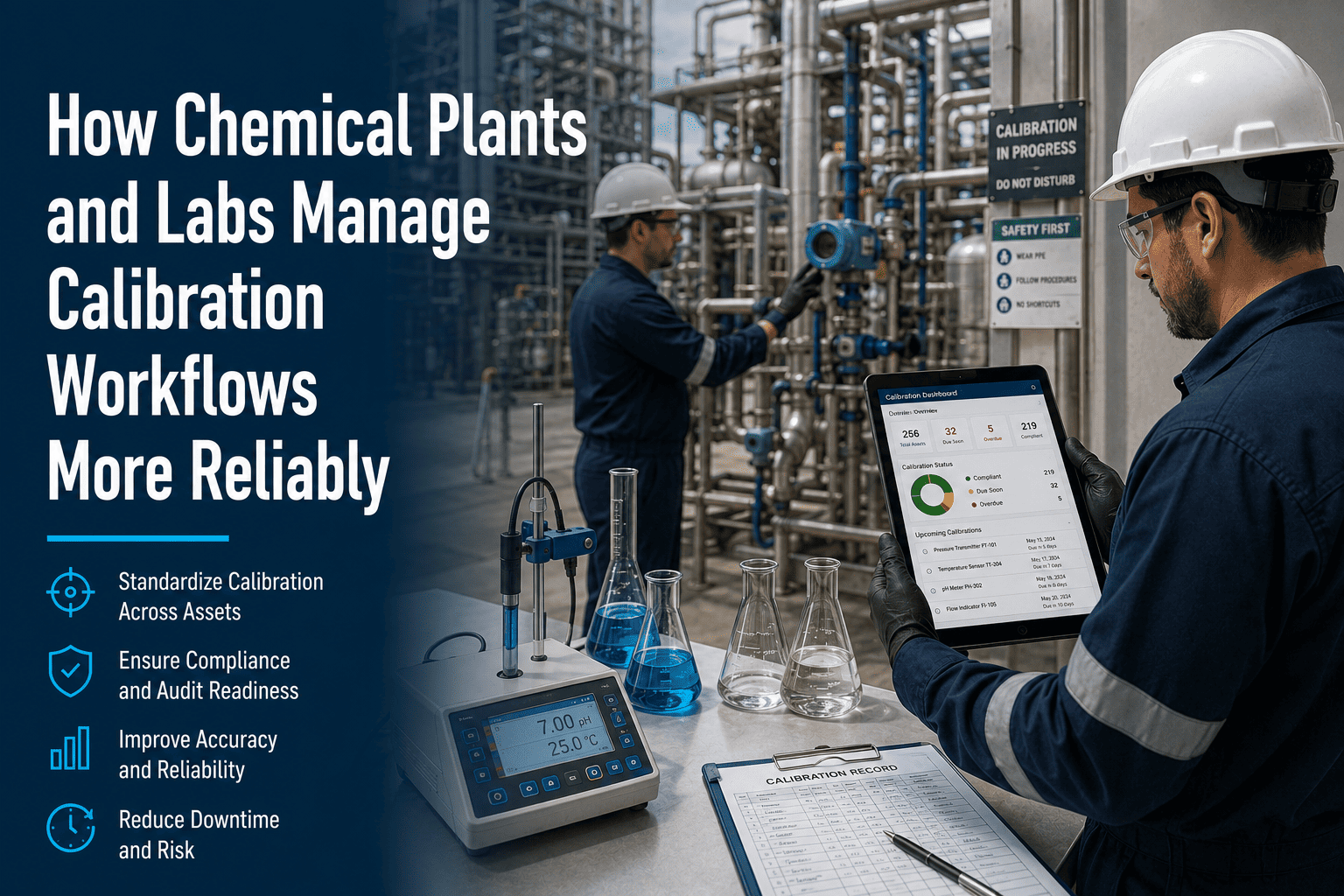
How Chemical Plants and Labs Manage Calibration Workflows More Reliably
Calibration records, inspection discipline, and equipment control are critical in both regulated plants and labs. See how QA and engineering teams build inspection-ready calibration programmes that withstand FDA, EPA, and ISO 17025 scrutiny.
What a Modern Calibration Workflow Looks Like
A modern calibration workflow is a closed loop that begins with an instrument inventory classified by criticality, runs each instrument through interval-based calibration with traceable standards, captures the result against a defined tolerance, generates a tamper-evident electronic record with electronic signatures, and surfaces any out-of-tolerance result to QA in real time. It replaces the historical paper-and-spreadsheet model — calibrate, write the result on a sticker, file the paper in a binder, hope it is retrievable later — with a system where every calibration is a 21 CFR Part 11-aligned record from the moment of capture.
The model matters because regulators no longer treat paper records and validated electronic records as equivalent. An FDA inspector asking for two years of calibration history on a pH meter, a balance, or a temperature transmitter expects retrieval within two hours, with the complete audit trail showing who, when, and what changed. Plants and labs that move from paper to a validated CMMS-based calibration programme typically eliminate overdue instruments within 90 days and recover hours of QA time per audit cycle — start a free trial to see how the workflow runs on your instrument inventory.
Six Pillars of a Compliant Calibration Programme
Six concepts separate calibration programmes that pass inspection cleanly from those that generate Form 483 observations. Each is a control the inspector will specifically look for — and each has to live in the system, not in a senior technician's head.
Where Calibration Programmes Fail Inspection
The patterns that produce Form 483 observations are remarkably consistent across chemical plants, pharma manufacturing, contract labs, and quality control labs. Six recurring failure modes account for the overwhelming share of inspection findings — and every one has the same fix. Plants that close even two or three of these gaps typically avoid the next inspection finding entirely — start a free trial to map your own programme against these.
How Oxmaint Runs Calibration as a Validated Workflow
Oxmaint turns calibration into a system-enforced workflow rather than a discipline that depends on technician memory. Every instrument is classified, every interval is automated, every calibration is captured on a mobile device with electronic signature on the spot, every out-of-tolerance result triggers a CAPA workflow, and every record lives in a tamper-evident, audit-trailed, 21 CFR Part 11-aligned electronic system. Start a free trial to see calibration on your instrument list.
Paper / Spreadsheet vs Validated Digital Calibration — Side by Side
The operational gap between traditional and validated digital calibration is widest in the moments inspectors specifically test — record retrieval, audit-trail completeness, OOT handling, reference standard chain-of-custody. The comparison below is built from regulated plants and labs that completed the transition under FDA, EPA, or ISO 17025 scope.
| Calibration Dimension | Paper / Spreadsheet | Validated Digital Calibration |
|---|---|---|
| Audit-trail integrity | Fails 21 CFR Part 11 | Tamper-evident, user-attributed, timestamped |
| Record retrieval time | Hours to days | Seconds — filtered export |
| Overdue instrument detection | Discovered at next audit | Real-time dashboard with escalation |
| OOT response | Manual escalation, often missed | Auto-CAPA + batch quarantine |
| Electronic signature | Wet signature only | Part 11-compliant e-signature |
| Reference standard control | Manual cert tracking | System blocks expired references |
| Inspector readiness | Scramble before audit | Always inspection-ready |
ROI After Digital Calibration Rollout
The numbers below come from chemical plants and pharma labs that completed a 6–12 week move from paper or spreadsheet calibration to a validated digital programme. The pattern is consistent — overdue instruments eliminated within a quarter, inspector findings dropped, and QA hours per audit cut significantly. The payback is typically the first avoided 483 observation.
Frequently Asked Questions
Is Oxmaint validated for 21 CFR Part 11 and GAMP 5
How does the system handle out-of-tolerance results without disrupting production
Can Oxmaint manage both plant-level instruments and analytical lab equipment in one system
How fast can a multi-site chemicals or pharma operation deploy
Stop Scrambling Two Weeks Before Every Inspection
Run calibration as a validated electronic workflow — and answer any inspector question with a filtered export in seconds.