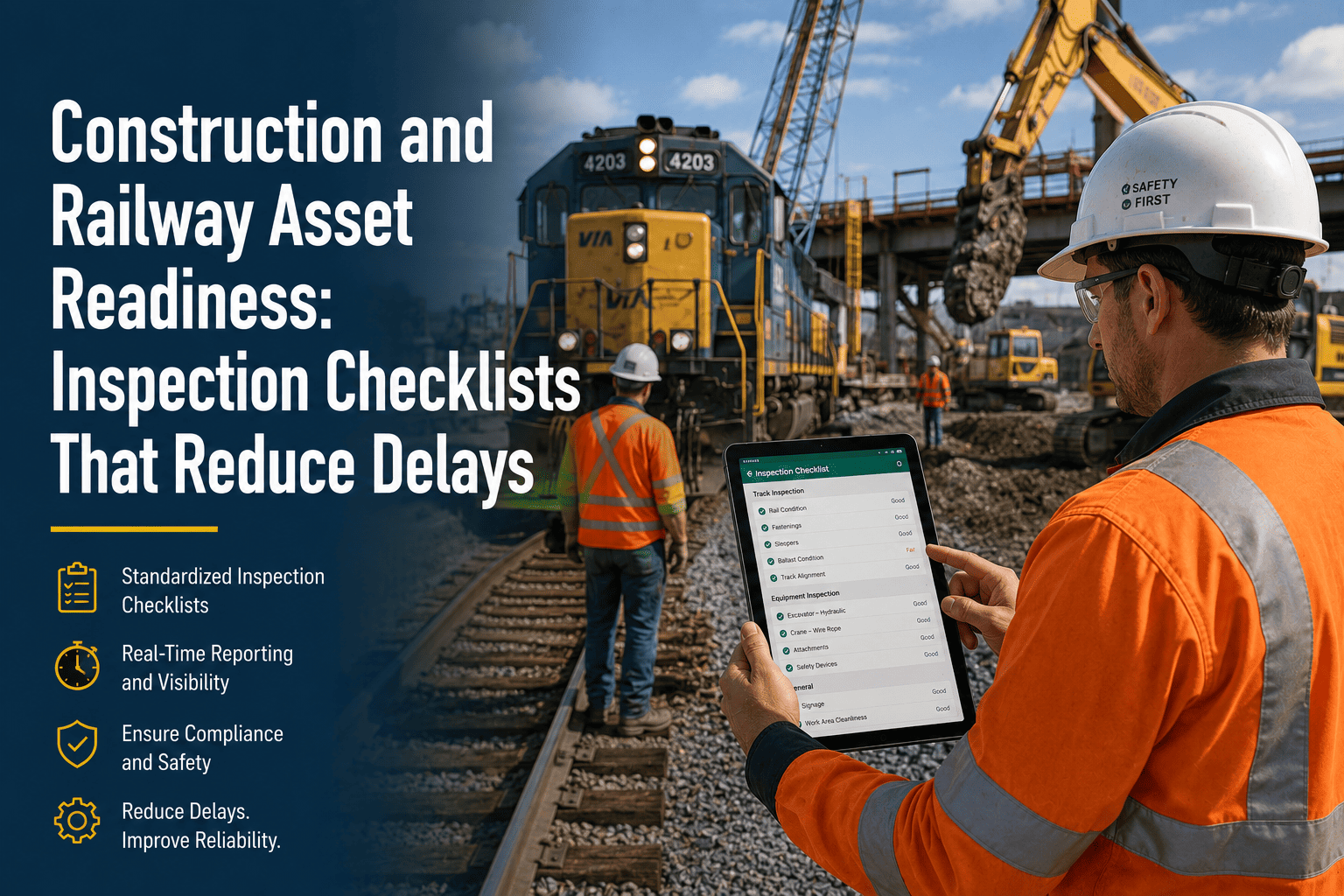
Construction and Railway Asset Readiness: Inspection Checklists That Reduce Delays

Connect with Industry Experts, Share Solutions, and Grow Together!

Join Discussion Forum
construction-railway-asset-readiness-checklists

Construction and railway operations share the same brutal economics: assets either show up to the job ready, or the entire downstream schedule collapses. A failed excavator stops concrete pours, idles subcontractors, and racks up $2,000+ per day in unplanned downtime per machine. A track inspection vehicle that misses its readiness check delays maintenance windows that can cost rail operators six figures per hour in service penalty. OSHA's 29 CFR 1926 mandates pre-shift inspections by a "competent person", and inspection documentation gaps are the most common construction safety finding — with fines starting at $16,550 per serious violation and reaching $165,514 for willful or repeated offenses. The 80% of common failures that daily inspections catch are also the 80% that paper checklists routinely lose. A 10-minute walkaround prevents 10–15 hours of downtime; the same walkaround logged on paper and filed in a binder produces neither the data nor the audit evidence. Start a free trial to digitise asset readiness inspections — or book a demo to see how Oxmaint turns every pre-shift check into a timestamped work order and a defect trail.

Construction & Railways · Asset Readiness · 2026

Construction and Railway Asset Readiness: Inspection Checklists That Reduce Delays

Use inspection checklists to keep heavy equipment and rail assets ready for active work schedules. See how site and depot teams cut equipment downtime, prove OSHA and FRA compliance, and stop losing days to defects that should have surfaced at sunrise.

Live in 4–6 weeks across multi-site fleets — measurable downtime reduction in the first 30 days, OSHA and FRA audit-ready.
$2KAverage daily cost of a single unplanned heavy equipment failure on an active construction site
80%Common heavy-equipment failures preventable with disciplined daily inspection routine
$165KMaximum OSHA fine for willful or repeated inspection-related violations under 29 CFR 1926
−40%Site downtime and incident reduction reported by contractors moving to digital inspection workflow

What Asset Readiness Actually Means

Asset readiness is the operational state where every piece of equipment scheduled for the day's work has been inspected, defects identified, critical issues lockout-tagged and assigned for repair, and return-to-service signed off — before the shift starts. It replaces the historical model — operator climbs in, machine runs, defects discovered when something fails — with a workflow where a 10-minute walkaround at sunrise prevents the 10-hour shutdown at noon. In railway operations, asset readiness extends to locomotive pre-departure inspections, track inspection vehicles, maintenance-of-way equipment, and rolling stock — every category with its own FRA-mandated inspection frequency and documentation requirement.

The model matters because the cost of a missed defect is asymmetric. A cracked hydraulic hose found at 7am is a $50 part and 15 minutes; the same hose discovered as a burst line at 11am costs a day of production, a contaminated jobsite, and a potential OSHA recordable. Daily inspections catch 80% of common failures before they become emergencies — and digital inspections turn the catch into trend data, work orders, and audit evidence in the same workflow. Sites that move from paper to digital inspections see 40% reductions in equipment downtime and incidents within the first year — start a free trial to see what that looks like on your fleet.

Six Pillars of a Real Asset-Readiness Programme

Six concepts separate sites and depots running disciplined readiness programmes from those running on whatever the operator notices that morning. Each is a decision point — get them right and the equipment shows up ready; get them wrong and the schedule slips at sunrise.

01
Asset-Specific Checklists
Excavator, crane, locomotive, and MOW each get distinct checklists — generic forms miss equipment-specific failure modes.
02
Pre-Shift Trigger
Inspection required before equipment can be marked operational — no checklist, no shift assignment.
03
Defect Severity Routing
Critical defects auto-lockout the asset; minor items become scheduled work orders — operator decision removed from triage.
04
Photo + GPS Capture
Every flagged defect carries a photo, asset ID, and location — auditable evidence that survives any regulator request.
05
Return-to-Service Sign-Off
Equipment cannot return to active duty without a qualified technician closing the corrective work order with sign-off.
06
Defect Trend Detection
Same component flagged across three inspections auto-triggers reliability engineering review — patterns surface fast.
A 10-minute pre-shift inspection prevents failures worth 10–15 hours of downtime — and a $30 filter change prevents a $5,000 pump failure.

Where Inspection Programmes Break Down — Six Failure Modes

Inspection failures repeat across construction sites, rail yards, and infrastructure depots in the same six patterns. Every after-action review surfaces the same root causes, and every cost overrun traces back to two or three of them combined. Contractors and depot managers who close even two of these gaps typically recover 15–25% of unplanned downtime in the first quarter — start a free trial to see your own profile.

Paper Walk-Around
A clipboard ticked once a week — no photos, no severity, no work-order trigger when a defect is flagged.
Generic Checklists
Same form for every machine — operator misses equipment-specific failure points that the OEM manual would flag.
Defects with No Closure
Issue noted on the form, no work order created — same defect flagged again next shift, repair never scheduled.
Skipped Inspections
Operator pressed by schedule, signs off without inspecting — paper never reveals it, digital records do.
No Defect Trend Data
Same component fails across three machines — paper records never connect the dots, the OEM defect goes uninvestigated.
OSHA / FRA Documentation Gap
Auditor requests 12 months of inspection records — paper binder is incomplete, finding issued under 29 CFR 1926.

How Oxmaint Builds Readiness Into Every Shift

Oxmaint turns the six pillars into one connected workflow that runs at every depot, every site, every shift. Asset-specific checklists load on the technician's tablet based on the equipment QR scan. Severity rules auto-route critical defects to lockout and assigned repair. Photos, GPS, and signatures attach to every record. Return-to-service requires a closed work order. Start a free trial to see readiness running on your asset list.

Asset-Specific Templates
Excavator, crane, dozer, locomotive, MOW vehicle — each gets its own OEM-aligned checklist, not a generic form.
QR Scan to Inspect
Operator scans the asset tag, the right checklist loads — no wrong form, no skipped equipment.
Auto Lockout on Critical
Critical defects flip asset status to lockout, dispatch is blocked, repair work order auto-generated.
Photo + GPS Stamp
Every flagged item carries photo, asset ID, and geo-tag — audit evidence that survives every inspector request.
RTS Sign-Off Workflow
Return-to-service requires qualified technician close-out — operator cannot unilaterally clear a lockout.
Defect Trend Dashboard
Recurring component failures surface automatically — reliability engineering catches OEM patterns weeks faster.
Construction sites lose $2,000 per day per machine to unplanned downtime — a single avoided breakdown pays back the platform many times over.

Paper Inspection vs Digital Readiness — Side by Side

The gap between traditional and digital inspection is widest in the four moments regulators specifically test — coverage, severity routing, defect closure, and audit retrieval. The comparison below comes from contractors and rail depots that completed the transition in a single quarter.

Readiness DimensionPaper InspectionDigital Readiness Workflow
Checklist coverageGeneric forms, missed itemsAsset-specific, OEM-aligned
Defect closureNote on form, often unresolvedAuto-generated work order with assignee
Critical defect handlingOperator judgmentAuto-lockout and dispatch block
Evidence captureTick box onlyPhoto, GPS, signature, timestamp
Audit retrievalDays of binder searchFiltered export in seconds
Trend visibilityNone — isolated formsAuto-flagged after 3 occurrences
Operator time per check10–15 min on paperUnder 10 min on tablet

ROI After Digital Inspection Rollout

The numbers below come from construction contractors and rail depots that completed a 6–12 month move from paper to digital pre-shift inspection. The pattern is consistent — fewer breakdowns, faster defect resolution, and a sharp drop in inspection-related compliance findings. The payback typically arrives with the first avoided multi-day site shutdown.

−40%
Reduction in equipment downtime and incidents in first 12 months of digital inspection
Critical defects caught at sunrise, scheduled work orders for the rest — production never sees the failure.
80%
Common failures preventable with disciplined daily inspection — caught before shift start
Hydraulic, brake, undercarriage, and electrical issues are the high-frequency catch rate.
−60%
Reduction in inspection time per asset on digital vs paper workflow
QR scan loads the right form; photo capture replaces transcription — under 10 minutes per machine.
$165K
Maximum OSHA willful-violation fine avoided through documented digital inspection trail
Filtered export to inspector replaces the binder retrieval that produces most findings.
Three Outcomes Operations Leaders See in 30 Days
Every asset starts every shift with a documented, audit-ready readiness inspection
Critical defects auto-lockout the equipment; minor defects become scheduled work orders
OSHA, FRA, and corporate audits answered with filtered exports in minutes, not weeks

Frequently Asked Questions

Does Oxmaint work for both construction heavy equipment and railway rolling stock
Yes — the platform supports asset-specific inspection templates across excavators, cranes, loaders, dozers, locomotives, maintenance-of-way vehicles, and rail inspection units. Each equipment type gets its own OEM-aligned checklist with the severity routing and lockout rules configured per category.
Can operators complete inspections without connectivity at remote jobsites
Yes — the mobile app is offline-first. Operators complete checklists, capture photos, and sign off without signal; the data syncs automatically when connectivity returns, with original field timestamps preserved.
How does the system handle OSHA and FRA documentation retention requirements
Every inspection record is timestamped, signed, and tamper-evident from capture. Retention periods are configurable per equipment type, and inspector requests are met with filtered exports — by asset, by date, by operator, by defect type — in seconds.
How fast can a multi-site contractor or rail depot deploy
Typical multi-site deployment runs 4–6 weeks. Asset registry import, checklist template configuration per equipment type, mobile rollout, and operator training are templated. No IT-side build, measurable downtime reduction in the first 30 days.
Decision Point

Stop Losing Days to Defects That Should Have Surfaced at Sunrise

Turn every pre-shift inspection into a structured, signed, audit-ready record — and let critical defects auto-lockout the asset before dispatch.


Used by contractors and rail depots running 24/7 — live in 4–6 weeks, no IT project.
By Jack Edwards

Experience
Oxmaint's
Power

Take a personalized tour with our product expert to see how OXmaint can help you streamline your maintenance operations and minimize downtime.

Book a Tour

Share This Story, Choose Your Platform!

Connect all your field staff and maintenance teams in real time.

Report, track and coordinate repairs. Awesome for asset, equipment & asset repair management.

Schedule a demo or start your free trial right away.

iphone

Get Oxmaint App
Most Affordable Maintenance Management Software

Download Our App