Data centers and the HVAC teams that protect them operate at the sharp end of risk management — a single CRAC unit failure, a leaking chilled-water line, or a missed humidity calibration can move a facility from full operation to thermal shutdown in under 12 minutes. The Uptime Institute documents average downtime costs between $5,600 and $9,000 per minute, with one in five financially consequential outages exceeding $3 million. Cooling failures alone account for 19% of all impactful data center outages, and combined power-and-cooling failures account for roughly 71% of every documented incident. Yet most facilities still manage CRAC PM cycles, refrigerant tracking, and humidity calibration in spreadsheets disconnected from BMS alarm data — a gap that turns a $400 sensor fault into a $540,000 outage. Start a free trial to put cooling risk under structured control — or see Oxmaint in action with a 30-minute walkthrough on your specific equipment.
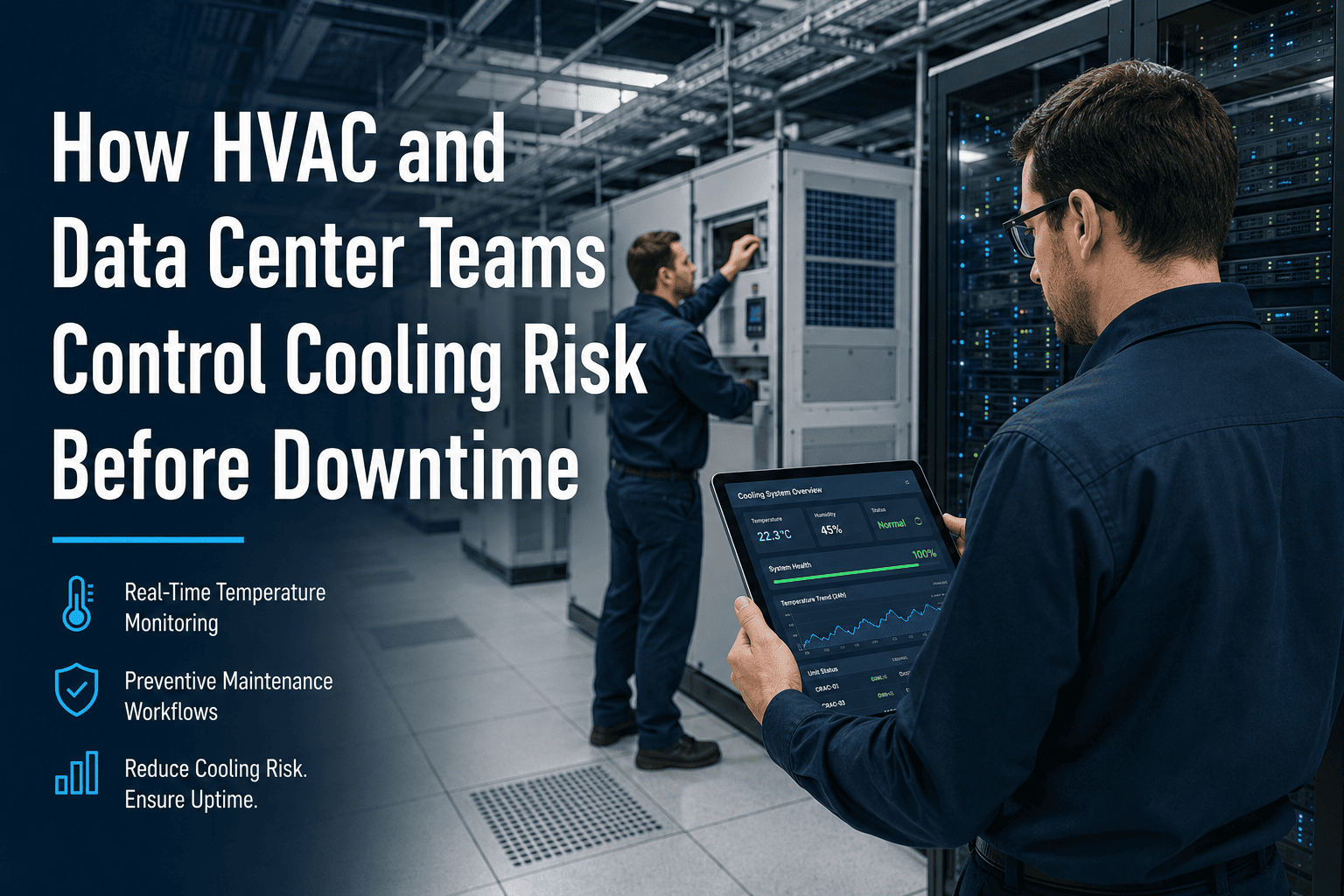
How HVAC and Data Center Teams Control Cooling Risk Before Downtime
CRAC, CRAH, chiller, and humidity-control assets unified under one CMMS — with BMS alarm routing, refrigerant tracking, redundancy scoring, and thermal runaway prevention built into every work order.
What is Cooling Risk Control in Data Center Operations
Cooling risk control is the structured discipline of managing every CRAC, CRAH, chiller, dry cooler, humidifier, leak detection sensor, and BMS control loop in a single system — with PM cycles, calibration intervals, refrigerant tracking, and redundancy validation enforced through documented work orders rather than operator memory. Unlike conventional HVAC management, mission-critical cooling treats every asset as a contributor to a thermal envelope where small failures cascade into total outages.
The model matters because cooling failures, unlike power failures, are gradual processes — capacity degrades, inlet temperatures rise, servers throttle performance, and then over-temperature protection trips entire racks. By the time the BMS alarm reaches a critical threshold, the time-to-shutdown window may be measured in minutes. Facilities running structured cooling risk control catch the early degradation signals — bearing vibration on a CRAC fan, a 2-degree creep in supply air temperature, a slow refrigerant loss — before they cascade. Start a free trial to see how condition-based PM closes the early warning gap.
Eight Concepts in Mission-Critical Cooling Management
Eight structural concepts separate facilities running disciplined cooling risk control from those running on hope and operator habit. Each represents a checkpoint that determines whether a degradation signal becomes a corrective work order or a 3am thermal shutdown.
Pain Points Across Cooling Risk Management
Every data center operations director recognises the same six recurring exposures — and every one of them stems from the same root issue: cooling systems generate degradation signals long before they fail, but those signals live in disconnected BMS dashboards, vendor reports, and spreadsheets that nobody reviews until the alarm has already gone red. Start a free trial to see how unified condition data closes this gap.
How Oxmaint Solves Cooling Risk Management
Oxmaint gives mission-critical facility teams one system that connects BMS alarms to documented work orders, tracks every cooling asset against its redundancy role, and enforces calibration and refrigerant compliance through structured PM cycles. Implementation runs in days, not months — book a demo to walk through configuration against your specific cooling envelope.
Reactive vs Planned Cooling Operations Side by Side
The clearest argument for structured cooling risk control is the cost and downtime difference between catching degradation early and responding after the cascade starts. The table below maps six common scenarios against both operating models — every row represents a real incident pattern documented in Uptime Institute outage data. Start a free trial to validate the model against your own asset list.
| Cooling Scenario | Reactive Operations | Planned Operations with Oxmaint |
|---|---|---|
| CRAC Bearing Wear | Vibration data sits in BMS, fan trips, adjacent units overrun, row thermal event at 2am | Vibration trend triggers work order at threshold, bearing replaced during planned bypass window |
| Refrigerant Leak | Slow charge loss invisible until cooling capacity drops, found during emergency callout | Section 608 log detects rate change, leak inspection scheduled, no capacity loss |
| Humidity Excursion | Static event damages PCB, RMA cycle begins, root cause untraced | ASHRAE envelope deviation alerts at 40%/60% boundary, humidifier serviced before incident |
| Maintenance Bypass | Verbal handoff, bypass left in place past shift change, redundancy gone during grid event | Bypass logged with risk score, auto-escalation if not closed, redundancy restored on schedule |
| PUE Drift | Energy bill rises, no traceable cause, optimisation project deferred year over year | PUE tracked per intervention, drift root-caused to specific setpoint, cooling spend reduced 20–35% |
| Section 608 Audit | Reconciliation across multiple spreadsheets and vendor reports, gaps exposed | Annual report exports in minutes from work order data — fully reconciled |
ROI and Uptime Outcomes for Cooling CMMS
The financial case for unified cooling risk management is documented in Uptime Institute survey data and operator case studies. The numbers below represent the recurring annual returns measured at mission-critical facilities that moved from spreadsheet-driven cooling management to a unified CMMS — typically within the first 12 months. Most data center teams switching to structured CMMS see cooling energy drop 20–35% and prevent six-figure outage events — which is why a free trial costs nothing to validate against your own thermal envelope.
Frequently Asked Questions
Does Oxmaint integrate with BMS and SCADA cooling alarms
How does Oxmaint handle EPA Section 608 refrigerant tracking
Can it enforce redundancy rules during maintenance bypass
Does it support PUE tracking and cooling optimisation reporting
Stop Losing Millions to Cooling Failures You Could See Coming
Turn every CRAC, chiller, and humidifier into a predictable, monitored asset. Used by operations teams managing 10,000+ assets. Measurable results in the first 30 days.