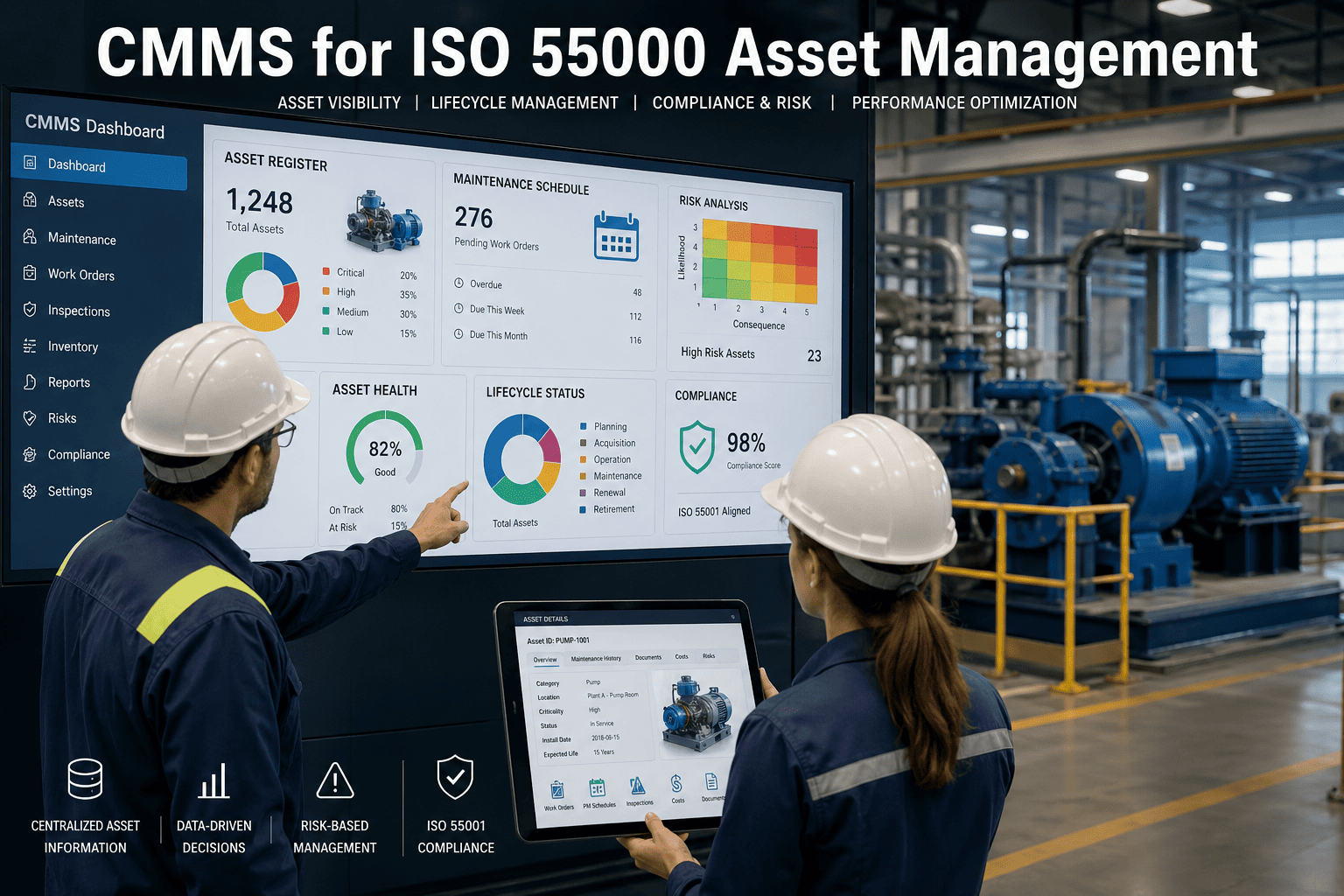
Organizations managing physical assets across multiple sites face a persistent challenge — proving that every asset decision is structured, risk-informed, and traceable. ISO 55000 provides the internationally recognized framework for exactly that, and a properly configured CMMS is the operational backbone that makes certification achievable without years of consulting overhead. Book a demo to see how Oxmaint maps directly to ISO 55001 clauses for audit-ready asset management.
Asset Management & Compliance · ISO 55000 · Lifecycle Planning
CMMS and ISO 55000: Achieve Asset Management Certification Faster
Asset register structuring, lifecycle cost tracking, risk-based maintenance planning, and audit-ready documentation — a complete operational guide to using CMMS for ISO 55000 certification readiness.
28%Average reduction in total cost of ownership after ISO 55001 adoption
45%Fewer unplanned failures with structured asset lifecycle management
$17B+Global asset management systems market size in 2024
4.8xCost multiplier of emergency repairs vs. planned maintenance
Map Your Asset Management System to ISO 55001 — Automatically
Oxmaint structures your asset register, automates lifecycle tracking, and generates the documentation auditors need — without spreadsheets or manual evidence gathering.
Section 01
What Is ISO 55000 and Why Does It Matter for Asset-Heavy Organizations?
ISO 55000 is a family of international standards that defines the requirements for establishing, implementing, maintaining, and improving an asset management system. Updated in 2024, the series consolidates around three core pillars — Value, Alignment, and Leadership — and applies to any organization that depends on physical assets to deliver its objectives. That includes manufacturing plants, utility networks, commercial property portfolios, and public infrastructure operators across the USA, UK, UAE, Australia, Germany, and Canada. The certifiable standard is ISO 55001, which specifies what your asset management system must demonstrate during an external audit. Organizations that achieve certification report an average 28% reduction in total cost of ownership within three years, driven by better lifecycle planning, fewer reactive interventions, and data-backed capital expenditure decisions. Want to see how Oxmaint accelerates your path to certification? Start a free trial and explore the full asset hierarchy today.
Section 02
Core ISO 55001 Requirements — And How CMMS Addresses Each One
ISO 55001 is structured around clauses 4 through 10, each defining a specific area your asset management system must address. A CMMS does not replace your management system — it provides the operational backbone, the data layer, and the audit trail that proves your system is functioning as documented.
Clause 4
Context of the Organization
Define asset scope, stakeholder needs, and organizational context. Oxmaint's portfolio hierarchy (Portfolio > Property > System > Asset > Component) maps directly to this requirement.
Clause 5
Leadership & Policy
Document asset management policy and assign roles. Oxmaint stores policies, assigns ownership at every hierarchy level, and logs management review evidence digitally.
Clause 6
Planning
Risk assessment and objective-setting. Oxmaint's condition scoring and criticality ranking feed directly into risk-based maintenance planning and 5–10 year CapEx forecasts.
Clause 7
Support & Resources
Competence records, documented information, and communication. Oxmaint tracks technician certifications, stores SOPs, and maintains a complete audit trail of every action.
Clause 8
Operation
Implement maintenance plans and manage change. Preventive maintenance scheduling, work order management, and spare parts inventory in Oxmaint cover this clause end-to-end.
Clause 9–10
Performance & Improvement
Monitor KPIs, conduct internal audits, and drive continual improvement. Oxmaint dashboards track MTBF, MTTR, OEE, and asset condition trends across your entire portfolio.
Section 03
The Pain Points That Stall ISO 55000 Certification
Most organizations that attempt ISO 55001 certification without a structured digital system encounter the same four barriers — each one adding months to the timeline and tens of thousands in consulting costs.
01
Fragmented Asset Records
Asset data scattered across spreadsheets, filing cabinets, and email threads. Auditors require a single, structured asset register — 67% of certification delays trace back to incomplete or inconsistent asset data.
02
No Lifecycle Visibility
Without condition tracking from acquisition through disposal, organizations cannot demonstrate lifecycle planning. ISO 55001 Clause 6 requires documented evidence of how asset decisions consider whole-life cost.
03
Risk Decisions on Guesswork
CapEx decisions made without condition data or failure history produce asset plans that auditors reject. 52% of organizations report their capital planning is based on age-only replacement, not risk or condition data.
04
Audit Evidence Gaps
Paper-based or informal maintenance records cannot provide the timestamped, traceable evidence that external auditors require. The average organization spends 120+ hours manually compiling audit documentation.
Section 04
How Oxmaint Solves Each Certification Barrier
Asset Register
Structured 5-Level Asset Hierarchy
Portfolio > Property > System > Asset > Component. Every asset tagged with location, criticality score, condition rating, and complete maintenance history. Auditors get the structured register ISO 55001 Clause 4 demands.
Lifecycle Tracking
Condition-Based Lifecycle Management
Track every asset from commissioning through operation, degradation, and disposal. Condition scoring updates with each inspection, feeding directly into replacement forecasts and remaining useful life calculations.
Risk Planning
Rolling 5–10 Year CapEx Forecasts
Data-driven capital planning based on condition scores, failure trends, and criticality rankings — not guesswork. Generate investor-grade CapEx reports that satisfy Clause 6 planning requirements automatically.
Audit Readiness
Digital Signatures & Complete Audit Trail
Every work order, inspection, and maintenance action is timestamped, technician-signed, and permanently stored. Pull audit evidence in minutes instead of weeks — with digital signatures that satisfy external certification bodies.
Multi-Site
Portfolio-Level Reporting
Consolidated asset performance across every property in your portfolio. Investors, ownership groups, and auditors see one unified view — not separate spreadsheets per site.
Mobile-First
Field Inspections on Any Device
Technicians capture condition data, complete inspections, and close work orders from the field. Data flows into the asset register in real time — no double entry, no paper forms.
Section 05
Before vs. After: Asset Management Without and With CMMS
| Dimension | Without CMMS | With Oxmaint CMMS |
|---|
| Asset Register | Spreadsheets, inconsistent formats, missing data | Structured 5-level hierarchy with condition scoring |
| Lifecycle Planning | Age-based replacement only — no condition data | Condition-based lifecycle tracking with remaining useful life |
| CapEx Decisions | Guesswork and historical budgets | Rolling 5–10 year forecasts based on real asset condition |
| Audit Documentation | 120+ hours manual compilation per audit | Auto-generated reports with digital signatures — minutes |
| Multi-Site Visibility | Siloed records, no portfolio view | Unified portfolio dashboard across all properties |
| Maintenance Strategy | Reactive — fix when it breaks | Preventive + condition-based with automated scheduling |
Section 06
ROI of ISO 55000 Certification with CMMS
28%
Lower Total Cost of Ownership
Organizations with certified asset management systems reduce TCO within 3 years through lifecycle optimization and planned replacements.
45%
Fewer Unplanned Failures
Condition-based tracking identifies degradation early, converting emergency breakdowns into scheduled interventions.
35%
Reduction in Maintenance Costs
Preventive strategies tied to asset criticality eliminate wasteful time-based maintenance on low-risk assets.
90%
Faster Audit Preparation
Digital audit trails with timestamped records reduce evidence gathering from weeks to hours across the entire portfolio.
These numbers are not theoretical — they reflect documented outcomes from asset-intensive organizations in utilities, manufacturing, property management, and public infrastructure. The common factor is replacing fragmented manual records with a structured CMMS that maps directly to ISO 55001 requirements. Ready to see this in action? Book a demo and walk through the full certification workflow with our team.
FAQs
Frequently Asked Questions
Does using a CMMS automatically make us ISO 55001 certified?
No. ISO 55001 certifies your asset management system — the policies, objectives, processes, and organizational structure. A CMMS is the technology tool that supports and documents those processes. Oxmaint provides the structured data layer, audit trail, and reporting that auditors need to verify your system is functioning — but certification requires the full management system framework including policy, leadership commitment, and continual improvement processes.
Start a free trial to explore how Oxmaint maps to each ISO 55001 clause.
How long does ISO 55001 certification typically take with CMMS support?
Organizations using a properly configured CMMS typically achieve certification readiness in 6–12 months, compared to 18–24 months for organizations relying on manual systems. The difference is primarily in documentation completeness — a CMMS eliminates the months spent retroactively building asset registers and compiling maintenance histories.
Book a demo to discuss your certification timeline.
What is the difference between ISO 55000 and ISO 55001?
ISO 55000 provides the overview, principles, and terminology for asset management. ISO 55001 specifies the requirements — it is the certifiable standard. ISO 55002 provides guidance on applying ISO 55001. When organizations say they are "ISO 55000 certified," they mean they have been certified against ISO 55001 requirements.
Can Oxmaint support multi-site certification across a property portfolio?
Yes. Oxmaint is built specifically for multi-site portfolios with a five-level asset hierarchy. Every property operates under a unified system, so auditors see consistent processes, standardized data, and portfolio-level reporting across all locations — which is exactly what certification bodies require for multi-site scope.
Start a free trial to see multi-site portfolio management in action.
Stop Guessing. Start Managing Assets With Certification-Grade Discipline.
Oxmaint gives you the structured asset register, condition-based lifecycle tracking, automated CapEx forecasts, and digital audit trail that ISO 55001 demands — with zero heavy implementation fees and no 18-month onboarding timelines.