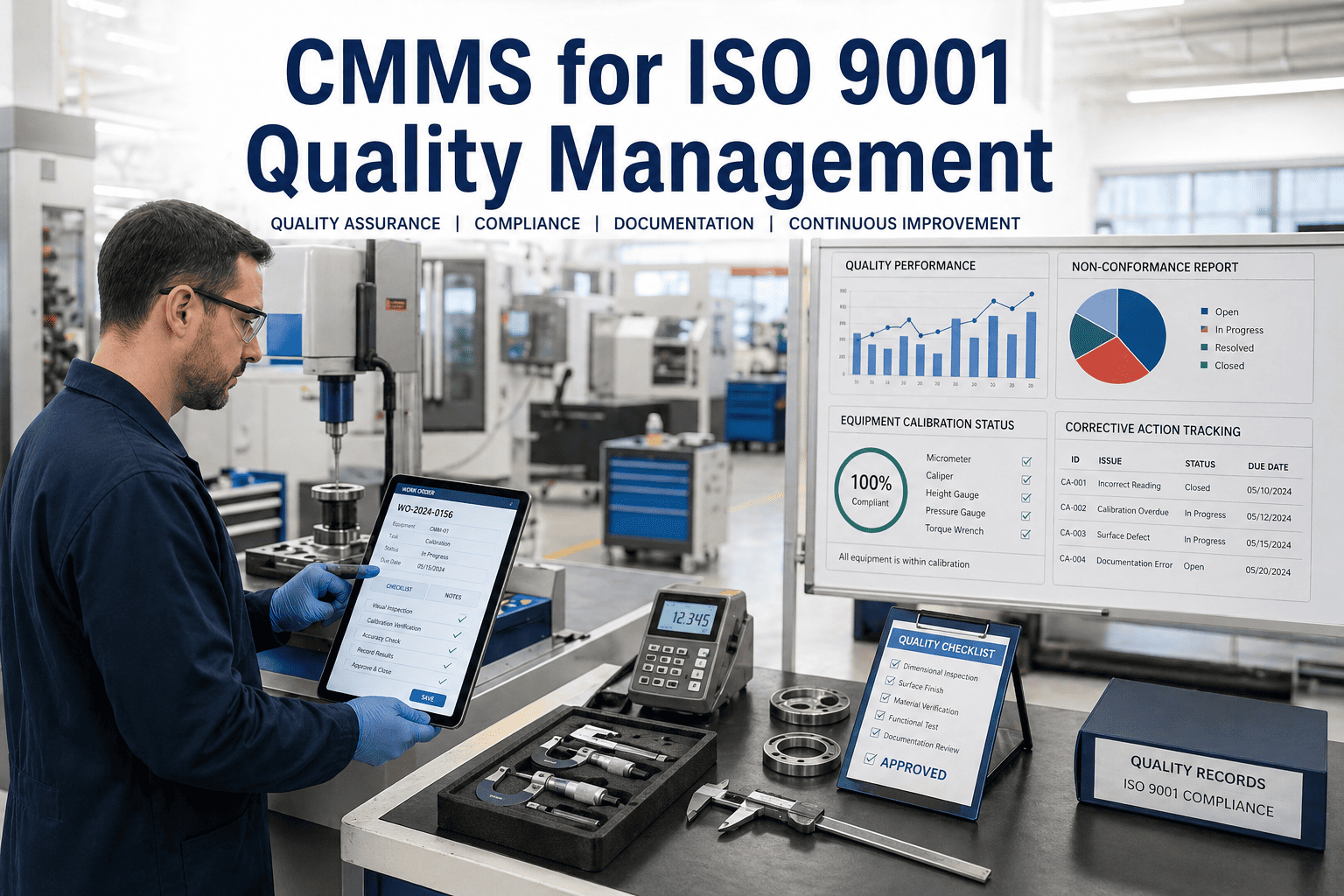
Quality management without traceable maintenance records is a liability waiting to surface during your next ISO 9001 audit. Equipment that drifts out of calibration, maintenance that happens but is never documented, and corrective actions that exist only in memory — these gaps cost organizations their certification and their credibility. A properly configured CMMS eliminates every one of these risks by embedding quality requirements directly into daily maintenance workflows. Book a demo to see how Oxmaint delivers audit-ready maintenance documentation for ISO 9001 compliance.
Quality Management · ISO 9001 · Maintenance Compliance
CMMS for ISO 9001: Simplify Maintenance and Quality Compliance
Calibration tracking, nonconformance management, preventive maintenance logs, corrective action workflows, and audit-ready documentation — a practical guide to using CMMS for ISO 9001 quality management compliance.
1.4M+Organizations worldwide hold ISO 9001 certification
40%Of audit nonconformances trace to incomplete maintenance records
25%Reduction in equipment-related defects with structured PM programs
90%Faster audit evidence retrieval with digital maintenance logs
Turn Every Maintenance Action Into Audit-Ready Quality Evidence
Oxmaint captures calibration records, maintenance logs, and corrective actions with digital signatures and timestamps — so your next ISO 9001 audit is a formality, not a crisis.
Section 01
What Is ISO 9001 and Why Does Maintenance Matter?
ISO 9001 is the world's most widely adopted quality management system standard, with over 1.4 million certified organizations across 189 countries. It requires organizations to demonstrate that infrastructure — including equipment, machinery, and measurement instruments — is maintained in a condition that ensures consistent product and service quality. Clause 7.1.3 (Infrastructure) and Clause 7.1.5 (Monitoring and Measuring Resources) specifically require documented evidence that equipment is maintained and calibration is traceable. Without a digital system capturing this evidence, maintenance teams spend weeks compiling paper trails that auditors can challenge on completeness, accuracy, and traceability. Organizations that digitize their maintenance workflows report 90% faster audit preparation and 25% fewer equipment-related quality defects within the first year. Ready to eliminate the audit scramble? Start a free trial and explore Oxmaint's calibration tracking today.
Section 02
ISO 9001 Clauses That Depend on Maintenance Data
7.1.3
Infrastructure
Maintain buildings, equipment, and utilities to ensure conformity. Oxmaint tracks every asset with full service history, condition scoring, and preventive maintenance schedules.
7.1.5
Monitoring & Measuring Resources
Calibrate instruments at defined intervals with traceable records. Oxmaint automates calibration scheduling and stores certificates with digital signatures.
8.5.1
Control of Production
Ensure equipment is suitable and maintained for intended use. Oxmaint links preventive maintenance completion directly to production asset records.
8.7
Control of Nonconforming Outputs
Document and manage nonconformances. Oxmaint logs equipment-related NCRs, links them to corrective actions, and tracks closure with auditable evidence.
10.2
Nonconformity & Corrective Action
Investigate root causes and implement corrective actions. Oxmaint's corrective action workflows ensure every issue is documented from detection through verified closure.
9.1
Monitoring, Measurement & Analysis
Track KPIs and analyze performance data. Oxmaint dashboards display MTBF, MTTR, PM completion rates, and calibration compliance in real time.
Section 03
Common Quality Gaps That Fail Audits
01
Missing Calibration Records
38% of ISO 9001 minor nonconformances involve calibration gaps — instruments used past their due date or calibration certificates that cannot be located during the audit.
02
Undocumented Maintenance Activities
Work gets done but never recorded. Auditors treat undocumented maintenance as non-existent — if it is not in the system, it did not happen. This accounts for 40% of infrastructure-related findings.
03
No Corrective Action Traceability
Equipment failures that caused quality defects without documented root cause analysis and corrective action closure. Clause 10.2 requires end-to-end traceability from detection to verified resolution.
04
Inconsistent PM Execution
Preventive maintenance schedules that exist on paper but are not consistently followed. Auditors check completion rates — anything below 85% raises questions about system effectiveness.
Section 04
How Oxmaint Delivers ISO 9001 Compliance
Calibration
Automated Calibration Tracking
Schedule calibrations by date or usage. Store certificates digitally with technician signatures. Auto-flag overdue instruments before they compromise measurement accuracy.
Work Orders
Complete Maintenance Logs
Every work order captures technician, parts used, time spent, and outcome — timestamped and signed digitally. No more "did we actually do that maintenance?" during audits.
NCR Tracking
Nonconformance Management
Log equipment-related nonconformances, link to root cause analysis, assign corrective actions, and track through verified closure — all within the same platform.
PM Scheduling
Preventive Maintenance Automation
Time-based, meter-based, and condition-based triggers ensure PM tasks execute on schedule. Track completion rates against your 85%+ target in real-time dashboards.
GMP Compliance
Digital Inspection Checklists
Standardized checklists with mandatory fields and photo capture. Eliminate variability between technicians and ensure every inspection follows documented procedures.
Reporting
Audit-Ready KPI Dashboards
MTBF, MTTR, PM completion rate, calibration compliance, and corrective action closure time — all available instantly when the auditor asks for performance evidence.
Section 05
Manual Records vs. CMMS: Quality Documentation Comparison
| Quality Requirement | Manual / Paper-Based | Oxmaint CMMS |
| Calibration Certificates |
Filed in binders, often misfiled or expired |
Digital storage with auto-expiry alerts and instant retrieval |
| Maintenance Logs |
Handwritten, incomplete, no timestamps |
Timestamped digital records with technician signatures |
| Corrective Actions |
Email chains, no closure verification |
Structured workflow: detection to root cause to verified closure |
| PM Completion Tracking |
Spreadsheet tallies, updated monthly |
Real-time dashboard with daily completion rates per asset |
| Audit Preparation Time |
2–4 weeks of manual compilation |
Minutes — all evidence available instantly on-demand |
| Cross-Site Consistency |
Different formats per location |
Unified templates and workflows across all sites |
Section 06
Measurable Quality Improvements with CMMS
25%
Fewer Equipment-Related Defects
Consistent PM execution and calibration compliance prevent the equipment drift that causes quality failures.
90%
Faster Audit Preparation
Digital records with search, filter, and export eliminate weeks of manual evidence compilation.
60%
Reduction in Repeat Nonconformances
Structured corrective action workflows ensure root causes are addressed, not just symptoms.
98%
PM Completion Rate Achievable
Automated scheduling with overdue escalation alerts ensures preventive tasks never fall through the cracks.
These outcomes are typical for organizations that transition from paper-based maintenance to a structured CMMS within their ISO 9001 quality management system. The investment pays for itself in reduced audit costs, fewer quality incidents, and eliminated rework alone. See the difference in your operation — book a demo and walk through the full ISO 9001 compliance workflow with our team.
FAQs
Frequently Asked Questions
Which ISO 9001 clauses require maintenance documentation?
The primary clauses are 7.1.3 (Infrastructure), 7.1.5 (Monitoring and Measuring Resources), 8.5.1 (Control of Production), 8.7 (Nonconforming Outputs), and 10.2 (Corrective Action). Each requires documented evidence that equipment is maintained, calibrated, and that nonconformances are systematically addressed.
Start a free trial to see how Oxmaint maps to each clause.
Can CMMS replace our quality management system for ISO 9001?
No — a CMMS is a supporting tool, not a replacement for your QMS. ISO 9001 requires a complete quality management system covering policy, objectives, processes, and continual improvement. Oxmaint handles the maintenance and calibration documentation layer that feeds into your QMS, ensuring equipment-related evidence is always audit-ready.
How does Oxmaint handle calibration tracking specifically?
Oxmaint schedules calibrations by date or meter reading, stores digital certificates with technician signatures, auto-flags instruments approaching their due date, and generates calibration compliance reports. When an instrument is found out of tolerance, the system triggers a nonconformance review for any products measured with that instrument since its last valid calibration.
Book a demo to see calibration management in action.
What PM completion rate do ISO 9001 auditors expect?
There is no fixed number in the standard, but auditors typically consider completion rates below 85% as evidence that your maintenance system is not effectively implemented. Best-in-class organizations using CMMS maintain 95–98% PM completion rates. Oxmaint tracks this in real time and escalates overdue tasks automatically.
Start a free trial to track your PM completion rate.
Your Next ISO 9001 Audit Should Be a Formality — Not a Fire Drill.
Oxmaint captures every calibration, every work order, every corrective action with digital signatures and timestamps. When the auditor arrives, your evidence is already organized, traceable, and complete.