School and university facilities teams that still manage custodial requests through phone calls, sticky notes, and email threads are not just slow — they are invisible to accountability. When a spill on the third floor of Building C goes unreported for two hours, a leak near the gym equipment room goes unrouted to the right crew, and a post-event cleanup in the auditorium never gets confirmed as completed, the result is not just a dirty building — it is a liability. Schools managing custodial operations with structured digital routing report 35–50% faster response times and a 60% reduction in missed or duplicated tasks. Start a free trial on Oxmaint or book a demo to see how your campus can get there.
See how much response time you can eliminate from your custodial workflow today.
No heavy implementation required | Live in days, not months | Works across multi-site campuses
What Is Campus Custodial Request Routing?
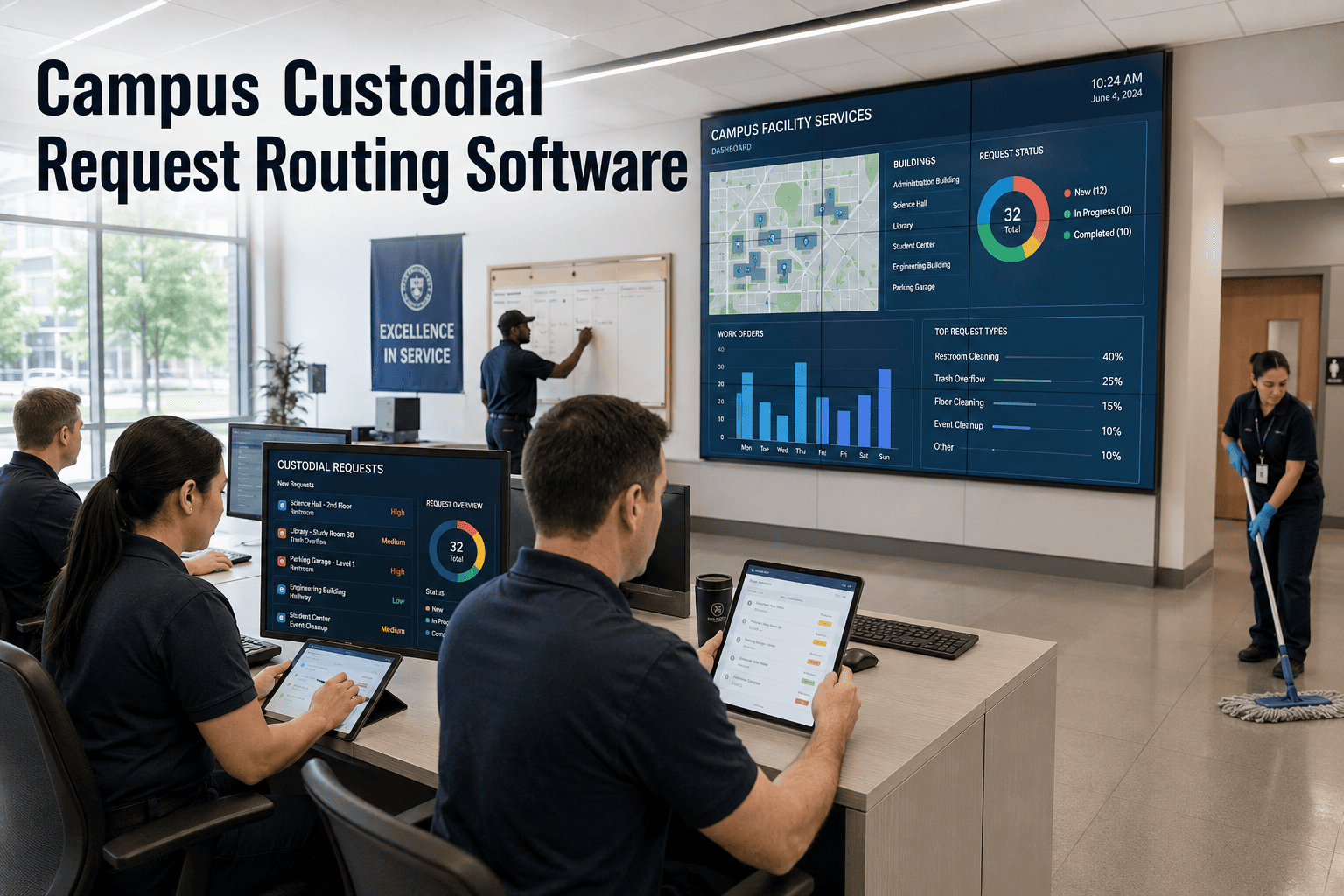
Campus custodial request routing is the structured process of capturing, categorizing, and dispatching cleaning and sanitation tasks to the right custodial staff — based on building zone, urgency level, crew availability, and shift schedule. Rather than relying on ad-hoc phone calls or supervisor memory, a digital routing system creates a traceable workflow from request submission to task completion and sign-off.
In an education environment, custodial requests arrive from multiple sources simultaneously: teachers reporting spills, administrators scheduling post-event cleanups, nurses flagging biohazard areas, and facilities staff identifying maintenance-related cleaning needs. Without a system, these requests either pile up on one person's desk or get lost entirely. According to APPA, education facilities spend an average of $1.98 per square foot annually on custodial services — and a significant portion of that cost is wasted on inefficient task distribution and duplicate efforts.
A purpose-built custodial routing platform connects request intake with workforce management — routing each task to the available crew member with the right skills and tools, at the right time. Teams that implement structured routing report completing 30% more tasks per shift without adding headcount — start a free trial to see how Oxmaint structures this for your campus, or book a demo and we will map your building structure into the platform live.
8 Key Concepts in Custodial Request Routing
Understanding these elements is the foundation of building a responsive, accountable custodial operation across any campus.
Mobile forms, QR-code room reports, and staff portals that capture cleaning requests from any campus location in seconds — no phone tag required.
Automatic tagging by severity — biohazard, safety-critical spill, routine cleaning, or scheduled service — so high-risk situations are never buried in a queue.
Each building, floor, and wing is mapped to a primary and backup custodian. Requests auto-route to the nearest available crew member in the correct zone.
Real-time crew schedules, shift assignments, and absence tracking ensure tasks are only dispatched to staff who are on-site and available to respond.
Every task moves through a defined workflow: submitted → assigned → in progress → completed → verified. Nothing falls through without a timestamped record.
Daily, weekly, and seasonal cleaning schedules auto-populate the task queue — cafeteria deep cleans, restroom checks, classroom rotations — without manual entry.
Photo documentation and digital sign-off confirm tasks are actually done — not just marked complete. Supervisors get real-time confirmation without walking every floor.
Response time by zone, task completion rates by shift, and repeat request trends reveal where the operation is strong and where it needs reinforcement.
6 Custodial Challenges Draining School Facility Budgets
These are the operational failures that make school custodial management expensive, reactive, and nearly impossible to improve without structured software. Teams that move to digital routing consistently eliminate the majority of these issues within 60 days — start a free trial to see how Oxmaint addresses your specific pain points.
Without a central intake system, requests accumulate in inboxes, voicemails, and hallway conversations. Supervisors have no real-time view of what is pending, in progress, or overdue across buildings.
Manual dispatching sends the wrong crew to the wrong building 15–20% of the time, according to ISSA benchmarks — burning labor hours and delaying legitimate urgent requests.
Spills, biohazards, and slip risks that are not responded to within documented timeframes create liability exposure. Without digital routing, schools cannot prove response times in the event of an incident.
Athletic events, assemblies, and cafeteria spills generate surges that overwhelm informal systems. Cleanup delays cascade into the next school day, impacting classroom readiness and health standards.
Without task tracking data, facilities managers cannot tell if a crew is understaffed, inefficient, or simply assigned to the wrong zones. Budget requests go unsupported because performance data does not exist.
Paper-based task sheets are easy to mark complete without verification. Without photo confirmation and timestamped digital records, supervisors cannot identify persistent performance issues or protect compliant staff.
6 Ways Oxmaint Transforms Campus Custodial Operations
Oxmaint replaces disconnected custodial workflows with a single platform built for education facilities — from a single school to a multi-campus district.
Place QR codes in every room and common area. Teachers, staff, and students scan to submit a cleaning request instantly — including photo, urgency level, and location — with no app download required.
Requests auto-dispatch to the nearest available custodian in the correct zone. Real-time crew availability prevents over-assignment and eliminates the "who do I call?" bottleneck for supervisors.
Biohazard and safety-critical requests trigger immediate alerts — not just queue entries. Escalation rules ensure high-risk situations are never delayed by routine task volume.
Daily classroom checks, restroom rotations, and seasonal deep cleans are pre-loaded and auto-scheduled — so crews always know their planned workload without daily supervisor briefings.
Custodians close tasks on their phone with a photo and digital sign-off. Supervisors see real-time completion confirmation on a live dashboard — without walking every floor.
Response time by zone, completion rate by shift, and top-request locations give facilities directors the data they need to optimize staffing, justify budgets, and improve performance across all campuses.
Reactive Custodial Management vs. Structured Routing
This is what changes when a school district moves from informal custodial coordination to Oxmaint's structured request routing platform.
| Operational Area | Reactive / Manual | With Oxmaint Routing | Impact |
|---|---|---|---|
| Request intake method | Phone calls, emails, verbal reports | QR code + mobile form, centralized inbox | Zero missed requests |
| Task assignment | Supervisor manually dispatches | Auto-routed by zone and availability | 40% faster dispatch |
| Urgency handling | All requests treated equally | Priority tiers with escalation alerts | Safety risks resolved first |
| Completion confirmation | Paper sign-off or verbal confirmation | Photo + digital sign-off in app | Full audit trail per task |
| Recurring task management | Printed schedules, memory-dependent | Auto-scheduled, auto-assigned | 30% more tasks completed per shift |
| Performance visibility | No data — anecdotal feedback only | Live dashboard, weekly reports | Data-backed staffing decisions |
What Schools Measure After Implementing Custodial Routing Software
These are the operational outcomes facilities teams report when they replace manual custodial coordination with structured digital routing. Teams that have made the shift consistently report measurable gains within 30 days — start a free trial to start tracking your own results.
Custodial teams using zone-based routing respond to urgent requests 35% faster than phone-dispatch operations, per ISSA benchmarks.
Eliminating dispatch friction and duplicate assignments allows existing staff to handle significantly higher task volumes without overtime.
Digital intake with confirmation notifications eliminates the verbal and email gaps that cause 20–30% of informal requests to go unaddressed in manual systems.
APPA data shows schools spending $1.98/sqft annually on custodial services — routing optimization can reduce that by 15–20% through labor efficiency gains.
Campus Custodial Routing Software — Answered
Can Oxmaint handle multiple school buildings within a single district?
How do teachers and staff submit custodial requests without downloading an app?
Does Oxmaint support custodial staff who work evening or weekend shifts?
What kind of reports can facilities directors export for compliance or budget reviews?
Stop Losing Custodial Hours to Miscommunication
Turn every cleaning request into a trackable, routable, verifiable task with Oxmaint — purpose-built for education facilities.
Used by operations teams managing 10,000+ assets | See measurable results in the first 30 days
No heavy implementation required | Live in days, not months | Works across multi-site campuses