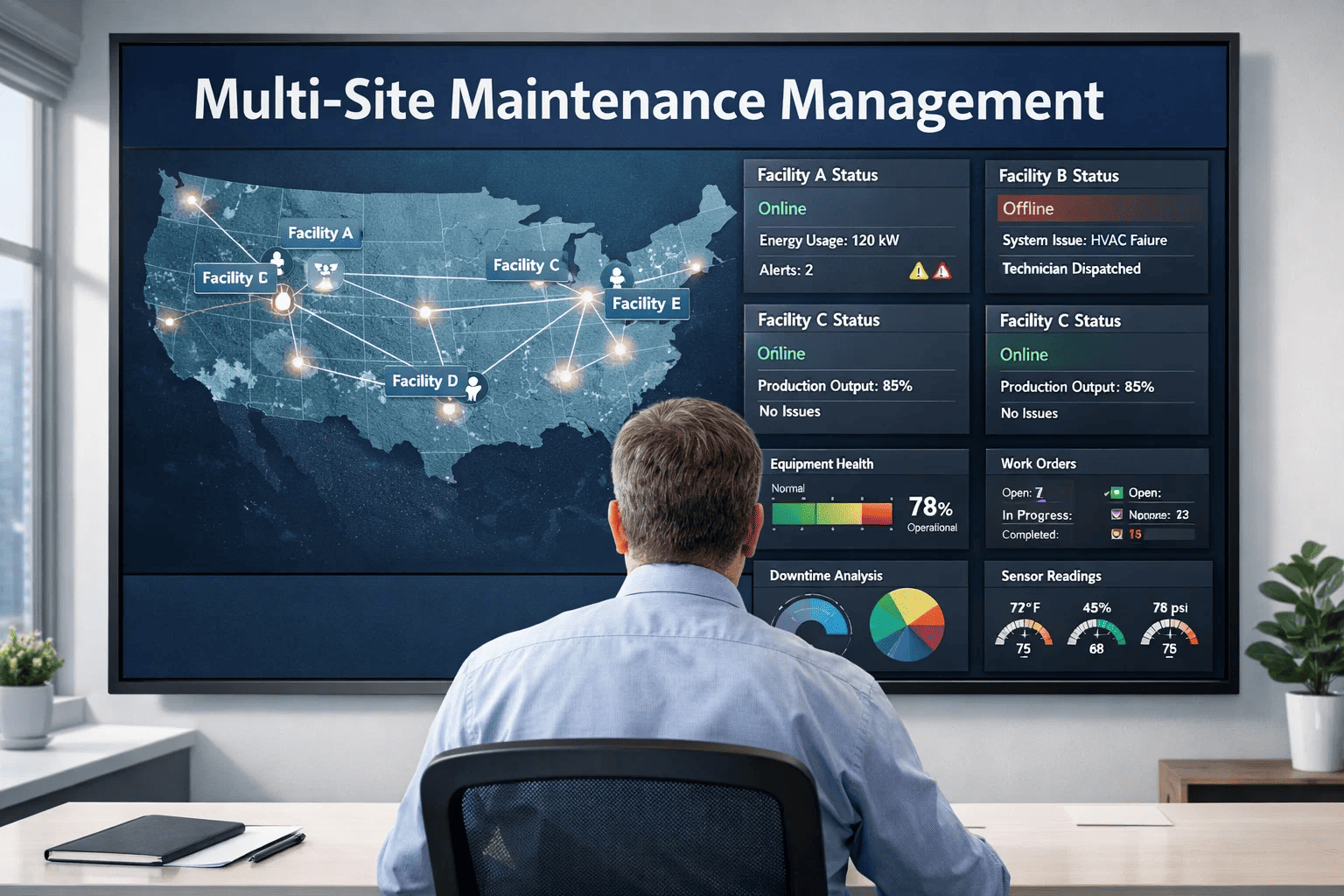
Managing maintenance across multiple facilities without a centralized system is like running five separate companies that happen to share a logo. Site A uses one PM schedule format, Site B tracks assets differently, Site C has its own spare parts ordering process, and Site D just lost its maintenance supervisor — taking all institutional knowledge with them. The result: no standardized processes, no cross-site benchmarking, no portfolio-level visibility, and no ability to detect that Site C's chiller maintenance costs are 3x higher than the identical equipment at Site A. Organizations managing 3+ facilities with decentralized maintenance systems spend 15–40% more than their centralized counterparts — driven by redundant inventory ($45K–$120K excess per site), inconsistent PM execution (25–40% variance in compliance rates between sites), and zero ability to share best practices, labor, or parts across locations. A centralized CMMS eliminates these inefficiencies by giving every facility the same platform, the same standards, and the same visibility — while giving leadership the portfolio-level analytics they need to allocate capital, benchmark performance, and detect underperformance before it becomes a budget crisis. Start a free trial to centralize your multi-site maintenance in Oxmaint, or book a demo to see enterprise CMMS deployment for multi-facility operations.
One Platform. Every Facility. Complete Visibility.
Oxmaint gives multi-site organizations a single maintenance platform with standardized workflows, portfolio-level analytics, cross-site benchmarking, and investor-grade CapEx reporting — designed for the operational reality of managing maintenance across 3 to 300+ facilities.
The Multi-Site Maintenance Challenge: Why Decentralized Fails
When each facility runs its own maintenance management — whether through spreadsheets, local CMMS installations, or paper-based systems — the organization loses the ability to see, compare, standardize, and optimize across its portfolio. The problems are not theoretical; they are measurable, costly, and compounding. Facilities operating independently develop their own workflows, their own maintenance cultures, and their own blind spots — and leadership has no mechanism to detect which sites are world-class and which are silently deteriorating until something expensive breaks. Book a demo to see how Oxmaint reveals the performance gaps hiding across your portfolio.
Centralized vs Decentralized: The Operational Impact
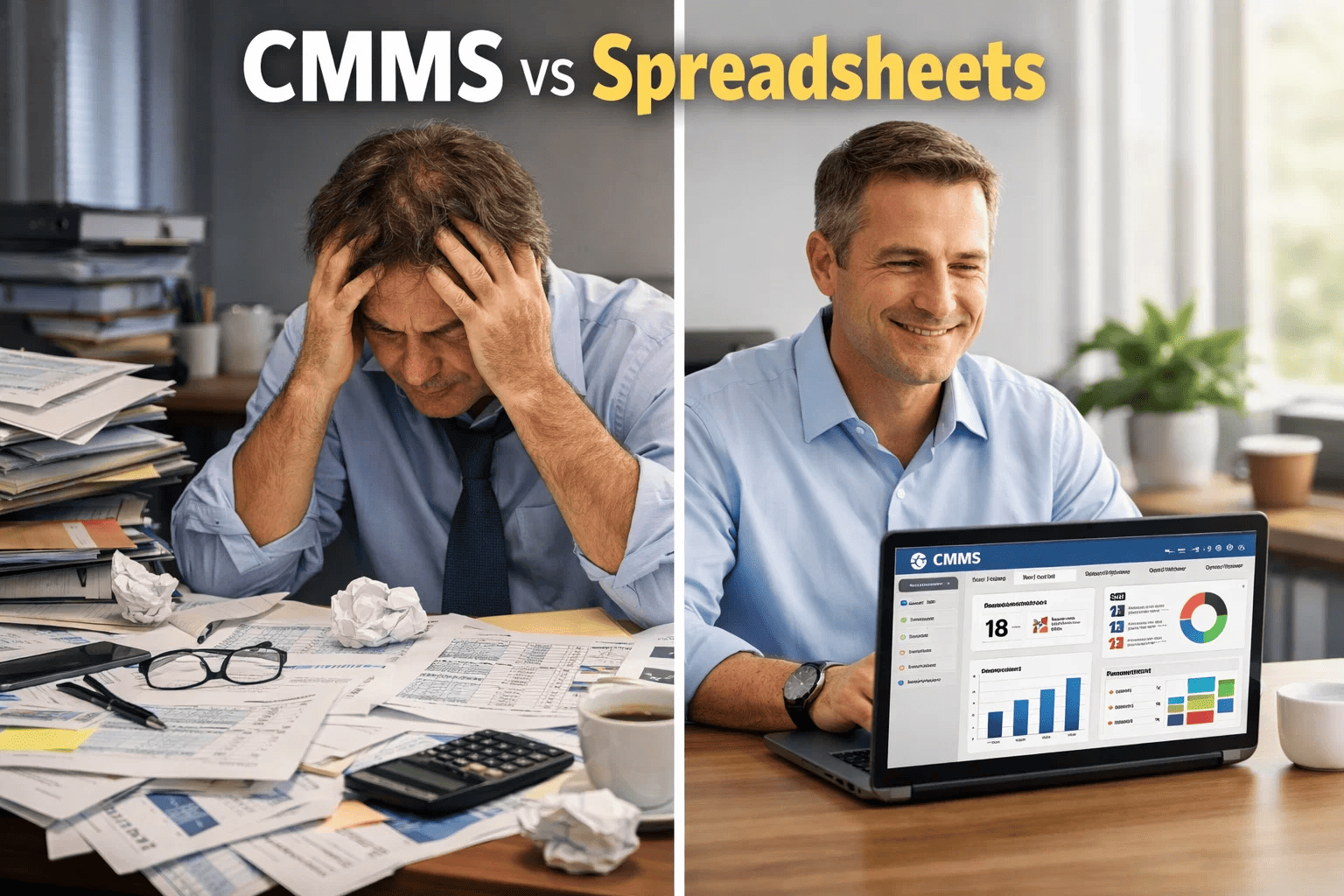
The comparison below shows measurable operational differences between organizations managing multi-site maintenance with fragmented tools versus those using a centralized CMMS platform. These are not theoretical projections — they are industry benchmarks from organizations that have made the transition. Start a free trial to test centralized maintenance management with your portfolio data.
How Oxmaint Powers Multi-Site Maintenance at Scale
Oxmaint is built for portfolios — not just individual facilities. The asset hierarchy (Portfolio, Property, System, Asset, Component) mirrors how multi-site organizations actually structure their operations, giving every stakeholder the right view at the right level of detail. Site managers see their facility. Regional directors see their region. VPs see the entire portfolio. Every view powered by the same real-time data. Book a demo to see portfolio-level maintenance management in Oxmaint.
Cross-Site Performance Dashboard
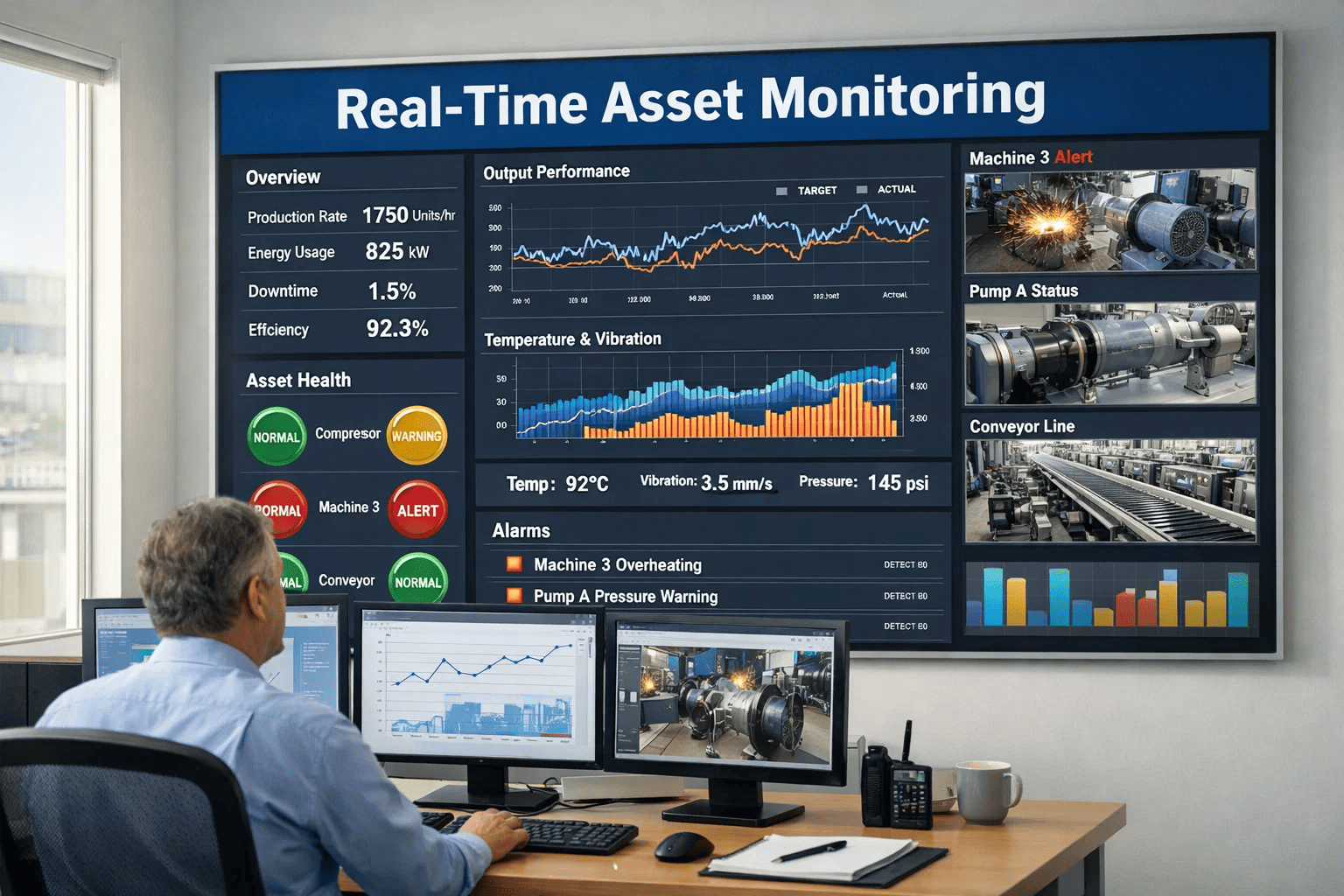
Compare MTBF, MTTR, PM compliance, maintenance cost per sq ft, and reactive work ratios across all facilities in a single view. Identify top performers and underperformers instantly — with drill-down capability to the individual asset level at any site.
Template-Based PM Programs
Create PM templates, inspection checklists, and work order procedures once — deploy to all sites with one click. When you update a template at headquarters, every site receives the updated version automatically. Standardized processes eliminate the 25–40% compliance variance that decentralized systems create.
Cross-Site Parts Visibility
See spare parts inventory across all locations in real time. Before placing an emergency order, check if another site has the part in stock. Enable inter-site transfers that eliminate emergency procurement costs ($45K–$120K annual savings per site) and reduce total inventory carrying costs by 30%.
Rolling 5–10 Year CapEx Forecasting
Portfolio-level capital expenditure forecasting based on asset condition scores, remaining useful life estimates, and maintenance cost trends. Investor-grade reporting that shows exactly when assets need replacement, what they will cost, and how to prioritize capital allocation across facilities.
1–2 Week New Site Onboarding
Add new facilities to your centralized CMMS in 1–2 weeks using pre-built templates from your existing sites. Asset hierarchies, PM schedules, inspection checklists, and work order workflows are cloned and customized — not built from scratch. Scale from 5 sites to 50 without proportional implementation effort.
Standardized Safety and Regulatory Records
Uniform compliance documentation across all sites — OSHA, FDA, ISO, building safety regulations. Digital checklists with timestamps and signatures ensure every facility meets the same regulatory standard. Portfolio-wide compliance dashboards flag non-compliant sites before auditors arrive.
Multi-Site CMMS ROI: What Centralization Delivers
Frequently Asked Questions
How does Oxmaint handle different regulatory requirements across regions?
Oxmaint supports region-specific compliance templates within a unified platform. US facilities get OSHA-aligned inspection checklists. UK sites get building safety regulation templates. UAE facilities access templates aligned with Vision 2030 requirements. German sites use templates meeting DIN and DGUV standards. Australian sites use templates reflecting WHS Act requirements. Each site operates within its regulatory context while the portfolio dashboard shows aggregate compliance status across all regions. This means a VP of Operations in New York can see compliance status for a facility in Dubai, Sydney, and London — all in one view with region-appropriate standards applied. Book a demo to see multi-region compliance management.
Can we roll out Oxmaint to one site first before expanding to the full portfolio?
Yes — and this is the recommended approach. Start with one pilot site (typically the facility with the most pain or the most supportive site manager), run for 60–90 days, measure the impact on PM compliance, downtime, and technician productivity, then use those results to build the business case for portfolio-wide deployment. Oxmaint's cloud architecture means adding sites requires no additional infrastructure — it is a configuration exercise, not an IT project. Most organizations expand from pilot to 5–10 sites within 6 months of initial deployment. Start a free trial with your pilot site today.
How does Oxmaint handle sites with different levels of maintenance maturity?
Multi-site portfolios almost always have a maturity spectrum — some sites run sophisticated PM programs while others are predominantly reactive. Oxmaint addresses this by deploying standardized baseline templates to all sites (ensuring minimum PM coverage) while allowing mature sites to layer on advanced capabilities like condition-based monitoring, predictive analytics, and IoT integration. The portfolio dashboard makes the maturity gap visible — showing exactly which sites are at world-class levels and which need targeted improvement. This visibility alone drives improvement because site managers see how their performance compares to peers, creating healthy competition and clear resource allocation priorities.
What does the asset hierarchy look like for a multi-site CMMS deployment?
Oxmaint structures assets in a five-level hierarchy: Portfolio (the entire organization), Property (individual facility or building), System (HVAC, electrical, plumbing, production line), Asset (specific equipment — chiller, compressor, motor), Component (sub-assembly — bearing, seal, belt). This hierarchy mirrors how maintenance organizations actually think about their assets and enables reporting at any level — from a single bearing failure to portfolio-wide CapEx forecasting. Each level inherits the compliance requirements, PM templates, and reporting standards configured above it, ensuring consistency without manual duplication across hundreds of sites.
Stop Managing 10 Sites With 10 Systems — Centralize With Oxmaint
Multi-site operators across commercial real estate, manufacturing, healthcare, and industrial portfolios in the USA, UK, UAE, Australia, and Germany use Oxmaint to standardize maintenance, benchmark performance, and make portfolio-level decisions with real-time data — not quarterly spreadsheets.