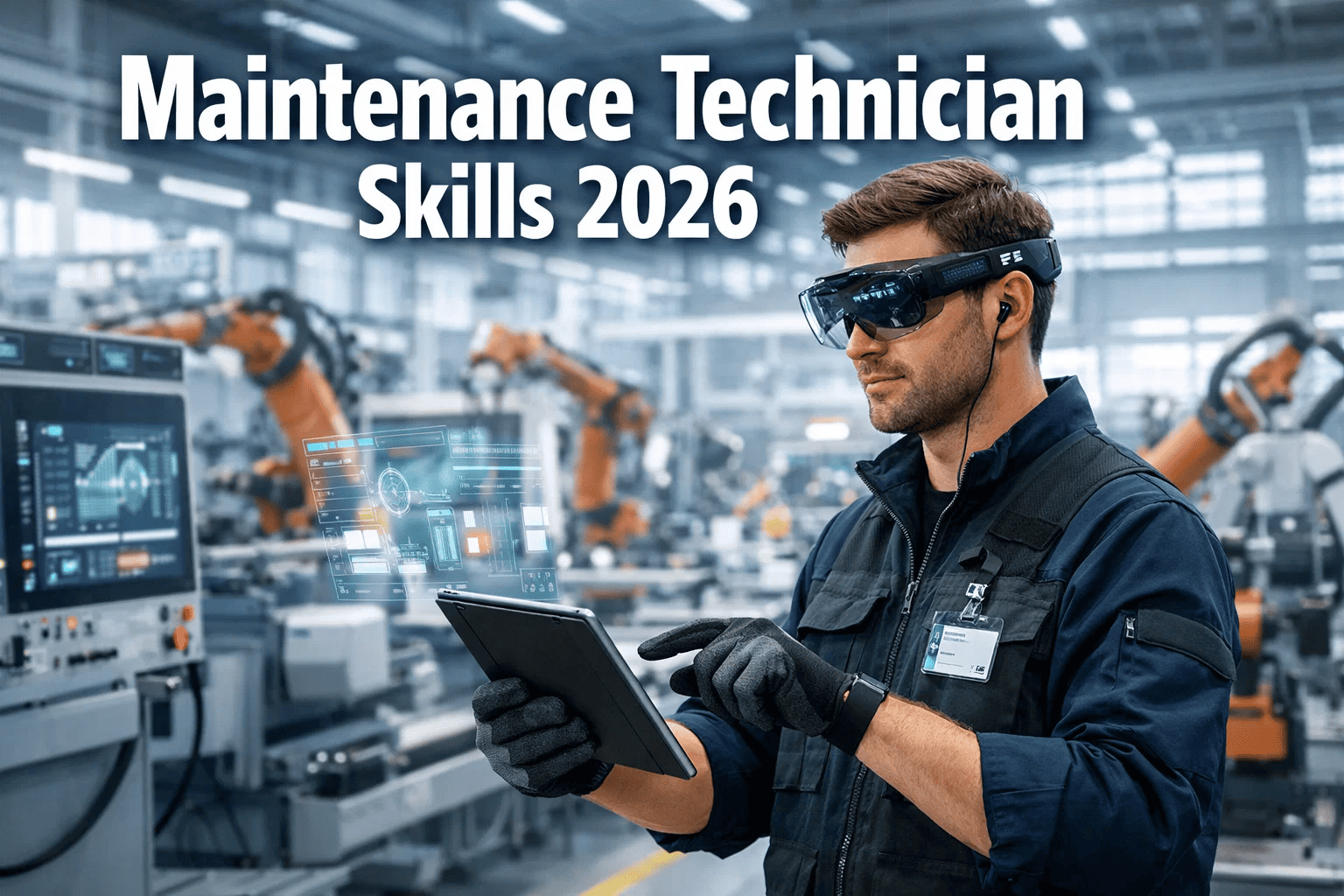
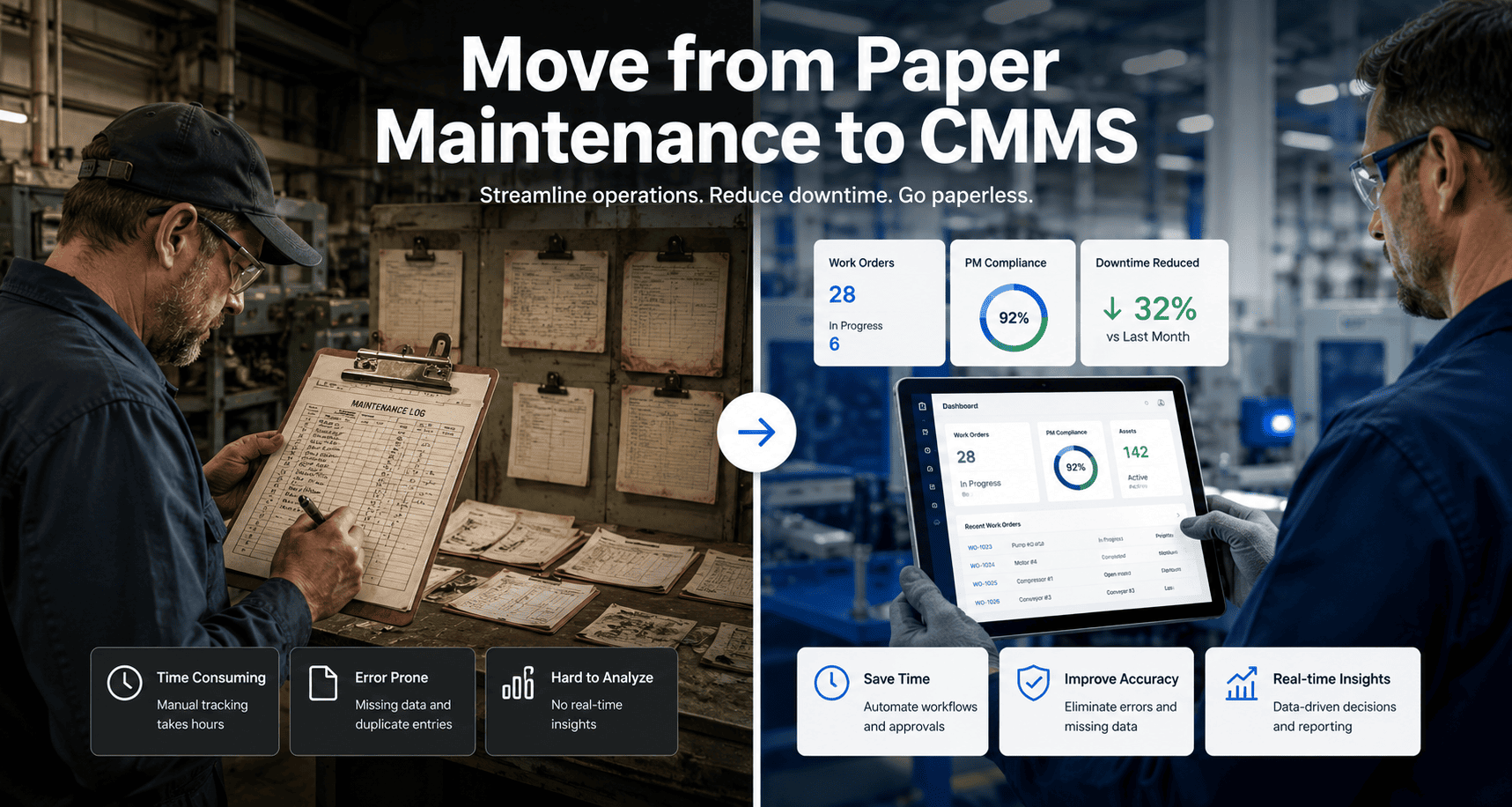
The maintenance technician role is undergoing its most dramatic transformation in industrial history — and the skills that kept equipment running in 2020 are no longer sufficient for the smart factories, IoT-connected assets, and predictive maintenance systems of 2026. Over 500,000 manufacturing jobs will go unfilled through 2030, with skilled maintenance technicians at the center of this crisis. As Baby Boomers retire and take decades of institutional knowledge with them, facilities are left scrambling to find technicians who can troubleshoot PLC logic, interpret CMMS data analytics, program industrial robots, and manage preventive maintenance schedules across multi-site portfolios. The technicians thriving in 2026 are not just wrench-turners — they are data-literate problem solvers who can read ladder logic as fluently as wiring diagrams, and who understand that a modern CMMS platform is as essential to their work as a multimeter. If you are looking to future-proof your maintenance career or upskill your technician team, understanding which capabilities command premium salaries and which training investments pay immediate dividends is no longer optional. Start a free trial of OxMaint's technician-friendly CMMS to see how modern maintenance teams track work orders, schedule PMs, and build digital skill libraries — or book a 30-minute demo to explore how your facility can close the skills gap before it impacts uptime.
Career Development · Workforce Training · Industrial Skills · CMMS Proficiency
Maintenance Technician Skills 2026: The Complete Training Roadmap for Smart Factory Careers
The maintenance technicians who command the highest salaries and fastest promotions in 2026 are those who combine traditional mechanical aptitude with digital troubleshooting skills, CMMS fluency, and predictive maintenance expertise. Here is exactly what to learn and how to build each competency.
67%
of maintenance teams will adopt AI-powered tools by end of 2026 — technicians who cannot interpret AI-generated alerts will fall behind
$28.12
Average hourly pay for maintenance technicians with PLC programming skills — 35% above baseline technician wages
76,300
New maintenance technician jobs projected over next decade — demand far outstrips qualified applicant supply
54 years
Average age of current maintenance professionals — massive knowledge transfer challenge as retirements accelerate
Build Your Maintenance Skills on a Modern CMMS Platform
The fastest way to develop CMMS proficiency, learn preventive maintenance scheduling, and master digital work order systems is hands-on practice with real industrial asset data. OxMaint gives maintenance technicians and facility managers immediate access to a complete maintenance management platform — no complex setup, no IT project required. Start a free trial for 30 days and build the digital maintenance skills employers are actively hiring for, or book a demo to see how your team can transition from reactive firefighting to data-driven maintenance operations.
Core Technical Foundation
The Six Foundational Competencies Every 2026 Maintenance Technician Must Master
Before diving into advanced automation and predictive analytics, modern maintenance technicians need a rock-solid foundation in both traditional mechanical systems and digital troubleshooting methods. The technicians who excel combine hands-on mechanical aptitude with structured problem-solving frameworks and digital documentation discipline.
01
Electrical Systems and Motor Controls
Read and interpret electrical schematics, troubleshoot three-phase motor circuits, understand VFD operation and configuration, and safely work with 480V industrial power systems. This remains the baseline technical requirement for any industrial maintenance role.
Certification: NFPA 70E, OSHA 1910 Subpart S
02
Hydraulics and Pneumatics
Diagnose fluid power system failures, read ISO hydraulic schematics, replace valves and actuators, tune pressure relief settings, and maintain compressed air systems with proper filtration and moisture control.
Certification: FPSI Hydraulic Specialist
03
Mechanical Drive Systems
Align rotating equipment with laser precision tools, perform vibration analysis with handheld analyzers, replace bearings and seals, tension belts to manufacturer specifications, and troubleshoot gearbox failures.
Certification: Vibration Institute Cat I
04
Welding and Fabrication
Execute basic MIG and stick welding repairs, fabricate custom brackets and guards, cut and thread pipe for process systems, and perform emergency structural repairs to minimize downtime during equipment failures.
Certification: AWS D1.1 Structural Welding
05
Precision Measurement and Calibration
Use micrometers, dial indicators, and CMM equipment to verify tolerances, calibrate process instrumentation to maintain quality standards, and document measurement results in digital asset records for trending.
Certification: ASQ Quality Inspector
06
Blueprint Reading and Technical Documentation
Interpret P&ID diagrams, mechanical assembly drawings, electrical one-line diagrams, and manufacturer service manuals to execute repairs correctly the first time without engineering support on every task.
Training: Technical Drawing Fundamentals
Digital and Automation Skills
The High-Value Digital Skills That Separate Entry-Level from Senior Technicians in 2026
The maintenance technician pay gap between baseline and advanced roles has widened dramatically as automation complexity increases. Technicians with PLC troubleshooting skills earn $28.12 per hour on average, while those without automation experience plateau around $21 per hour. The skills below represent the highest-ROI training investments for technicians looking to advance their careers and facilities looking to reduce their dependence on expensive outside integrators.
Highest Demand
PLC
PLC Troubleshooting and Ladder Logic
Modern manufacturing runs on programmable logic controllers from Allen-Bradley, Siemens, Mitsubishi, and other platforms. Technicians who can read ladder logic, identify faulted rungs, force I/O points for diagnostic testing, and modify simple programs to accommodate process changes are in extreme demand. You do not need to be a controls engineer — but you must be able to navigate a PLC program, understand timer and counter instructions, and trace a fault from the field device back through the logic to the output.
Training Path: Start with Allen-Bradley SLC 500 or ControlLogix fundamentals, practice with free RSLogix Emulate software, then pursue hands-on courses with real hardware. Community colleges and manufacturer training centers offer 40-80 hour certificate programs.
Salary Impact: Adds $6-9/hour to baseline technician pay
HMI
HMI and SCADA Systems
Human-Machine Interfaces and SCADA dashboards are the windows into your process — and technicians who can interpret alarm histories, acknowledge faults correctly, adjust setpoints within safe parameters, and navigate multi-screen HMI applications are far more effective at diagnosing problems before they escalate into production shutdowns.
Training Path: Learn one major platform deeply — FactoryTalk View, Wonderware, or Ignition — then expand. Most HMI skills transfer across platforms once you understand the underlying concepts.
VFD
Variable Frequency Drive Configuration
VFDs control motor speed in pumps, fans, conveyors, and compressors across industrial facilities. Technicians who can configure acceleration ramps, set current limits, tune PID loops for process control, and troubleshoot drive faults using parameter displays and diagnostic codes eliminate the need for outside service calls on every drive issue.
Training Path: Focus on ABB, Siemens, or Allen-Bradley PowerFlex drives depending on what your facility runs. Manufacturer training is highly recommended — online courses lack the hands-on parameter adjustment experience.
ROBOT
Industrial Robotics Fundamentals
You do not need to program complex robot paths — but you must be able to jog a robot to a home position, clear fault codes, replace teach pendants and cables, and understand basic coordinate systems and safety zones. As robotic density increases in manufacturing, every maintenance technician will interact with robots regularly.
Training Path: FANUC, ABB, KUKA, and Yaskawa all offer entry-level robot operation courses. Many are 2-3 days and focus on maintenance tasks rather than programming.
Why Automation Skills Matter
4-7%
Projected growth rate for industrial maintenance jobs — driven entirely by automation complexity requiring skilled technicians
$45k-$79k
Total annual compensation range for PLC-skilled maintenance technicians with bonus and profit-sharing included
71%
of facilities use preventive maintenance as primary strategy — requiring technicians who can execute scheduled PM tasks in CMMS systems
The technicians we promote to lead roles are those who can walk up to a faulted production line, pull up the PLC program on a laptop, identify the failed sensor in the ladder logic, and have the line running again in under 20 minutes. That skill is worth its weight in gold when your downtime cost is $8,000 per hour.
Maintenance Manager · Automotive Tier 1 Supplier · 240-person facility
CMMS and Data Skills
CMMS Proficiency Is No Longer Optional — It Is the Baseline Expectation for Every Maintenance Role
The single biggest dividing line between reactive maintenance departments and high-performing reliability programs is structured CMMS adoption. Digitizing maintenance procedures through CMMS software reduces downtime and labor costs while increasing operational efficiency. Yet many experienced technicians resist CMMS adoption because they view it as administrative burden rather than a tool that makes their work more effective. The reality in 2026: if you cannot navigate a CMMS work order, log completion notes with photos, update asset records, and interpret basic PM compliance reports, you will not advance past entry-level roles.
WO
Work Order Management
Receive and acknowledge assigned work orders on mobile device
Update labor hours, parts consumed, and completion status in real-time
Attach photos of completed repairs and failed components
Document root cause and corrective actions for repeat failures
Escalate work orders that require engineering support or capital approval
PM
Preventive Maintenance Execution
Follow digital PM checklists with pass/fail criteria per task
Record inspection readings — vibration, temperature, pressure, flow
Generate corrective work orders when PM inspection reveals defects
Update PM task intervals based on actual asset runtime data
Complete PM work orders on schedule to maintain compliance metrics
ASSET
Asset Record Maintenance
Update asset nameplate data and serial numbers after replacements
Link equipment manuals and wiring diagrams to asset records
Track warranty expiration dates and maintenance history
Build parent-child asset hierarchies for complex machines
Record condition assessment scores based on inspection findings
PARTS
Inventory and Parts Tracking
Issue parts from storeroom inventory with proper transaction codes
Create purchase requisitions for non-stock emergency repairs
Update reorder points based on actual consumption patterns
Link parts to assets and work orders for accurate cost tracking
Return unused parts to inventory with transaction documentation
DATA
KPI and Analytics Literacy
Interpret MTBF and MTTR trends for assigned equipment
Review PM compliance percentages and backlog aging reports
Identify repeat failure patterns from work order history
Understand how labor utilization is calculated and tracked
Use failure mode data to prioritize preventive actions
MOBILE
Mobile CMMS Operation
Access work orders and asset data from tablet or smartphone
Scan QR codes or NFC tags to pull up equipment records instantly
Capture and upload photos and videos directly from mobile device
Update work order status without returning to desktop workstation
Receive push notifications for urgent work order assignments
OxMaint's maintenance CMMS is built for technicians first — not accountants or executives. The mobile interface puts work orders, asset histories, and PM checklists at your fingertips without navigating complex menus or legacy desktop software.
Create a free account and see how fast you can log a completed work order, schedule a PM task, and pull up an asset's full maintenance history. Or
book a demo to walk through the exact workflows your maintenance team will use daily.
Emerging Technologies
Predictive Maintenance and IoT Skills — The Next Frontier for Career Advancement
Predictive maintenance adoption sits at 27% in 2025, but that percentage is climbing rapidly as sensor costs fall and AI-powered analytics platforms mature. The maintenance technicians who learn to interpret vibration trends, thermal imaging data, oil analysis reports, and IoT sensor alerts will be the ones who transition from reactive firefighters to proactive reliability engineers. These skills do not require an engineering degree — but they do require structured training and hands-on practice with real condition monitoring data.
Skill Area
Vibration Analysis
Use handheld vibration analyzers to collect data on rotating equipment, interpret FFT spectra to identify bearing defects, misalignment, imbalance, and looseness, and recommend corrective actions before catastrophic failure occurs.
Certification: Vibration Institute Category I or II
Value: Prevents unplanned failures on high-cost rotating assets like pumps, motors, gearboxes, and fans
Skill Area
Thermal Imaging
Conduct infrared inspections of electrical panels, motor bearings, steam traps, and process equipment to detect hot spots indicating impending failure, calibrate thermal cameras properly, and document findings with temperature differentials.
Certification: ITC Level I Certified Thermographer
Value: Identifies electrical connection failures and bearing lubrication issues 30-90 days before failure
Skill Area
Oil Analysis Interpretation
Collect oil samples using proper techniques to avoid contamination, interpret lab reports showing wear metal concentrations, viscosity breakdown, and contamination levels, and take action when trend analysis indicates accelerating degradation.
Training: ICML MLA Level I
Value: Extends gearbox and hydraulic system life by 40-60% through condition-based oil changes
Skill Area
Ultrasonic Testing
Use ultrasonic detectors to find compressed air leaks, steam trap failures, electrical arcing, and bearing lubrication defects by detecting high-frequency sound inaudible to human hearing, and quantify energy losses from each leak source.
Training: SDT or UE Systems certification programs
Value: Typical air leak surveys identify $15k-50k annual energy savings in compressed air systems
Skill Area
IoT Sensor Installation and Data Review
Mount wireless vibration, temperature, and current sensors on critical assets, configure sensor parameters and alert thresholds, sync sensors to gateway devices, and review trend data in cloud analytics dashboards to catch developing failures.
Training: Vendor-specific for platforms like IFM, Banner, Fluke
Value: Provides 24/7 monitoring on assets without dedicated technician rounds
Skill Area
Predictive Analytics and AI Alert Interpretation
Review AI-generated failure predictions from platforms like OxMaint, understand confidence scores and time-to-failure estimates, validate alerts against physical inspection findings, and feed corrective action results back into machine learning models.
Training: CMMS platform-specific — most platforms offer certification programs
Value: Reduces false positives and improves prediction accuracy through technician feedback loop
Professional Competencies
The Soft Skills That Separate Good Technicians from Leadership-Track Candidates
Technical skills get you hired — but soft skills determine how far you advance. Employers increasingly value communication, problem-solving, and teamwork alongside technical expertise. The technicians who become maintenance supervisors, reliability engineers, and facility managers are those who can document clearly, train others effectively, communicate upward to management, and work collaboratively across departments.
Technical Writing and Documentation
Write clear work order completion notes that other technicians can understand months later, create step-by-step procedures for complex repairs, document troubleshooting logic so knowledge transfers to junior staff, and maintain accurate records that survive audits and warranty claims.
Root Cause Analysis
Move beyond symptom-fixing to identify underlying failure mechanisms using 5-Why methodology, Fishbone diagrams, and structured problem-solving frameworks. Facilities that master RCA reduce repeat failures by 40-60% and lower overall maintenance costs significantly.
Cross-Functional Communication
Explain technical problems to non-technical stakeholders like production supervisors and plant managers, translate maintenance needs into business impact and cost justification, and collaborate with engineering, quality, and operations teams on continuous improvement projects.
Training and Knowledge Transfer
Mentor junior technicians through complex repairs, create informal training sessions on new equipment, share tribal knowledge before retirement, and build institutional memory through documented procedures rather than keeping critical knowledge locked in your head.
Time Management and Priority Setting
Balance emergency breakdowns against scheduled PM work, assess which failures truly require immediate attention versus those that can wait for planned downtime, and manage multiple work orders simultaneously without letting critical tasks fall through cracks.
Safety Leadership
Model proper lockout-tagout procedures, challenge unsafe shortcuts even when under production pressure, conduct pre-job hazard assessments, and create a culture where safety is non-negotiable regardless of downtime cost or schedule demands.
Career Trajectory
2020 Maintenance Technician vs 2026 Maintenance Technician — What Changed
Electrical Troubleshooting
Read schematics, use multimeter, replace contactors and relays
Troubleshoot VFD parameter faults, tune PID loops, interpret power quality data from analyzers
Work Order System
Receive paper work orders, log completion in logbook
Mobile CMMS proficiency, real-time status updates, attach photos and sensor data to digital records
Preventive Maintenance
Follow calendar-based PM checklists, record pass/fail
Execute condition-based PMs triggered by runtime or sensor thresholds, optimize intervals using CMMS analytics
Automation Knowledge
Replace sensors and actuators, call integrator for PLC issues
Read ladder logic, force I/O for diagnostics, modify simple programs, troubleshoot HMI communication faults
Diagnostics Approach
Reactive troubleshooting when equipment fails
Proactive monitoring using vibration data, thermal imaging, and IoT alerts to catch failures before they occur
Documentation
Minimal notes, tribal knowledge kept in technician's head
Structured RCA documentation, knowledge base contributions, photo/video evidence attached to all major repairs
Data Literacy
Not expected — focus entirely on hands-on repair work
Interpret MTBF trends, review PM compliance dashboards, use failure mode data to prioritize improvements
Training Investment
Occasional manufacturer course every 2-3 years
Continuous learning expectation — 40+ hours annual training in automation, predictive technologies, safety updates
Training Roadmap
Your 18-Month Skill Development Plan — From Entry-Level to Advanced Technician
Building a complete modern maintenance skillset does not happen overnight, but it also does not require a four-year engineering degree. The roadmap below shows a realistic progression for someone starting with basic mechanical aptitude and working toward advanced automation and predictive maintenance competencies. Each phase builds on the previous, and most technicians can complete this progression in 12-18 months with focused effort.
Months 1-3
Foundation Phase
Core electrical fundamentals — Ohm's law, series and parallel circuits, three-phase power, motor control basics
Blueprint reading — electrical schematics, P&ID diagrams, mechanical assembly drawings
Hand and power tool safety and proper usage
CMMS basics — navigate work orders, log completions, attach photos
Certifications: OSHA 10, basic electrical safety
Months 4-6
Mechanical Systems Phase
Hydraulics and pneumatics — circuit design, valve types, actuator sizing, troubleshooting leaks
Belt and chain drive systems — tensioning, alignment, failure modes
Bearing installation and failure analysis
Preventive maintenance execution using digital checklists
Certifications: FPSI Hydraulic Fundamentals
Months 7-9
Automation Fundamentals Phase
PLC basics — ladder logic structure, I/O addressing, timer and counter instructions
Sensor technology — proximity, photoelectric, analog signals, wiring standards
HMI navigation and alarm acknowledgment
VFD configuration for simple pump and fan applications
Training: Allen-Bradley or Siemens PLC fundamentals course
Months 10-12
Advanced Diagnostics Phase
Vibration analysis — data collection routes, FFT interpretation, bearing fault frequencies
Thermal imaging — electrical panel scans, motor bearing surveys, steam trap testing
Root cause analysis methodologies
CMMS analytics — MTBF trending, PM compliance review, failure mode analysis
Certifications: Vibration Institute Cat I, ITC Thermographer Level I
Months 13-18
Reliability and Leadership Phase
Predictive maintenance program design and execution
IoT sensor installation and cloud platform configuration
Training and knowledge transfer skills
Cross-functional project leadership — work with operations, quality, engineering
Certifications: CMRP (Certified Maintenance and Reliability Professional)
Compensation and Career Growth
What Different Skill Levels Actually Earn — 2026 Salary Benchmarks
The average salary for a maintenance technician is $67,128 per year, but that figure masks enormous variation based on skills, certifications, and industry. The data below shows actual compensation ranges for different skill profiles based on 2026 market data.
Entry-Level Technician
$42,000 - $52,000
Basic electrical and mechanical skills
Can follow work order instructions
Minimal CMMS experience
High school diploma or trade certificate
Hourly: $20-25
Journeyman Technician
$52,000 - $68,000
3-5 years experience across multiple systems
Can diagnose and repair independently
Proficient CMMS user
Some automation exposure
Hourly: $25-33
PLC-Skilled Technician
$58,000 - $79,000
Ladder logic troubleshooting capability
Can modify simple PLC programs
HMI and SCADA familiarity
VFD configuration experience
Hourly: $28-38
Reliability Technician
$65,000 - $85,000
Vibration analysis certified
Predictive maintenance program experience
Root cause analysis expertise
Advanced CMMS analytics user
Hourly: $31-41
Lead Technician / Supervisor
$70,000 - $95,000
7+ years comprehensive experience
Team leadership and training responsibilities
Project management capability
Cross-functional communication skills
Hourly: $34-46
Maintenance Engineer
$75,000 - $105,000
Engineering degree or equivalent experience
Reliability program design and implementation
CMRP or similar certification
Budget and capital project management
Salaried position
Industry Premium Sectors
Top-paying industries for maintenance technicians include Energy/Mining/Utilities at $66,069 median, Aerospace & Defense at $64,305, and Pharmaceutical & Biotechnology at $61,815. Manufacturing sector median sits at $60,602. Geographic location also significantly impacts compensation — technicians in high cost-of-living metros and industrial clusters command 15-25% premium over national averages.
CMMS Platform · Mobile Work Orders · Predictive Analytics · Free 30-Day Trial
The Skills You Build Today Determine the Roles You Qualify for Tomorrow
Every maintenance technician looking to advance from reactive firefighting to proactive reliability needs hands-on experience with modern CMMS platforms, digital work order systems, and data-driven maintenance workflows. OxMaint gives you immediate access to the exact tools industrial facilities use to manage preventive maintenance schedules, track asset performance, and build institutional knowledge that survives technician turnover. No complex implementation, no IT project, no minimum contract — just a professional maintenance platform you can start using in minutes. Create your free account and start building the digital maintenance skills that separate entry-level roles from leadership-track positions, or schedule a 30-minute demo to see how your facility can close the skills gap and reduce dependency on outside contractors.
Common Questions
Maintenance Technician Skills and Training — What People Ask Most
Do I need a college degree to become a maintenance technician in 2026?
No. Most entry-level maintenance technician positions require only a high school diploma or GED, with advancement opportunities available through specialized training and certifications rather than four-year degrees. Community college certificate programs in industrial maintenance, trade school training in specific systems like HVAC or electrical, and manufacturer-sponsored automation courses provide faster pathways to employment than traditional bachelor's degrees. That said, an associate degree in industrial maintenance technology or mechatronics can accelerate your career progression and opens doors to reliability engineer and maintenance supervisor roles faster than experience alone. The key differentiator is not the credential — it is demonstrable competency in troubleshooting complex systems, proficiency with CMMS platforms, and willingness to continuously learn new technologies.
Start building CMMS skills with a free trial to develop the digital maintenance competencies employers actively seek.
What certifications have the highest ROI for maintenance technician career advancement?
The certifications with measurable salary impact are those that address critical skill gaps in automation and predictive maintenance. PLC troubleshooting training from recognized providers like Rockwell Automation or Siemens typically adds $6-9 per hour to base technician pay. Vibration Institute Category I certification enables predictive maintenance work and opens reliability technician positions in the $65k-85k range. CMRP (Certified Maintenance and Reliability Professional) credential signals advanced competency and positions you for maintenance supervisor and engineering roles. Thermal imaging certification from ITC or similar bodies provides differentiated diagnostic capability. Electrical safety certifications like NFPA 70E are increasingly mandatory rather than optional. Focus your training investment on skills your facility actually needs — if your plant runs Allen-Bradley controls, get trained on ControlLogix rather than generic PLC theory. If you work in food processing, GMP compliance training matters more than general manufacturing certifications.
Book a demo to see how OxMaint tracks technician certifications and training requirements in your CMMS system.
How much time should I expect to invest in continuous learning to stay current as a maintenance technician?
Plan for 40-80 hours of structured training annually to maintain competitiveness in modern maintenance roles. This breaks down to one week-long intensive course per year, or 3-4 hours monthly in ongoing learning through webinars, manufacturer training, and online courses. Those who engage in ongoing education are better equipped to stay ahead in the face of rapid technological change. The learning investment is not optional — equipment complexity is accelerating, automation systems are becoming more sophisticated, and predictive maintenance technologies are evolving continuously. Facilities that support technician development typically provide paid training time, tuition reimbursement, and access to online learning platforms. If your current employer does not invest in your skill development, that is a red flag about career growth potential. The most effective learning combines formal coursework with hands-on practice — reading about PLC troubleshooting helps, but nothing replaces actually connecting to a faulted system and tracing the problem through the ladder logic.
Practice CMMS workflows with a free trial to build proficiency before your facility goes live with digital maintenance systems.
Is the maintenance technician shortage creating opportunities for career changers without prior industrial experience?
Yes — the skilled labor shortage is forcing facilities to consider candidates from non-traditional backgrounds who demonstrate mechanical aptitude and willingness to learn. The U.S. Bureau of Labor Statistics projects over 500,000 manufacturing jobs will go unfilled through 2030, creating unprecedented opportunity for career changers who can commit to structured training programs. Military veterans with technical MOSs, automotive technicians looking for more stable work environments, HVAC technicians seeking industrial roles, and even IT professionals with troubleshooting mindsets are successfully transitioning into maintenance careers. The key is demonstrating transferable problem-solving skills, comfort with technical documentation, and commitment to safety. Most facilities offer apprenticeship-style onboarding where you shadow experienced technicians for 3-6 months while attending evening classes in electrical fundamentals, hydraulics, and automation basics. Starting pay for career changers typically sits 10-15% below experienced technicians but catches up quickly once you prove competency. The advantage in 2026 is that digital maintenance tools like modern CMMS platforms level the playing field — you may lack 20 years of tribal knowledge, but you can access digital asset histories, troubleshooting guides, and structured procedures that make that experience gap less critical.
See how OxMaint's knowledge base features support technician onboarding in a demo session.