Most plant managers cannot answer one question with confidence: what does unplanned downtime actually cost per hour. The answer, across manufacturing, is $260,000 per hour on average — yet 68% of facilities still allocate maintenance budgets using last year's spreadsheet rather than asset condition data. Wireless predictive maintenance changes that equation. Sensors that cost $400 to $1,200 per asset can protect equipment worth $50,000 to $2 million, with payback periods measured in weeks, not years. The CFO question is not whether predictive maintenance is worth it — it is whether your current system can prove the ROI. Start a free trial to see how Oxmaint tracks sensor data, work orders, and CapEx forecasts in one platform, or book a demo and we will walk through the exact ROI model for your asset portfolio.
Maintenance ROI · CapEx Strategy · 2026 Procurement Guide
Wireless Predictive Maintenance Cost, Pricing and ROI
Sensor pricing, gateway costs, CMMS integration, and payback timelines — the complete CFO and procurement guide for 2026.
average cost of one hour of unplanned downtime in manufacturing (Vanson Bourne, 2023)
10x
average ROI on predictive maintenance programs when fully integrated with CMMS work orders
$400–$1,200
typical installed cost per wireless vibration sensor node including hardware and commissioning
6–14 mo
average payback period for wireless PdM programs in process manufacturing (Deloitte, 2024)
Most facilities overspend on reactive repairs by 20–40% annually — and never see it in any budget line.
What Does Wireless Predictive Maintenance Actually Cost?
Wireless predictive maintenance is a condition-monitoring strategy that uses battery-powered or wired IoT sensors — vibration, temperature, ultrasonic, current — to stream real-time asset health data to a CMMS platform, triggering work orders before failures occur. Unlike time-based preventive maintenance, PdM acts on actual asset condition. The total cost of a wireless PdM program has four components: sensor hardware, wireless gateway and network infrastructure, CMMS or analytics software, and internal labor for commissioning and ongoing analysis. Each component has a wide cost range depending on asset criticality, sensor specification, site complexity, and vendor selection. Understanding the true total cost of ownership — and the offsetting savings from downtime reduction — is the foundation of any credible ROI case. Start a free trial to see Oxmaint's asset registry and sensor integration layer in action, or book a demo to review a CapEx model built around your specific asset count.
The Six Cost Components of a Wireless PdM Program
01
Wireless Vibration Sensors
Entry-level nodes: $150–$350. Mid-range with FFT: $400–$800. Industrial-rated ATEX/Class 1 Div 2: $900–$1,800. Battery life 2–5 years depending on sampling rate and transmission frequency.
02
Temperature and Process Sensors
Wireless temperature transmitters: $120–$450 per point. Combined vibration and temperature nodes reduce per-point cost by 15–25% vs. separate devices on the same asset.
03
Gateway and Network Infrastructure
LoRaWAN, WirelessHART, or Bluetooth mesh gateway: $800–$3,500 per unit covering 50–500 sensor nodes. Cellular LTE gateway adds $30–$80/month data plan per site.
04
CMMS and Analytics Software
Cloud CMMS with IoT integration: $3–$15 per asset per month. Standalone edge analytics: $8,000–$40,000 one-time license. Open-source integration to existing CMMS: $2,000–$12,000 implementation cost.
05
Installation and Commissioning
Sensor mounting, baseline measurement, and threshold configuration: $80–$200 per node labor cost. Typical 50-node site commissioned in 3–5 days by a two-person team. Remote commissioning support reduces this 30–40%.
06
Ongoing Analysis and Maintenance
AI-driven anomaly detection reduces analyst labor by 60–70%. Manual spectrum analysis: 0.5–2 hours per flagged asset. Annual sensor replacement and calibration: 5–10% of hardware cost per year.
Where PdM Budgets Break Down — The Four Pain Points
Hidden Total Cost of Ownership
Most procurement decisions compare sensor unit price without accounting for gateway infrastructure, IT integration, analyst labor, and annual calibration — inflating real costs by 40–70% post-purchase.
No Baseline Asset Condition Data
Without a documented pre-deployment baseline, teams cannot prove what the sensors caught or justify renewal budgets. Anomaly detection is only meaningful when normal is clearly defined.
Sensor Data Siloed From Work Orders
Vibration alerts sitting in a standalone dashboard never trigger a work order. Teams without CMMS integration catch the anomaly but miss the repair — the entire point of the investment is lost.
ROI Not Captured for CapEx Justification
When failures are prevented, nothing visibly happens — making it hard to prove value to finance. Without automated savings tracking linked to avoided downtime events, budgets get cut at the next review cycle.
Operations teams that connect sensor alerts directly to CMMS work orders eliminate the gap between detection and action — and generate the audit trail finance needs to approve the next budget cycle. Start a free trial to connect your first sensor to an Oxmaint work order in minutes, or book a demo to see the CapEx ROI reporting built into the platform.
Facilities with no CMMS integration spend 3x more on emergency repairs than those with sensor-to-work-order automation.
How Oxmaint Integrates PdM Into Your Maintenance Workflow
Asset Registry with Condition Scoring
Every asset carries a live condition score derived from sensor readings, inspection history, and age-adjusted lifecycle stage. No more guessing which assets need attention this quarter.
Sensor Alert to Work Order in Seconds
When vibration or temperature thresholds are breached, Oxmaint auto-creates a prioritized work order assigned to the right technician — closing the gap between anomaly detection and repair action.
Rolling 5–10 Year CapEx Forecasting
Oxmaint builds asset replacement forecasts from condition data, not age assumptions. Finance gets investor-grade CapEx projections with documented cost avoidance evidence for every deferred replacement.
IoT and SCADA Integration Layer
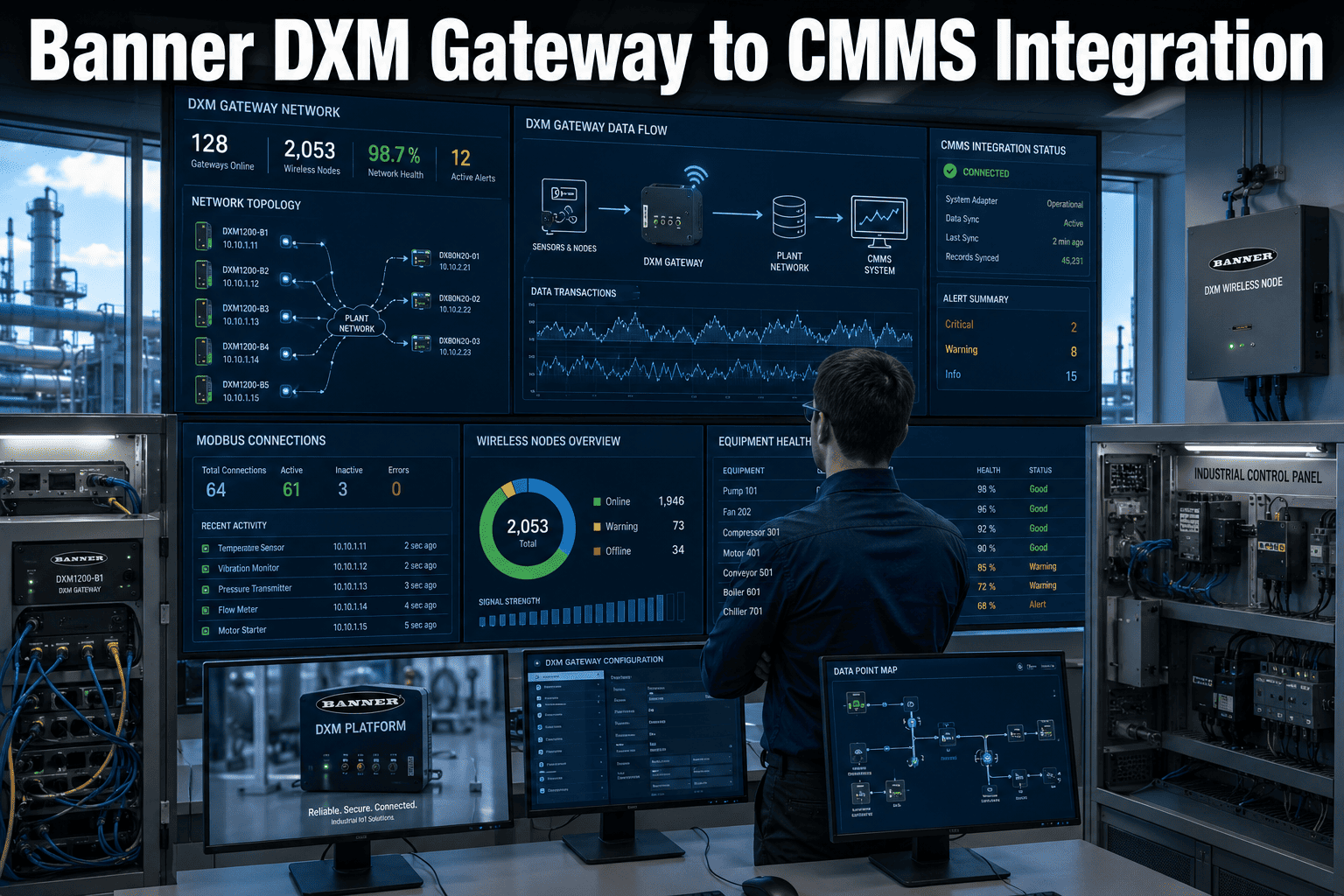
Native connectors for LoRaWAN, Modbus, OPC-UA, and BACnet mean Oxmaint integrates with sensors and control systems already installed — no rip-and-replace required for existing IIoT infrastructure.
OEE Dashboards and Downtime Tracking
Overall Equipment Effectiveness scores update in real time as work orders are closed. Every avoided failure event is logged with asset ID, time saved, and estimated cost avoidance — the data your CFO needs.
Multi-Site Portfolio Visibility
Portfolio managers see sensor health, open alerts, and work order status across every site from one dashboard. Benchmark asset performance across plants and allocate maintenance resources where condition data shows the greatest risk.
Reactive Maintenance vs. Wireless Predictive Maintenance
Criteria
Reactive Maintenance
Wireless PdM with CMMS
Failure Detection
After breakdown — production already stopped
2–8 weeks before failure using vibration trend
Repair Cost per Event
4.8× higher than planned repair (McKinsey)
Planned parts, labor, and scheduled downtime window
Maintenance Budget Visibility
Unpredictable — emergency spend distorts planning
Condition-driven CapEx model with 5–10yr forecast
Technician Utilization
Crisis-driven — resources pulled from PM tasks
Scheduled workload matched to priority alerts
Asset Lifespan
Shortened by undetected stress accumulation
Extended 20–40% through early intervention
ROI Evidence for Finance
No audit trail — cost avoidance invisible
Avoided downtime events logged with cost estimates
ROI and Results: What PdM Programs Actually Deliver
25–30%
reduction in overall maintenance costs
Deloitte global manufacturing study, 2024
70–75%
elimination of equipment breakdowns
When PdM covers all critical rotating assets
10x
average ROI on PdM investment
U.S. Department of Energy Advanced Manufacturing Office
40%
increase in asset useful life
Condition-based lifecycle tracking vs. calendar-based replacement
Operations teams that move from reactive to condition-based maintenance consistently achieve payback in under 14 months — and the ROI compounds as sensor coverage expands to more assets. Start a free trial to model your facility's savings potential inside Oxmaint, or book a demo to see a custom ROI projection built on your asset count and current downtime costs.
Frequently Asked Questions
What is the total cost to deploy wireless predictive maintenance on 50 assets?
For a 50-asset deployment using mid-range wireless vibration and temperature sensors, expect total installed cost of $35,000 to $75,000 including hardware, gateway infrastructure, CMMS integration, and commissioning labor. Annual ongoing costs run $8,000 to $18,000 covering software subscriptions, sensor maintenance, and analyst time. At an average downtime cost of $260,000 per hour, preventing two or three failures per year delivers full payback within 6 to 14 months.
How does wireless PdM sensor cost compare to walk-around inspection programs?
Walk-around inspection programs for 50 assets require 2 to 4 hours per round at weekly frequency — roughly 150 to 250 technician hours per year at $65 to $120 per hour, totaling $10,000 to $30,000 annually. Wireless sensors replace continuous manual rounds with real-time data, reducing inspection labor by 60 to 80% while providing continuous coverage that a monthly or weekly walk-around cannot match. The net cost difference closes within 18 months while detection accuracy improves significantly.
Can Oxmaint integrate with sensors and IIoT hardware already installed on-site?
Yes. Oxmaint supports native integration with LoRaWAN, WirelessHART, Modbus, OPC-UA, BACnet, and standard MQTT data streams. If sensors are already transmitting data, Oxmaint can receive that data, apply threshold rules, and auto-generate work orders without requiring new hardware. For new deployments, Oxmaint provides a hardware partner network covering ATEX-rated, food-grade, and standard industrial sensor specifications.
How do I justify wireless PdM investment to a CFO or finance committee?
The most effective CFO case uses three numbers: current annual emergency repair spend, average hourly downtime cost, and number of unplanned failures in the last 12 months. Oxmaint's CapEx forecasting module tracks cost avoidance events automatically — every prevented failure is logged with asset ID, detection timestamp, and estimated downtime cost avoided. After 90 days, the platform generates an ROI report comparing maintenance spend before and after sensor deployment, giving finance documented evidence rather than estimates.
Start Eliminating Reactive Failures Today
Stop Losing Budget to Breakdowns You Could Have Predicted
Turn every critical asset into a trackable, condition-scored system with Oxmaint. Connect sensor data, auto-generate work orders, and prove ROI to finance — in days, not months.
Real-time asset condition visibility across every site
Sensor alerts auto-converted to prioritized work orders
5–10 year CapEx forecasting with cost avoidance tracking
Used by operations teams managing 10,000+ assets — live in days, not months. No heavy implementation required.