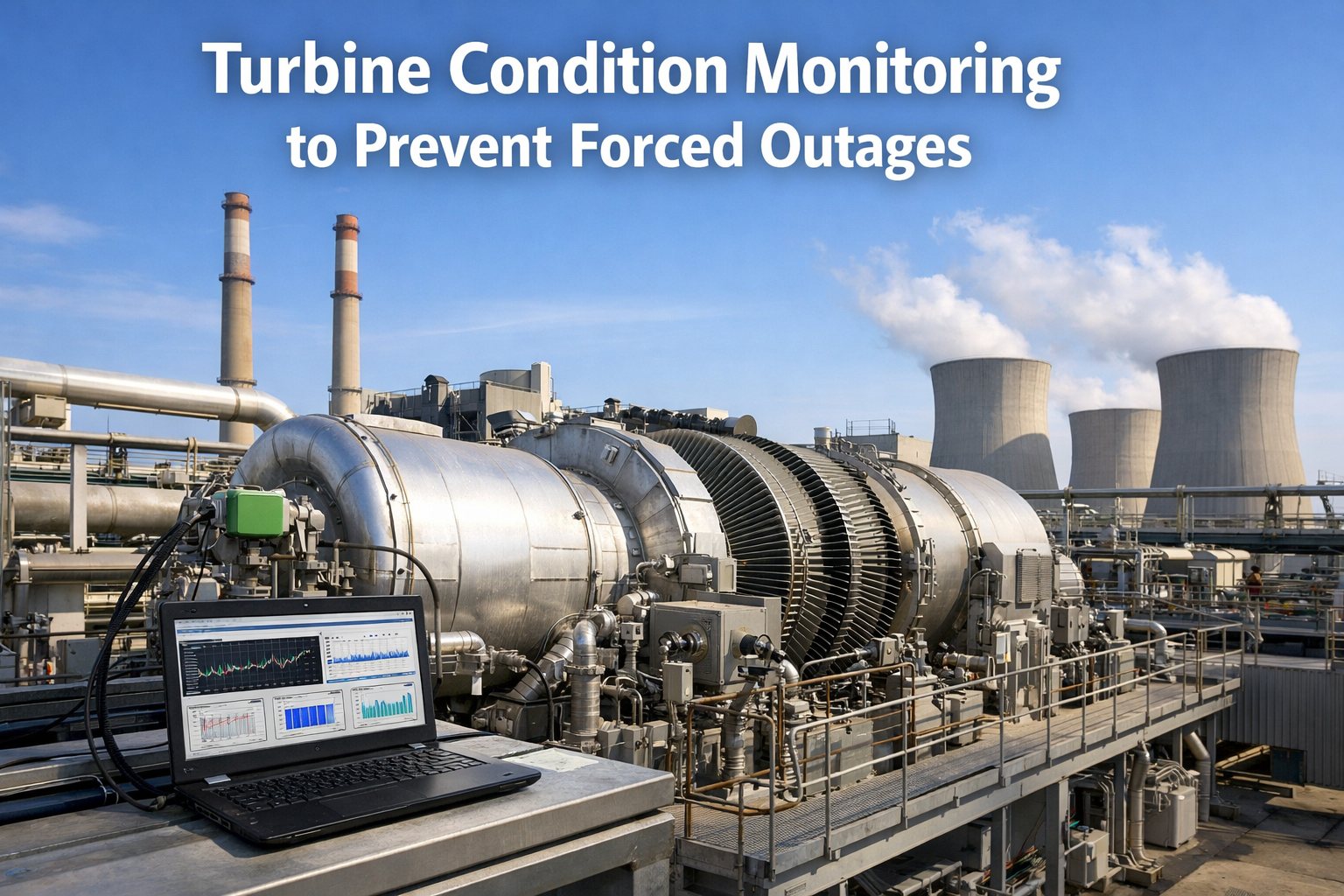
Last month, a 500 MW combined cycle plant in Texas ignored a 4°C bearing temperature rise on their gas turbine. Fifty-two days later, the bearing seized during peak summer demand. Direct repair cost: $287,000. Lost generation revenue at $85/MWh for 9 days: $918,000. Grid penalty for failing capacity commitment: $340,000. Total impact from one ignored warning sign: $1.54 million. Turbine condition monitoring transforms these invisible degradation signals into actionable maintenance intelligence—giving your team weeks of advance warning to schedule repairs on your terms, not your turbine's.
The True Cost of Turbine Failures
Why Turbines Fail—And How Monitoring Catches It Early
Steam and gas turbines don't fail without warning. They broadcast distress signals through vibration patterns, thermal anomalies, and position shifts—often weeks before catastrophic failure. The challenge is that these signals exist in frequency ranges and temperature gradients that human senses can't detect. A bearing developing micro-pitting produces vibration frequencies between 5-20 kHz. By the time you hear "that funny sound," internal damage is already extensive. Power plants that deploy continuous monitoring systems intercept these signals at their earliest stage, converting emergency shutdowns into planned maintenance windows.
What Your Turbine Sensors Detect
Early warning capabilities by failure mode
Bearing Degradation
Blade Fatigue
Shaft Misalignment
Rotor Imbalance
Detection probability based on continuous monitoring vs. periodic inspection
The Four Monitoring Technologies That Prevent Forced Outages
No single measurement tells the complete story of turbine health. Bearing temperature alone might indicate a problem—or it might reflect ambient conditions. Vibration amplitude could signal bearing wear—or a temporary load imbalance. The power of modern condition monitoring lies in correlating multiple data streams: when temperature, vibration, position, and process data all point in the same direction, failure prediction accuracy exceeds 90%. Plants ready to explore integrated monitoring can schedule a technical consultation to assess their current capabilities.
The cornerstone of rotating equipment monitoring. Detects imbalance, misalignment, bearing defects, and blade damage through characteristic frequency signatures.
Temperature anomalies reveal lubrication breakdown, combustion problems, and cooling system failures before they escalate.
Shaft position tracking reveals bearing wear progression, thermal growth patterns, and rotor-to-stator clearance changes.
Correlating mechanical health with operational context enables AI to distinguish normal variations from genuine degradation.
From Alert to Action: The CMMS Integration Advantage
Monitoring data without automated response workflows is just expensive record-keeping. The real transformation occurs when sensor intelligence flows directly into your maintenance management system. When algorithms detect bearing degradation crossing the action threshold, your CMMS automatically generates a prioritized work order, verifies parts availability, assigns the optimal technician, and schedules the repair during your next planned maintenance window.
Automated Turbine Health Response
From sensor signal to scheduled repair—without manual intervention
See Automated Turbine Monitoring in Action
Watch how OXmaint transforms sensor data into scheduled maintenance. Our 30-minute demo shows the complete workflow from anomaly detection to work order completion.
The ROI Case for Predictive Turbine Maintenance
Maintenance costs represent 15-60% of total production costs in power generation. The financial impact of shifting from reactive to predictive maintenance compounds across multiple dimensions: direct repair savings, extended equipment life, optimized parts inventory, reduced insurance premiums and—most significantly—the ability to schedule outages during low-revenue periods rather than when failures occur. Most plants achieve positive ROI within 12-18 months.
Maintenance Strategy Comparison
| Performance Metric | Reactive | Preventive | Predictive |
|---|---|---|---|
| Unplanned Downtime | 30-50% of total | 15-25% of total | <5% of total |
| Repair Cost Multiplier | 3-5x planned cost | 1.2-1.5x optimal | Baseline cost |
| Equipment Life Impact | 20-40% shortened | Design life achieved | 20-40% extended |
| Parts Inventory Cost | High (emergency) | Moderate | Optimized |
Expert Perspective on Turbine Reliability
"The most successful power plants don't just monitor their turbines—they integrate monitoring intelligence directly into maintenance workflows. When a bearing temperature trend indicates 45 days to failure threshold, the system should automatically create a work order, check parts inventory, and schedule the repair during the next planned weekend outage."
Power plants looking to benchmark their current monitoring capabilities can request a complimentary assessment from our turbine reliability specialists.
Implementation: Your 90-Day Path to Predictive Excellence
Most power plants already have the sensor infrastructure for predictive maintenance—vibration protection systems, RTDs, SCADA data. The gap is typically in analytics and workflow automation. Implementation doesn't require replacing existing systems; it requires connecting them to a platform that can perform advanced pattern recognition and automate the maintenance response.
90-Day Implementation Roadmap
Discovery & Integration
- Audit existing sensors and data infrastructure
- Connect monitoring systems to CMMS platform
- Establish baseline signatures for critical turbines
Analytics & Automation
- Configure AI pattern recognition algorithms
- Set failure prediction thresholds by component
- Build automated work order templates
Optimization & Scale
- Refine prediction models based on results
- Train operations and maintenance teams
- Plan expansion to additional equipment
Transform Your Turbine Reliability Today
Join power plants that have eliminated forced outages through intelligent condition monitoring. See how OXmaint integrates with your existing systems to automate the path from sensor data to scheduled maintenance.