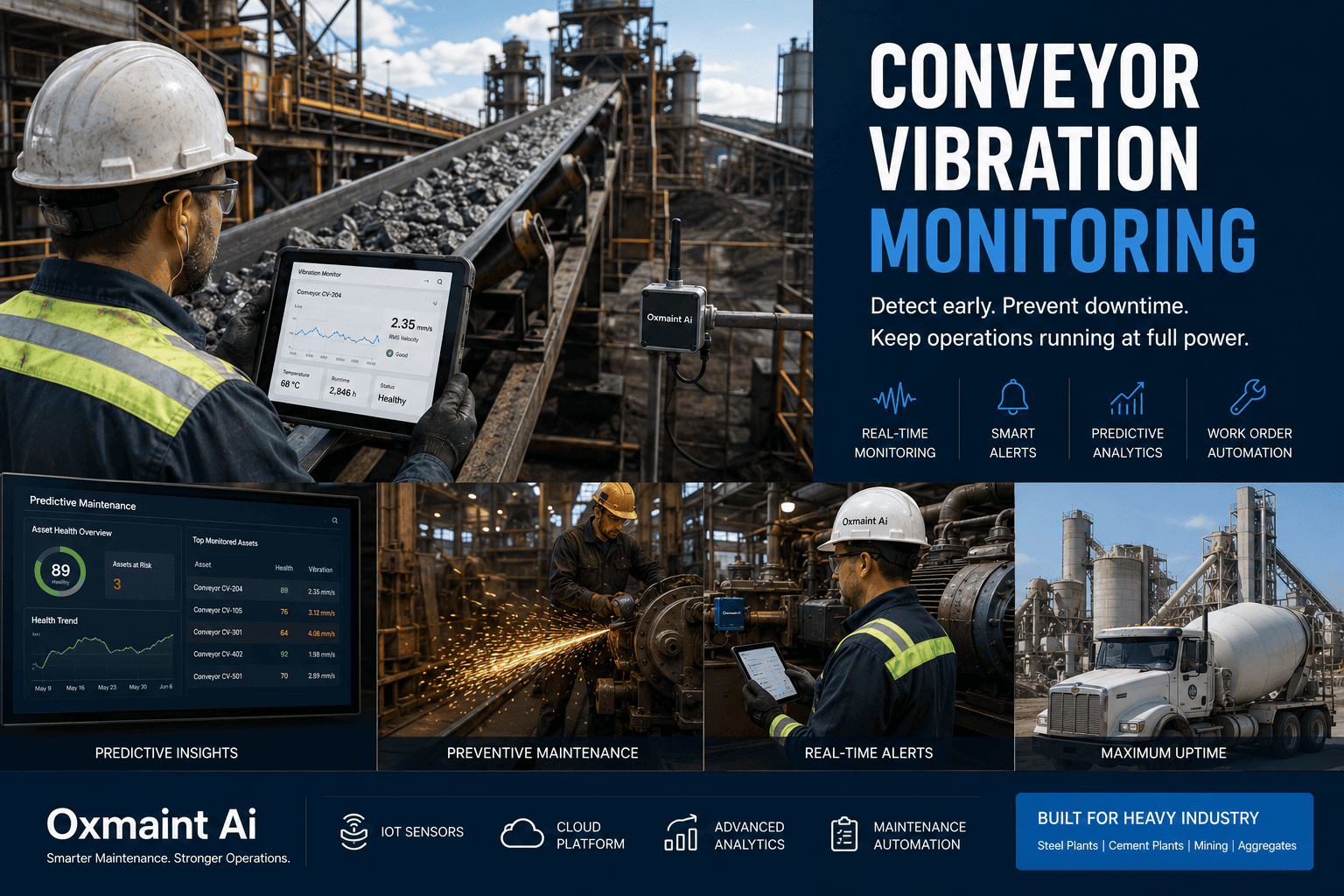
In a cement plant, the main belt conveyor moving clinker from the kiln cooler to the storage silo runs eighteen to twenty hours a day at variable speed under loads that vary by hundreds of tons hour to hour, and when a single idler bearing seizes the resulting belt tear can pull a plant down for forty-eight hours of unplanned outage. In a steel mill, the conveyor systems feeding the sinter plant or moving hot briquetted iron are even less forgiving — vibration anomalies that look minor on a paper log are early warning signals of catastrophic gearbox or pulley failure that will cost six figures in lost production. Vibration monitoring is the single highest-ROI predictive maintenance technique for heavy industry conveyors, yet most steel and cement plants still rely on manual handheld vibration readings taken weekly or monthly — leaving an enormous detection gap. Oxmaint connects to wireless vibration sensors, processes ISO 10816 severity thresholds, and converts vibration anomalies into work orders before the bearing fails — start a free trial to map your conveyor critical points and pilot continuous vibration monitoring, or book a 30-minute demo to see the full sensor-to-work-order pipeline for heavy industry.
See how steel and cement plants are catching bearing failure 4–8 weeks before it happens.
- Wireless vibration sensors mapped to every critical conveyor asset
- ISO 10816 severity thresholds automated into work orders
- Mean-time-between-failure tracked across the full conveyor fleet
Industry Snapshot
Conveyor Failure in Heavy Industry by the Numbers
30–50%
Of unplanned outages traced to conveyor failures
Plant Engineering reliability survey, 2024
$100K+
Cost per hour of unplanned conveyor outage
Steel and cement industry average
4–8 wk
Typical vibration warning lead time
Before bearing or gearbox failure
ISO 10816
Industry standard for vibration severity
Adopted across heavy industry globally
Definition
What is Conveyor Vibration Monitoring?
Conveyor vibration monitoring is the continuous measurement of mechanical vibration on the rotating elements of a belt or chain conveyor — motors, gearboxes, head and tail pulleys, idlers, and bearings — to detect the early-stage degradation patterns that precede catastrophic failure. In heavy industry, vibration is the most reliable single indicator of mechanical health because it directly reflects bearing wear, gear tooth damage, shaft misalignment, imbalance, and looseness, all of which generate characteristic vibration signatures long before the asset reaches functional failure.
The shift in heavy industry has been from periodic walkaround vibration readings — handheld meter, monthly route, paper log — to continuous wireless monitoring with severity thresholds defined by ISO 10816 or vendor-specific standards. The data alone is not the value, however. The value is in the workflow: sensor reading exceeds threshold, work order auto-generated, parts and labor planned, repair executed inside the maintenance window. Start a free trial to pilot vibration monitoring on a single critical conveyor, or book a demo to see the full deployment architecture.
Monitoring Framework
The Six Vibration Signatures Every Conveyor Program Must Track
Signal 01
Bearing Defect Frequencies
Inner race, outer race, ball, and cage frequencies detect bearing wear weeks before audible warning or thermal rise.
Signal 02
Gear Mesh Frequencies
Tooth count multiplied by shaft speed reveals gearbox tooth damage, eccentricity, and lubrication failure early.
Signal 03
Imbalance at 1× Running Speed
Material buildup on pulleys, missing balance weights, and shaft bow show up as peaks at running frequency.
Signal 04
Misalignment at 2× Running Speed
Coupling misalignment between motor and gearbox, or gearbox and pulley, produces strong 2× peaks long before bearing damage.
Signal 05
Looseness and Resonance
Loose foundation bolts, worn pillow blocks, and structural resonance produce broadband and harmonic patterns.
Signal 06
Overall Velocity (ISO 10816)
Single severity metric across the spectrum — the threshold rule that drives most work order automation.
A single catastrophic conveyor bearing failure in a cement plant typically costs more than the entire annual cost of a full continuous vibration monitoring program.
Signature Scale
The ISO 10816 Vibration Severity Bar
Zone A
Good
Below 2.3 mm/s
Normal operation — no action required
Zone B
Acceptable
2.3 – 4.5 mm/s
Continue operation, increase monitoring frequency
Zone C
Unsatisfactory
4.5 – 7.1 mm/s
Plan repair within scheduled outage window
Zone D
Unacceptable
Above 7.1 mm/s
Immediate work order, plan shutdown, avoid catastrophic failure
Operational Pain Points
Why Steel and Cement Plants Keep Losing Conveyors
Monthly Walkaround Misses Fast-Onset Faults
A bearing can transition from acceptable to functional failure in two to four weeks. A monthly handheld vibration route catches roughly one in three of these events in time.
Vibration Data Stays in a Vendor Spreadsheet
The reliability engineer's vibration software is disconnected from the work order system, so detected faults sit in the report queue for days before generating action.
No MTBF Tracking by Asset
Without mean-time-between-failure data per conveyor and per bearing position, the reliability team cannot identify chronic bad actors or justify capital replacement.
Idler Failures Drive Belt Damage
A single seized idler can score the conveyor belt and trigger a cascading repair costing tens of thousands more than the idler itself, yet idlers are rarely monitored individually.
Gearbox Failures Discovered at Shutdown
Gear mesh degradation is highly detectable via vibration analysis, but most plants only inspect gearboxes during major outages — long after the early warning has come and gone.
No Severity-Based Prioritization
When a hundred conveyor positions are monitored, the team needs ISO 10816 severity sorting to decide which to repair first — without it, prioritization collapses into guesswork.
Plants running continuous vibration monitoring with automated work orders typically cut conveyor-driven unplanned outages by 50–70% within twelve months — start a free trial to pilot the workflow on one conveyor, or book a demo to see how steel and cement deployments are structured.
The Solution
How Oxmaint Turns Vibration Data into Maintenance Action
Sensor-to-WO Pipeline
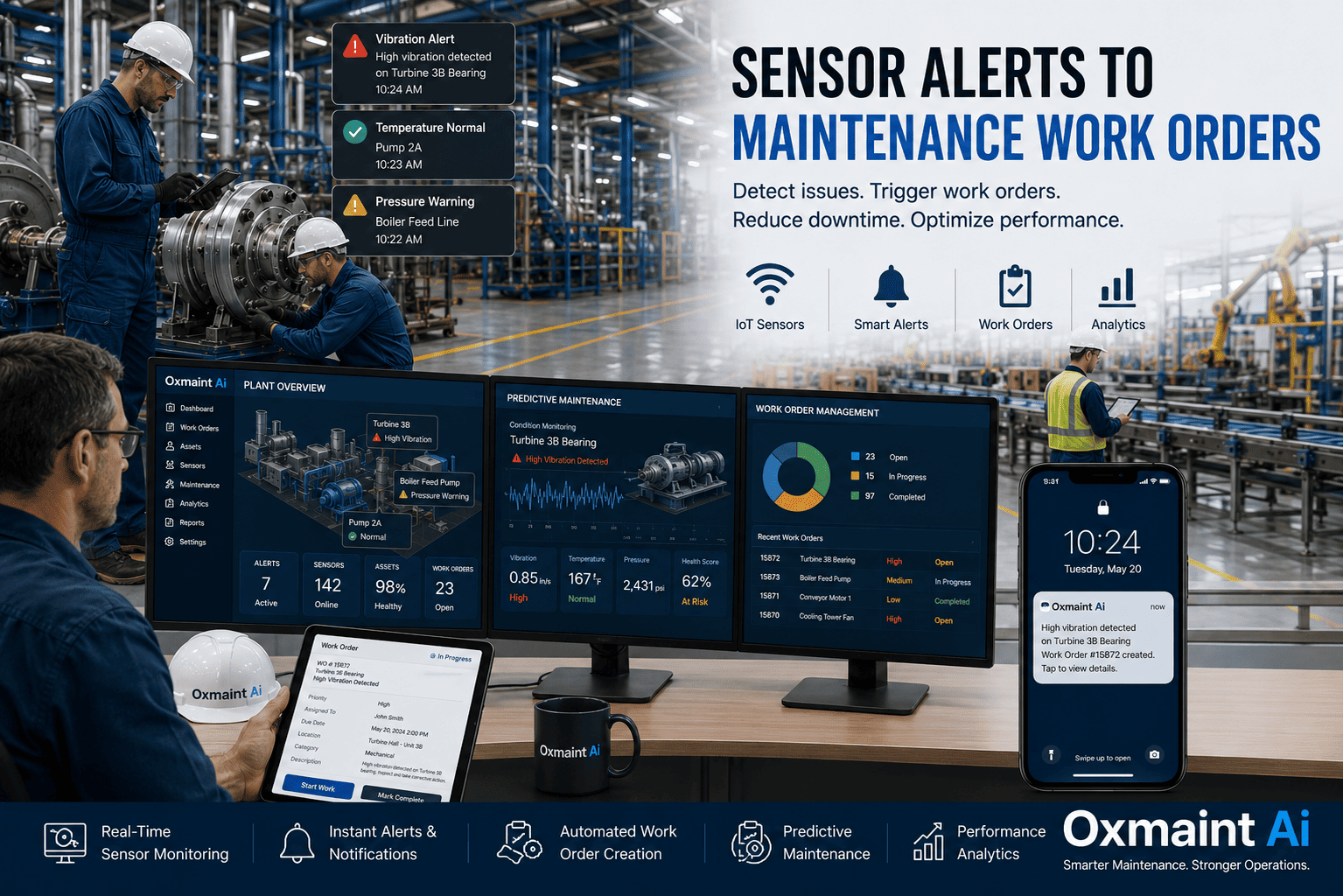
Wireless vibration sensors stream readings into Oxmaint, ISO 10816 thresholds applied, work order auto-generated when severity crosses.
Asset Hierarchy by Conveyor Position
Each motor, gearbox, head pulley, tail pulley, and idler tracked as a discrete asset with its own vibration history and MTBF.
Severity Trending and Alerts
Per-asset severity charts surface trending degradation before threshold violation, giving reliability teams weeks of lead time.
Repair History Linked to Vibration
Every repair logged against the vibration record so the team can see which interventions actually restored health.
MTBF and Reliability Reporting
Mean-time-between-failure tracked per asset, per bearing position, per failure mode — bad actors surface for capital review.
Spare Parts Tied to Failure Mode
When a specific bearing failure mode is predicted, the matching spare part is auto-flagged for issue from the storeroom.
Move from monthly handheld walkarounds to continuous wireless monitoring — without replacing your existing vibration analyst's expertise.
Before vs After
Reactive Vibration Program vs Oxmaint Workflow
| Capability |
Manual Walkaround Program |
Oxmaint with Continuous Monitoring |
| Data Collection Frequency |
Handheld readings, weekly or monthly per route |
Continuous wireless sensor data, every 15–60 minutes |
| Fault Detection Lead Time |
Often less than one week before functional failure |
4–8 weeks typical lead time on bearing and gearbox faults |
| Severity Standardization |
Analyst's judgment, varies between technicians |
ISO 10816 zones automated across every monitored asset |
| Work Order Generation |
Manual entry days after analysis report completes |
Auto-generated at threshold violation with severity and asset linked |
| MTBF Tracking |
Rarely computed, lost in spreadsheets and binders |
Continuously calculated per asset and per bearing position |
| Spare Parts Planning |
Reactive ordering after fault discovery, expedited freight |
Predictive parts staging based on degradation trend |
| Repair Cost Profile |
Emergency repair rates, 4–5× planned cost when failure is catastrophic |
Planned repair during scheduled outage at standard rate |
| Outage Risk |
Unplanned shutdowns from missed early warnings |
Planned interventions inside scheduled maintenance windows |
Measured Outcomes
ROI of Continuous Conveyor Vibration Monitoring
50–70%
Fewer Unplanned Conveyor Outages
Within 12 months of continuous monitoring
4–8 wk
Average Fault Lead Time
Bearing and gearbox failures detected early
$500K+
Avoided Catastrophic Failure
Per major bearing or gearbox event prevented
25–35%
Lower Total Maintenance Cost
Planned vs reactive repair shift
6–12 mo
ROI Payback Period
Typical for steel and cement deployments
3–5 yr
Equipment Life Extension
Conveyor assets under continuous monitoring
A single avoided catastrophic conveyor failure typically pays back the entire annual investment in vibration monitoring infrastructure — start a free trial to pilot on a critical conveyor, or book a demo to see the deployment architecture for your plant.
Frequently Asked Questions
Common Questions on Conveyor Vibration Monitoring
Does Oxmaint replace our existing vibration analysis software?
Oxmaint sits alongside your vibration analysis tools, not in place of them. The vibration software remains the diagnostic instrument for the reliability engineer; Oxmaint is the workflow layer that converts detected anomalies into work orders, tracks MTBF, and links repair history back to the vibration record. Customers typically keep their existing analysis tool and integrate via standard data feeds.
What types of vibration sensors does Oxmaint support?
Oxmaint integrates with wireless and wired vibration sensors using standard protocols including MQTT, Modbus, OPC UA, and REST APIs. Common deployments include triaxial wireless accelerometers on motors, gearboxes, and pulleys, supplemented by handheld route data where wireless coverage is incomplete. Sensor selection is plant-specific and confirmed during scoping.
How does Oxmaint handle vibration thresholds across different conveyor types?
Oxmaint supports ISO 10816 zone thresholds as the default plus per-asset customization for plants that have established their own baseline severity values. Different conveyor types, motor sizes, and operating speeds get their own threshold profiles, and thresholds can be tuned over time as the team builds confidence in the data.
How long does it take to deploy continuous vibration monitoring on a conveyor fleet?
Pilot deployments on a single critical conveyor are typically live within two to four weeks. Full plant rollout across the conveyor fleet runs eight to sixteen weeks depending on sensor selection, network coverage, and asset count. Most plants stage rollout by criticality, starting with the conveyors whose failure has the highest production impact.
Stop Losing Conveyors to Bearing Failure
Catch Conveyor Faults 4–8 Weeks Before They Stop the Plant
Turn vibration data into automated work orders with Oxmaint — and keep your kiln, sinter, and rolling mills feeding without interruption.
- ISO 10816 severity automation across every monitored asset
- Per-asset MTBF and reliability reporting
- Planned interventions inside scheduled outage windows
Pilot live in 2–4 weeks. Works with your existing vibration analysis tools. Used in steel and cement plants worldwide.