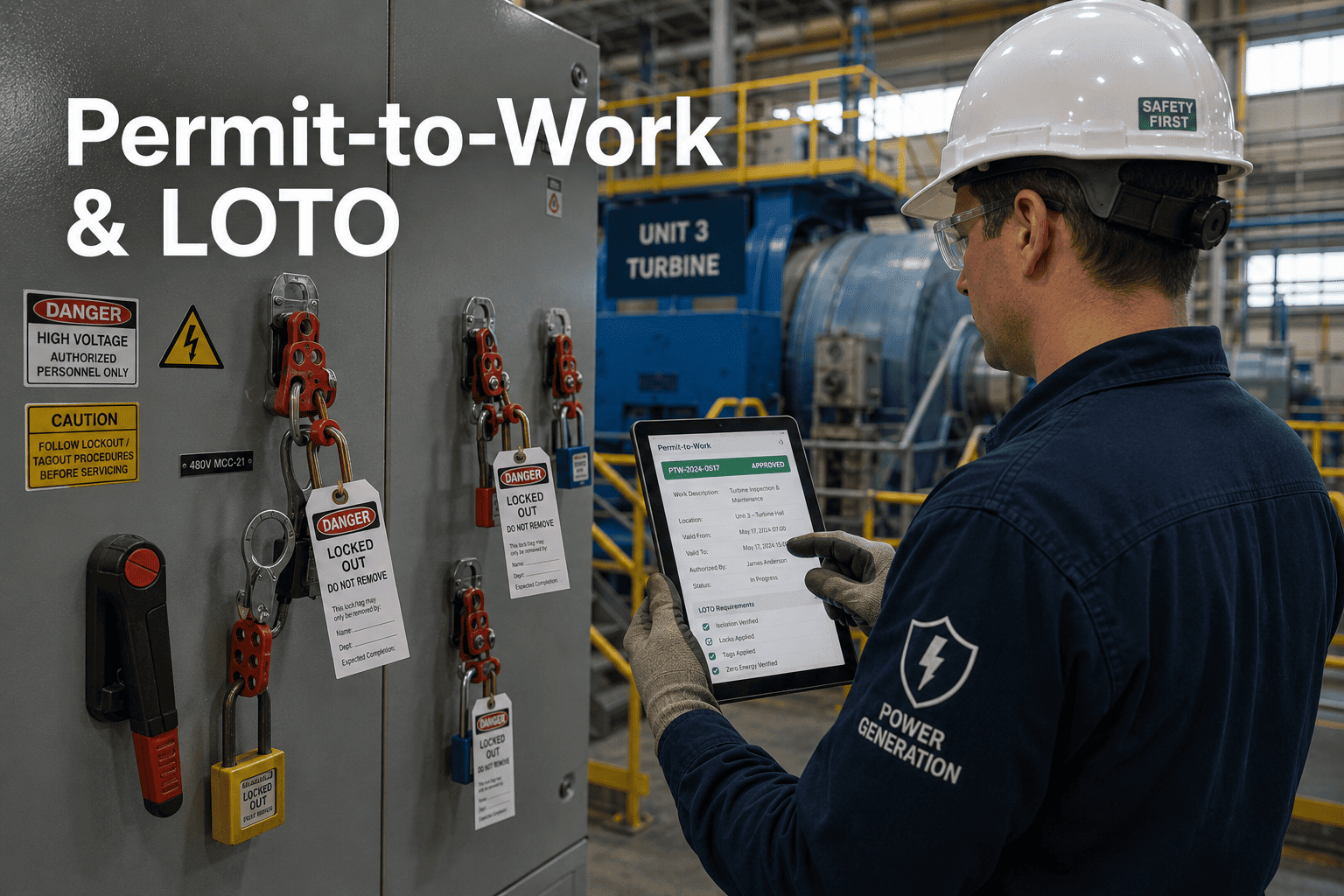
Permit-to-work and lockout/tagout procedures are the most safety-critical — and most audit-scrutinised — maintenance processes in power generation. A single LOTO violation at a power plant can result in electrocution, steam burns, or rotating equipment contact injuries with consequences ranging from permanent disability to fatality. OSHA citations for LOTO violations average $15,000–$150,000 per instance, and repeat violations trigger $500,000+ penalties that compound with insurance rate increases and potential criminal liability for plant management. Yet most power plants still manage permit-to-work and LOTO processes through paper forms, physical lockboxes, and manual verification procedures that depend entirely on human attention and supervisor availability — systems that fail precisely when workload pressure is highest, during outages and emergency repairs when the risk of procedural shortcuts is greatest. OxMaint CMMS digitises the entire permit-to-work and LOTO lifecycle — from energy source identification through lock placement verification to permit closure — ensuring every isolation is documented, every authorisation is captured, and every de-energisation is verified before work begins.
Permit-to-Work and LOTO for Power Plants
Digitise permit-to-work and lockout/tagout compliance to eliminate paper-based LOTO failures, ensure every isolation is verified before work begins, and maintain audit-ready documentation for OSHA, NERC, and state regulatory inspections.
What Is Digital Permit-to-Work and LOTO Management
Digital permit-to-work and LOTO management is the CMMS-driven process of creating, authorising, executing, and closing isolation permits and lockout/tagout procedures through a structured digital workflow — replacing paper permit forms, physical lock logs, and manual verification steps with enforced digital sequences that cannot be bypassed or shortcut. The system covers the complete permit lifecycle: energy source identification from the equipment isolation diagram, lock/tag placement with photo verification, authorised worker sign-on, zero energy verification confirmation, work execution under the active permit, and controlled permit closure with lock removal sequencing.
The safety case is absolute — 85% of LOTO incidents involve procedural failures, not equipment failures. Workers are injured or killed because a step was skipped, an energy source was missed, or a lock was removed before all workers cleared the isolation zone. Paper-based permit systems allow these procedural shortcuts because they depend on human discipline and supervisor oversight to enforce step completion. Digital CMMS-based permit systems enforce the sequence procedurally — the next step cannot begin until the previous step is documented and verified, and the permit cannot close until every lock is accounted for and every worker has signed off. Start a free trial to see how Oxmaint structures LOTO permit workflows, or book a demo for a walkthrough of power plant permit management dashboards.
8 CMMS Capabilities for Permit-to-Work and LOTO Compliance
CMMS maintains equipment-specific isolation diagrams identifying every energy source — electrical, pneumatic, hydraulic, thermal, gravitational, chemical. Technicians access the correct procedure for the specific equipment, not a generic template.
Each lock placement is documented with isolation point ID, lock number, and photo verification. The system tracks locked vs remaining points and prevents advancement to "work authorised" until all points are confirmed.
CMMS enforces zero energy verification as a mandatory step before work authorisation — the technician must document the verification method used (try start, voltage check, pressure bleed) and confirm zero energy state. The permit cannot advance without this confirmation.
Every worker signs on to the active permit through CMMS. The system tracks who is under each permit at all times — preventing premature lock removal while workers remain in the hazard zone.
Power plant maintenance often requires multiple overlapping permits on interconnected systems. CMMS maps permit relationships and prevents conflicting isolation removals — ensuring that de-energising one system does not inadvertently re-energise equipment under a different active permit.
When permits span shift changes, CMMS enforces structured handover documentation — incoming shift personnel must acknowledge the active permit status, isolation configuration, and worker list before assuming permit responsibility. No silent handover gaps.
Permit closure follows an enforced sequence: workers signed off, tools removed, locks removed in order, re-energisation authorised by the issuer. The system prevents premature removal and documents the complete closure.
Every permit creates a complete digital audit record — energy identification, lock placements with photos, zero energy verification, worker tracking, and closure documentation. Available instantly for OSHA, NERC, or insurance audits.
4 Pain Points in Paper-Based LOTO and Permit Management
Paper permit forms allow steps to be signed without being performed — particularly during high-pressure outage periods when production restart urgency overrides procedural discipline. A technician signing "zero energy verified" on a paper form without actually testing creates a life-threatening condition that the paper system cannot detect or prevent.
Paper-based isolation procedures may reference outdated equipment drawings or generic procedures that miss equipment-specific energy sources — particularly after equipment modifications or system additions. Workers performing lockout on an equipment that has been modified since the procedure was last updated face unidentified energy sources that the paper procedure does not warn about.
During major outages with 20–50 active permits on interconnected systems, paper-based tracking cannot reliably identify permit conflicts — situations where removing isolation on one permit re-energises equipment under a different active permit. These conflicts are the most dangerous LOTO failure mode and are virtually impossible to detect reliably with manual cross-referencing of paper permits.
Paper permit records stored in filing cabinets create audit vulnerability — missing forms, illegible signatures, undated entries, and incomplete closure records. When OSHA or state regulators request LOTO compliance documentation, incomplete paper records become evidence of programme deficiency. Teams ready to fix this can start a free trial today.
How Oxmaint Solves Permit-to-Work and LOTO Compliance
CMMS enforces the LOTO procedure step-by-step — each step must be documented and verified before the next step becomes available. Energy identification, lock placement, zero energy verification, and work authorisation follow a mandatory sequence that cannot be bypassed.
Every asset in CMMS has a linked isolation diagram identifying all energy sources. When a LOTO permit is initiated, the system presents the correct equipment-specific procedure — not a generic template. Diagrams update when equipment is modified, ensuring procedures always reflect current configuration.
Each lock placement is documented with a photo of the lock on the isolation point. Visual verification provides auditable evidence that the lock was physically placed — not just signed on a paper form. The permit cannot advance until all required lock placements have photo documentation.
Every worker under an active permit is tracked by sign-on and sign-off. The system prevents lock removal while any worker remains signed on to the permit — eliminating the premature re-energisation risk that causes the most severe LOTO injuries.
CMMS maps isolation point usage across all active permits. When a permit closure or lock removal would affect equipment under a different active permit, the system flags the conflict and prevents the action — protecting against the most dangerous multi-permit failure mode.
Complete permit records — energy identification, lock placements with photos, zero energy verification, worker lists, shift handovers, and permit closure — available instantly for any regulatory audit. No filing cabinet retrieval, no missing records, no incomplete documentation.
Paper-Based LOTO vs CMMS-Digitised Permit Management — Before and After
| LOTO Compliance Factor | Paper-Based Permits (Before) | CMMS-Digitised Permits (After) |
|---|---|---|
| Procedural Compliance Rate | 60–75% of permits have at least one procedural shortcut — steps signed without being performed, particularly during high-pressure outage periods. | 95–99% compliance. CMMS enforces sequential step completion — each step must be documented before the next becomes available. |
| Energy Source Identification | Dependent on paper procedures that may be outdated after equipment modifications. Generic procedures miss equipment-specific energy sources. | Equipment-specific isolation diagrams linked to CMMS assets. Updated automatically when equipment modifications are documented. |
| Multi-Permit Conflict Detection | Manual cross-referencing of paper permits. Virtually impossible to detect all conflicts during major outages with 20–50 concurrent active permits. | Automated conflict detection across all active permits. System prevents lock removal actions that would affect equipment under other active permits. |
| Audit Readiness | Paper records in filing cabinets with missing forms, illegible entries, and incomplete closure records. 2–4 weeks to compile audit package. | Complete digital records available instantly. Every permit has a full audit trail with timestamps, photos, and digital signatures. |
| OSHA Citation Risk | High. Paper-based systems cannot prove procedural compliance — audit gaps become evidence of programme deficiency. | Minimal. CMMS-enforced procedures with complete digital documentation demonstrate programme effectiveness to regulators. |
ROI and Results — Digitised LOTO and Permit-to-Work
Frequently Asked Questions
How does CMMS enforce LOTO procedural compliance in the field?
Can Oxmaint manage group lockout procedures with multiple workers and shifts?
How does the system handle permit-to-work for contractors during outages?
What regulatory standards does Oxmaint's LOTO module support?
Stop Risking Lives and Licences with Paper-Based LOTO
Paper permits allow the procedural shortcuts that cause 85% of LOTO incidents. Oxmaint digitises the entire permit lifecycle — enforcing step completion, verifying lock placement with photos, tracking every worker under every permit, and maintaining audit-ready records that prove compliance when regulators arrive.
Protecting power plant teams across generation portfolios. Live in days, not months. No heavy implementation required.