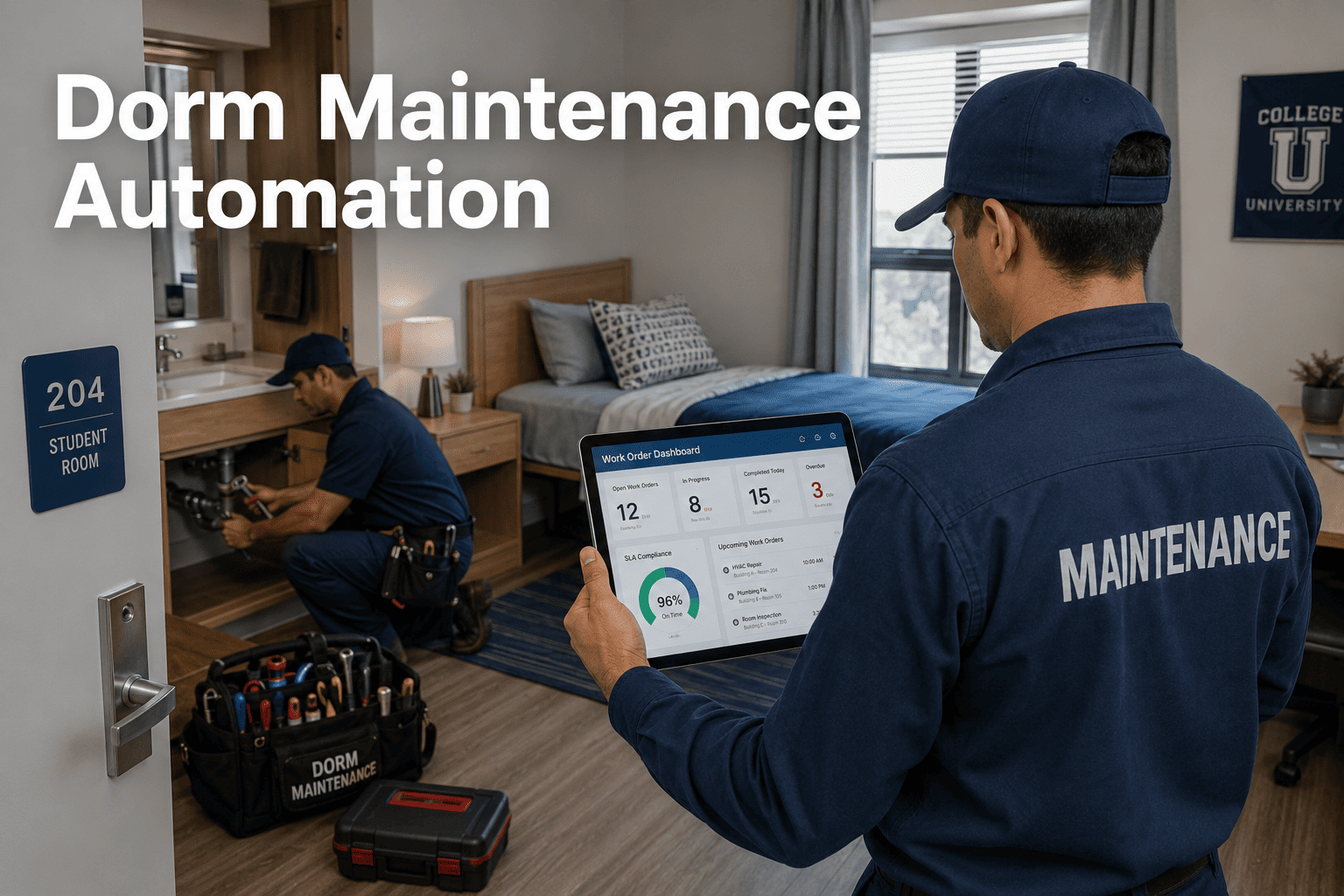
Student dormitory maintenance is one of the most operationally complex maintenance environments in higher education — high-density residential buildings with 200–1,200 occupants each, 24/7 access requirements, diverse maintenance request volumes that spike at semester transitions, and a resident population with zero tolerance for maintenance delays and a social media amplification reflex that turns a 48-hour response lag into a public relations event. Yet most universities still manage dorm maintenance through email-based work order submission, phone call dispatch, and spreadsheet tracking — systems that have no automatic escalation, no SLA enforcement, no real-time visibility into response times, and no way to demonstrate to housing management or student affairs leadership that maintenance commitments are being met. OxMaint CMMS gives university housing and facilities teams the automated escalation workflows, SLA tracking, and real-time visibility that transform dorm maintenance from a reactive complaint-response operation into a proactive, measurable service delivery system that drives student satisfaction and reduces complaint volume.
Dorm Maintenance Escalation and SLA Automation
Automate dormitory maintenance escalation, enforce SLA response commitments, and eliminate student complaints from deferred maintenance requests with CMMS designed for the high-volume, time-sensitive demands of university residential facilities.
What Is Dorm Maintenance Escalation and SLA Automation
Dorm maintenance escalation and SLA automation is the CMMS-driven process of automatically enforcing response time commitments, escalating overdue work orders to the appropriate supervisory level, and providing maintenance teams and housing management with real-time visibility into work order status across the residence hall portfolio. It replaces the manual follow-up, supervisor check-ins, and complaint-driven escalation that characterise unstructured dorm maintenance operations.
In practice, automation covers three integrated functions: SLA configuration (defining response time commitments by request type and severity — emergency plumbing within 2 hours, HVAC complaint within 24 hours, standard repair within 72 hours); automatic escalation (generating supervisor notifications and work order re-prioritisation when SLA thresholds are approaching or exceeded, without requiring manual monitoring); and student communication (automatic status update notifications to the student who submitted the request, eliminating the follow-up calls and emails that consume housing staff time).
The operational and reputational case is direct. Universities with ACUHO-I data show that 68% of student housing satisfaction complaints relate to maintenance response time — not the underlying issue, but the response lag. A CMMS escalation system that enforces response commitments and communicates proactively eliminates the majority of these complaints at the source. Universities ready to make the shift can start a free trial to map their dorm maintenance SLA structure, or book a demo for a walkthrough of housing maintenance escalation dashboards.
8 CMMS Capabilities for Dorm Maintenance Escalation and SLA Management
Configure response time SLAs by request category, severity, and building type. Emergency plumbing, HVAC failures, safety hazards, and standard repairs each have defined response commitments that CMMS tracks and enforces automatically — not manually.
When a work order approaches its SLA threshold without being assigned, CMMS automatically escalates to the appropriate supervisor with a notification and re-prioritisation flag. No manual monitoring required — the system escalates before the SLA is missed, not after the student complains.
Students submit maintenance requests through a configured portal that feeds directly into the CMMS work order queue. No phone tag, no email parsing, no lost requests — every submission creates a timestamped work order that enters the priority queue immediately.
Students receive automatic status updates when their work order is assigned, when technicians are en route, and when the repair is completed. Proactive communication eliminates the follow-up emails and phone calls that consume housing staff time and frustrate students.
Maintenance technicians receive work order assignments, room access information, and task details on mobile devices. Real-time work order acceptance and status updates give supervisors live visibility into field team activity across all residence halls.
Housing directors and facilities managers see real-time SLA compliance rates, overdue work order counts, average response times, and escalation frequency across every residence hall — updated continuously as technicians close work orders in the field.
CMMS tracks repeat maintenance requests by room, floor, and building — identifying plumbing leaks, HVAC issues, and structural defects that generate repeated work orders. Pattern detection enables root cause repair rather than repeated symptom response.
CMMS manages the high-volume maintenance workload of semester transitions — room inspections, damage assessments, HVAC service, plumbing checks — with structured work order batches, technician scheduling, and completion tracking across all residence halls.
4 Pain Points in Manual Dorm Maintenance Operations
Without CMMS escalation automation, SLA commitments are aspirational targets that depend entirely on supervisor follow-up capacity. When work order volumes spike at semester transitions or exam periods, supervisors are managing crises — not monitoring SLA timers. Work orders slip past their deadlines silently, and students escalate through social media or resident advisor complaints rather than a structured system.
The majority of student maintenance satisfaction complaints are not about the underlying problem — they are about not knowing what is happening with their request. Manual operations have no automatic communication mechanism: students submit a request and receive silence until the technician appears. The communication gap feels like neglect and generates complaint volume disproportionate to the actual service delivery problem.
Email-based and phone-based work order submission creates inevitable data loss — emails buried in inboxes, phone messages not transcribed, duplicate requests from multiple students on the same HVAC issue distorting demand signals. Without a structured intake system, work order data is unreliable and resource allocation is driven by noise rather than actual priority.
Housing directors and VP Student Affairs cannot demonstrate maintenance performance to institutional leadership, accreditation bodies, or student government without structured CMMS data. Average response times and SLA compliance rates are unavailable in real time — meaning housing management is flying blind on the metric most correlated with student satisfaction survey scores. Teams ready to fix this can start a free trial today.
How Oxmaint Transforms Dorm Maintenance Operations
CMMS monitors every open work order against its configured SLA. Approaching deadlines trigger supervisor notifications automatically — before the SLA is missed. No manual monitoring required, no work orders slip through silently.
Housing directors see open work order counts, overdue requests, SLA compliance rates, and average response times across every residence hall in real time — updated continuously. Performance data is available at any time for housing leadership or student affairs reporting.
Students receive automatic status notifications at each work order milestone — assignment, technician dispatch, completion. The communication gap that drives 68% of housing satisfaction complaints is eliminated without adding housing staff workload.
All maintenance requests enter through a structured CMMS portal — no email parsing, no lost requests. Duplicate submissions are flagged automatically. Every request creates a timestamped work order that enters the priority queue immediately on submission.
Maintenance technicians work from mobile devices with real-time work order assignments, room details, and task instructions. Work order acceptance and status updates are captured in the field — giving supervisors accurate visibility without end-of-day paperwork submission.
VP Student Affairs and facilities leadership receive structured performance reports — SLA compliance by building, response time trends, complaint volume, and technician productivity — with data granularity sufficient for institutional reporting and accreditation documentation.
Manual Maintenance vs CMMS Escalation Automation — Before and After
| Operational Factor | Manual Operations (Before) | Oxmaint CMMS Automation (After) |
|---|---|---|
| Average Work Order Response Time | 48–96 hours for standard requests. No automatic escalation — response time depends on supervisor workload and attention. | 18–28 hours for standard requests. Automatic escalation triggers before SLA expiry — response time is enforced by the system, not supervisor memory. |
| SLA Compliance Rate | 45–62%. Less than half of standard requests completed within SLA. High-volume periods see compliance drop below 40%. | 84–93% after 12 months. Automated enforcement removes the human attention dependency that allows SLA misses to accumulate unnoticed. |
| Student Complaint Volume | High and growing. Without proactive communication, students escalate through resident advisors, social media, and student government. | 55–70% reduction after CMMS implementation. Proactive status notifications eliminate the communication gap driving the majority of complaints. |
| Work Order Visibility for Leadership | None in real time. Performance metrics compiled manually on request — weeks out of date when they reach housing leadership. | Real-time dashboard. Housing directors and VP Student Affairs have live performance metrics available at any time for any building in the portfolio. |
| Semester Turn-Around Efficiency | Chaotic. High-volume inspection and repair demand managed through manual coordination, with missed items and incomplete documentation creating liability at occupancy. | Structured batch work orders, technician scheduling, and completion tracking. Turn-around progress is visible in real time across every building in the transition. |
ROI and Results — CMMS Dorm Maintenance Automation
Frequently Asked Questions
How are SLA thresholds configured for different types of dorm maintenance requests?
Can students submit maintenance requests through the university housing portal rather than a separate CMMS interface?
How does Oxmaint handle dorm maintenance across multiple residence halls in a single system?
Can Oxmaint generate maintenance performance reports for student government, housing satisfaction surveys, and institutional accreditation?
Stop Losing Student Satisfaction Scores to Maintenance Response Gaps
Student maintenance complaints are not a staffing problem — they are a process problem. Oxmaint replaces the email-based, memory-dependent, complaint-driven dorm maintenance operation with automated SLA enforcement, proactive student communication, and real-time performance visibility that housing leadership can act on before satisfaction scores decline.
No heavy implementation required. Works across multi-building residential portfolios. Live in days, not months.