Lean maintenance is not about doing less — it is about doing exactly what needs to be done, at exactly the right time, with no wasted motion, no redundant effort, and no cost that does not directly move the needle on asset reliability. Most maintenance operations are running at 35–50% efficiency. The rest is waste: waiting on parts that should have been stocked, searching for work history that should have been logged, dispatching technicians to jobs that could have been batched. A modern CMMS built for lean workflows closes that gap systematically. Start a free trial with Oxmaint and map your own waste in the first week, or book a demo to see a live lean maintenance workflow built inside the platform.
Lean Operations · Process Efficiency · CMMS Automation
Lean Maintenance: Eliminate Waste Using CMMS Workflows
Apply the eight lean waste categories directly to your maintenance operation. Use Oxmaint's automation, scheduling, and analytics to cut what does not add value — and sharpen everything that does.
35–50%
of typical maintenance labor time is non-value-added waste
25%
reduction in maintenance costs achieved by lean-adopting facilities
40%
of reactive work orders could be eliminated with proper PM scheduling
3x
faster work order completion when digital workflows replace paper-based processes
The Concept
What Is Lean Maintenance — and Where Does Waste Actually Hide?
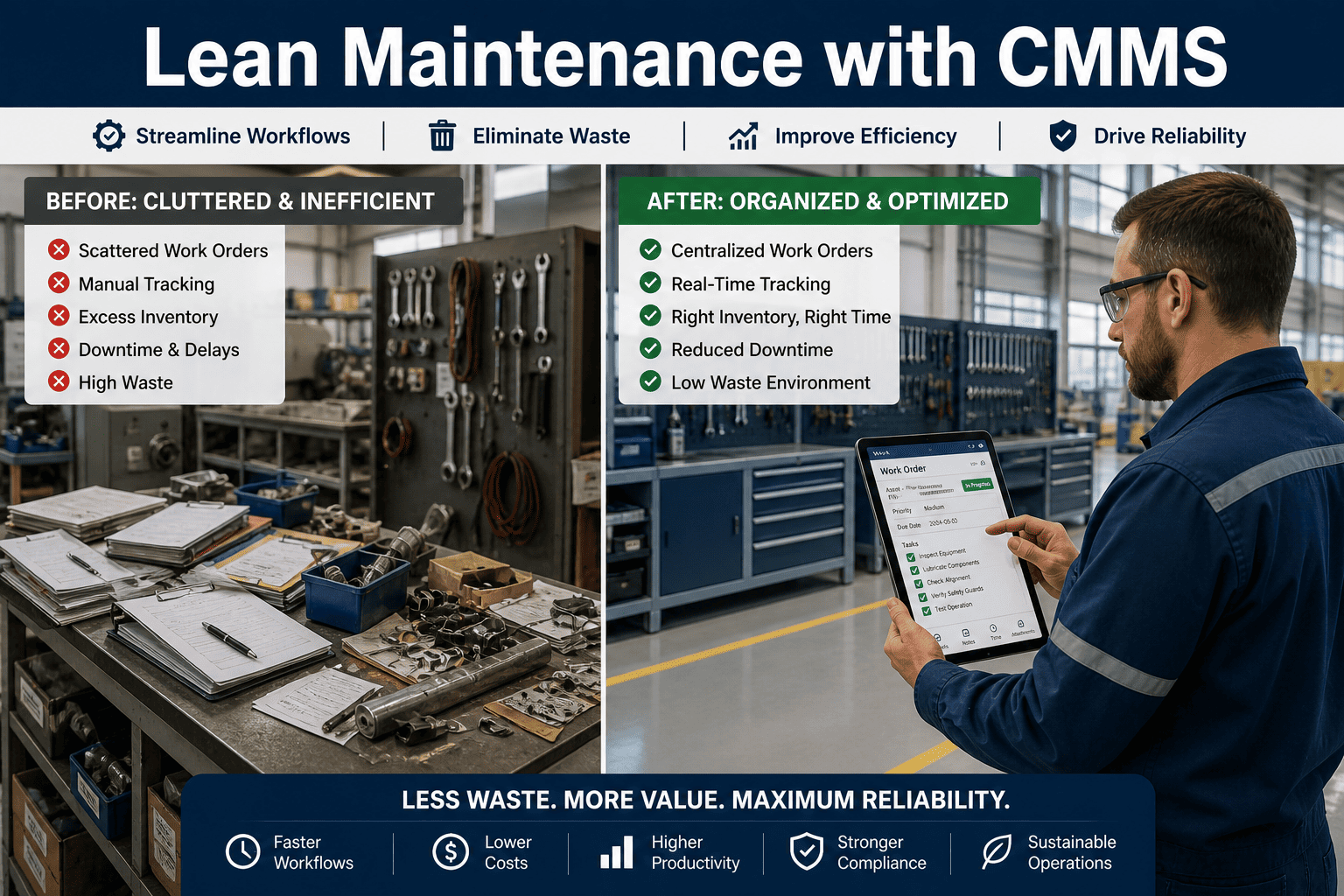
Lean maintenance applies the Toyota Production System principles — originally designed for manufacturing — directly to how maintenance teams plan, schedule, execute, and review their work. The goal is to maximize the ratio of value-added wrench time against total maintenance hours. In most operations, that ratio sits below 30%. Lean practice brings it to 55% or higher. The roadblock is always the same: no system to see the waste clearly.
Waste 01
Waiting
Technicians idle waiting for parts, permits, or instructions. Accounts for up to 30% of total maintenance time in unoptimized operations.
Waste 02
Over-Processing
Performing more maintenance than the asset's condition or risk level requires. PM schedules based on calendar dates instead of asset condition are the main cause.
Waste 03
Motion Waste
Unnecessary travel between assets, trips to the storeroom, and time spent hunting for information. Kills technician productivity faster than any other waste type.
Waste 04
Inventory Excess
Overstocked parts tying up capital alongside stockouts that cause emergency downtime. Both are symptoms of the same problem: no real-time inventory visibility.
Waste 05
Rework
Repairs that fail within 30 days, callbacks, and repeat failures on the same asset. Usually caused by incomplete work orders or missing checklists at the point of execution.
Waste 06
Overproduction
Generating work orders, reports, and documentation that nobody acts on. Paper-based and disconnected CMMS systems are the primary source of this administrative waste.
Waste 07
Defects
Work done incorrectly the first time, leading to premature failures. Lack of standardized procedures and mobile checklists at point-of-maintenance drives defect rates up.
Waste 08
Talent Underuse
Skilled technicians doing administrative tasks instead of technical work. When knowledge is not captured in the CMMS, tribal knowledge walks out the door at retirement.
The Pain Points
Why Lean Maintenance Efforts Stall Without the Right System
!
No Visibility Into Wrench Time
Without digital work order tracking, managers cannot tell how much time is actually spent on value-added work versus waiting, travelling, and admin. You cannot improve what you cannot measure.
!
Schedules Built Around Emergencies
When 60–70% of work is reactive, planning and scheduling becomes impossible. Lean principles require a stable, predictable maintenance schedule — which only comes from a functioning PM program.
!
Parts Not Ready When Jobs Start
Jobs kick off without staged parts. Technicians stop work, travel to the storeroom, wait on procurement. A single parts-waiting event can add 2–4 hours of waste to a 45-minute job.
!
No Standardized Work Procedures
Without standardized task instructions, every technician does the job differently. Inconsistency is the enemy of lean — it creates defects, rework, and impossible-to-analyze failure patterns.
Oxmaint Solution
Six Ways Oxmaint CMMS Workflows Eliminate Maintenance Waste
Lean maintenance needs more than good intentions — it needs a CMMS that is structured to eliminate waste by design. Oxmaint is built around the workflows that make lean maintenance operationally real, not just theoretically sound. Start a free trial to run your first lean workflow, or book a demo to see it built for your asset type.
01
Automated PM Scheduling Replaces Reactive Firefighting
PM tasks trigger automatically by time, usage hours, or production cycles — pulling maintenance out of reactive mode entirely. Teams report a 40% drop in emergency work orders within 90 days.
02
Mobile Work Orders With Step-by-Step Checklists
Technicians complete standardized digital checklists on mobile — no paper, no missing steps, no rework. Completion data feeds directly back into asset history and condition scoring.
03
Parts Staging and MRO Inventory Linked to Work Orders
Required parts are reserved against planned jobs before technicians leave the bench. Stockouts trigger automatic reorder. Waiting waste from missing parts drops to near zero.
04
Route-Based Maintenance for Multi-Asset Inspections
Batch similar tasks into optimized inspection routes that eliminate travel waste. A technician walking a planned route covers 40% more assets per shift than one responding to ad hoc requests.
05
Real-Time Wrench Time Visibility for Managers
Oxmaint dashboards show planned vs actual time per job, waiting events, and travel waste across your team. You see exactly where hours are leaking — and have the data to fix it.
06
Knowledge Capture That Outlasts Individual Technicians
Every repair, adjustment, and observation is logged against the asset record. When experienced technicians retire, their knowledge stays in the system — eliminating the talent-loss waste that derails lean programs.
Before vs After
Lean Maintenance With CMMS: The Operational Shift
Documented Results
What Lean CMMS Adoption Delivers in Real Numbers
25%
Lower Maintenance Cost
Average reduction in total maintenance spend after lean CMMS workflows are fully operational across a site.
55%+
Wrench Time Achievement
Value-added wrench time rises from a typical 28–35% to above 55% when waiting, travel, and admin waste is systematically eliminated.
40%
Fewer Emergency Work Orders
Reactive jobs drop sharply once PM scheduling is automated and parts staging is tied to planned maintenance windows.
18 mo
To Full Lean Maturity
Average time from Oxmaint implementation to achieving lean maintenance benchmarks — with measurable wins visible within the first 90 days.
Stop Tolerating Waste. Start Measuring It.
Lean Maintenance Without a Supporting CMMS Is Just a Whiteboard Exercise
Oxmaint gives your maintenance team the scheduling automation, mobile execution tools, parts visibility, and analytics that make lean maintenance operationally real — not just a training course outcome. Build workflows that eliminate waste by design, and measure the improvement week over week.
Frequently Asked
Lean Maintenance and CMMS — Common Questions
Where should a lean maintenance program start — with the CMMS or the process?
Start with a waste audit — identify your top two or three sources of lost wrench time using whatever data you have. Then configure the CMMS to eliminate those specific wastes first. Oxmaint's setup is fast enough that teams can be scheduling and tracking PM tasks within the first week.
Start a free trial and run your first waste audit inside the platform.
How does lean maintenance differ from preventive maintenance?
Preventive maintenance is one tool within a lean maintenance strategy. Lean maintenance is the broader philosophy — it ensures that even your PM program is free of waste: tasks are scheduled at the right interval, parts are ready, routes are efficient, and results are measured. Oxmaint's PM scheduling, route planning, and analytics make all of that practical.
Book a demo to see how PM scheduling is built inside a lean-optimized workflow.
Can lean maintenance work in a multi-site industrial environment?
Yes — and multi-site is actually where lean CMMS delivers the biggest return. Standardized work procedures, consistent PM schedules, and portfolio-level reporting mean your best site's performance becomes the baseline for all others. Oxmaint is built specifically for multi-site portfolios — single platform, full visibility, no siloed records across locations.
How do I measure lean maintenance progress over time?
Track wrench time percentage, planned vs reactive work ratio, PM compliance rate, mean time to complete (MTTC), and parts wait events per work order. Oxmaint's dashboards surface all of these metrics automatically. Most teams establish a baseline in week one and see measurable improvement within 60 days.
Start a free trial and set up your lean KPI dashboard in your first session.
Lean · Digital · Results-Driven
Build a Maintenance Operation That Gets Better Every Month
Oxmaint gives facility and maintenance managers the CMMS infrastructure to apply lean principles at the asset level — with automated scheduling, digital execution, real-time analytics, and zero paper. Start eliminating waste this week, not next quarter.