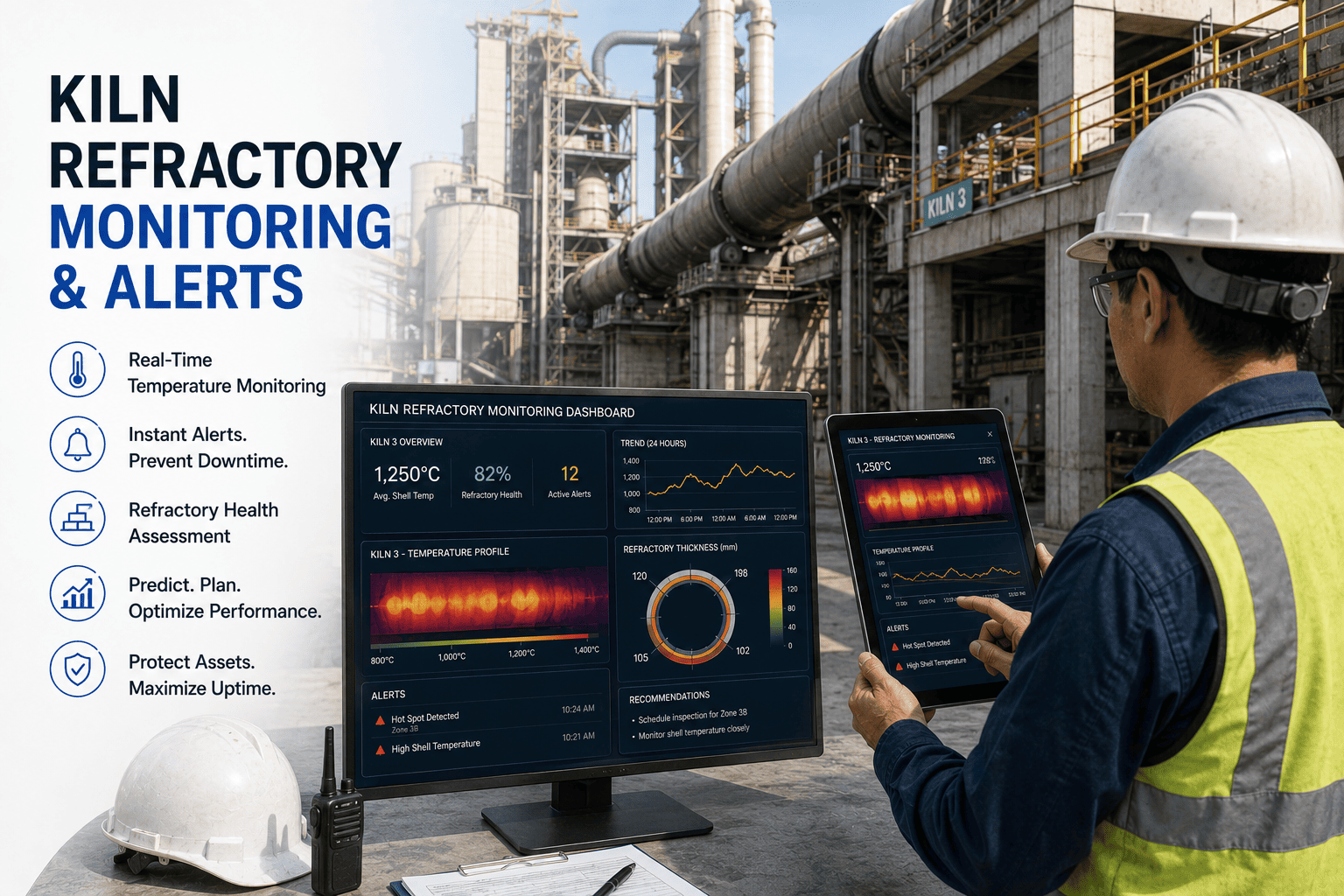
Kiln refractory monitoring is the operating discipline that separates cement plants running 320+ days a year from those losing 30–60 days to refractory-driven shutdowns. The rotary kiln burns at 1,450–2,000 deg C; the refractory lining is the only thing standing between the flame, the alkali-rich clinker chemistry, and the steel shell. When the lining degrades — through chemical attack, thermal cycling, mechanical abrasion, or coating loss — the consequences cascade: red-spot formation on the shell, sudden brick spalling, unplanned shutdown, and in worst cases a kiln burn-through that takes the unit out for 45–90 days. Plants moving from reactive refractory practice to structured monitoring typically extend lining life by 35–60% and cut emergency outage days by half. Oxmaint consolidates shell thermography, brick wear logs, coating index, and PM cadence using Predictive Maintenance, Condition Monitoring, Inspection Management, and Work Order Management — so every refractory event is logged, alerted, and traceable. To see refractory monitoring on your kiln, start a free trial or book a demo.
Catch Refractory Wear Before Shell Damage
See how many shutdown days you can eliminate by catching refractory degradation 4–8 weeks earlier — most plants recover 15–30 days annually.
Cement Kiln Reality
Numbers That Define Modern Refractory Practice
USD 1.8M
average cost of an unplanned 7-day kiln shutdown — including lost clinker production
350 deg
shell temperature threshold above which red-spot risk requires immediate inspection
+45%
average refractory life extension reported by plants monitoring on Oxmaint
-58%
reduction in unplanned kiln outages within first 12 months of structured monitoring
Kiln refractory monitoring is the structured tracking of shell temperature distribution, brick thickness, coating stability, and chemical attack indicators along the full length of the rotary kiln — from feed-end to discharge — combined with the maintenance, inspection, and intervention history that explains how each zone got there. Modern plants instrument the shell with continuous infrared scanners (Heitronics, IRT, Smartshell, KilnScan) and supplement with periodic borescope inspections, lance probes, and laser thickness gauges during scheduled stops.
The monitoring data only converts to operating value when it lives inside a single asset record linked to PM history, work orders, and brick supplier batch information. Oxmaint sits as that consolidation layer — pulling thermography data, inspection findings, and brick records into one kiln asset view. To see this consolidated view, start a free trial or book a demo.
The Six-Zone Kiln Monitoring Framework
Each kiln zone carries distinct refractory chemistry, failure mode, and monitoring requirement. Oxmaint encodes each zone as a separate sub-asset with its own thresholds.
Z1
Feed Inlet / Calcining Zone
High-alumina brick exposed to alkali attack and abrasion from raw meal — monitored for alkali infiltration depth and brick wear.
Z2
Upper Transition Zone
Where coating begins to form — coating instability and thermal cycling drive accelerated wear if not monitored closely.
Z3
Burning Zone
Magnesia-spinel or magnesia-zirconia brick at peak thermal load — coating loss here triggers immediate red-spot risk.
Z4
Lower Transition Zone
Subject to high mechanical stress as clinker forms and tumbles — coating loss correlates with feed chemistry variation.
Z5
Cooling / Discharge Zone
Spinel and high-alumina brick exposed to clinker abrasion and thermal shock from cooling air — wear-rate driven by clinker hardness.
Z6
Nose Ring & Outlet
High thermal cycling, mechanical impact from clinker exit — alumina-silica brick monitored for spalling and joint opening.
A single uncaught red-spot can escalate to shell deformation in 6–12 hours and force an unplanned 30+ day kiln outage.
Where Manual Refractory Tracking Fails Cement Plants
Six recurring monitoring failures that drive every uncontrolled kiln shutdown in plants without structured digital monitoring.
DATA
Thermography Data in Silos
Shell scanner produces hours of high-temperature trend data — none of it linked to brick history, PM cadence, or supplier batch in CMMS.
ALERT
Red-Spot Caught Too Late
Operators notice hotspots from rounds — by the time it is logged and acted on, shell temperature has been above limit for hours.
COATING
Coating Index Not Tracked
Coating stability indicators — feed chemistry, fuel chemistry, flame profile — not correlated with refractory wear over time.
INSPECTION
Borescope Findings Lost
Cold-stop inspection findings written in notebooks, photographed on phones — never make it back into the asset history record.
SUPPLIER
Brick Performance Untracked
Brick supplier and batch data not linked to zone-specific wear rates — supplier accountability and warranty claims become impossible.
SHUTDOWN
Reline Planning Reactive
Reline campaigns scheduled by calendar or by emergency — not by quantified zone wear, leading to over-relining or under-relining.
These gaps compound into the difference between a 320-day and a 280-day kiln operating year — which is why cement plant managers start a free trial on one kiln first, or book a demo for the refractory module walkthrough.
How Oxmaint Monitors Kiln Refractory Health
Six Oxmaint capabilities combine to convert refractory monitoring from reactive into predictive — and from siloed into auditable.
Real-time ingestion from Heitronics, IRT, KilnScan, Smartshell and other infrared scanners with zone-by-zone trending.
Configurable temperature, rate-of-rise, and circumferential gradient thresholds trigger alerts before manual rounds catch them.
Cold-stop inspection workflow captures brick thickness, joint condition, photos, and operator notes against each kiln zone.
Reline scope built from zone-specific wear data — labor, brick volume, anchor count, and downtime planned at asset level.
Brick supplier, batch, and chemistry tracked against zone installed and historical wear performance — supplier accountability enabled.
Refractory contribution to kiln availability factor calculated monthly — with year-over-year comparison and benchmarking.
Cement plant maintenance managers typically prove out refractory monitoring on one kiln before scaling — which is why teams start a free trial on a single kiln, or book a demo for the full module walkthrough.
Plants on Oxmaint refractory monitoring extend lining life by 35–60% and cut emergency outage days by half.
Reactive Refractory Plant vs. Oxmaint Monitored Plant
The operational gap between cement plants without structured refractory monitoring and those running Oxmaint.
| Operating Dimension |
Reactive Plant |
Oxmaint Monitored Plant |
| Shell Temperature Visibility |
Periodic walk-around or one-screen scanner |
Live zone-by-zone trends with alert thresholds |
| Red-Spot Detection Time |
2–6 hours after onset |
Minutes via auto-alert and gradient analysis |
| Brick Thickness Records |
Notebook / spreadsheet, often incomplete |
Zone-tagged, digital, queryable over years |
| Reline Planning |
Calendar-based or emergency-driven |
Wear-data-driven scope and timing |
| Brick Supplier Accountability |
Tribal, anecdotal |
Batch-tracked wear performance |
| Average Refractory Life |
9–14 months on burning zone |
14–22 months with monitoring discipline |
| Unplanned Outage Days |
30–45 days per year typical |
10–18 days per year with monitoring |
| Coating Stability Tracking |
Operator judgment only |
Indexed and correlated with feed chemistry |
ROI & Reliability Outcomes from Oxmaint Refractory Monitoring
Measurable outcomes cement plants achieve within 12 months of deploying structured kiln refractory monitoring on Oxmaint.
+45%
refractory life extension
Average across burning zone and transition zones
-58%
unplanned outages
Reduction in refractory-driven shutdown events
+25 days
operating year
Net kiln operating days recovered per year
USD 4.2M
annual benefit
Typical 5,000 TPD kiln first-year run-rate
-32%
reline cost variance
From data-driven scope vs. calendar-driven scope
90 days
typical payback
On a single-kiln refractory monitoring deployment
These numbers form the business case cement maintenance managers carry to plant heads and group reliability — which is why teams start a free trial on one kiln first, or book a demo for multi-plant scale-up.
Kiln Refractory Monitoring FAQ
Which shell scanners and infrared systems does Oxmaint integrate with
Oxmaint integrates with major shell thermography systems including Heitronics, IRT, KilnScan, Smartshell, and FLIR-based custom installations. Data is ingested via OPC-UA, Modbus, MQTT, or CSV — no replacement of scanning hardware required.
Can the system alert on rate-of-rise as well as absolute temperature
Yes. Oxmaint supports absolute threshold, rate-of-rise, circumferential gradient, and zone-vs-baseline deviation alerts. Each threshold is configurable per zone with severity bands routing alerts to control room, maintenance, and shift supervisor independently.
Does Oxmaint support refractory chemistry compatibility analysis
Yes. Each brick batch carries its chemistry, supplier, install date, and zone. Performance is tracked against fuel chemistry, raw meal chemistry, and coating stability so future brick selection can be evidence-based per zone.
How long does deployment take for a typical cement kiln
A complete refractory monitoring deployment on a single rotary kiln is typically live in 21–30 days using Oxmaint cement-plant templates. Scanner integration takes 1 week, zone mapping 1 week, and dashboard rollout to operations 1–2 weeks.
Decision Point
Stop Losing Operating Days to Refractory Surprises
Turn every kiln zone into a live, monitored, alert-driven asset on Oxmaint. Used by cement operators managing kilns from 1,500 TPD to 12,000+ TPD across global portfolios.
Shell scanner integration
Zone-by-zone wear tracking
Live in 21–30 days
No scanner replacement. Works across multi-plant cement portfolios. Measurable results in the first reline campaign.