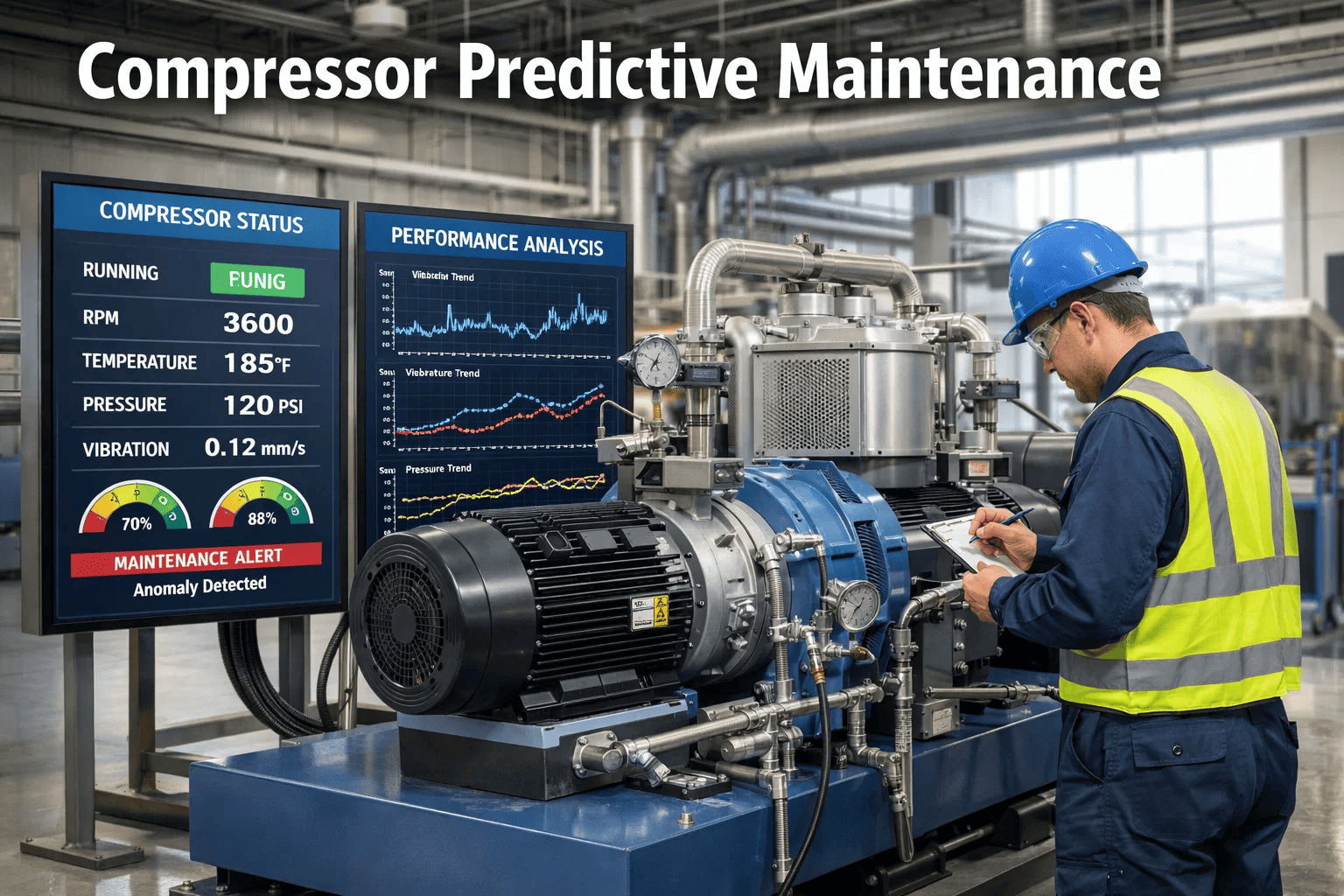
Your rotating equipment is telling you exactly when it will fail. The question is whether your maintenance team is listening — or waiting for the breakdown to answer for them. Vibration analysis turns inaudible mechanical signals into precise failure forecasts, giving plant managers the window they need to act on their own terms. Start a free 30-day trial and connect your first vibration data stream to a live CMMS workflow, or book a demo to see how Oxmaint closes the gap between sensor alert and scheduled work order.
Predictive Maintenance · Vibration Analysis & Condition Monitoring
Stop Waiting for the Bang. Start Reading the Signal.
Vibration analysis detects bearing faults, shaft misalignment, and rotor imbalance weeks before catastrophic failure — turning your maintenance team from firefighters into forecasters.
39.7%
of all predictive maintenance programs globally rely on vibration analysis as their primary detection method
$260K
average cost per hour of unplanned manufacturing downtime — avoidable with early vibration fault detection
11 wks
advance warning a wireless vibration sensor can provide before a bearing failure reaches critical stage
10–30x
ROI ratio achieved within 12–18 months by facilities implementing AI-driven vibration-based predictive maintenance
Ready to Turn Sensor Data Into Scheduled Work Orders?
Oxmaint connects your vibration sensor alerts directly to a live CMMS workflow — asset history, fault classification, technician assignment, and audit trail included. No spreadsheets. No missed alerts. No emergency callouts.
What Is It
Vibration Analysis: The Sharpest Tool in Predictive Maintenance
Every rotating machine — motor, pump, fan, compressor, gearbox — generates vibration as a byproduct of its normal operation. When something starts going wrong internally, that vibration pattern changes. A cracked bearing race, a shaft running out of alignment, a rotor with uneven mass distribution: each produces a distinct frequency signature that appears in vibration data long before the human ear detects anything or a temperature sensor registers heat.
Vibration analysis is the discipline of collecting, processing, and interpreting those signals to identify fault types, estimate fault severity, and forecast remaining useful life. It is the most widely deployed condition monitoring technique in industrial maintenance — because it works on virtually any rotating asset, at any speed, in any industry sector. When combined with a CMMS that converts every alert into a tracked work order, it becomes the backbone of a true predictive maintenance program. Want to see how this works in practice? Start a free trial with Oxmaint or book a demo to walk through a live sensor-to-work-order workflow.
The 4 Failure Stages
How a Bearing Failure Actually Unfolds — And Where You Need to Be
Bearing failures do not happen overnight. They follow a predictable progression across four stages. Stage III is the optimal intervention window — detectable, but not yet critical. By Stage IV, the machine has already failed.
01
Microscopic
5 kHz+
Sub-surface stress cracks form. No vibration detectable at low frequency. High-frequency ultrasonic energy begins to rise. Lubrication monitoring is the only viable tool here.
Very Early
02
Developing
Envelope Analysis
Bearing natural frequencies become excited. High-frequency energy spikes. Envelope analysis and demodulation can identify fault type. Sideband harmonics begin to appear.
Early Warning
03
Recognizable
BPFO / BPFI / BSF
Classic fault patterns appear at low-frequency velocity spectrum. BPFO harmonics for outer race damage. BPFI with sidebands for inner race. Fault is identifiable, machine still operable.
Optimal Intervention
04
Critical
Audible / Visible
Bearing in rapid degradation. Noise and heat are now detectable by human senses. Secondary damage to shafts and housings is imminent. Catastrophic failure is hours away.
Too Late
Vibration analysis performed at Stage III gives maintenance teams a planned replacement window. Waiting until Stage IV means emergency callout, collateral damage, and production loss — every time.
What Vibration Detects
The 4 Core Fault Families That Vibration Analysis Identifies
BPFO · BPFI · BSF · FTF
Each bearing component — outer race, inner race, rolling element, cage — produces a specific defect frequency when damaged. Vibration analysis pinpoints exactly which component is compromised, how severe the damage is, and how fast it is progressing.
Bearings account for 40–50% of all rotating equipment failures
1x · 2x · 3x RPM harmonics
Angular and parallel misalignment between coupled shafts generate strong 2x RPM peaks in the axial direction. Left uncorrected, misalignment accelerates bearing wear, seal failure, and coupling damage simultaneously across multiple components.
Misalignment causes up to 50% of premature bearing failures in industry
Dominant 1x RPM peak
Uneven mass distribution around a rotating shaft produces a characteristic 1x RPM vibration peak. Detected early, correction takes minutes. Detected late, the same imbalance will have destroyed bearings, seals, and the machine housing over thousands of cycles.
Rotor imbalance reduces bearing life by 20–40% when left uncorrected
Gear mesh frequency · Sidebands
Worn gear teeth generate energy at gear mesh frequencies with characteristic sidebands. Mechanical looseness creates a broad spectrum of sub-harmonic and half-order peaks. Both are easily distinguished from bearing faults by an experienced analyst or trained AI model.
Gearbox failures average $50K–$250K in repair costs per incident
Pain Points
What Happens When Vibration Data Stays in a Dashboard Nobody Checks
Sensors are only the first half of the problem. The second half is execution. Most facilities that invest in vibration monitoring still fail to capture the ROI — because detection and action are disconnected.
!
Alerts Without Actions
Sensor dashboards flag anomalies. No work order is created. The alert sits unread until the machine fails. The same $260,000/hour downtime event that vibration monitoring was supposed to prevent still happens.
!
No Asset History at Point of Repair
Technician arrives on site with no context on previous faults, parts replaced, or failure patterns. Every repair starts from zero. Root cause analysis is impossible. Recurring failures are treated as bad luck, not systemic failures.
!
Reactive Culture Survives
Even with sensors installed, if alerts are not converted into scheduled tasks with assigned ownership and tracked completion, the maintenance team stays reactive. Technology without process delivers sensors that monitor failures — not prevent them.
!
Spare Parts Not Staged in Time
Vibration data identifies a deteriorating bearing 8 weeks before failure. Without CMMS integration, the bearing is not ordered until the machine stops. Lead time is 3 weeks. Production waits. The whole early warning window was wasted.
The Comparison
Reactive vs. Vibration-Based Predictive Maintenance — The Numbers
| Scenario |
Reactive Maintenance |
Vibration-Based Predictive |
| First fault detection |
Machine stops (Stage IV) |
11 weeks before failure (Stage III) |
| Bearing replacement cost |
$47,000+ (emergency, collateral damage) |
$800 in parts, 2 hours labour |
| Production loss |
36+ hours unplanned downtime |
Zero — planned during scheduled window |
| Maintenance cost per asset-hour |
$8–12 / hour |
$2–4 / hour |
| Equipment lifespan |
Shortened by repeated overload events |
Extended 20–40% with early intervention |
| Spare parts readiness |
Emergency procurement, 2–3x cost premium |
Staged in advance from forecast data |
| Secondary damage risk |
High — cascade failure to shafts, housing |
Eliminated — component replaced before propagation |
| Downtime reduction vs reactive |
Baseline |
30–50% fewer unplanned stoppages |
How Oxmaint Solves It
From Sensor Alert to Closed Work Order — The Oxmaint Vibration Workflow
The single biggest failure in condition monitoring is not detection — it is execution. Oxmaint closes the gap between a vibration sensor flagging an anomaly and a technician completing a documented repair with parts history attached. Every step is tracked, every alert becomes accountable, every repair feeds future forecasts. See this end-to-end in a live session — book a demo with a predictive maintenance specialist, or start a free trial and connect your first asset today.
01
Sensor Platform Integration
Oxmaint connects to vibration monitoring platforms via API. When a sensor exceeds configured severity thresholds — frequency amplitude, RMS velocity, acceleration — it pushes a fault-classified alert into Oxmaint automatically. No manual data entry, no dashboard polling.
02
Auto-Generated Work Order With Full Context
Every sensor alert auto-creates a work order in Oxmaint — attaching the spectral data, fault classification, asset history, previous repair records, and recommended action. The technician arrives with complete context, not a blank sheet.
03
Asset Condition Scoring Updates Automatically
Oxmaint's full asset registry maintains a condition score for every monitored asset. Each vibration reading — normal, warning, or critical — updates the score in real time. Facility managers see a live condition map across the entire portfolio, not just the asset that just failed.
04
Spare Parts Triggered in Advance
When condition scores reach a configurable warning threshold, Oxmaint flags the associated spare parts in inventory. If stock is insufficient, it raises a procurement trigger — staging the replacement component days or weeks before the work order becomes urgent.
05
Work Order Execution and Technician History
Technicians complete work orders on mobile — logging actual time, parts used, photos, and observations. Every repair is timestamped and linked permanently to the asset record. Pattern recognition for recurring faults becomes possible from the first maintenance cycle.
06
CapEx Forecasting From Degradation Curves
Oxmaint builds rolling 5–10 year CapEx models from condition score trajectories. When vibration trends indicate an asset is entering terminal decline, the replacement cost is automatically surfaced in the CapEx forecast — giving ownership groups investor-grade planning data from the same sensor data that runs daily operations.
ROI & Results
The Financial Case for Vibration-Based Predictive Maintenance
30–50%
Downtime Reduction
Facilities implementing vibration-based predictive maintenance programs achieve 30–50% fewer unplanned production stoppages within the first year of deployment.
$250K
Annual Savings Per Asset
Rotating equipment in process industries saves $50,000–$250,000 per asset annually through vibration monitoring — from bearing replacements prevented to production loss avoided.
40%
Longer Equipment Life
Early fault intervention extends equipment lifespan by 20–40%, deferring capital replacement costs and improving the long-term return on existing asset base across all sites.
25–30%
Lower Maintenance Costs
Organizations switching from reactive or purely time-based maintenance to vibration-driven predictive programs reduce total maintenance expenditure by 25–30% in the first two years.
Real Scenario — The Cost of Missing Stage III
Without Vibration Monitoring
Bearing fault missed at Stage II–III
Machine seizes at Stage IV
36 hours unplanned downtime
Emergency parts air-freighted
$47,000 repair cost
$120,000 production loss
Total: $167,000+
With Vibration Monitoring + Oxmaint
Fault detected 11 weeks before failure
Work order auto-created in Oxmaint
Bearing staged from inventory
Replacement in scheduled window
$800 parts, 2 hours labour
Zero production loss
Total: $800
Vibration Metrics
Key Vibration Parameters Your Team Should Be Tracking
RMS
Root Mean Square Velocity
The primary severity indicator for overall machine health. Measured in mm/s, benchmarked against ISO 10816-3 limits. Rising RMS trend on a stable machine is the earliest broadband signal that something is developing.
FFT
Fast Fourier Transform Spectrum
Decomposes the raw vibration signal into individual frequency components. The FFT spectrum is the primary diagnostic tool — each fault type appears at a predictable frequency, allowing precise fault identification rather than general health status.
CF
Crest Factor
The ratio of peak amplitude to RMS. High crest factor with low RMS indicates early impulsive bearing defects before they register in broadband measurements. Crest factor decreases as the fault grows — a counterintuitive indicator that requires trend context to interpret correctly.
ENV
Envelope / Demodulation Analysis
Particularly effective for Stage II bearing faults when the defect frequency is buried in background noise. Envelope analysis filters the signal to a specific band around a resonance frequency, amplifying impulsive content and revealing defect frequencies that broadband analysis misses entirely.
FAQ
Vibration Analysis and Predictive Maintenance — Common Questions
How often should vibration measurements be taken on critical rotating equipment?
Critical assets — compressors, pumps, main drive motors — need continuous online monitoring. For less critical equipment, route-based checks every 2–4 weeks is the practical minimum. The rule: measure at least twice within the P-F interval (typically 3–8 weeks for industrial bearings) so no developing fault slips between surveys.
Start a free trial with Oxmaint to automate the full collection-to-work-order pipeline.
What is the difference between overall vibration monitoring and spectral analysis?
Overall (broadband) monitoring tells you something is wrong — spectral (FFT) analysis tells you exactly what and where. Broadband RMS rising above baseline triggers investigation; the FFT spectrum then identifies fault type (bearing, misalignment, imbalance) by its specific frequency signature. Use broadband for trending, FFT for diagnosis.
Book a demo to see how Oxmaint links both into one asset condition record.
How does Oxmaint convert a vibration sensor alert into a tracked maintenance action?
When a connected sensor platform exceeds your configured threshold, it pushes an alert to Oxmaint via API. Oxmaint auto-creates a work order with fault classification, asset history, and linked spare parts attached — assigned, tracked, and closed with documented evidence. No manual entry, no missed alerts.
Connect your first asset with a free Oxmaint trial.
We already have a vibration program but our team is still reactive. What is missing?
The sensors are not the problem — execution is. Alerts sitting in a dashboard nobody acts on deliver zero ROI. The fix is a CMMS that converts every alert into an assigned, scheduled work order with ownership and a deadline. You do not need more sensors; you need the sensors you have connected to accountable action.
Book a demo — show us your current workflow and we will map the gap.
Oxmaint CMMS · Vibration-Driven Predictive Maintenance
Your Sensors Are Already Talking. Is Anyone Acting on What They Say?
Oxmaint converts vibration alerts into assigned, tracked, documented work orders — with asset history, spare parts staging, and CapEx forecasting built in. From first sensor spike to closed repair, every step is accountable. Deploy on your most critical rotating equipment today. No heavy implementation. No long onboarding. Results in weeks.