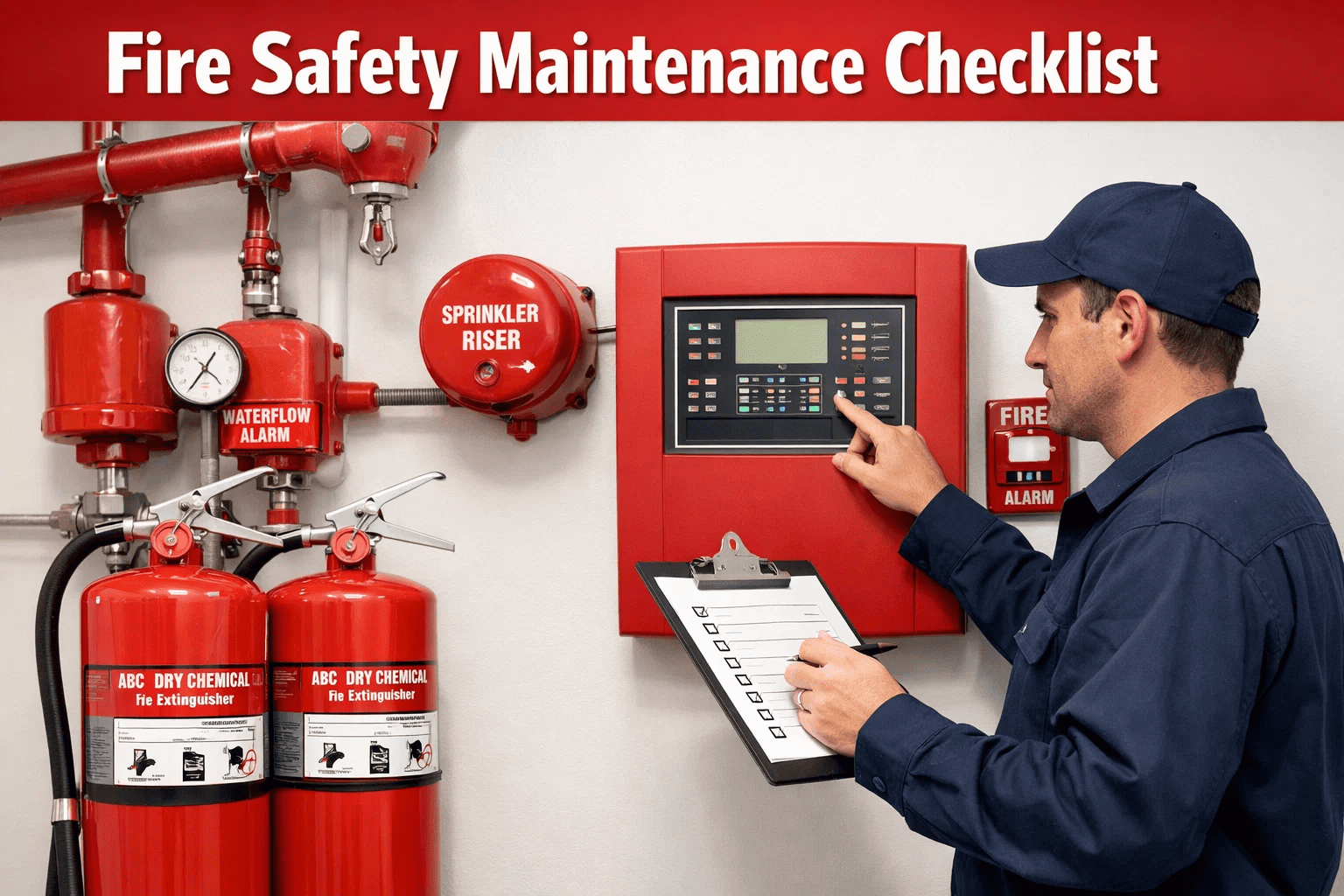
When a fire alarm fails to sound or a sprinkler head doesn't activate, nobody grades your maintenance program on effort — they measure it on outcome. And in the aftermath of any fire incident, the first three things investigators request are your inspection logs, your testing records, and your deficiency repair history. A fire safety program that can't produce those on demand is legally exposed before the smoke clears. This guide maps the complete fire safety maintenance checklist across alarms, sprinklers, extinguishers, suppression systems, and emergency egress — aligned to NFPA and OSHA frequency requirements. Facility teams that want to see compliance tracking run across a multi-site portfolio can start a free trial or book a demo to walk through the workflow today.
NFPA + OSHA + AHJ COMPLIANT
$1.2M+
average cost of a major commercial fire loss
40%
of commercial fires show deficient alarm or suppression records
NFPA 25
the code governing sprinkler inspection frequency
Monthly
minimum inspection cadence for fire extinguishers
Your fire inspection logs shouldn't live in a folder nobody can find.
OxMaint turns every monthly, quarterly, and annual fire system task into a tracked work order with signatures, photos, and timestamps — exportable on demand for your AHJ, insurer, or investigator.
What "Fire Safety Maintenance" Really Includes
Fire safety maintenance is a multi-system discipline covering every asset your building depends on when something catches fire — detection, notification, suppression, containment, and egress. Each system has its own NFPA code, its own inspection cadence, and its own deficiency classification. Miss any one piece and your entire defense-in-depth strategy collapses. Portfolio operators managing 10+ properties can't run this on memory or spreadsheets — they need work-order-driven tracking that ties every task to an asset, a date, and a signature. Teams that want to see this running on live multi-property data can book a demo to walk through the compliance dashboard.
The Six Fire System Zones
ZONE 1
Fire Alarm Systems
Smoke detectors, heat detectors, pull stations, notification appliances, control panels, monitoring. Governed by NFPA 72.
Test Annually + Quarterly FACP
ZONE 2
Sprinkler Systems
Wet pipe, dry pipe, pre-action, deluge systems with valve assemblies, gauges, and FDC connections. Governed by NFPA 25.
Weekly Valves + Annual Flow
ZONE 3
Fire Extinguishers
Portable ABC, BC, K-class, and specialty extinguishers placed at egress paths and high-risk areas. Governed by NFPA 10.
Monthly Visual + Annual Cert
ZONE 4
Suppression Systems
Clean agent, CO2, wet chemical, dry chemical systems protecting kitchens, server rooms, and hazard areas. Multiple NFPA standards.
Semi-Annual Service
ZONE 5
Emergency Lighting + Egress
Exit signs, emergency battery lighting, path-marking, stairwell lighting. Governed by NFPA 101 + OSHA 1910.37.
Monthly 30-sec + Annual 90-min
ZONE 6
Passive Protection
Fire doors, dampers, fire-rated walls, penetration seals, smoke control systems. Governed by NFPA 80 + NFPA 105.
Annual Inspection Minimum
The NFPA Inspection Calendar at a Glance
| Task | System | Frequency | NFPA Code | Who Performs |
|---|
| Extinguisher visual inspection | Extinguishers | Monthly | NFPA 10 | Facility staff |
| Control valve position check | Sprinkler | Weekly | NFPA 25 | Facility staff |
| Emergency light 30-sec test | Egress | Monthly | NFPA 101 | Facility staff |
| FACP supervisory test | Alarm | Quarterly | NFPA 72 | Licensed tech |
| Main drain test | Sprinkler | Quarterly | NFPA 25 | Licensed tech |
| Suppression system service | Suppression | Semi-Annual | NFPA 17/17A/2001 | Certified vendor |
| Full alarm + detection test | Alarm | Annual | NFPA 72 | Licensed tech |
| Sprinkler flow + trip test | Sprinkler | Annual | NFPA 25 | Licensed tech |
| Extinguisher certification | Extinguishers | Annual | NFPA 10 | Certified vendor |
| Fire door + damper inspection | Passive | Annual | NFPA 80/105 | Licensed tech |
| Hydrostatic extinguisher test | Extinguishers | 5–12 Yr | NFPA 10 | Certified vendor |
| Sprinkler internal pipe exam | Sprinkler | 5 Year | NFPA 25 | Licensed tech |
Six Compliance Gaps That Show Up Under Audit
G1
Untagged Extinguishers
Missing or illegible monthly tags fail NFPA 10 inspection immediately. Common in corridors where turnover of facilities staff interrupts the monthly walk.
G2
Closed Sprinkler Valves
A control valve left in the wrong position disables the sprinkler system for the entire zone. NFPA 25 requires weekly verification — and most paper systems miss 1 in 6 weeks.
G3
Expired Kitchen Suppression
NFPA 17A requires semi-annual service on kitchen hood suppression. Restaurants and cafeterias routinely run 9–14 months without documented service.
G4
Dead Emergency Batteries
Annual 90-minute battery load test catches units that fail under actual emergency duration. 30-sec tests alone hide 60% of actual failures.
G5
Blocked Fire Doors
Wedged-open fire doors violate NFPA 80 and defeat smoke compartmentation. Annual inspection requires closure verification on every rated assembly.
G6
Untracked Deficiency Repairs
Vendor reports deficiencies after annual testing, but repair work is never tied back to the finding. AHJ audits specifically look for closed deficiency loops.
Every deficiency without a closed repair is a compliance finding.
OxMaint links every vendor deficiency to a work order — and won't close it until the repair is signed off, photographed, and dated.
How OxMaint Runs Your Fire Safety Program
NFPA-ALIGNED
Pre-Built Inspection Templates
Weekly, monthly, quarterly, and annual templates for every NFPA category ship with the platform. Configure once, run for years.
MOBILE
QR-Coded Extinguisher Rounds
Scan the QR tag on each extinguisher, log the month, snap a photo, sign off. Full NFPA 10 rounds in 20% of the time of paper.
VENDOR
External Contractor Portal
Your fire alarm, sprinkler, and suppression vendors log in, upload annual reports, and flag deficiencies directly into the system.
WORKFLOW
Deficiency-to-Repair Closure
Every flagged deficiency auto-creates a repair work order that cannot close until the fix is documented and the vendor re-verifies.
ALERTS
Certificate Expiration Tracking
Extinguisher hydro dates, alarm certifications, sprinkler 5-year internal exams — all tracked with 90/60/30-day reminders.
REPORTING
AHJ-Ready Export
Fire marshal shows up? Export every log, every repair, every signature for any date range as a single PDF in under 5 minutes.
Paper-Based Tracking vs. OxMaint Tracking
| Program Dimension | Paper/Spreadsheet | OxMaint |
|---|
| Monthly extinguisher completion | 68% | 98% |
| Valve position verification | Inconsistent | Weekly, auto-flagged |
| Deficiency closure rate | 55% within 90 days | 96% within 90 days |
| Audit document retrieval | 2–4 hours per event | Under 5 minutes |
| Vendor report integration | Email attachments | Direct portal upload |
| Certificate expiry surprises | Common | Zero — 90-day alerts |
What Facilities Teams See After One Compliance Cycle
01
92%
Reduction in AHJ findings
Year-one audit improvements across commercial portfolios
02
100%
Monthly completion rate
Mobile QR rounds vs. 68% under paper systems
03
5 min
Avg. audit export time
Down from 2–4 hours of binder digging
04
$45K
Avg. insurance premium impact
Typical reduction after documented PM history
Frequently Asked Questions
Can in-house facility staff perform fire extinguisher inspections?
Yes — NFPA 10 explicitly permits trained facility personnel to perform monthly visual inspections (the "quick check"). However, annual maintenance, internal examinations, and hydrostatic testing must be performed by certified fire protection vendors. OxMaint tracks both streams separately against each extinguisher asset.
What's the difference between inspection, testing, and maintenance in NFPA terms?
Inspection is a visual check to confirm a device is in place and appears operational. Testing is an operational verification that it actually functions. Maintenance is the corrective work performed when inspection or testing reveals a deficiency. NFPA 25, 72, and 10 all distinguish these three activities — and your records must show all three were performed.
How does OxMaint integrate with our fire alarm monitoring company?
Your monitoring and testing vendors receive external portal logins. They upload quarterly supervisory reports, annual test certifications, and deficiency lists directly against the correct asset. Your staff sees everything in one dashboard — no more chasing emails for last year's inspection certificate.
What happens to our historical fire inspection records during onboarding?
Legacy certificates, vendor reports, and inspection logs can be uploaded against each asset during setup, preserving the full compliance history. This matters for 5-year sprinkler internal exams and hydrostatic extinguisher tests where the previous test date determines the next due date.
When the Fire Marshal Shows Up, You Want to Be the Easiest Building They Inspected That Day
Every monthly, quarterly, and annual fire system record — organized, signed, and exportable. Built for facility teams who manage compliance as an operational asset, not an audit crisis.