An elevator out of service for 48 hours can cost a commercial property $12,000 in tenant goodwill, service credits, and emergency callout fees — and that's before anyone asks about the liability exposure from a stuck car or a compliance lapse. Yet most portfolios still track lift maintenance on a spreadsheet, hope their contractor files the inspection reports, and find out about a missed anniversary inspection only when the city red-tags the equipment. This guide lays out how modern elevator maintenance management actually works: inspection cadence, compliance tracking, preventive scheduling, and the reporting that keeps owners, tenants, and regulators satisfied. If you want to see portfolio-level elevator visibility built specifically for multi-property owners, you can start a free trial or book a demo for a walkthrough today.
27
average days per year an elevator is out of service in under-managed buildings
$250
average cost per emergency elevator callout in commercial portfolios
ASME A17.1
the governing safety code in North American jurisdictions
68%
of elevator entrapments are traceable to deferred preventive maintenance
Running elevator maintenance out of a spreadsheet?
See how 50+ portfolio owners moved from email chains and paper inspection logs to a single dashboard covering every car, every property.
What Elevator Maintenance Management Actually Covers
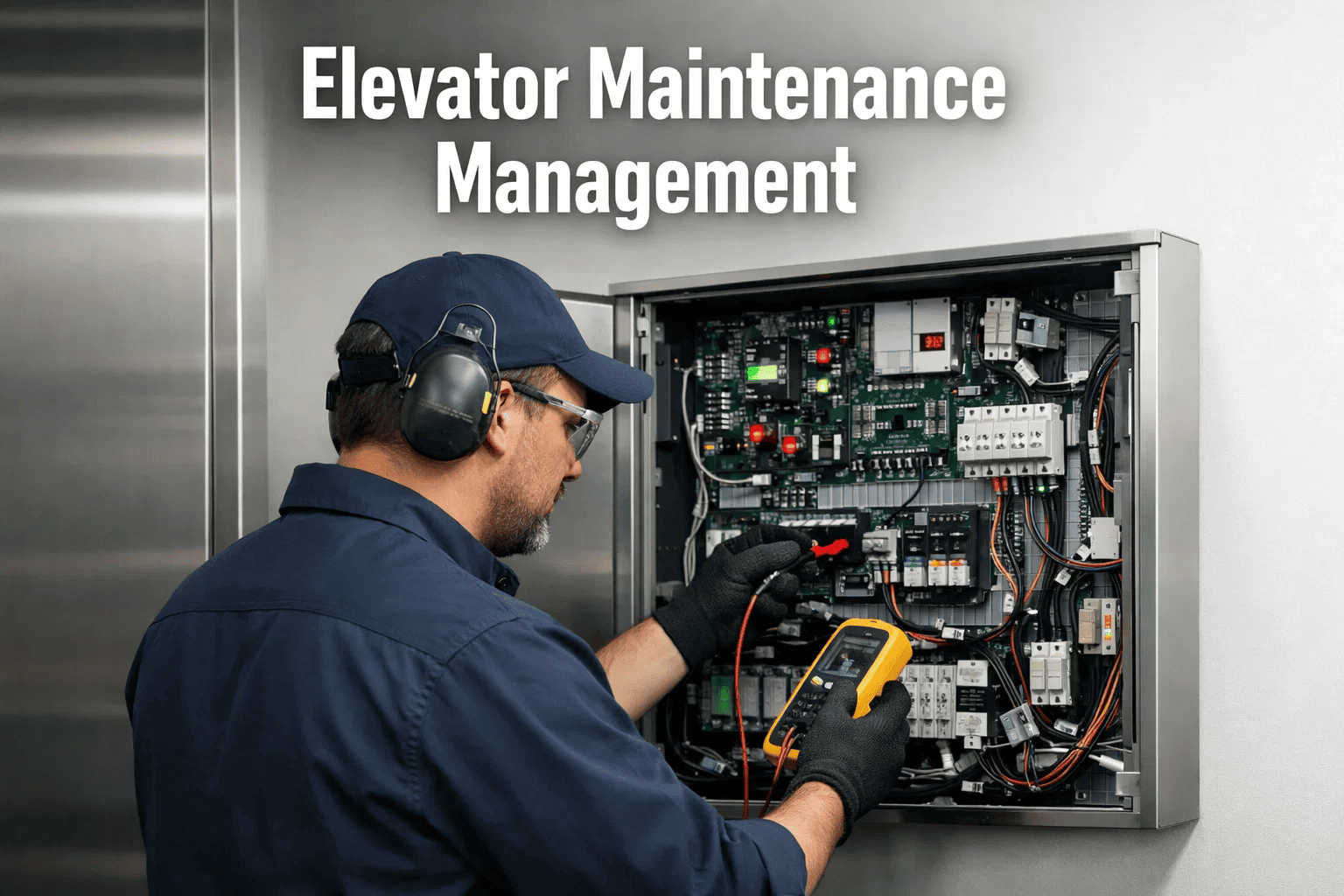
Elevator maintenance management is the operational discipline of tracking inspection cycles, contractor work, preventive tasks, code compliance, and tenant service response across every vertical-transport asset in a building or portfolio. It spans passenger elevators, freight lifts, service elevators, and escalators — each with its own inspection cadence and regulatory framework. Done well, it reduces entrapment risk, extends equipment life 25–35%, and defends the property against liability claims. Done poorly, it turns every code inspection into a compliance crisis. Facility teams that want a structured view can book a demo and see the scheduling engine in under 30 minutes.
The Six Management Pillars
P1
Asset Registry
Every car cataloged with type, OEM, install date, state certificate number, and warranty status.
P2
Inspection Scheduling
Annual, Category 1, and Category 5 inspection due dates with 90/60/30-day auto-reminders.
P3
Preventive Tasks
Monthly and quarterly PM work orders routed to your elevator service contractor.
P4
Callout Tracking
Every entrapment, shutdown, and emergency response timed, logged, and trended.
P5
Contractor Oversight
SLA tracking, response time data, and contractor scorecard by property.
P6
Audit Trail
Signed certificates, state filings, and inspector reports stored against each asset.
The Inspection Frequency Matrix
| Inspection Type | Frequency | Who Performs | What's Covered | Regulatory Basis |
|---|
| Routine PM Visit | Monthly | Service contractor | Lubrication, door operation, call buttons, fixtures | Contract requirement |
| Category 1 Inspection | Annual | Licensed inspector | Safety devices, car operation, load test (empty car) | ASME A17.2 |
| Category 5 Inspection | Every 5 years | Licensed inspector | Full-load safety test, governor test, buffer test | ASME A17.1 8.11 |
| Firefighter Service Test | Monthly | Trained personnel | Phase I recall, Phase II operation, hat switch | NFPA 72, ASME A17.3 |
| Elevator Pit Inspection | Quarterly | Maintenance staff | Water, debris, pit switch, buffer condition | ASME A17.1 2.2 |
| Escalator Walk-Through | Daily | Building staff | Step condition, handrail speed, comb plates | ASME A17.1 8.7 |
The Four Ways Portfolios Lose Control
Compliance Gap
Expired Inspection Certificates
City codes require current certificates posted inside every car. Portfolios with 40+ cars regularly discover expired certificates during surprise audits — triggering fines of $500–$5,000 per car.
Financial Leak
Unchecked Contractor Invoices
Monthly PM contracts covering "all routine work" routinely get billed twice when service calls happen. Without linked work-order tracking, 15–22% of elevator invoices are duplicate billings.
Safety Exposure
Deferred Category 5 Tests
Full-load safety tests required every 5 years get skipped when ownership changes or contractors rotate. A failure in an untested car is the single largest liability exposure in any vertical building.
Operational Drain
Entrapments Without Trend Data
If you can't see that car #3 has had 11 entrapments in 6 months, you cannot push your contractor to replace the failing component. Without trend data, patterns stay invisible.
Every missed Category 1 inspection is a violation waiting for an inspector.
OxMaint sends 90/60/30-day reminders automatically and lets your contractor upload signed certificates directly to the asset record.
How OxMaint Structures Elevator Portfolios
ASSET HIERARCHY
Portfolio-Down Organization
Every elevator sits under Portfolio > Property > System > Component. A VP sees 100 cars; a site manager sees 4; a tech sees today's work. Same system, right view per role.
AUTO-SCHEDULING
Certificate Expiry Alerts
Upload a Category 1 certificate; system calculates expiration and fires reminders at 90, 60, and 30 days. No lift enters a red-tag window by surprise.
CONTRACTOR PORTAL
External Service Access
Your elevator contractor logs in, receives work orders, uploads signed checklists, and closes tickets — all against the same asset record your team sees.
CALLOUT ANALYTICS
Entrapment Pattern Detection
Auto-flags any car with more than 3 callouts in 30 days. Gives you the data to push for component replacement before the next liability event.
COMPLIANCE VAULT
Single-Click Audit Export
State inspector shows up unexpectedly? Export every certificate, test result, and PM record for every car in the building as a dated PDF in under 3 minutes.
CAPEX FORECAST
Modernization Planning
Condition scoring on every car feeds 5–10 year CapEx models. Know which cars need modernization before the service calls start spiking.
Reactive Contractor Model vs. Managed Program
| Dimension | Reactive Model | OxMaint-Managed |
|---|
| Certificate compliance visibility | Reactive — found at audit | Live dashboard, 90-day warning |
| Entrapment trend detection | Invisible | Auto-flagged at 3+ events |
| Contractor invoice auditing | Manual, inconsistent | Matched to work orders |
| Average outage duration | 27 days/year | under 10 days/year |
| Category 5 test tracking | Contractor memory | 5-year rolling calendar |
| CapEx forecast integration | Separate spreadsheet | Built-in per asset |
What Portfolios Measure After Year One
63%
Fewer callouts per car
Average reduction after 12 months of tracked PM
100%
Certificate compliance
Zero expired certificates across managed portfolios
18%
Lower contractor spend
From invoice verification + reduced emergency calls
8+ hrs
Saved per audit event
One-click export vs. manual reconstruction
Frequently Asked Questions
Who is responsible for elevator inspections — the building owner or the contractor?
Ultimate responsibility for compliance sits with the building owner or manager. Service contractors perform the maintenance and may arrange inspections, but the fine for an expired certificate goes to the property owner. This is why portfolio-level tracking is critical — you cannot rely on contractor reminders alone.
What's the difference between Category 1 and Category 5 elevator inspections?
Category 1 inspections happen annually and cover general condition, safety device function, and an empty-car load test. Category 5 inspections happen every 5 years and add a full-rated-load safety test, governor test, and buffer test. Both are mandated under ASME A17.1 and cannot be skipped without violating code.
How does OxMaint work with our existing elevator service contract?
OxMaint sits on top of your contractor relationship, not in place of it. Your service company gets a login to submit work, upload certificates, and close tickets. You get visibility into what's been done, when it's due, and how contractor performance compares across properties. No contract change required.
Can OxMaint track escalators and freight lifts too?
Yes. Every vertical-transport asset — passenger elevators, escalators, freight lifts, dumbwaiters, moving walks — lives in the same asset hierarchy with its own PM schedule and inspection cadence. Portfolio dashboards show status across all types from one view.
Stop Finding Out About Expired Elevator Certificates From an Inspector
Every car, every property, every certificate — tracked, timed, and defensible. Built for portfolio operators who manage vertical transportation at scale.