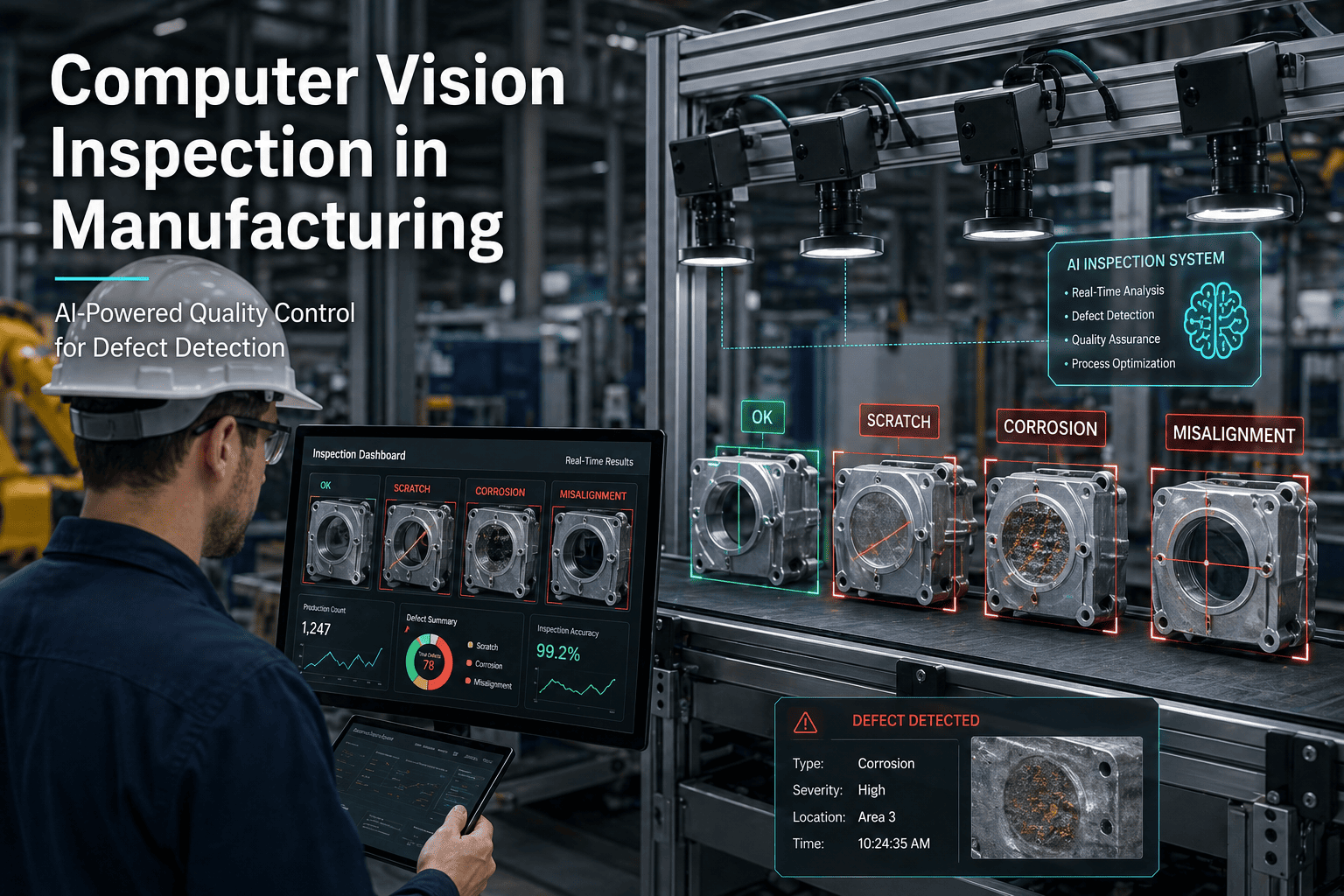
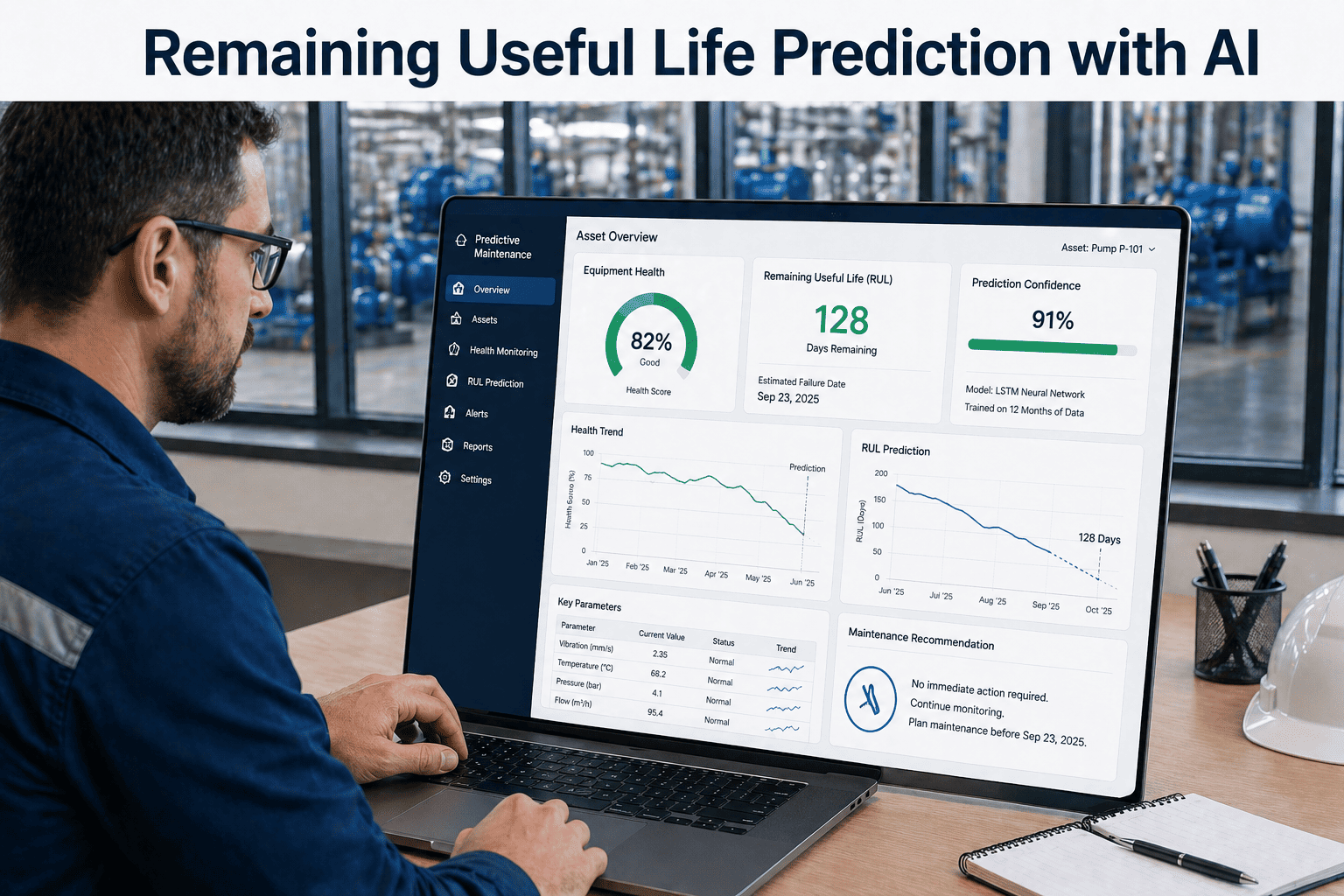
A semiconductor fab in Dresden runs 9,200 wafers per day across 14 inspection stations. Until 2024, three inspectors per shift checked them — averaging 87% defect-catch accuracy and missing roughly 1,196 marginal defects every day. After deploying AI-powered computer vision inspection, the same line now hits 99.2% defect-catch accuracy at 4x the throughput, and every flagged defect generates a CMMS work order before the wafer leaves the chamber. The human eye is brilliant. It is also tired, distracted, and hourly. Computer vision is not. To see how this connects to your production line and CMMS, you can start a free trial and connect your first camera in under 20 minutes.
Computer Vision Inspection in Manufacturing: Detect Defects, Trigger Work Orders, Eliminate Rework
From PCB solder joints to weld seams to corrosion on rotating equipment — AI-powered cameras now catch what humans miss, then auto-generate CMMS work orders before defects move downstream.
99.2%Defect detection accuracy with deep-learning vision
$6.07BAI defect detection market by 2035 (8.6% CAGR)
300–500Units per minute inspected — vs 60 for human inspectors
85–90%Human inspector accuracy ceiling on continuous shifts
Stop shipping defects. Start catching them at the camera.OxMaint connects vision systems to your work-order engine — flag a defect, ship a fix.
Computer vision inspection is the use of cameras, optics, and deep-learning models to automatically detect defects, dimensional errors, surface flaws, and assembly mistakes on production lines or fielded equipment. Unlike rule-based machine vision — which checks pixel patterns against fixed templates — modern AI inspection learns from examples, generalizes to new defect types, and improves with every part inspected. Manufacturing now generates more visual data in a single shift than a human inspector could see in a lifetime. Deep learning makes that data useful in real time. If you are evaluating systems, you can book a demo and walk through how OxMaint connects vision output to your maintenance workflow.
Inspection Categories
6 Inspection Types Powered by Computer Vision
Different defects need different vision strategies. Surface inspection on a steel coil is not the same problem as solder verification on a PCB. Here are the six categories that cover 92% of industrial use cases.
01
Surface Defect Detection
Scratches, dents, corrosion, pitting, paint flaws on metal, glass, plastic, or composite surfaces. Sub-pixel resolution catches defects smaller than 50 microns at line speeds up to 8 m/s.
Steel · Automotive · Aerospace
02
Dimensional Measurement
Non-contact measurement of width, height, gap, alignment, and runout. Replaces calipers and fixtures with sub-micron repeatability across hundreds of parts per minute.
Precision Machining · Electronics
03
Assembly Verification
Confirms every component is present, oriented correctly, and in the right position. Catches missed screws, mis-clipped harnesses, and incorrect part numbers before downstream stations.
Automotive · Appliances
04
Print & Label Verification
OCR + image classification verifies barcodes, lot codes, expiration dates, and label placement. Pharma and food regulators require 100% verification — vision delivers it.
Pharma · Food & Beverage · Logistics
05
Weld & Joint Inspection
Detects porosity, cracks, undercut, and misalignment in welds. Replaces destructive sampling with 100% inline coverage — critical for pressure vessels and structural fabrication.
Heavy Industry · Pressure Equipment
06
Equipment Condition Monitoring
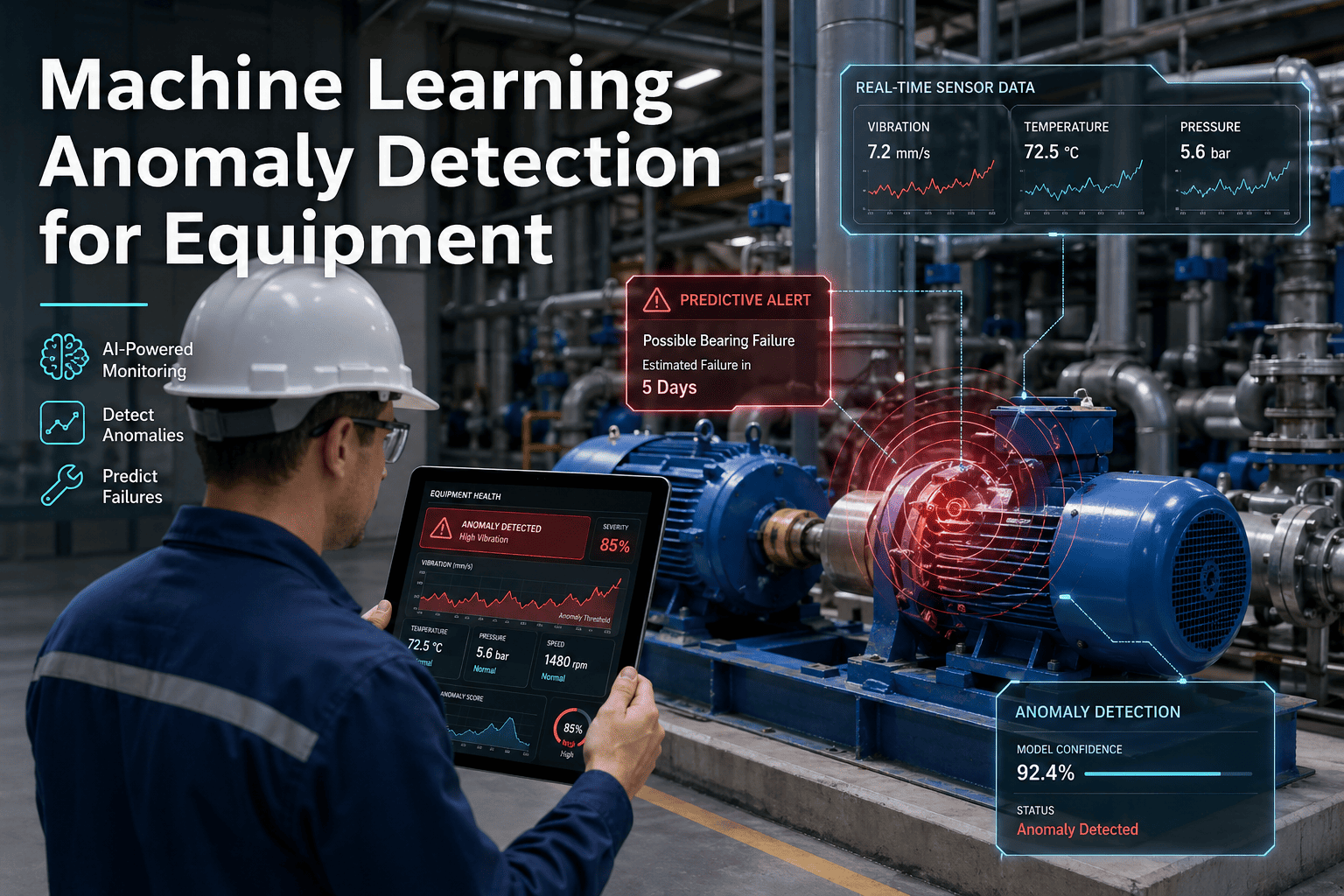
Thermal + visible cameras watching rotating equipment for hotspots, oil leaks, vibration-induced misalignment, belt wear. Generates CMMS work orders the moment a condition shifts.
Plants · Substations · Process Industry
The Reality
Where Manual & Rule-Based Inspection Falls Apart
Inspector Fatigue
Human accuracy drops from 90% to under 60% after 4 hours on the same task. AI vision holds 99%+ across three-shift operations.
Throughput Ceiling
Manual inspection caps lines at 60 units/min. Vision systems run at 300–500 units/min — same headcount, 5–8x output.
Rule-Based Brittleness
Traditional vision breaks when lighting, color, or part shape changes. Deep learning generalizes — same model, multiple variants, no re-tuning.
Insight Silos
A defect spotted at the camera does not become a fix unless it triggers a work order. Standalone vision dies in spreadsheets. Integration is the lever.
Scrap & Rework Cost
Late defect detection adds 10–15x rework cost vs catching it at the source. AI inspection at the first station eliminates downstream contamination.
Audit Trail Gaps
Regulators want image-level evidence per part. Manual inspection produces none. Vision systems store every frame — audit-ready by default.
How It Works
From Camera to Work Order — The 6-Step OxMaint Vision Pipeline
01
Image Capture
Industrial cameras (2–25 MP), structured lighting, telecentric optics. Frame rates up to 200 fps. Edge buffer holds last 60 seconds for context.
02
Pre-processing
Color correction, ROI cropping, distortion removal. Image normalized so the model sees the part — not the lighting variation.
03
Deep-Learning Inference
CNN runs on edge GPU. Output: pass/fail, defect type, location heatmap, confidence score. Latency under 80 ms per part.
04
Defect Classification
Multi-class model assigns defect type — porosity, scratch, contamination, dimensional error. Drives the right corrective action downstream.
05
CMMS Work Order Trigger
OxMaint receives the defect event with image, classification, and asset ID. A work order is created with priority, technician skill match, and parts requirement.
06
Continuous Learning
Technician outcomes feed back into the model. False positives down 23% per quarter. The system gets sharper every shift.
Side By Side
Manual Inspection vs Computer Vision Inspection
Manual / Rule-Based
Accuracy ceiling: 85–90%
60 units/min throughput cap
Re-tuning required for every variant
Defect data lives in inspector notebooks
No image audit trail per part
Defect missed → downstream contamination
Inspector fatigue degrades shift performance
Manual handoff to maintenance team
OxMaint + Computer Vision
Accuracy: 99.2% with deep learning
300–500 units/min — same operator
One model, multiple variants generalized
All defects logged with image evidence
Per-part image stored, audit-ready
Defect caught at source — zero downstream
Constant accuracy across 24/7 operations
Auto work order to right technician in seconds
Measured Outcomes
What Vision-Powered Plants Achieve in 12 Months
99.2%
Defect detection accuracy with AI vision
30%
Reduction in line defect rates per industry data
5–8x
Throughput gain on inspection-bound lines
10–20%
Yield improvement with vision-based quality control
$4.2M
Annual scrap reduction on a mid-size assembly plant
9 mo
Average payback on AI vision + CMMS integration
Want to see how the vision-to-CMMS pipeline runs on your defect categories? You can book a demo tailored to your line in 30 minutes.
FAQs
Frequently Asked Questions
How many defect images do we need to train a working model?
For most industrial defects, 200–500 labeled examples per defect class produce 95%+ accuracy. With synthetic data augmentation and pre-trained backbones, we have seen plants go live with as few as 80 real images per class. OxMaint's onboarding includes a labeling workflow that gets you to production in 2–4 weeks.
Can computer vision inspection retrofit onto existing equipment, or do we need a new line?
Retrofit is the norm. Industrial cameras, lighting, and edge GPU enclosures are designed for installation on existing conveyors, machining centers, and inspection stations. No production interruption required — most installations complete during a planned weekend window.
How does the vision system connect to OxMaint CMMS for work-order generation?
OxMaint exposes a defect-event API. When the vision system detects a defect, it posts the image, classification, severity, and asset ID. OxMaint generates the work order with the right priority, technician skill match, and parts list. End-to-end latency from defect to dispatched technician: under 60 seconds.
What is the typical ROI window for AI vision inspection?
Most installations pay back in 7–12 months on scrap reduction and throughput gain alone. Plants in regulated industries (pharma, aerospace, automotive) often pay back faster because the audit-trail value is bookable. Start a free trial to model ROI for your line.
Trusted by Plants Across 40+ Countries
Catch Every Defect. Trigger Every Work Order. Audit Every Part.
OxMaint connects your camera to your CMMS — defect events become work orders in under 60 seconds, with image evidence stored per part. Live in days, not months.