At $100.76 per minute of aircraft block time, a baggage conveyor failure at 6 AM during peak departures is not a maintenance inconvenience — it is a cascading operational crisis affecting thousands of passengers, triggering FAA reporting requirements, and exposing your airport to airline penalty claims before noon. Airports manage 10,000+ assets across millions of square feet, under simultaneous regulatory oversight from FAA, TSA, OSHA, NFPA, and ICAO, with maintenance windows compressed to 3–4 overnight hours between last arrival and first departure. The airports that consistently deliver operational reliability are not the ones with the newest equipment. They are the ones with the most disciplined maintenance programs. Start a free trial to see how Oxmaint is built for FAA Part 139 airport operations or book a demo configured for your facility type.
$100.76
Per Minute Aircraft Block Cost
FAA 2024 data — every ground equipment failure has a direct cost chain to airlines
1 in 4
Flights Delayed or Cancelled
July 2024–June 2025 US data — infrastructure maintenance is a controllable variable
4–8x
Emergency Repair Premium
A $2,000 planned motor replacement becomes a $10,000 emergency without PM scheduling
$3.87B
Airport Mgmt Software Market 2025
Growing at 10.4% CAGR — industry has concluded manual methods cannot scale
The Airport Asset Landscape: What You Are Actually Maintaining
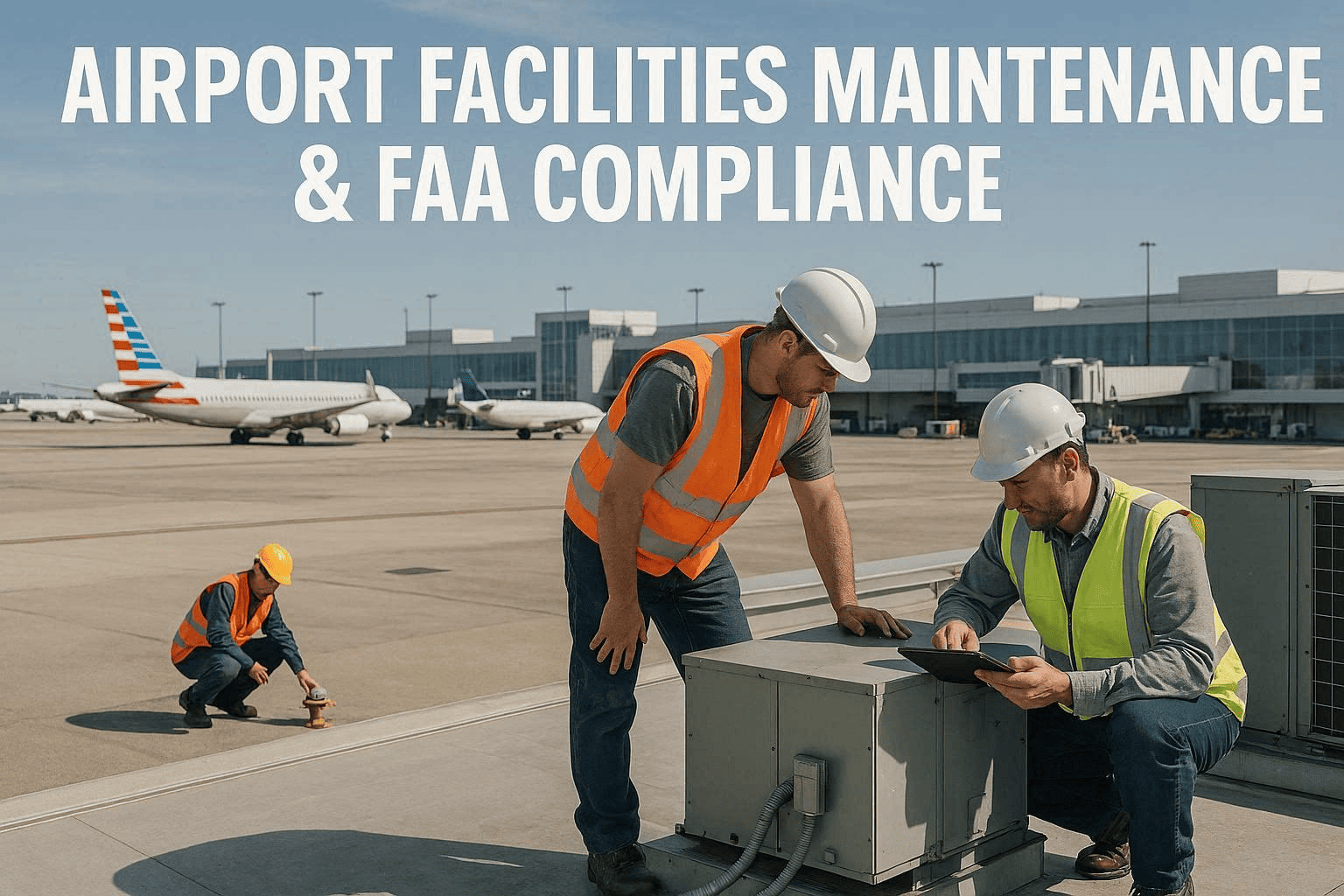
An airport is not a building. It is a city within a city — a collection of interdependent systems, each with its own regulatory framework, maintenance cycle, and failure consequence. Understanding the full asset landscape is the first step toward a maintenance program that actually prevents failures rather than responding to them. Start a free trial and load your full airport asset registry in OxMaint today.
Airside — FAA Part 139 Regulated
Runways & Taxiways
Daily self-inspections required. Pavement condition, markings, lighting, and signage documented every operational day. FAA AC 150/5200-18 governs inspection procedures.
ARFF Vehicles
Rescue and firefighting vehicles require documented readiness checks every shift. Response time requirements are certifiable — and certification requires maintenance records to prove it.
Airfield Lighting Systems
Approach lights, runway edge lights, taxiway centerlines — all safety-critical. A single inoperative PAPI creates a NOTAM, delays operations, and triggers an FAA inspection request within 24 hours.
Ground Support Equipment (GSE)
Tugs, belt loaders, GPU units, pushback tractors — failures cascade directly into airline turn time penalties. GSE maintenance is often airline-contracted but airport-accountable at certificated facilities.
Landside — Terminal & Passenger Systems
Baggage Handling Systems (BHS)
Miles of conveyors, sorters, and carousels controlled by PLCs. A single bearing failure on a critical conveyor creates a bag jam that backs up the entire system. BHS downtime is measured in FAA tarmac delay fines — not just technician hours.
Jet Bridges / PBBs
Hydraulic seal failure, tunnel structure integrity, leveler function. A failed jet bridge creates a gate shortage that ripples through the schedule for hours. These are high-consequence, high-frequency assets requiring weekly PM cycles.
Terminal HVAC
Chillers, AHUs, and terminal HVAC serving millions of square feet of continuously occupied space. Thermal comfort directly affects dwell time, retail revenue, and airport reputation scores tracked by airlines.
Escalators, Elevators & Moving Walks
ADA-required accessible routes. Failure means regulatory non-compliance, passenger bottlenecks, and TSA checkpoint access issues. State elevator codes typically require monthly PM with licensed mechanic sign-off.
FAA Part 139: What Compliance Actually Requires
FAA Part 139 is the federal certification standard for commercial service airports. Every certificated airport must meet its maintenance documentation requirements or risk losing certification — which terminates all commercial airline service. Book a demo to see OxMaint's FAA Part 139 compliance module.
14 CFR Part 139
Daily Airfield Self-Inspections
Twice-daily documented self-inspections covering pavement conditions, markings, lighting, signage, and safety areas. Each inspection must be logged with timestamp, inspector ID, conditions found, and corrective actions taken.
AC 150/5210-24
FOD Management Program
Foreign Object Debris program requires documented patrols, collection logs, and trend analysis. FOD on runways or taxiways creates FOD/wildlife hazard conditions that require immediate NOTAM and corrective action documentation.
Part 139.319
ARFF Vehicle Readiness
ARFF vehicles must meet minimum response time standards and be documented as ready at every shift change. Vehicle maintenance records must prove readiness certification — not just that maintenance was performed.
Part 139.325
Annual FAA Certification Review
FAA conducts annual certification reviews requiring complete maintenance records, inspection documentation, and corrective action histories. Airports that cannot produce complete records face certification conditions — and airlines that fly there notice immediately.
Reactive Maintenance vs. CMMS-Driven Airport Operations
Scenario
Without CMMS
With Oxmaint
Baggage Conveyor PM
Bearing failure causes 4-hour BHS outage during peak morning banks — missed bag cascade, airline penalties
Runtime-based bearing check catches wear at 80% threshold — $800 planned replacement, zero outage
FAA Audit Readiness
3–6 weeks of manual record assembly; gaps require remediation; $80K–$200K corrective costs
Complete 18-month inspection history exported in under 5 minutes from compliance dashboard
Parts Inventory
Critical jet bridge part not in stock — rush shipping adds 5-day delay; aircraft repositioned at airline's cost
Auto-reorder triggered at minimum stock level; part on hand before the failure reaches completion
Emergency vs. Planned Ratio
55%+ emergency ratio — each emergency costs 4–8× the planned maintenance price
Emergency ratio below 15% with predictive PM scheduling and condition-based triggers
35%
Maintenance Cost Reduction
Documented at airports deploying CMMS with AI analytics
50%
Less Unplanned Downtime
Predictive scheduling replaces reactive repair across all asset classes
25%
Equipment Life Extension
Consistent PM on conveyors, GSE, HVAC, and passenger bridges
40–60%
Admin Overhead Reduction
CMMS eliminates 15–20 hours/week of manual spreadsheet and report compilation
FAA Compliance, Zero Downtime, Lower Costs — Not a Trade-Off
OxMaint ships with pre-configured FAA Part 139, ICAO, and OSHA compliance templates. Every inspection, work order, and corrective action generates an immutable audit record — automatically. Start free and go live in under 14 days.
Frequently Asked Questions
What FAA documentation is required for airport maintenance compliance under Part 139?
FAA Part 139 requires documented twice-daily airfield self-inspections, ARFF vehicle readiness records at every shift change, corrective action documentation for all deficiencies found during inspections, and annual certification review records. Additionally, FAA Advisory Circulars govern specific programs including FOD management, pavement maintenance, and wildlife hazard management — each with their own documentation requirements. OxMaint ships with pre-configured compliance templates for all of these requirements. When an FAA surveyor requests the complete airfield inspection history for the past 18 months, the report exports in seconds.
Start a free trial to explore FAA compliance documentation.
How does airport CMMS handle maintenance windows when operations run 24/7?
OxMaint's scheduling engine respects operational constraints by classifying assets by their available maintenance windows. Airside assets with compressed overnight windows — typically 3–4 hours between last arrival and first departure — have work orders scheduled specifically within that window, with alerts generated if the window is missed. Terminal systems that can be maintained with partial closure during low-traffic periods are scheduled differently from airside equipment. The system also manages regulatory requirements that have fixed schedules regardless of operational tempo — like ARFF readiness checks, which happen at every shift change whether the airport is busy or not.
Book a demo to see 24/7 airport maintenance scheduling in action.
Can Oxmaint manage both FAA-regulated airside assets and terminal/landside systems in one platform?
Yes. OxMaint creates a unified asset registry spanning runways, taxiways, ARFF vehicles, airfield lighting, baggage handling systems, jet bridges, terminal HVAC, escalators, and ground support equipment — all in one platform. Each asset class has its own PM template, regulatory tagging, and compliance documentation pathway. Airside assets generate FAA Part 139-formatted inspection records automatically. Terminal systems generate building code and insurance documentation. The airport operations director sees a single dashboard showing PM compliance across all asset classes, with clear visibility into which systems are at risk and which are fully compliant.
What is the typical ROI timeline for an airport CMMS implementation?
Airports typically see initial ROI within the first 90 days from three sources: first, emergency repair cost avoidance as PM schedules catch high-cost failures before they occur; second, labor efficiency gains as technicians spend less time on manual scheduling and documentation; and third, audit preparation time reduction, which alone often recovers 15–20 staff hours per week. At major hub airports managing thousands of assets, the documented outcome is 20–40% total maintenance cost reduction and 50% reduction in unplanned downtime — results that compound into eight-figure savings over a three-to-five year horizon. OxMaint goes live in under 14 days, so the ROI clock starts immediately.
Start a free trial and begin your ROI tracking from day one.