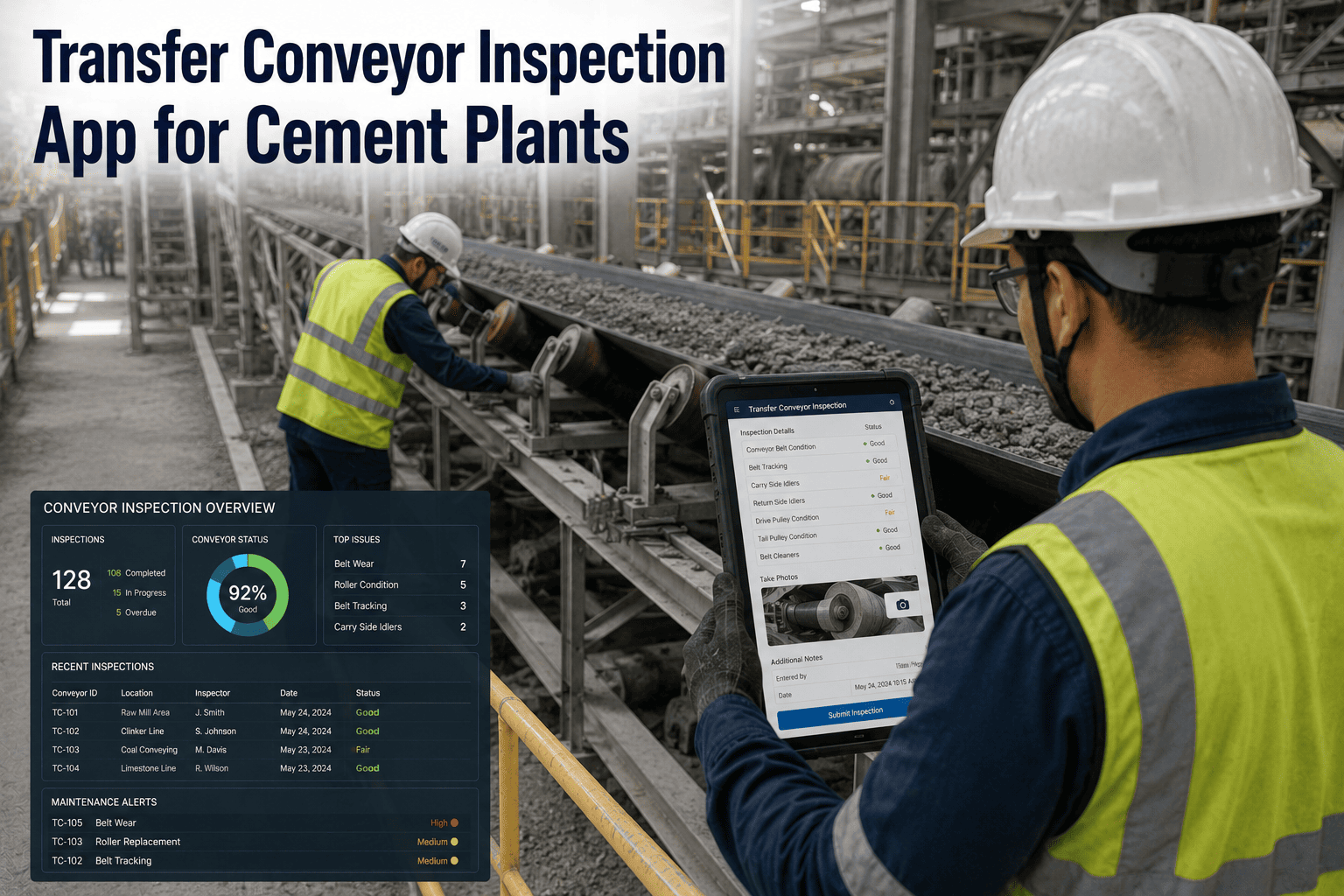
Cement plant transfer conveyors are the circulatory system of bulk material flow — and when one fails, the entire production chain stops. Industry data shows conveyor-related downtime accounts for 12–18% of total unplanned production losses in cement manufacturing, yet the majority of plants still rely on paper checklists, verbal walk-arounds, and reactive repair orders to manage conveyor health. A mobile inspection app built for cement plant conditions — dust, vibration, shift handovers — eliminates the paper trail that lets belt damage, roller failures, and drive faults accumulate undetected until they become emergency events. Start a free trial to see how Oxmaint's mobile inspection checklists work across your conveyor network, or book a demo and we will walk through your specific conveyor asset structure.
See how much downtime you can prevent with structured conveyor inspection across your cement plant.
- Real-time conveyor health visibility across all transfer points
- Predictive failure alerts from inspection trend data
- Photo documentation and full inspection history per asset
No heavy implementation required · Works across multi-site portfolios · Live in days, not months
What is a Transfer Conveyor Inspection App?
A transfer conveyor inspection app is a mobile-first software tool that replaces paper checklists and manual inspection logs with structured digital workflows — enabling cement plant technicians to record belt condition, roller status, drive health, alignment, and wear findings on a smartphone or tablet during their normal inspection rounds.
Unlike generic forms software, a purpose-built conveyor inspection app links each finding to a specific asset record in a CMMS — so that a failed idler roller logged during a morning inspection automatically triggers a work order, updates the asset's condition score, and contributes to the inspection trend data that predicts the next failure before it happens. Photo documentation captures belt edge damage, carry-side wear, and chute spillage that written descriptions miss.
For cement plants with 20, 50, or 200 transfer conveyors across multiple transfer points, a mobile inspection app transforms the conveyor network from a collection of individually managed equipment into a managed asset portfolio with unified health visibility. Start a free trial to experience mobile inspection workflows built for cement plant environments.
Key Inspection Modules for Cement Conveyors
Pain Points in Cement Conveyor Maintenance
These six problems are endemic to cement plants managing conveyor inspection with paper-based or informal systems. Book a demo to see how Oxmaint eliminates each one across your conveyor network.
| Operational Failure | Cost / Impact |
|---|---|
| Lost Inspection Records | Paper checklists are filed, lost, or never completed in harsh plant conditions. When a belt fails, there is no inspection history to determine cause, frequency, or whether warning signs were present and unacted on. |
| No Work Order Linkage | Faults found during inspection are written on paper and handed to a supervisor — who may or may not convert them to work orders. Faulty rollers sit for weeks while the condition deteriorates toward a belt-damaging failure. |
| No Trend Visibility | Without digital inspection records, managers cannot see whether belt cover wear is accelerating, how many rollers have been replaced in the past quarter, or which conveyors are consuming disproportionate maintenance hours. |
| Shift Handover Gaps | Critical findings from the night shift are communicated verbally or not at all. The day shift team has no visibility into what was flagged six hours earlier — and emergency repairs begin from zero information. |
| Inconsistent Inspection Coverage | Without structured digital checklists, inspection thoroughness depends entirely on the individual technician. High-turnover or multi-shift plants have no mechanism to ensure consistent coverage across all conveyors. |
| Compliance Audit Exposure | OSHA, Mine Safety, and ISO inspection requirements demand documented evidence of safety device checks and inspection frequency. Paper records cannot provide the audit trail that digital inspection software generates automatically. |
How Oxmaint Powers Conveyor Inspection in Cement Plants
Oxmaint's mobile-first CMMS applies its asset hierarchy directly to cement plant conveyor networks — every conveyor, belt, roller set, drive, and chute exists as a tracked component with full inspection history and condition scoring.
Before vs. After: Cement Conveyor Inspection Transformation
|
| ||
|---|---|---|
| Inspection Dimension | Before — Paper-Based | After — Oxmaint Mobile |
| Record Availability | Filed in binders, frequently incomplete or missing | 100% digital — searchable by date, conveyor, or fault type |
| Fault-to-Work Order Speed | 24–72 hours — paper to supervisor to maintenance planner | Automatic — work order created at moment of inspection finding |
| Photo Documentation | Rarely captured — verbal descriptions only | Standard — every finding includes geo-tagged photo evidence |
| Trend Analysis | Impossible — no aggregated inspection data | Automatic — condition score trends per conveyor, updated each inspection |
| Inspection Compliance | Unknown — paper log completeness unverifiable | Live dashboard — completion rate by conveyor, shift, and technician |
| Audit Readiness | 3–5 days of manual record assembly per audit | Instant export — full inspection history with photos per conveyor |
| Shift Handover | Verbal or paper note — high information loss rate | Digital asset record — incoming shift sees all open findings immediately |
ROI: What Digital Conveyor Inspection Delivers
These results reflect outcomes from industrial plants that transitioned from paper-based to mobile digital inspection workflows. Start a free trial and see your conveyor inspection data organised from day one.
Frequently Asked Questions
Does the Oxmaint inspection app work offline in cement plant environments with no signal?
Yes. Technicians download assigned inspection checklists before entering the plant, complete all fields including photo capture in fully offline mode, and the completed inspection syncs automatically when the device reconnects. No data is lost during offline operation. Work orders created from offline findings are queued and dispatched as soon as connectivity is restored — essential for conveyor galleries, raw material handling areas, and enclosed transfer towers where signal is absent.
How are inspection findings connected to work orders in Oxmaint?
When a technician records a finding below a defined condition threshold, the system automatically generates a corrective work order linked to the specific conveyor asset and inspection finding. The work order inherits the finding description, attached photos, asset location, and priority level. Maintenance planners receive incoming work orders with full inspection context — eliminating the fault-to-action delay that allows developing problems to progress to failures.
Can Oxmaint manage conveyor inspection compliance across multiple cement plants?
Yes. Oxmaint's portfolio dashboard shows inspection compliance rates across all plants simultaneously — by plant, conveyor, inspection type, and shift. Directors receive alerts when compliance at any site drops below a defined threshold. Site-specific inspection templates reflect local regulatory requirements (OSHA, Australian WHS, UK Building Safety, EU Machinery Directive) while feeding into a unified portfolio-level compliance dashboard.
How quickly can a cement plant deploy Oxmaint for conveyor inspection?
Most cement plants reach active inspection deployment within 3–5 days: conveyor asset registry setup (1–2 days), inspection checklist configuration (1 day), and technician mobile app onboarding (half day). Plants with an existing conveyor asset list in a spreadsheet can import it directly. The inspection compliance and condition trend dashboards begin populating from the first completed inspection.
Stop Losing Production to Undetected Conveyor Faults
Turn every conveyor inspection into a structured, tracked, work-order-linked maintenance action with Oxmaint. Mobile checklists. Automatic fault escalation. Portfolio-wide compliance visibility.
- Real-time conveyor health visibility across all transfer points
- Predictive failure alerts from inspection trend data
- 5–10 year CapEx forecasting for belt and drive replacement
Limited onboarding slots available this quarter · Measurable results in the first 30 days
No heavy implementation required · Works across multi-site portfolios · Live in days, not months