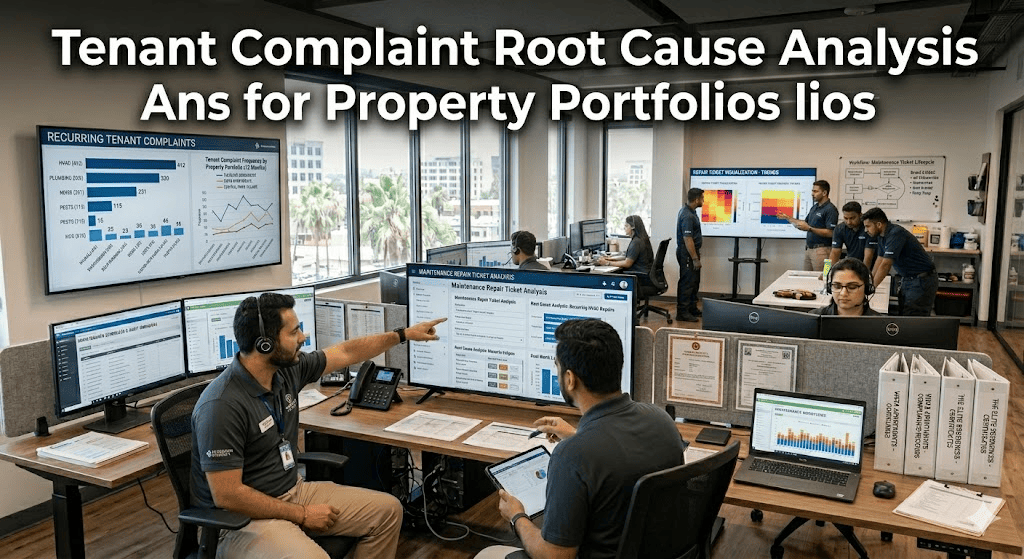
Tenant complaints are the most expensive leading indicator that a property portfolio's maintenance system is failing — and most property teams treat them as individual service tickets rather than diagnostic data. When a tenant in apartment 4B reports heating issues for the third time in six months, the instinct is to dispatch a technician. The right response is to ask why this is the third time, what the underlying failure pattern is, and how many other units or buildings share the same root condition. Reactive ticket-by-ticket resolution keeps maintenance teams permanently in firefighting mode, while the underlying asset failures and systemic maintenance gaps compound. OxMaint's repair history and analytics tools give property managers the ability to surface recurring complaint patterns, identify root causes in asset condition and PM frequency, and eliminate the issues that drive repeat tenant escalations — before they become lease-breaking problems.
Identify Your Highest-Cost Recurring Repair Patterns — 30-Minute Analysis
See which assets, buildings, and maintenance gaps are driving your repeat tenant complaints — and how much they are costing your portfolio.
Works across multi-site portfolios · Live in days · No heavy implementation required
What Is Tenant Complaint Root Cause Analysis?
Tenant complaint root cause analysis (RCA) is the structured process of tracing recurring maintenance complaints back to their underlying asset, system, or process failure — rather than treating each complaint as an isolated service event. In a property context, RCA distinguishes between a symptom (the tenant reports cold radiators) and the root cause (the boiler zone valve serving that building's wing has a recurring failure that the current PM frequency is not catching).
Without a CMMS that captures every complaint, repair, asset reading, and work order in a unified database, RCA is impossible at scale — because the data required to identify patterns is fragmented across email chains, ticketing systems, technician call logs, and contractor invoices. OxMaint aggregates all of this into an analytics platform that surfaces complaint frequency by asset, building, and system type — turning tenant escalations from operational headaches into actionable intelligence. Start a free trial to map your current complaint history against asset condition, or book a demo and we will walk through your top recurring complaint categories live.
8 Most Common Tenant Complaint Root Causes in Property Portfolios
Annual servicing on HVAC systems in high-occupancy residential buildings leads to filter fouling, coil degradation, and zone valve failures mid-season — generating clusters of heating and cooling complaints from multiple units simultaneously.
Buildings with original copper or galvanised pipework generate recurring complaints about water pressure, temperature fluctuation, and discolouration — often misdiagnosed as isolated unit faults when the root cause is a building-wide infrastructure degradation trend.
Recurring MCB trips, power fluctuations, and intermittent electrical faults in specific units are frequently symptomatic of distribution board aging or overloading — not individual unit wiring issues. Repeat electrical complaints in the same zone signal a panel inspection need, not a unit repair.
Damp, mould, and condensation complaints that recur across multiple units in the same building section typically trace to building envelope failures — roof membrane breaches, failed cavity wall insulation, or bridged damp-proof courses — that surface as individual unit issues.
Repeated elevator breakdowns in mid- and high-rise residential buildings are among the highest-impact tenant complaints — particularly for elderly or mobility-limited residents. Recurring lift faults signal PM gap or end-of-component-life conditions that require replacement planning, not repeated repair cycles.
Recurring complaints about lighting, cleaning, landscaping, and common area equipment often trace to poorly scoped service contracts — where the contractor's obligations do not cover the specific items generating complaints, or where sign-off processes allow substandard completion to pass without tenant input.
Pest complaints that recur despite regular treatment typically have a structural root cause — utility penetrations without appropriate sealing, failed weatherstripping, or drainage gaps — that chemical treatment cannot resolve. RCA identifies the entry point rather than repeating the extermination cycle.
Noise complaints attributed to neighbours are frequently caused by aging HVAC fans, pump vibration, or pipe water hammer that is transmitted through building structure. RCA distinguishes between occupant-generated noise (a management issue) and equipment-generated noise (a maintenance issue) — enabling the correct resolution path.
4 Systemic Failures That Allow Root Causes to Stay Hidden
When tenant complaints are managed in a CRM or ticketing system and maintenance work orders are managed in a separate platform, the link between complaint frequency and asset repair history is invisible. No one can see that the HVAC unit in Zone C has been repaired 7 times this year and is generating 40% of the heating complaints in Building B without manually correlating two separate databases.
Technicians closing work orders with "repaired" rather than "replaced zone valve — failed due to scale buildup from untreated water" eliminate the diagnostic data that would enable pattern recognition. Without mandatory root cause fields in work order closure, repair history becomes a count of incidents, not a map of failure causes.
Property managers who only see complaint data property-by-property cannot identify cross-portfolio patterns — for example, that all buildings of a specific construction vintage or with a specific HVAC specification are generating the same complaint cluster. This building-block pattern recognition requires portfolio-level data aggregation that most property teams cannot produce without specialist BI tools.
When external contractors complete repairs, their work notes, part replacements, and failure diagnoses rarely make it back into the property's asset records. This creates an invisible repair history — the building manager knows repairs happened but cannot see what failed, what was replaced, and what the failure cause was. Root cause analysis without complete repair history is guesswork.
Property teams that unify complaint data and maintenance records in OxMaint reduce recurring complaint rates by 50-65% within 12 months by addressing root causes rather than symptoms — start a free trial and connect your first property today.
How OxMaint Enables Tenant Complaint Root Cause Analysis
Every tenant complaint links directly to a work order on the relevant asset — building a combined complaint-repair history that makes frequency patterns visible without manual data correlation across systems.
Work order closure in OxMaint requires selection of a root cause category and free-text failure description. This builds a structured failure database that enables pattern analysis — distinguishing wear, installation defect, PM gap, and environmental causes across asset types.
Assets that exceed a configurable repair frequency threshold are automatically flagged for review — surfacing end-of-life candidates and PM-inadequacy conditions before they generate further tenant escalations or drive higher repair cost than replacement would.
Directors see complaint and repair data aggregated across all properties — with top complaint categories by building, top repeat-failure assets, and maintenance cost concentration visible in a single analytics view without report extraction.
Reactive Complaint Response vs. Root Cause Management
| Area | Reactive Ticket-by-Ticket Response | OxMaint Root Cause Management |
|---|---|---|
| Complaint Data | Separate ticketing system, no asset link | Linked to asset work order history in one system |
| Repeat Failure Detection | Manual review — rarely happens | Automatic flagging at configurable frequency threshold |
| Root Cause Capture | Free text "repaired" — no structured data | Mandatory category + description at WO closure |
| Contractor Repair Data | Email-based, not filed to asset history | Required at work order closure with document attach |
| Portfolio Analytics | Not available without BI tool | Live cross-property complaint and repair dashboard |
| Tenant Churn Impact | 3.4x higher non-renewal from 3+ unresolved complaints | 50-65% recurring complaint reduction within 12 months |
Property teams that identify and address root causes rather than recurring symptoms recover 50-65% of their repeat repair budget within a year — start a free trial to connect your complaint and maintenance data today, or book a demo for a live analysis of your top recurring complaint categories.
Frequently Asked Questions
How does OxMaint connect tenant complaints to asset maintenance records?
What data is required to perform root cause analysis across a property portfolio?
How quickly can we identify which assets are driving the most tenant complaints?
Can OxMaint help justify capital replacement decisions based on repeat complaint data?
Stop Treating Symptoms — Find and Fix the Root Cause
Every Recurring Tenant Complaint Is Costing You 3-4 Repairs When One Root Cause Fix Would End It
OxMaint links complaint data, asset history, and maintenance analytics into a single platform — so you can see which assets, buildings, and maintenance gaps are driving your repeat escalations and eliminate them permanently.
- Real-time complaint and repair pattern visibility across your portfolio
- Automated repeat-failure flagging before tenant escalation
- 5-10 year CapEx forecasting from asset repair and condition data
Used by portfolio teams managing 10,000+ assets · See measurable results in the first 30 days