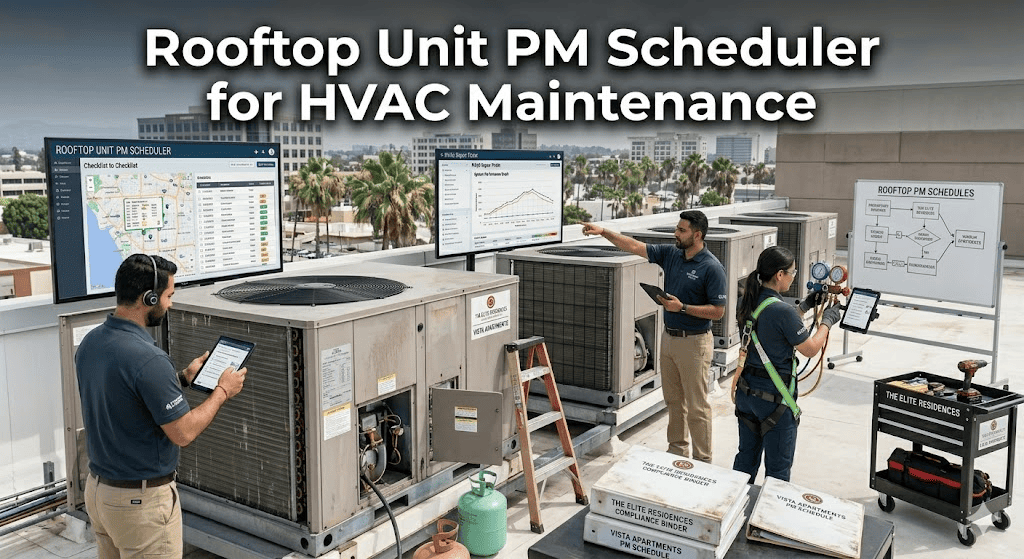
Rooftop HVAC units are among the highest-maintenance assets in any commercial building — exposed to UV degradation, thermal cycling, debris accumulation, and seasonal demand spikes that accelerate component wear at rates no standard annual service contract is designed to handle. Yet most commercial buildings run rooftop units on calendar-based PM schedules that were defined at installation and have never been revised against actual runtime data, local climate conditions, or seasonal occupancy patterns. The result is predictable: compressor failures in July, heat exchanger fouling in October, and refrigerant losses that compound quietly until an emergency call-out interrupts building operations at 3x the cost of a scheduled service. OxMaint's rooftop unit PM scheduler replaces fixed-interval servicing with runtime-triggered, seasonally adjusted, and automated preventive maintenance scheduling — so rooftop HVAC assets get serviced when they need it, not when the calendar says so.
See Your Rooftop HVAC Risk Profile — 30-Minute Walkthrough
See how much cost you can eliminate from reactive rooftop HVAC failures across your building portfolio.
Works across multi-site portfolios · No heavy implementation · Live in days
What Is a Rooftop Unit PM Scheduler?
A rooftop unit PM scheduler is a CMMS-based maintenance planning tool that generates preventive maintenance work orders for rooftop HVAC equipment based on multiple trigger types — runtime hours, seasonal demand thresholds, filter pressure drop readings, and calendar intervals — rather than relying on a single fixed-date schedule. By combining multiple trigger sources, a smart PM scheduler ensures that a rooftop unit that has run 1,200 hours since its last service gets a PM visit regardless of where it falls in the calendar year.
For building operations teams managing multiple rooftop units across single or multi-building portfolios, automated PM scheduling eliminates the manual tracking burden that causes most rooftop HVAC PM gaps — where filters go unchanged for two seasons, refrigerant levels go unchecked until performance degrades noticeably, and coil cleaning is skipped because the PM visit was rescheduled and never rebooked. Start a free trial to see how OxMaint maps your rooftop unit inventory and generates PM schedules, or book a demo for a live walkthrough.
6 Key Components of an Effective Rooftop Unit PM Program
PM work orders generated at defined runtime hour intervals — not just calendar dates. Units running in high-occupancy retail or industrial zones accumulate service hours faster than office buildings and need more frequent attention regardless of the calendar date.
Automatic PM scheduling before peak summer cooling and winter heating seasons — ensuring every rooftop unit is fully serviced before it faces maximum demand. Seasonal pre-checks reduce in-season failures by 60-70% compared to standard annual servicing.
Every PM work order delivers a structured rooftop unit checklist: refrigerant pressure, filter condition, coil cleanliness, belt tension, motor current draw, condensate drain, and electrical connection integrity — with mandatory reading capture and photo evidence.
Overdue PM work orders trigger automatic escalation to the facilities manager — preventing the silent drift where PM visits get rescheduled repeatedly until a unit that was 2 weeks overdue becomes 6 months overdue without anyone tracking the gap.
Each PM completion updates the rooftop unit's condition score — tracking refrigerant level trend, filter replacement frequency, and component wear rates over time. Units trending toward failure are flagged before they generate emergency call-outs.
Building operations managers see all rooftop units across all buildings in a single PM schedule view — with overdue items, upcoming service dates, and PM compliance percentage visible without switching between individual asset records.
4 Rooftop Unit Maintenance Pain Points That Drive Emergency Spend
A rooftop unit in a 24-hour retail or industrial facility accumulates 3-4x the runtime hours of an office building unit in the same calendar year. Annual servicing leaves it running 8,000+ hours on filters and lubricants rated for 2,000-3,000 hours — accelerating wear at a rate that eventually produces a mid-season compressor failure worth $4,800-$18,000 in emergency parts, labor, and lost cooling capacity.
Slow refrigerant leaks — 5-10% per year from normal connection degradation — are undetectable without refrigerant pressure checks at every PM visit. A unit running at 85% charge produces 15% higher energy consumption and 25% higher compressor wear rate. By the time comfort complaints arrive, the system has been operating in a degraded state for months.
Building operations managers overseeing 5+ buildings with 3-8 rooftop units each have no reliable way to know which units have received their seasonal PM visit without contacting each building's maintenance contact individually. Units get missed, PM gaps compound over multiple seasons, and the first visibility the manager gets is a breakdown notification.
Condenser and evaporator coil fouling on rooftop units in urban or dusty environments degrades heat exchange efficiency by 10-20% per year without cleaning. The energy waste is real but invisible — until the unit eventually fails from compressor overload caused by the same fouling that had been quietly adding 15% to the building's cooling energy consumption for two or three seasons.
HVAC teams that shift from calendar-based to runtime and condition-triggered PM scheduling see 40-55% fewer emergency rooftop unit call-outs — start a free trial to see how OxMaint schedules your rooftop unit fleet automatically.
How OxMaint Automates Rooftop Unit PM Scheduling
Configure PM triggers by runtime hours, calendar interval, or seasonal pre-check for each unit type. A unit serving a 24-hour facility can have a quarterly filter change triggered by runtime, while a school building HVAC gets seasonal pre-checks before each term — all managed automatically.
ASHRAE 180-aligned preventive maintenance checklists for all standard rooftop unit types — split systems, package units, heat pumps, VRF condensers. Each checklist captures mandatory readings, condition scores, and photo evidence for refrigerant charge, filter condition, and coil cleanliness.
Building and portfolio managers see PM completion rate, overdue service count, and upcoming schedule for all rooftop units across all buildings in a single dashboard — with automatic alerts when any unit exceeds its PM interval without a completed service record.
Asset condition scores from each PM visit feed OxMaint's lifecycle analytics — identifying units approaching end-of-economic-life and generating 5-10 year CapEx projections for rooftop unit replacement. Replace on data, not on failure.
Calendar PM vs. OxMaint Runtime-Triggered Scheduling
| PM Attribute | Calendar-Only Scheduling | OxMaint Runtime + Condition Scheduling |
|---|---|---|
| Service Trigger | Fixed date — regardless of runtime or load | Runtime hours, season, and condition combined |
| High-Runtime Units | Under-maintained — same schedule as low-runtime | Higher frequency triggered automatically by hours |
| Seasonal Pre-Checks | Manual reminder — frequently skipped | Auto-scheduled before each peak demand season |
| Multi-Building Visibility | No portfolio view — gaps hidden | Live compliance dashboard across all buildings |
| CapEx Planning | Reactive replacement after failure | Condition-based 5-10yr replacement forecast |
| Emergency Call-Out Rate | High — PM gaps cause mid-season failures | 40-55% reduction with structured PM compliance |
HVAC teams switching to runtime-triggered PM scheduling see emergency call-out reductions within the first season — start a free trial and schedule your first rooftop unit PM run today, or book a demo to see the full rooftop unit scheduling module live.
Frequently Asked Questions
Can OxMaint schedule PM for different rooftop unit types with different service requirements?
How does OxMaint track runtime hours for rooftop units without building automation system integration?
What rooftop HVAC checklist items does OxMaint include in its standard PM template?
How does OxMaint help plan rooftop unit replacement across a multi-building portfolio?
Stop Paying Emergency Rates for Failures PM Should Have Prevented
Turn Every Rooftop Unit Into a Predictable, Trackable, Schedulable Asset
OxMaint's rooftop unit PM scheduler replaces calendar guesswork with runtime-triggered, condition-monitored, portfolio-visible preventive maintenance — so your HVAC assets run longer and fail less often.
- Automated PM scheduling by runtime, season, and condition
- Live compliance dashboard across all buildings and units
- 5-10 year rooftop unit CapEx replacement forecasting
Used by HVAC operations teams managing 10,000+ assets · See results in the first season