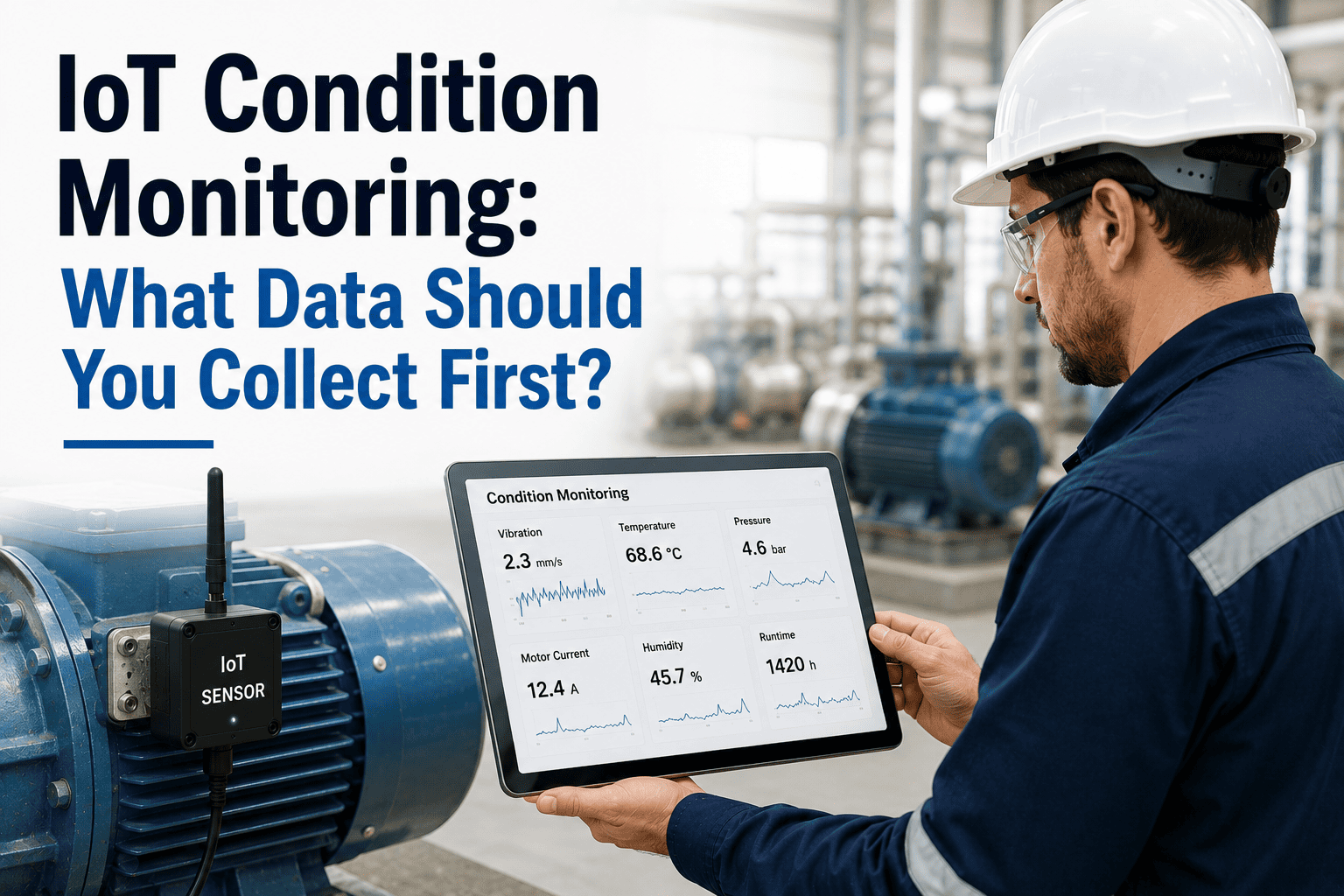
IoT condition monitoring delivers its highest ROI when you deploy on the right assets with the right sensor types first — not when you instrument everything at once. The most common mistake in condition monitoring programs is treating all equipment equally, spreading sensors across the plant floor, and then drowning in low-value data while the one asset that could kill your production line goes unwatched. The 80/20 rule applies precisely here: roughly 20% of your assets generate 80% of your failure costs, and those are the assets that need IoT monitoring first. OxMaint's predictive maintenance platform maps sensor data directly to asset criticality tiers, so condition monitoring programs start on the assets that matter most and expand from a proven ROI base.
IoT Condition Monitoring: Which Sensor Data Should You Collect First?
The data prioritization guide for maintenance managers — which sensor types deliver the fastest ROI, which assets to instrument first, and how to build a condition monitoring program that doesn't collapse under its own alert volume.
What Is IoT Condition Monitoring?
IoT condition monitoring is the continuous measurement of equipment health parameters — vibration, temperature, pressure, current, acoustic emissions — using networked sensors that feed real-time data into a maintenance management platform. Unlike scheduled inspections that give you a point-in-time snapshot, condition monitoring gives you a continuous data stream that captures degradation patterns as they develop, weeks before any operational symptom appears.
The value is not the data itself — it is what the data enables. A motor showing a rising vibration trend over 14 days is telling you a bearing is degrading. A compressor with increasing discharge temperature is signaling valve wear. Condition monitoring converts that signal into a scheduled work order before the failure, replacing an emergency repair with a planned one. Start a free trial to see OxMaint convert sensor readings into predictive work orders automatically.
The 6 Sensor Data Types — Prioritized by ROI
Not all sensor data delivers equal value. Here is every major condition monitoring data type ranked by implementation complexity and failure coverage, so you build your program in the right order.
Detects bearing wear, shaft misalignment, imbalance, looseness, gear mesh defects, cavitation. Covers 60–70% of rotating equipment failures. Deploy first on motors, pumps, fans, compressors — the assets with highest downtime impact. Triaxial wireless sensors at $200–$500/point deliver immediate ROI on any critical rotating asset.
Detects motor winding degradation, overloaded bearings, electrical hotspots, cooling system failure, and thermal runaway in batteries and transformers. Deploy alongside vibration on the same critical assets — the combination catches failure modes that neither type detects alone, pushing prediction accuracy from 78% to 92%.
Detects motor loading changes, developing mechanical faults (through increased amp draw), voltage imbalance, and efficiency degradation. Current transducers are non-invasive and retrofit easily without shutdowns — a strong Phase 2 addition to existing vibration+temperature monitoring.
Detects leaks, blockages, pump performance degradation, filter saturation, and valve wear in hydraulic, pneumatic, and fluid systems. Critical for compressed air systems where undetected leaks cost $2,500–$8,000/year in wasted energy per plant.
Detects early-stage crack propagation, corrosion, material fatigue, and lubrication failure in structural components and pressure vessels. Highest diagnostic specificity of any sensor type — typically deployed on assets where failure consequence is catastrophic (pressure vessels, structural supports, critical piping).
Monitors particle count, viscosity, water content, and acid number in lubrication systems. Eliminates fixed oil change intervals — oil is changed only when analysis confirms degradation. Typical ROI: 30–40% reduction in lubricant spend plus avoided catastrophic failures from contaminated lubrication.
4 Data Collection Mistakes That Kill Condition Monitoring ROI
Spreading sensors equally across the plant floor dilutes ROI and overwhelms your team with data from assets whose failure doesn't materially affect production. Start with the 3–5 highest-consequence assets. Prove the alert-to-work-order loop works. Then expand.
A vibration threshold of 0.3 in/s means nothing without knowing what normal looks like for that specific asset under its actual operating load. Run sensors for 2–4 weeks before activating alerts. Baseline-relative alerting reduces false alarms by 40–60% versus fixed thresholds.
One sensor type detects one failure family. OxMaint's AI correlates vibration + temperature + current data from the same asset, increasing prediction accuracy from 78% (single sensor) to 92% (multi-sensor). For critical assets, multi-sensor monitoring is not a luxury — it's the threshold between a useful program and an incomplete one.
Condition monitoring data sitting in a separate dashboard that requires someone to manually check it and create work orders is not a maintenance program — it is an expensive inspection round. The data must flow directly into automated work order creation to deliver ROI. Book a demo to see the complete sensor-to-work-order workflow.
How OxMaint Structures Condition Monitoring Data
OxMaint's asset management module assigns each asset a criticality tier (Critical / Major / Minor) based on failure consequence, production dependency, and repair cost. Sensor deployment recommendations and alert priority levels are automatically weighted by criticality — so a vibration alert on a Tier 1 motor fires immediately, while a Tier 3 auxiliary fan alert queues for scheduled review.
OxMaint's AI correlates data from multiple sensor types on the same asset simultaneously. Vibration anomaly + temperature rise + increased amp draw in the same 4-hour window is a failing bearing with 92% confidence. Any one of those signals alone is only 78% reliable. Multi-sensor correlation is built into the platform — no data science team required.
OxMaint maps condition data to three alert levels automatically. Advisory: early anomaly, log and watch. Warning: schedule maintenance within defined window. Critical: immediate work order generation and mobile alert to the nearest certified technician. Three-tier thresholds prevent alert fatigue and ensure technicians respond proportionally to actual risk.
Sensor data catches internal degradation. OxMaint's AI Vision Camera catches surface failures — cracks, corrosion, thermal hotspots, PPE violations — at 99.2% detection accuracy. Both data streams feed the same work order queue, giving maintenance teams internal and external asset health visibility from a single platform.
Condition Monitoring Data Maturity: Stage by Stage
| Stage | Data Collected | What It Enables | Typical Timeline |
|---|---|---|---|
| 1 — Baseline | Vibration + temperature on top 5 critical assets | Normal operating envelope per asset established | Weeks 1–4 |
| 2 — Alerting | Threshold rules activated; 3-tier alert logic | First condition-based work orders generated automatically | Month 2 |
| 3 — Expansion | Add current, pressure sensors; expand to Tier 2 assets | Multi-sensor correlation; 92% prediction accuracy | Months 3–6 |
| 4 — Predictive | Failure history accumulates; AI trains on plant-specific patterns | RUL estimates; failures predicted 2–6 weeks ahead | Month 6+ |
| 5 — Optimized | PM intervals adjusted by sensor trend data | 35%+ maintenance cost reduction; near-zero reactive spend | Year 1–2 |
Results: What Condition Monitoring Programs Deliver
Model your facility's ROI at the OxMaint ROI Calculator, or book a demo and we'll map it against your current maintenance budget.
Frequently Asked Questions
What is the most important sensor data to collect first for predictive maintenance?
How much sensor data do I need before predictive analytics become reliable?
Can OxMaint handle condition monitoring data from multiple sensor vendors?
What industries benefit most from IoT condition monitoring?
IoT Condition Monitoring: Know Your Asset Health Before It Fails
OxMaint connects vibration, temperature, pressure, and current sensors to AI-powered predictive work orders — starting with your highest-consequence assets and expanding as ROI compounds. 94% prediction accuracy. 62% less downtime. Free to start.
Trusted by 1,000+ facilities · Live in days, not months