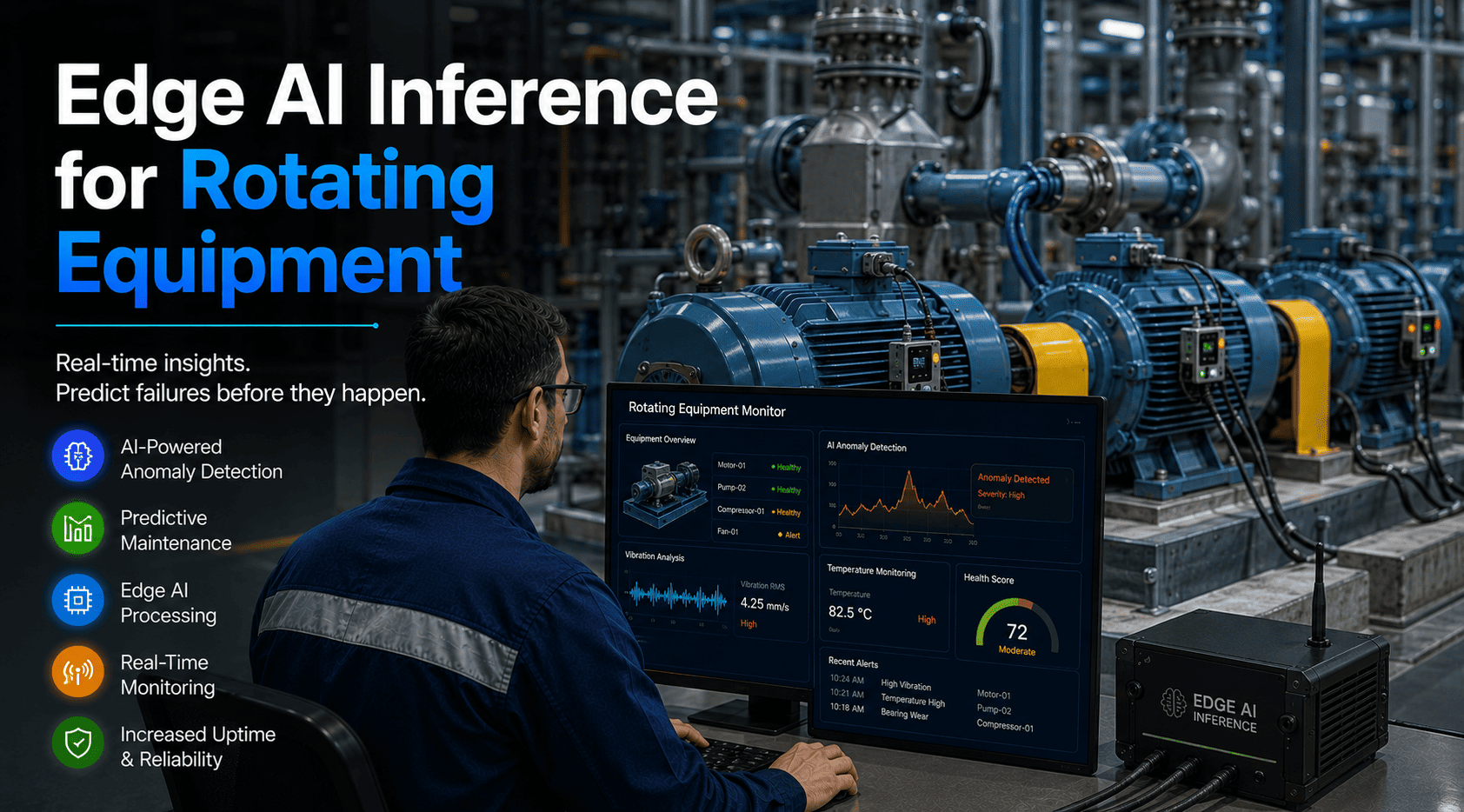
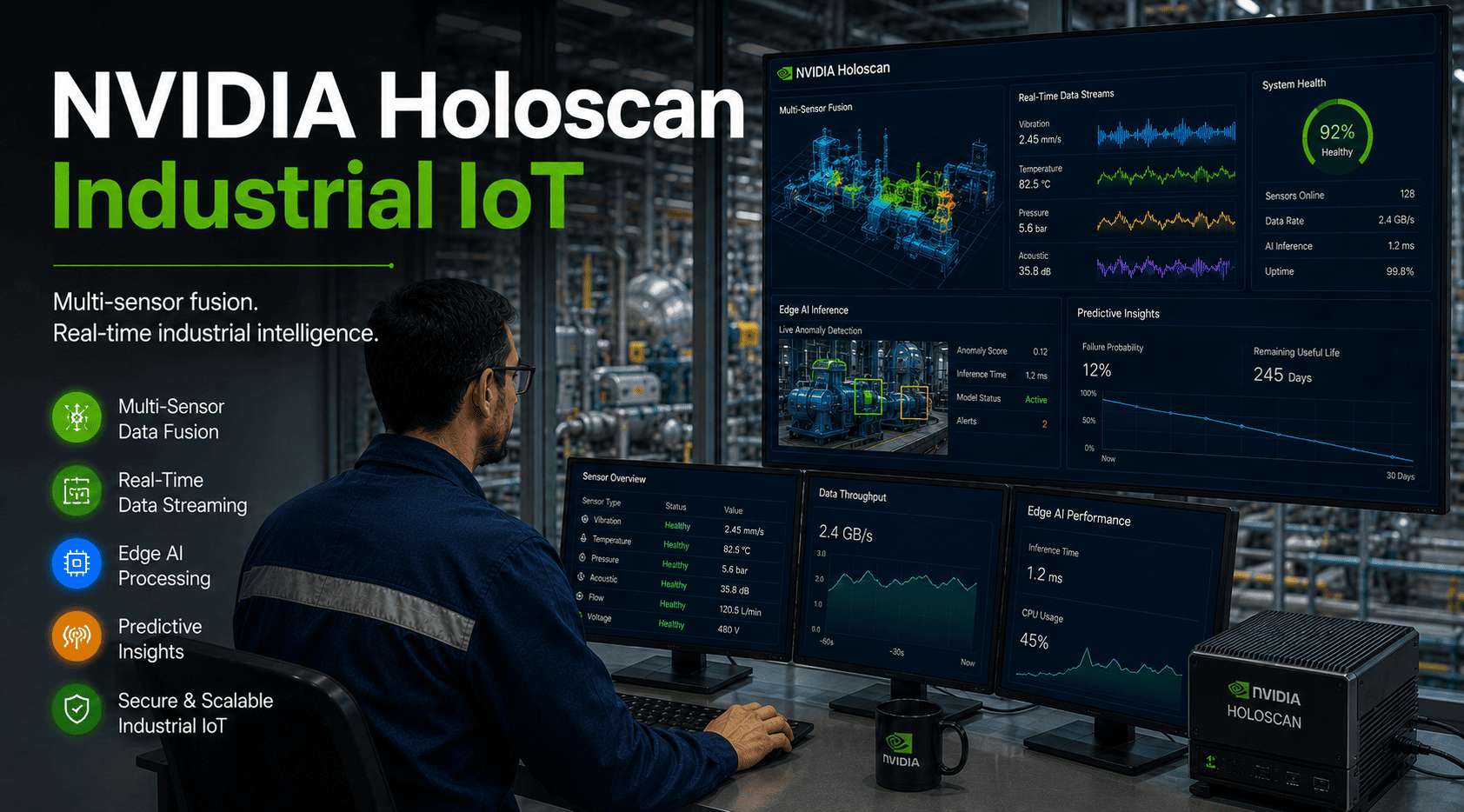
Rotating equipment — motors, compressors, pumps, turbines — accounts for 60–80% of unplanned downtime in industrial facilities. When a bearing fails at 2:47 AM and the nearest engineer is 45 minutes away, every second of lag between anomaly and alert costs money. Cloud-dependent AI detection adds 200–800ms of round-trip latency. Edge AI inference eliminates that lag entirely, running sub-millisecond anomaly detection directly on the device — no internet dependency, no cloud bottleneck, no delayed response. Start a free trial to see how OxMaint integrates edge AI anomaly data into your maintenance workflow.
EDGE AI FOR INDUSTRIAL MAINTENANCE
Sub-Millisecond Anomaly Detection. On-Device. No Cloud Required.
OxMaint connects your edge AI inference layer directly to automated work orders, CapEx forecasting, and multi-site dashboards — turning raw sensor signals into actionable maintenance intelligence.
Used by operations teams managing 10,000+ assets — live in days, not months.
Real-time asset anomaly visibility
Predictive failure alerts before breakdown
5–10 year CapEx forecasting from condition data
What Is Edge AI Inference for Rotating Equipment?
Edge AI inference means running machine learning models directly on hardware co-located with the equipment being monitored — not in a remote data center. For rotating equipment, this translates to vibration, temperature, current, and acoustic signals being analyzed in real time by an onboard AI model that classifies anomalies in under one millisecond. No internet dependency. No latency spikes. No single-point cloud failure.
The shift from cloud-dependent AI to on-device inference is driven by a simple physics problem: rotating equipment faults develop in microseconds. A bearing spall, a rotor imbalance event, or a cavitation spike produces a signal that is actionable for a window measured in milliseconds — not seconds. By the time a cloud-round-trip completes, the diagnostic window has closed and the fault has either self-resolved or cascaded into a larger failure mode.
OxMaint's platform ingests edge inference outputs — fault classifications, severity scores, confidence intervals — and converts them into structured maintenance events: work orders, PM adjustments, asset condition score updates, and CapEx risk flags. The edge layer detects; OxMaint decides, documents, and dispatches. Book a demo to walk through how edge AI outputs map to your specific asset structure.
70%
of unplanned industrial downtime
traced to rotating equipment failures (Plant Engineering)
<1ms
inference latency on modern edge hardware
vs. 200–800ms cloud round-trip average
4.8×
higher cost of reactive vs. planned repair
McKinsey Industrial Operations Report
40%
reduction in maintenance costs
reported by facilities using condition-based monitoring
Most facilities lose 20–40% of their maintenance budget to undetected rotating equipment degradation that edge AI catches weeks before failure.
Core Concepts: How Edge AI Inference Works on Rotating Equipment
01
On-Device Model Deployment
Trained neural networks are compiled to edge hardware (ARM Cortex, NVIDIA Jetson, Hailo-8) using TensorRT, TFLite, or ONNX Runtime. Models run natively without cloud connectivity, enabling continuous inference even in air-gapped industrial environments.
02
Vibration Signature Analysis
Accelerometer data is processed via FFT and envelope analysis on-device. The model classifies frequency-domain signatures against known fault patterns: bearing defect frequencies (BPFO, BPFI, BSF), rotor imbalance harmonics, and gear mesh anomalies.
03
Multi-Modal Sensor Fusion
Edge processors combine vibration, thermal imaging, current signature (MCSA), and acoustic emission data simultaneously. Fusion models reduce false-positive rates by 60–80% compared to single-sensor approaches, producing high-confidence fault classifications.
04
Quantized Model Inference
INT8 and FP16 quantization compresses model size by 4× while maintaining 95–98% of FP32 accuracy. This allows complex fault detection models to run on low-power edge chips at under 1ms per inference — critical for high-speed machinery monitoring.
05
Anomaly Scoring and Thresholding
Each inference produces a fault probability score and severity classification. Adaptive thresholding adjusts alert sensitivity based on operating conditions — speed, load, temperature — preventing nuisance alarms during normal transient events like startup and shutdown.
06
Edge-to-CMMS Event Pipeline
Confirmed fault events are published via MQTT, OPC-UA, or REST to the CMMS layer. OxMaint receives structured fault payloads — asset ID, fault type, severity, timestamp — and automatically generates work orders, updates condition scores, and adjusts PM schedules.
07
Federated Learning at the Edge
Edge devices improve their local models by sharing gradient updates — not raw sensor data — with a central aggregator. This enables continuous model improvement across a fleet of rotating equipment without transmitting sensitive operational data to the cloud.
08
Remaining Useful Life Estimation
Beyond binary fault detection, advanced edge models estimate remaining useful life (RUL) using degradation trajectory models. OxMaint ingests RUL outputs to populate 5–10 year CapEx forecasts with probabilistic replacement timelines grounded in actual measured degradation rates.
Why Cloud AI Fails Rotating Equipment Monitoring
01
Latency Kills Diagnostic Windows
Cloud round-trips average 200–800ms. Bearing spall events produce diagnostic signatures in 50–200ms windows. By the time a cloud model processes the signal and returns a classification, the actionable window has closed — and the fault has either propagated or disappeared from the frequency spectrum entirely.
02
Bandwidth Costs Scale With Asset Count
A single vibration sensor sampling at 25.6 kHz generates 50MB+ of raw data per hour. Streaming this to the cloud across a 200-asset facility consumes 10TB+ per day — bandwidth costs that dwarf the value of the insights produced. Edge inference reduces cloud transmission to structured event data only.
03
Network Failures Create Monitoring Blind Spots
Industrial facilities in remote locations, oil platforms, underground mines, and manufacturing plants with dense RF shielding experience regular network outages. Cloud-dependent AI monitoring goes dark during these periods — precisely when equipment is most likely to be running under stress without human oversight.
04
Data Sovereignty and Security Constraints
Defense contractors, pharmaceutical manufacturers, and utilities operating under OT/IT segmentation requirements cannot transmit raw operational data to public cloud endpoints. Edge inference keeps sensitive production data on-premise, satisfying NERC CIP, ITAR, and GxP data residency requirements without compromise.
05
Generic Models Miss Equipment-Specific Fault Patterns
Cloud AI vendors train on broad datasets that don't capture the specific vibration signatures of your equipment configurations, wear states, and operating profiles. Edge models fine-tuned on local asset data achieve 15–30% higher fault detection accuracy than generic cloud models applied without adaptation.
06
Cloud Dependency Creates Single Points of Failure
When your cloud AI provider experiences an outage, your entire predictive maintenance capability disappears simultaneously across every monitored asset. Edge inference ensures each device operates independently — a network failure affects connectivity reporting but never interrupts local fault detection and alerting.
Facilities that transition from cloud-dependent monitoring to edge AI inference report 35–50% reductions in false-positive alerts and near-zero monitoring blind spots — start a free trial to connect your edge AI layer to OxMaint's work order engine, or book a demo to see how edge fault events map to CapEx forecasts.
Edge AI inference on rotating equipment detects bearing failures 2–8 weeks before catastrophic breakdown — eliminating the 4.8× cost multiplier of emergency repairs.
How OxMaint Turns Edge AI Outputs Into Maintenance Intelligence
Automated Work Order Generation
Edge fault classifications above configurable severity thresholds automatically generate work orders in OxMaint — pre-populated with asset ID, fault type, recommended corrective action, and required parts from the MRO inventory. Zero manual data entry from alert to dispatch.
Asset Condition Score Updates
Every edge inference event updates the asset's condition score in OxMaint's registry. Condition scores drive PM schedule adjustments, replacement prioritization, and portfolio-level health dashboards — giving operations managers a real-time view of fleet degradation state across all sites.
RUL-Driven CapEx Forecasting
Remaining useful life estimates from edge models feed OxMaint's rolling 5–10 year CapEx models. Replacement timelines are grounded in measured degradation trajectories — not manufacturer MTBF estimates — producing investor-grade capital planning reports that reflect actual asset condition.
OPC-UA and MQTT Integration
OxMaint connects to edge AI gateways via OPC-UA, MQTT, and REST endpoints. Structured fault payloads from any edge inference platform — NVIDIA Jetson, Hailo-8, Advantech, Siemens — are ingested without custom middleware, enabling plug-in connectivity across heterogeneous edge deployments.
Multi-Site Anomaly Portfolio View
OxMaint's portfolio dashboard aggregates edge AI anomaly events across all facilities into a unified risk view. Plant managers see which sites have the highest concentration of critical fault flags, enabling cross-site resource allocation decisions based on objective severity data rather than loudest-voice escalations.
Mobile-First Alert Dispatch
Edge fault alerts reach field technicians via OxMaint's mobile app — with asset location, fault classification, historical repair context, and spare parts availability displayed on a single screen. Technicians arrive at the equipment knowing what is wrong before they touch it, cutting diagnostic time by 40–60%.
Reactive Monitoring vs. Edge AI Inference: What Changes
| Capability |
Reactive / Cloud-Dependent |
Edge AI Inference + OxMaint |
| Fault detection latency |
200–800ms cloud round-trip; blind spots during outages |
Sub-1ms on-device; continuous even without network |
| Bearing failure lead time |
Detected at or after catastrophic failure |
2–8 weeks advance warning from vibration signature degradation |
| Work order creation |
Manual — after operator notices fault or equipment stops |
Automatic — triggered by edge fault classification, pre-populated |
| Bandwidth requirements |
10TB+/day streaming raw sensor data to cloud per facility |
KB/day — structured event data only transmitted |
| CapEx planning input |
Manufacturer MTBF estimates — not site-specific |
RUL from measured degradation trajectories per asset |
| Data security posture |
Raw operational data transmitted to public cloud endpoints |
Raw data stays on-premise; only fault classifications transmitted |
| False positive rate |
High — generic models, no operating context awareness |
60–80% lower with multi-modal fusion and adaptive thresholding |
| Emergency repair cost |
4.8× planned repair cost per breakdown event |
Planned interventions at 1× cost; emergency events near-eliminated |
ROI and Operational Results: Edge AI on Rotating Equipment
35%
Reduction in unplanned downtime
Facilities using edge AI condition monitoring vs. time-based PM alone
2–8 wks
Advance warning on bearing failures
Converting emergency replacements into planned maintenance events
60%
Fewer false-positive alerts
Multi-modal sensor fusion vs. single-sensor cloud AI approaches
10× faster
CapEx plan accuracy improvement
RUL-grounded forecasts vs. manufacturer MTBF-based estimates
Operations teams that pair edge AI inference with OxMaint's CMMS layer report measurable results within the first 30 days — start a free trial to identify hidden cost leaks in your rotating equipment portfolio, or book a demo and we will walk through your specific asset structure and edge integration path.
Frequently Asked Questions
What hardware is required to run edge AI inference on rotating equipment?
Edge AI inference runs on a range of hardware depending on model complexity and required throughput. Common platforms include NVIDIA Jetson Orin (high-throughput, multi-sensor fusion), Hailo-8 AI accelerators (low-power, high-efficiency), Advantech industrial edge controllers, and ARM Cortex-M series for simpler anomaly scoring. OxMaint connects to any edge platform that exposes fault events via MQTT, OPC-UA, or REST — no proprietary hardware required.
How does OxMaint connect to existing edge AI or IIoT monitoring systems?
OxMaint integrates with edge AI gateways and IIoT platforms via standard industrial protocols: MQTT, OPC-UA, Modbus TCP, and REST APIs. Structured fault event payloads from any compliant edge platform are ingested without custom middleware. OxMaint maps incoming fault classifications to asset records in the registry and triggers downstream workflows — work orders, condition score updates, CapEx adjustments — automatically.
How accurate is edge AI fault detection compared to traditional vibration analysis?
Well-trained edge AI models achieve 90–97% fault detection accuracy on bearing failures, imbalance, misalignment, and looseness — comparable to expert vibration analyst interpretation. Multi-modal fusion models (vibration + thermal + MCSA) reduce false positives by 60–80% compared to single-sensor approaches. Accuracy improves over time as models are fine-tuned on site-specific operating data collected through OxMaint's asset history.
Can edge AI inference work in facilities with poor or intermittent network connectivity?
Yes — this is one of the primary advantages of edge inference. Fault detection, anomaly scoring, and local alerting continue uninterrupted regardless of network state. When connectivity is restored, OxMaint synchronizes buffered fault events, updates asset condition scores, and generates any pending work orders. Remote oil platforms, underground mines, and facilities with RF-shielded environments benefit most from this offline-first architecture.
OXMAINT EDGE AI INTEGRATION
Stop Losing Millions to Rotating Equipment Failures You Could Have Predicted
Turn every fault signal from your edge AI layer into a structured maintenance event — automated work orders, condition-based PM adjustments, and RUL-grounded CapEx forecasts.
Real-time asset visibility across every monitored asset
Predictive failure alerts 2–8 weeks before breakdown
5–10 year CapEx forecasting from measured degradation data
See measurable results in the first 30 days. No heavy implementation required. Works across multi-site portfolios.