A single particle 0.1 microns in diameter — invisible to the human eye, smaller than most bacteria — can destroy a wafer worth $5,000 and wipe out an entire production run. Semiconductor fabs operate in some of the most precisely controlled environments on Earth, and every piece of equipment within that environment is either protecting yield or threatening it. Contamination control is not a facilities function. It is the product itself. When tool qualification slips, when HEPA filter PM is deferred, when vibration from a failing chiller propagates to a lithography tool — yield drops immediately. Start a free trial to see how Oxmaint manages cleanroom equipment maintenance or book a demo tailored for semiconductor operations.
$11.88B
Cleanroom Market by 2030
CAGR of 8.0% driven by advanced node demand (MarketsandMarkets)
ISO 1–9
Cleanroom Classification Range
Semiconductor fabs typically operate at ISO Class 1–4 — the most demanding environments on Earth
35–45%
Target Relative Humidity
Tight ±2% control required — uncalibrated HVAC systems drift past spec within weeks
4.8x
Emergency vs. Planned Repair Cost
Reactive cleanroom tool repair costs 4.8× more and carries yield loss exposure
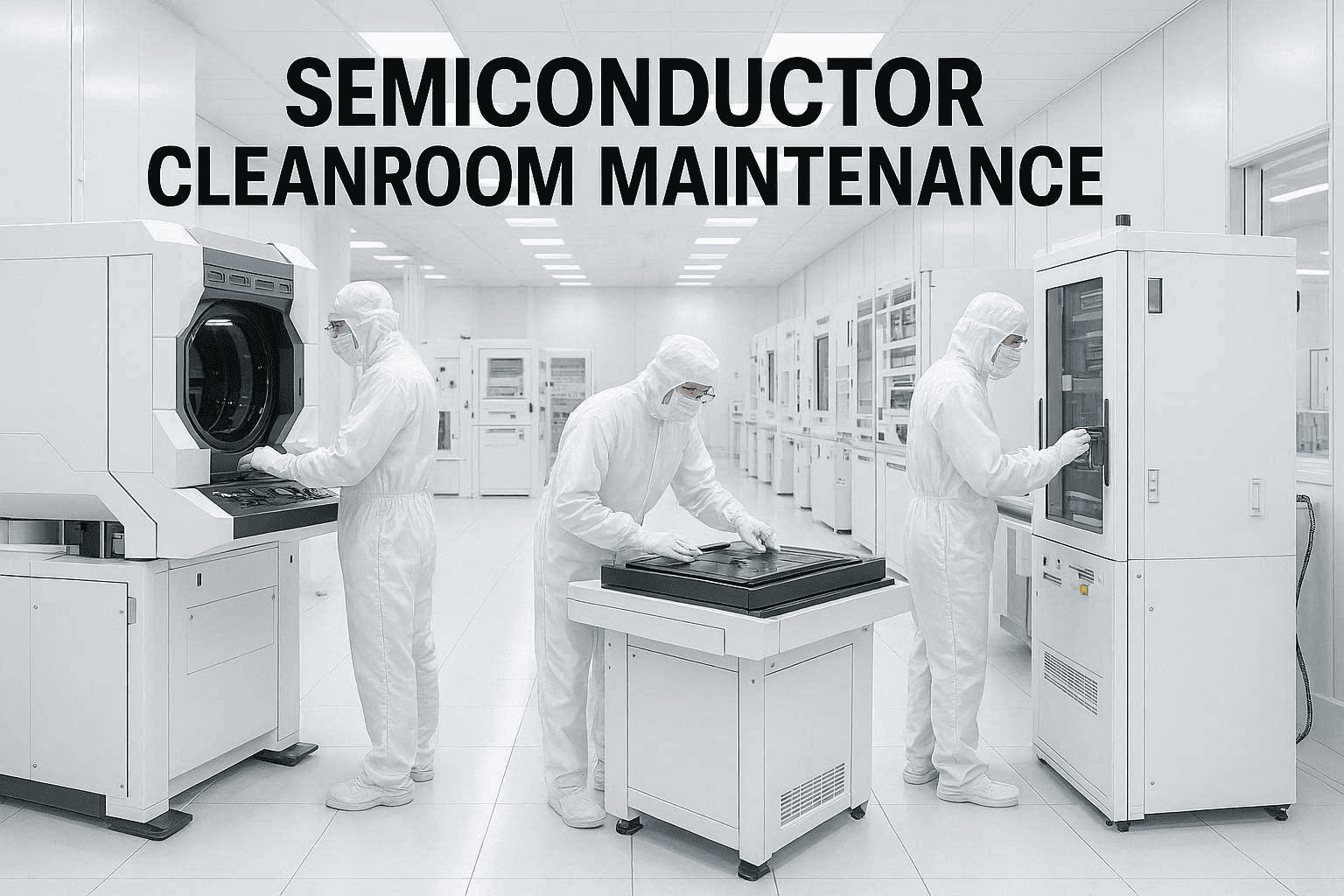
What Cleanroom Equipment Maintenance Actually Controls
Cleanroom maintenance is not about keeping rooms clean — it is about maintaining the physics of contamination control across thousands of interdependent variables simultaneously. Every equipment system feeds into yield. HVAC, FFUs, chemical delivery, process tools, HEPA filtration, vibration isolation — all of them have to be running within spec, at all times, with documented evidence that they are. Start a free trial to see how Oxmaint maps every cleanroom asset to its contamination control function.
HVAC & Air Handling
Controls temperature (±0.5°C), humidity (±2%), and positive pressure differentials that prevent contaminant ingress. Filter loading, coil fouling, and duct integrity all affect particle counts directly.
Failure impact: ISO class exceedance within hours
Fan Filter Units (FFUs)
HEPA and ULPA filters capturing particles down to 0.12 microns. Filter loading increases pressure drop and reduces airflow velocity — directly degrading ISO class compliance. PM scheduling prevents gradual contamination drift.
Failure impact: Particle counts exceed ISO limits; yield crashes
Process Equipment (Tools)
Lithography, etch, CVD, CMP — each tool requires qualification maintenance with documented baseline metrics. Tool qualification failure or drift must be caught before wafers enter the process step, not after.
Failure impact: Entire lot scrapped; batch yield to zero
Vibration Isolation Systems
Lithography tools operate at nanometer tolerances. Vibration from failing HVAC fans, pumps, or building systems propagates through the slab and directly degrades exposure alignment. Vibration monitoring is non-negotiable for advanced node fabs.
Ultra-pure water (UPW), specialty gases, and wet chemistry systems with sub-ppb purity requirements. Seal integrity, filter replacement, and valve condition directly affect chemical purity — and therefore device performance.
Failure impact: Chemical contamination cascades across wafer lots
ESD & Static Control Systems
Electrostatic discharge destroys circuitry on contact. Ionizer performance, flooring conductivity, and grounding system integrity all require regular verification — a single ESD event can silently kill an entire wafer batch at final test.
Failure impact: Silent latent defects; fallout at final test
AMC Monitoring Systems
Airborne Molecular Contamination monitoring detects ppb-level chemical traces that particle counters miss. AMC monitoring equipment led cleanroom market share in 2024 — because at 3nm and below, molecular contamination is as dangerous as particles.
Reactive vs. Controlled: What a PM Gap Costs in a Fab
Without Structured PM
HEPA filter degrades past threshold — particle counts climb for 2 weeks before an operator notices
Tool qualification drift goes undetected — 400 wafers process through out-of-spec equipment
Chiller vibration causes lithography overlay error — root cause takes 72 hours to isolate
Emergency tool vendor call-out at 3x premium labor rate; expedited parts shipping adds 5-day delay
No audit trail for ISO 14644-2 monitoring compliance — third-party certification at risk
With Oxmaint CMMS
HEPA filter PM auto-scheduled at 90% of rated life — replaced before particle threshold is approached
Tool qualification work orders triggered by run count, runtime hours, and process drift alerts
Vibration baselines tracked per tool — anomaly detected before production impact occurs
All planned interventions at standard labor rate; parts in inventory because consumption is predicted
ISO 14644-2 monitoring records auto-generated, timestamped, linked to each monitored zone
How Oxmaint Is Built for Semiconductor Maintenance
Generic CMMS platforms track work orders. OxMaint tracks contamination risk. Every asset, every PM trigger, every qualification record is connected to the yield impact of that equipment. That is the difference between maintenance management and cleanroom operations management. Book a demo to see a semiconductor-configured OxMaint instance.
01
Tool Qualification Workflows
Each process tool has a qualification work order template with documented baseline metrics, acceptance criteria, and sign-off requirements. Qualification status is linked to wafer lot release — tools out of qualification cannot release lots to the next process step.
02
Production-Based PM Triggers
PM schedules driven by wafer count, RF hours, pump cycles, and process run counts — not just calendar time. A CVD tool that runs 300% of forecast capacity in a quarter triggers its PM 3× earlier, protecting both the tool and the wafers behind it.
03
Environmental Monitoring Integration
Particle counter data, temperature and humidity readings, and pressure differential logs feed directly into OxMaint. Environmental exceedances auto-generate investigation work orders — linking the environmental event to the equipment condition that caused it.
04
Spare Parts Criticality Management
Long-lead semiconductor spare parts — turbo pumps, RF generators, end effectors — tracked with minimum stock levels based on MTBF and lead time. A pump that fails without a spare in stock means a tool down for 6–12 weeks. OxMaint prevents that.
25%
Fewer Equipment Failures
With predictive PM programs replacing calendar-only schedules
40%
Less Administrative Overhead
Compliance documentation auto-generated vs. manual record assembly
Overall equipment effectiveness gains from proactive cleanroom maintenance
Every Particle That Reaches Your Wafer Is a Maintenance Failure
OxMaint connects cleanroom equipment maintenance to contamination control outcomes — with tool qualification workflows, production-based PM triggers, and ISO 14644-compliant documentation. Built for the precision your fab demands.
How does a CMMS help maintain ISO 14644 cleanroom compliance?
ISO 14644-2 requires ongoing monitoring of cleanroom conditions — particle counts, temperature, humidity, and pressure differentials — with documented records that demonstrate continued compliance between classification certifications. OxMaint integrates with environmental monitoring systems so that every reading is timestamped and linked to specific cleanroom zones and the equipment responsible for maintaining those conditions. When an exceedance occurs, an investigation work order is auto-generated. Audit packages for ISO re-certification are exportable in minutes. Start free and configure your cleanroom monitoring integration today.
What is tool qualification and why does it require CMMS tracking?
Tool qualification is the documented process of verifying that a piece of process equipment meets its performance specifications before it can process production wafers. This typically involves running test wafers, measuring critical parameters against acceptance criteria, and obtaining sign-off from process and equipment engineers. Without CMMS tracking, qualification status exists in spreadsheets or tribal knowledge — and tools drift out of qualification without anyone knowing. OxMaint links qualification records to wafer lot release, creating a hard gate that prevents out-of-spec tools from processing product.
How do production-based PM triggers differ from calendar-based scheduling for semiconductor tools?
Calendar-based scheduling ignores actual tool usage. A tool that ran 300% of planned capacity in a quarter will reach its PM threshold in one month — not three. Conversely, a tool that ran 20% of capacity still gets a PM it doesn't need, consuming scarce engineering time. OxMaint's production-based triggers schedule PMs based on actual wafer count, RF hours, pump cycles, or process run counts — matching maintenance frequency to actual tool wear rather than the calendar. This reduces both missed PMs (which cause failures) and unnecessary PMs (which consume budget). Book a demo to see production-based triggering configured for your tool set.
Can Oxmaint handle spare parts management for long-lead semiconductor components?
Yes. OxMaint tracks spare parts inventory with minimum stock levels set per part based on MTBF, lead time, and criticality classification. For long-lead components — turbo pumps, RF generators, end effectors — the system generates reorder alerts when stock falls below the minimum calculated to cover the lead time plus a safety buffer. Parts consumption from work orders updates stock levels automatically, so the inventory record always reflects reality. A tool that fails without a critical spare in stock becomes a 6–12 week outage. OxMaint prevents that scenario by predicting when spares will be needed before the tool fails.