A maintenance technician at a food processing plant used to spend 40 minutes every morning walking a 200,000 sq ft facility checking 86 conveyor belt tension points, recording readings on a clipboard, and then typing them into the CMMS at a desk. Today, a mobile cobot on an autonomous base rolls that same route in 22 minutes — scanning belt tension, motor temperature, and vibration at each checkpoint with sensors that detect degradation invisible to the human eye. The technician now reviews the cobot's exception report over coffee in 4 minutes, dispatches only the 3–5 points that actually need attention, and spends the remaining 35 minutes doing the skilled diagnostic work that no robot can do. That is the cobot value proposition for maintenance: not replacing technicians, but multiplying their effectiveness by automating the repetitive, physically demanding, and data-intensive tasks that consume 40–60% of their day. The cobot market is projected to grow from $2.95 billion in 2025 to over $32 billion by 2035, with maintenance departments emerging as one of the fastest-growing adoption segments — because the ROI is undeniable. Schedule a demo to see how OxMaint integrates cobot inspection data directly into maintenance workflows.
$2.95B
Global cobot market value in 2025 — growing 23–25% CAGR through 2033
12–18 mo
Average ROI for well-implemented cobot projects — vs. 3–5 years for traditional robots
64,542
Cobots deployed globally in 2024 — a 12% increase year-over-year
84%
Of businesses plan to adopt or expand robotic automation within the next decade
What Are Cobots — And Why Should Maintenance Teams Care?
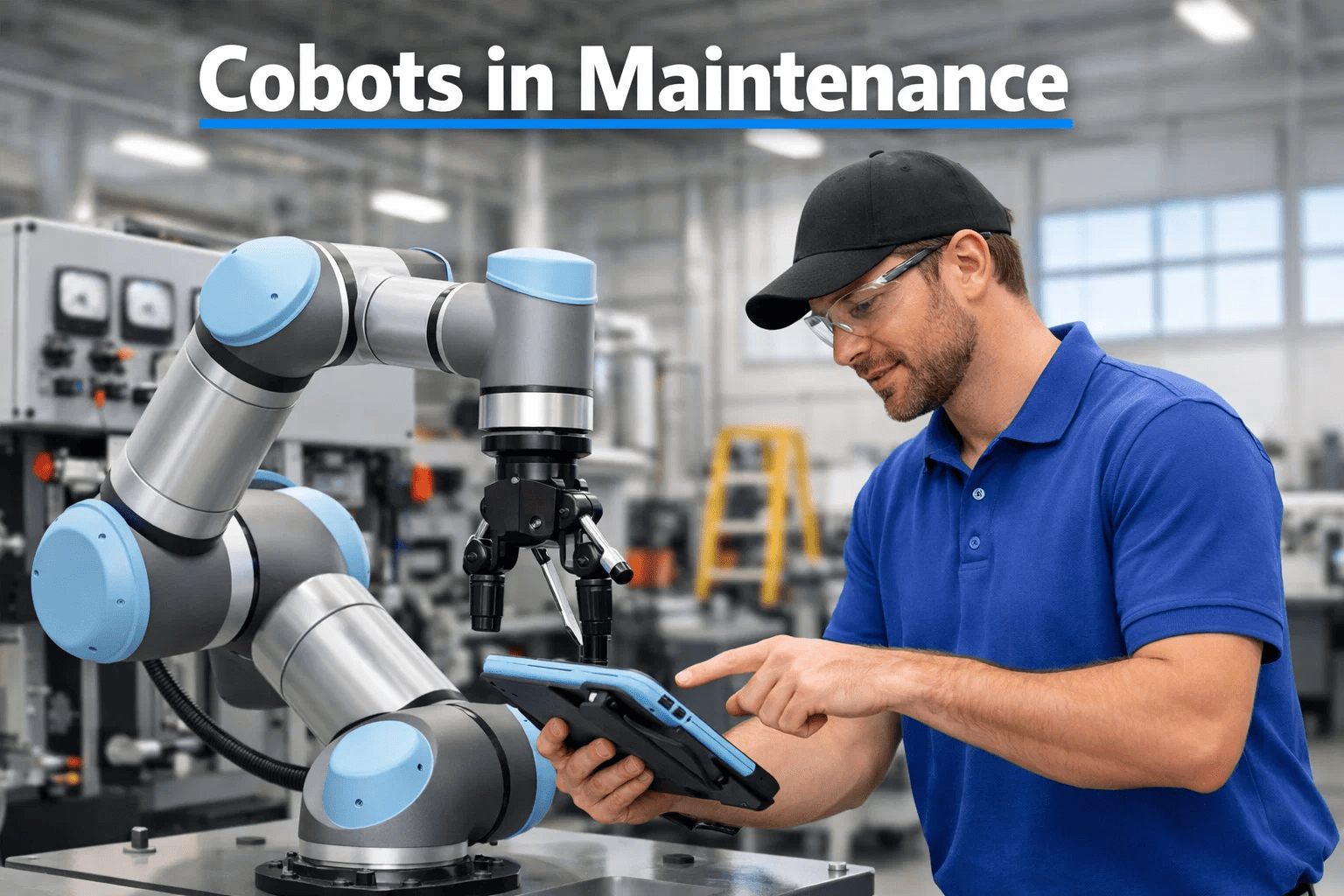
A collaborative robot (cobot) is a robot designed to work safely alongside human workers without safety cages or barriers. Unlike traditional industrial robots that are isolated behind fencing, cobots use force sensors, vision systems, and collision detection to operate in shared workspaces — slowing or stopping automatically when a person is near. For maintenance teams, cobots represent something specific: the automation of inspection, data collection, and repetitive physical tasks that currently consume the majority of technician time — freeing skilled workers to focus on diagnostics, repairs, and reliability engineering that require human judgment. Start a free trial of OxMaint and see how cobot-generated data flows directly into work orders and PM schedules.
Traditional Industrial Robots
Require safety cages and fencing — no human proximity allowed
Complex programming requiring specialized robotics engineers
Upfront cost typically exceeding $250,000 with 6–12 month implementation
Fixed installation — permanent placement on production lines
3–5 year ROI timeline makes justification difficult for maintenance use
Maintenance teams become consumers of the robot, not operators of it
Result: Powerful but inflexible. Built for production, not maintenance. Maintenance teams rarely benefit directly.
Collaborative Robots (Cobots)
Work alongside humans — no cages, no barriers, shared workspace
No-code or drag-and-drop programming — technicians can teach tasks directly
Cost range $2K–$100K with deployment in days, not months
Portable and redeployable — move between tasks and locations as needed
12–18 month average ROI with immediate wrench-time improvements
Maintenance teams own, program, and operate the cobot directly
Result: Affordable, flexible, and maintenance-team-owned. Designed to augment technicians, not replace them.
Six Cobot Use Cases for Maintenance Teams
Cobots in maintenance are not about replacing technicians. They are about automating the 40–60% of technician time spent on data collection, routine inspections, and physically demanding repetitive tasks — and redirecting that time to the skilled diagnostic and repair work that only humans can do.
What the cobot does: A mobile cobot on an AMR base performs scheduled inspection routes — scanning vibration, temperature, acoustic signatures, and visual condition at each checkpoint. Data feeds directly into the CMMS.
What the technician did before: 30–60 minutes walking routes, recording readings manually, then 15–20 minutes typing data into the system. 85% of readings show no anomaly — the walk was information-gathering, not problem-solving.
The result: Cobot completes the route faster, more consistently, and with sensor precision humans cannot match. Technician reviews only the exceptions. Wrench time increases 35%+ as data collection time drops to near zero.
CMMS integration: Cobot anomaly data auto-generates work orders in OxMaint — asset identified, failure mode classified, priority scored, technician assigned.
What the cobot does: Equipped with thermal cameras, vibration sensors, and acoustic analyzers, the cobot detects bearing wear, motor overheating, belt degradation, and seal leaks 2–6 weeks before human senses can perceive them.
Why it matters: Human inspectors catch failures after they become visible or audible — often too late for planned intervention. Cobots detect micro-changes in vibration frequency or thermal signatures that predict failure while there is still time to plan the repair during scheduled downtime.
Impact: 30–50% reduction in unplanned downtime when cobot monitoring feeds predictive maintenance models through the CMMS.
What the cobot does: Inspects confined spaces, high-temperature zones, chemical storage areas, and elevated structures — environments that require permits, PPE, and buddy systems for human entry. The cobot goes where people should not.
Safety impact: Eliminates human exposure to fall hazards, toxic atmospheres, extreme temperatures, and confined space risks. Every inspection that a cobot performs in a hazardous zone is one fewer permit, one fewer risk exposure, and one fewer potential incident.
Result: Facilities report 40–60% reduction in confined space entry permits and associated safety incidents after cobot deployment.
What the cobot does: Performs physically repetitive tasks — tightening fasteners to precise torque specs, applying lubrication at exact intervals, cleaning filters, and swapping consumable components. Tasks that are dull, dirty, or physically demanding.
Ergonomic benefit: Repetitive motion injuries account for a significant portion of maintenance worker disability claims. Cobots handle the repetitive physical work while technicians focus on diagnosis, decision-making, and complex repairs.
Impact: Reduced musculoskeletal injuries, consistent torque and lubrication quality, and technician time redirected to high-value work.
What the cobot does: When a work order is approved in the CMMS, a mobile cobot retrieves the required parts from the storeroom and delivers them to the job site — so the technician never leaves the work area to hunt for parts.
Why it matters: Studies show technicians spend 15–25% of their shift walking to and from parts rooms. A mobile cobot delivering parts to the point of repair recovers 1–2 hours per technician per shift of productive wrench time.
CMMS integration: OxMaint work order triggers automatic parts pick and delivery through the cobot's navigation system.
What the cobot does: Captures high-resolution images, 3D scans, and sensor data during every inspection — building a continuously updated digital twin of every asset. Each scan is timestamped, geo-tagged, and linked to the asset record in the CMMS.
Long-term value: Over months, the cobot builds a complete visual and condition history of every asset — enabling trend analysis that predicts failures based on progressive degradation patterns invisible in spot-check inspections.
Result: Digital twins fed by cobot data improve AI failure prediction accuracy 15–20% within 90 days of deployment.
Cobots Collect the Data. OxMaint Turns It Into Action.
When cobot inspection data flows directly into OxMaint, anomalies become work orders automatically — asset identified, failure classified, technician assigned. No manual data entry. No lost observations. The cobot sees it. The CMMS acts on it.
How Cobots Connect to Your CMMS
Layer 1
Cobot Sensors Capture Field Data
Vibration
Thermal
Acoustic
Visual
Oil analysis
What happens: The cobot completes its inspection route, capturing multi-sensor data at every checkpoint. Each reading is timestamped, geo-tagged, and linked to the specific asset ID in the system. Raw data is pre-processed at the edge for anomaly scoring before transmission.
data stream
Layer 2
AI Anomaly Detection and Classification
Pattern matching
Threshold alerts
Trend analysis
Failure scoring
What happens: AI models compare current readings against baseline profiles and historical degradation patterns. Anomalies are classified by severity: normal, watch, warning, or critical. Only readings that exceed defined thresholds trigger the next layer — eliminating noise and false alarms.
actionable alerts
Layer 3
CMMS Work Order Auto-Generation
Asset matched
Priority scored
Parts linked
Technician assigned
What happens: OxMaint receives the classified anomaly, auto-generates a work order with the correct asset, failure mode, priority, recommended parts, and available technician. The technician receives a mobile notification with full context — including the cobot's sensor data and photos. Parts are pre-staged from inventory before the technician arrives.
→
The closed loop: Cobot inspects → AI classifies → CMMS creates work order → Technician executes → Completion data feeds back into AI model → Cobot adjusts inspection sensitivity. This loop gets smarter with every cycle — improving prediction accuracy 15–20% within 90 days.
Implementation: Getting Cobots Into Your Maintenance Operation
01
Start With Inspection Routes, Not Complex Tasks
The highest-ROI first deployment for maintenance cobots is autonomous inspection rounds. Choose your most time-consuming daily route — the one where technicians walk 30–60 minutes recording readings that are normal 85% of the time. Deploy the cobot on that route first. ROI is visible within the first week as technician wrench time immediately increases.
02
Connect Cobot Data to Your CMMS from Day One
A cobot that collects data but does not feed it into the CMMS is an expensive thermometer. The value multiplier is automatic work order generation from anomaly detection. Configure the CMMS integration before the cobot's first route — so every exception it finds becomes a tracked, prioritized, assigned maintenance action.
OxMaint supports direct cobot data integration — start free and configure the connection.
03
Let Technicians Own the Cobot
The fastest path to adoption failure is deploying a cobot that only the IT team or an outside integrator can program. Modern cobots use no-code, drag-and-drop, or teach-by-demonstration programming. The maintenance technician who walks the inspection route today should be the person who teaches the cobot that route tomorrow. Ownership drives adoption. Adoption drives ROI.
04
Expand to Hazardous and Physically Demanding Tasks
After inspection routes prove the concept, extend to confined space inspections, elevated structure surveys, and repetitive physical tasks. Each expansion reduces safety risk and frees skilled technician time. Track the reduction in confined space permits, fall risk exposures, and repetitive motion complaints as secondary ROI metrics.
05
Build the Predictive Loop
After 60–90 days of cobot inspection data flowing through the CMMS, the AI models have enough history to begin predicting failures — not just detecting current anomalies. This is where the ROI compounds: the cobot becomes a predictive sensor network, the CMMS becomes the action engine, and the maintenance team shifts from reactive to truly predictive operations.
Measurable Impact: What Changes When Cobots Join the Team
35%+
Increase in technician wrench time — inspection and data collection hours redirected to skilled repair work
30–50%
Reduction in unplanned downtime when cobot condition monitoring feeds predictive maintenance models
40–60%
Fewer confined space entries and hazardous environment exposures after cobot inspection deployment
12–18 mo
Average payback period for maintenance cobot deployment — vs. 3–5 years for traditional industrial robots
Cobots Handle the Routine. Your Technicians Handle the Complex. OxMaint Connects Both.
Whether your cobots are deployed today or on the roadmap for next quarter, OxMaint is the CMMS that turns cobot sensor data into automated work orders, predictive maintenance schedules, and audit-ready inspection records. The platform is ready when your cobots are.
Frequently Asked Questions
How much does a maintenance cobot cost?
Cobots range from $2,000 for basic light-duty arms to $100,000+ for industrial-grade mobile inspection platforms with integrated sensors. For maintenance inspection applications, a mobile cobot with thermal, vibration, and visual sensors typically falls in the $25,000–$60,000 range including end-of-arm tooling and integration. Average ROI is achieved in 12–18 months from wrench time recovery and downtime reduction alone.
Book a demo to discuss cobot-CMMS integration for your facility.
Do maintenance technicians need robotics training to operate cobots?
No — modern cobots are designed for no-code programming. Technicians teach the cobot inspection routes using lead-through demonstration (physically guiding the arm), drag-and-drop route mapping on a tablet, or voice commands. The same technician who walked the route yesterday can program the cobot to walk it today. Most teams are fully operational within 1–2 weeks. The key principle: the maintenance team owns and operates the cobot, not the IT department.
Are cobots safe to work around in maintenance environments?
Yes — cobots are specifically designed for shared human-robot workspaces. They include force sensors that detect contact and stop immediately, vision systems that slow the cobot when a person is nearby, speed and force limiting that prevents injury even in a direct collision, and emergency stop capabilities accessible from the teach pendant or any nearby station. Cobots comply with ISO 10218 and ISO/TS 15066 safety standards. In maintenance environments, they reduce safety risk by performing confined space, elevated, and hazardous inspections that would otherwise expose human workers.
How does cobot data integrate with a CMMS like OxMaint?
Cobot sensor data feeds into OxMaint through API integration or MQTT/OPC-UA protocols. When the cobot detects an anomaly that exceeds defined thresholds, OxMaint auto-generates a work order — matching the reading to the correct asset, classifying the failure mode, scoring priority, and assigning the appropriate technician. The technician receives the work order on their phone with the cobot's sensor data and photos attached. Every inspection reading — normal or anomalous — is stored in the asset history for trend analysis.
Start free and configure cobot data integration in your first week.
Will cobots replace maintenance technicians?
No. Cobots automate the repetitive, data-intensive, and physically demanding 40–60% of a technician's day — inspection walks, data recording, parts retrieval, and routine physical tasks. The skilled work — diagnostics, complex repairs, root cause analysis, and reliability engineering — requires human judgment, experience, and adaptability that no cobot can replicate. The result is not fewer technicians, but technicians who spend 35%+ more time doing the high-value work they were trained for. In a market where 73% of manufacturers cannot find enough skilled maintenance workers, cobots extend the capacity of the team you already have.