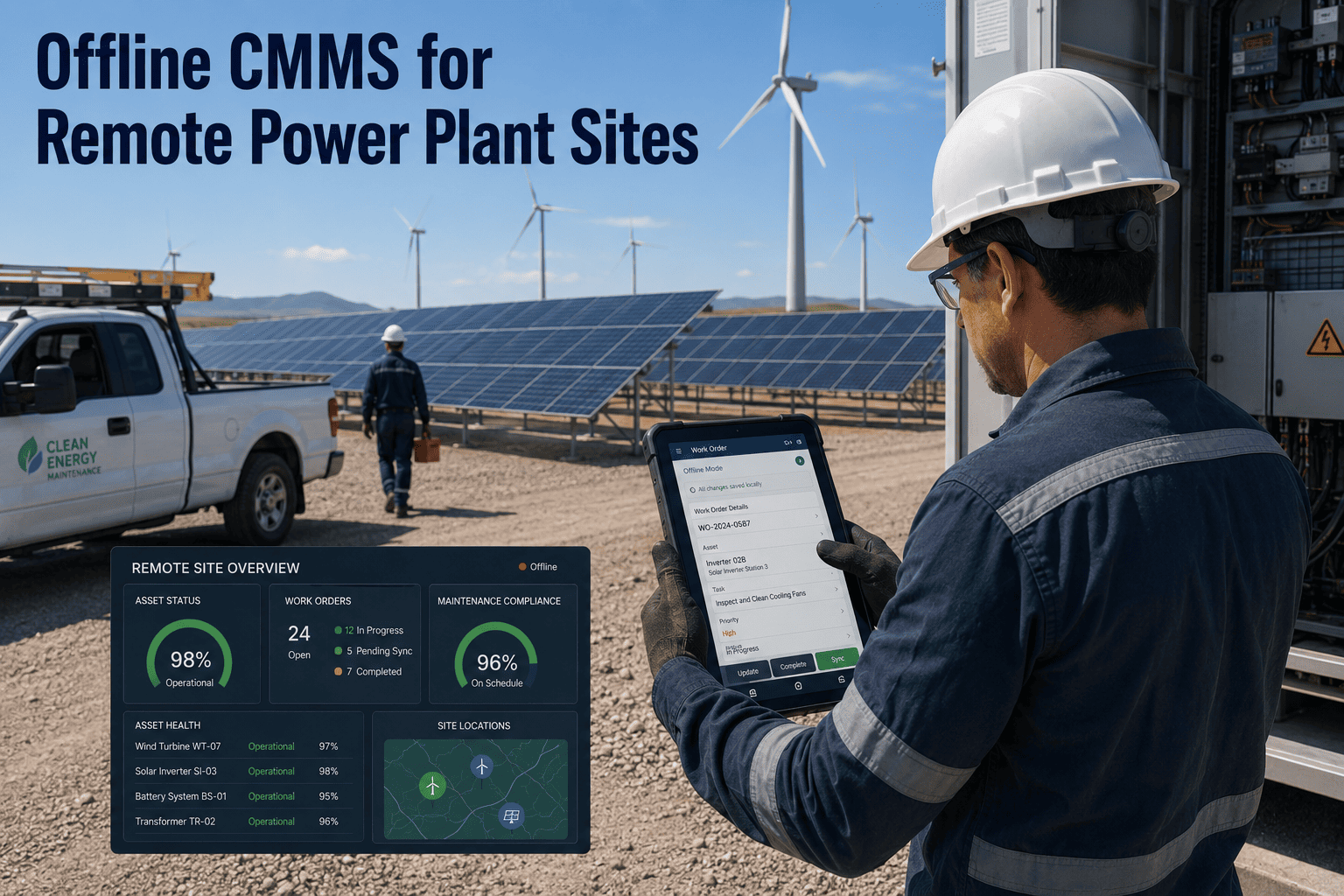
A wind farm operator managing 180 turbines across 40 square miles of remote terrain spent $2.4M annually on vibration monitoring — not on the sensors themselves, but on the connectivity infrastructure required to transmit high-frequency vibration data from nacelles 300 feet in the air across kilometers of open land to a central monitoring system. The Wi-Fi mesh network covering the farm required 74 access points, 12 fiber backhaul connections, and a full-time network technician. Despite this investment, the system could only transmit averaged vibration data every 60 seconds — sufficient for trend analysis but blind to the transient events (bearing spalls, gear tooth impacts, blade pitch faults) that occur in milliseconds and disappear before the next transmission window. In 2025, the operator replaced the entire mesh network with a private 5G deployment: 6 base stations covering all 180 turbines with direct, high-bandwidth connectivity. Each turbine now streams raw 25.6kHz vibration data in real time — capturing every transient event the Wi-Fi system missed. The 5G network cost $380K to deploy and $85K annually to operate, replacing $2.4M in annual Wi-Fi infrastructure costs while delivering 100× the data resolution. Three bearing failures were detected in the first 90 days from transient signatures the previous system was physically incapable of capturing. Each prevented failure: $180K–$350K in avoided crane mobilization, component replacement, and lost generation. 5G for industrial maintenance is not faster Wi-Fi. It is a fundamentally different connectivity architecture that eliminates the bandwidth, latency, and coverage limitations that force current IoT deployments to compromise between data resolution and cost. Schedule a demo to see how 5G-connected IoT sensor data integrates with CMMS predictive maintenance workflows.
Current IoT Connectivity Limitations
5G Private Network Solution
Why Current Industrial IoT Connectivity Fails Maintenance
Wi-Fi, Bluetooth, LoRaWAN, and cellular 4G each solve part of the industrial IoT connectivity problem — but none solve it completely. Wi-Fi provides bandwidth but limited range and requires dense access point infrastructure. LoRaWAN provides range but cannot handle high-frequency sensor data. Bluetooth provides low power but only 100-meter range. 4G LTE provides coverage but with latency and bandwidth limitations that force data compression and transmission delays. 5G eliminates these trade-offs by delivering all four capabilities simultaneously: massive bandwidth, ultra-low latency, wide coverage, and support for thousands of simultaneous device connections. Sign up free and see how 5G-connected sensor data feeds OxMaint predictive analytics from day one.
5G Network Capabilities for Maintenance IoT
Enhanced Mobile Broadband (eMBB): Up to 10 Gbps downlink — streams raw vibration spectra, thermal video, and 3D scan data from hundreds of sensors simultaneously without compression or averaging
Ultra-Reliable Low Latency (URLLC): Sub-1ms latency for time-critical applications — enables real-time protective actions, AR remote expert assistance, and edge-to-cloud synchronization at machine speed
Massive Machine-Type Communication (mMTC): Supports 1 million devices per km² — connects every sensor, actuator, and mobile device across a large industrial facility on a single network
Network Slicing: Dedicated virtual networks for different traffic types — mission-critical sensor data gets guaranteed bandwidth while mobile CMMS access shares capacity without interference
5G vs. Current Protocols: The Connectivity Comparison
Each current protocol forces a compromise. 5G eliminates the compromise by delivering bandwidth, range, latency, and device density simultaneously on a single infrastructure.
Bandwidth Comparison
Latency Comparison
Coverage and Density
Five Industrial Use Cases Where 5G Transforms Maintenance
High-Frequency Vibration Streaming
5G streams raw 25.6kHz vibration data from rotating equipment without compression or averaging — capturing bearing defect transients, gear mesh anomalies, and structural resonances that Wi-Fi and 4G systems miss due to bandwidth limitations. One prevented turbine bearing failure ($180K–$350K) justifies years of 5G network cost.
AR Remote Expert Assistance
5G's sub-1ms latency and high bandwidth enable real-time AR video streaming from smart glasses — the remote expert sees exactly what the technician sees with zero perceptible delay. Wi-Fi dead zones and 4G latency make AR sessions frustrating or impossible in most industrial environments. 5G makes AR work everywhere on site.
Autonomous Drone Inspection
5G provides the real-time command-and-control link for beyond-visual-line-of-sight (BVLOS) autonomous drone flights — streaming HD and thermal video to AI processing while receiving navigation updates with sub-millisecond latency. This enables fully autonomous inspection programs across large facilities without pilot line-of-sight requirements.
Mobile CMMS for Distributed Teams
Maintenance teams working across large campuses, remote sites, and distributed facilities get consistent, high-speed CMMS access everywhere — no more dead zones where work orders can't load, photos can't upload, or sensor data can't display. OxMaint's mobile app delivers full functionality over 5G with sub-second response times regardless of facility location.
5G Doesn't Just Connect Your Sensors. It Connects Your Entire Maintenance Operation.
OxMaint integrates with 5G-connected IoT platforms — ingesting high-resolution sensor data, supporting AR remote expert sessions, and delivering instant mobile CMMS access across distributed facilities. One network. Every maintenance capability.
Private 5G vs. Public 5G: Which Deployment Model for Maintenance
Private 5G Network (On-Premise)
CBRS (3.5 GHz) in the US allows private 5G deployment without carrier involvement. Full control over coverage, capacity, and priority.
All sensor data stays on-premise — never traverses public networks. Critical for defense, pharma, and facilities with ITAR/CMMC requirements.
No shared bandwidth with public users. Network slicing dedicates capacity to mission-critical sensor data vs. general mobile traffic.
$200K–$800K deployment + $50K–$150K/yr operation for a large industrial facility. ROI from eliminated Wi-Fi infrastructure within 12–18 months.
Public 5G with Network Slicing
Leverage existing carrier 5G coverage. No on-premise equipment beyond SIM-enabled sensors and devices. Fastest deployment path.
Carriers offer dedicated "slices" with guaranteed bandwidth, latency, and reliability for industrial IoT — approaching private network performance.
Ideal for distributed assets across geographic regions — pipeline corridors, fleet vehicles, remote substations — where private deployment is impractical.
$5–$25/device/month subscription. No capital deployment. Best for mobile assets, distributed facilities, and organizations testing 5G before private investment.
Implementation Roadmap: 5G for Maintenance IoT
Coverage Assessment and Network Design
Network Deployment and Sensor Migration
Advanced Capabilities Activation
Measurable Results: 5G Impact on Maintenance Operations
Your Sensors Are Smarter Than Your Network Lets Them Be. 5G Fixes That.
OxMaint integrates with 5G-connected IoT ecosystems — ingesting high-resolution sensor data, enabling AR remote expert sessions, and delivering instant mobile CMMS access everywhere on your facility. Stop compressing your maintenance intelligence to fit yesterday's bandwidth. Start your free trial today.
Frequently Asked Questions
Do we need to replace all existing sensors to use 5G?
No. Existing sensors connect to 5G via industrial gateways that bridge protocols (BLE, Zigbee, Modbus, wired Ethernet) to the 5G network. The gateway translates and transmits — your existing sensor investment is preserved. New sensors deployed going forward can use native 5G modules, but the transition is gradual and non-disruptive. OxMaint integrates with both legacy and 5G-native sensor data streams simultaneously.
Is private 5G realistic for mid-size industrial facilities?
Yes. CBRS spectrum in the US allows private 5G deployment without carrier involvement or spectrum licensing fees. A mid-size facility (500K–2M sq ft) typically requires 3–8 base stations at $200K–$500K total deployment cost. Annual operating cost ($50K–$100K) is typically lower than the Wi-Fi mesh infrastructure it replaces. ROI from eliminated Wi-Fi infrastructure, improved sensor data resolution, and prevented failures achieves payback within 12–18 months for most facilities.
How does 5G handle industrial environments with metal structures and RF interference?
5G operates across multiple frequency bands — sub-6 GHz bands penetrate walls and metal structures effectively (similar to 4G), while mmWave bands provide extreme bandwidth in line-of-sight scenarios. Private 5G network design includes RF propagation modeling specific to your facility's construction and equipment layout. Indoor small cells and distributed antenna systems (DAS) ensure coverage in challenging industrial environments including metal buildings, underground areas, and multi-story facilities.
What cybersecurity considerations apply to 5G industrial IoT networks?
Private 5G networks provide inherently stronger security than Wi-Fi — SIM-based device authentication, encrypted air interface, and network isolation prevent unauthorized access. Network slicing adds logical separation between sensor traffic and general mobile access. For facilities with ITAR, CMMC, or classified requirements, private 5G keeps all data on-premise with no public network traversal. OxMaint's CMMS integrates via secured API connections within the private network perimeter, maintaining data sovereignty throughout the analytics pipeline. Book a demo to discuss 5G security architecture for your facility classification.
What is the realistic ROI for deploying 5G alongside CMMS?
ROI comes from three sources: infrastructure cost reduction (84% lower than Wi-Fi mesh = $1.5M–$2M annual savings for large facilities), failure prevention from high-resolution data (3 prevented turbine failures in 90 days = $540K–$1.05M), and operational capability (AR remote expert, autonomous drones, real-time mobile CMMS). A wind farm operator documented $2.0M first-year savings on a $380K deployment. Manufacturing facilities report 12–18 month payback from combined infrastructure savings and prevented failures. Start free and calculate your facility's 5G maintenance ROI.