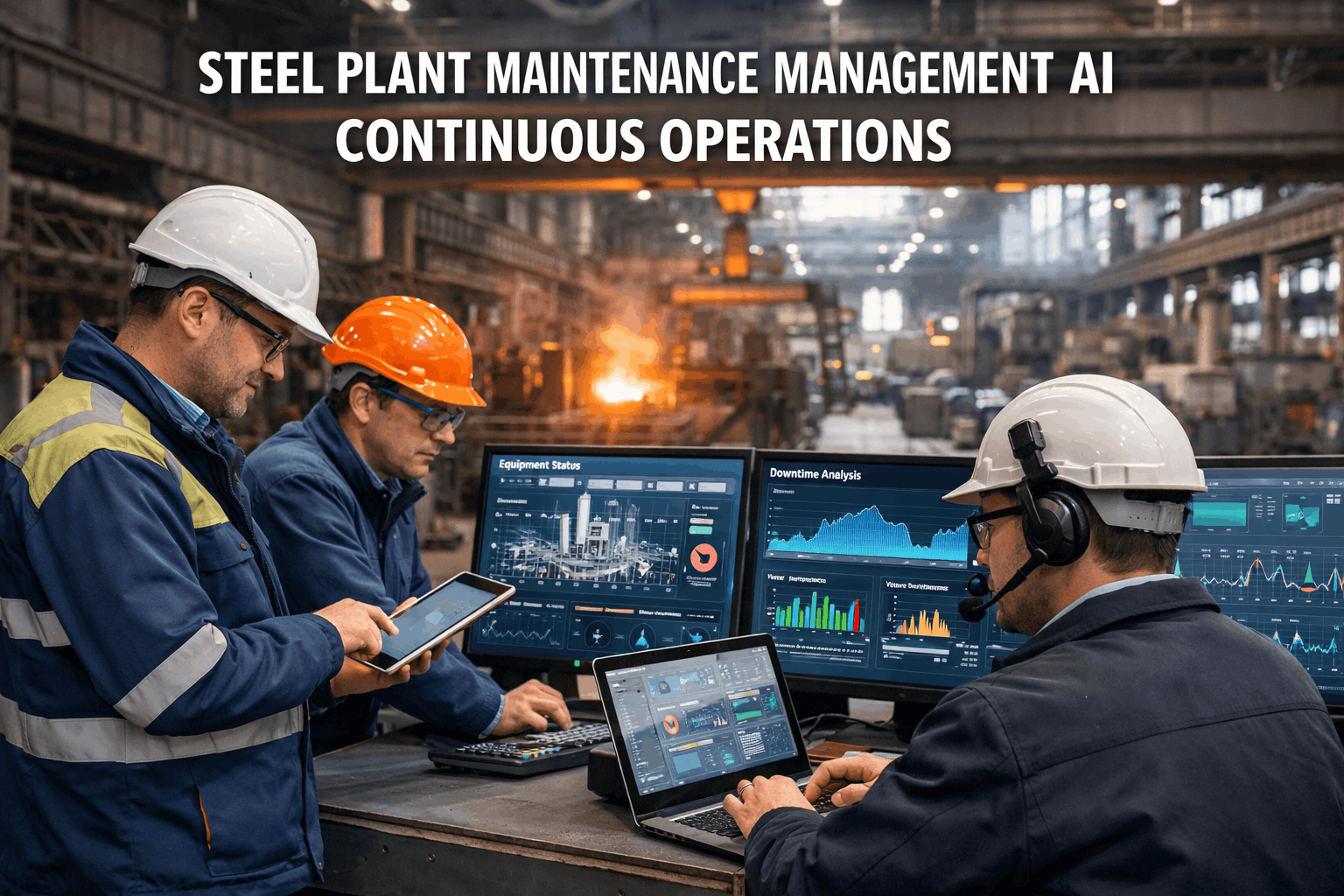
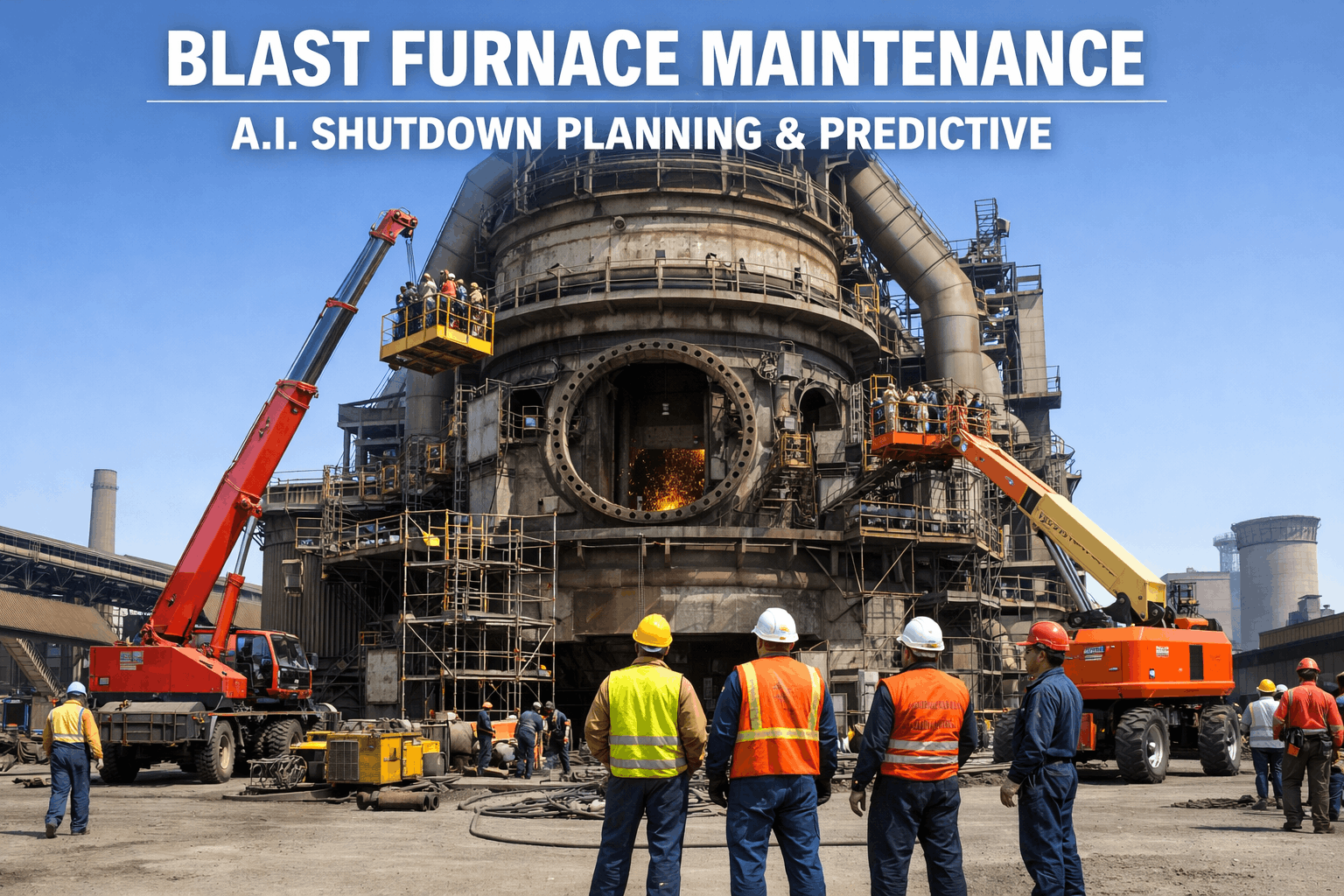
Integrated steel plants operate 24/7 with 15,000–40,000 maintainable assets across blast furnaces, steelmaking vessels, continuous casters, rolling mills, and utility systems — all running at extreme temperatures (2,200–3,000°F+) where a single undetected equipment failure cascades into full production shutdown within minutes. Unplanned downtime costs $1.2 million or more per day at a typical 3.5 MTPA integrated mill. Yet 55–65% of maintenance activity at the average North American steel plant remains reactive — unplanned work triggered by equipment failure rather than predicted degradation. The financial consequence: $28–$45 million annually consumed by emergency repairs at 3–5× planned maintenance cost, expedited spare parts at 40–120% markup, collateral damage from cascading failures, and 8–14 days of lost production. AI-powered predictive maintenance changes this equation fundamentally — monitoring thousands of equipment parameters simultaneously, detecting degradation 2–8 weeks before failure, and generating prioritized CMMS work orders that convert million-dollar emergencies into planned interventions executed during scheduled production windows. The barrier to deployment is not the technology. It is the absence of an integrated maintenance platform that connects sensor data, work order management, spare parts logistics, and capital planning into a unified system built for continuous steelmaking complexity. Sign up for Oxmaint and start building the AI-powered maintenance intelligence layer that eliminates unplanned downtime from your steel plant operations.
Unplanned Downtime Cost
$1.2M+
Average cost per day of unplanned shutdown for an integrated steel mill blast furnace or continuous caster
Reactive Maintenance Share
55–65%
Percentage of maintenance activity that is unplanned across the average North American steel plant
AI Predictive Detection Lead
2–8 wk
How far in advance AI identifies equipment degradation that manual inspection and calendar-based PM miss entirely
Five Critical Failure Domains in Steel Plant Operations
Steel manufacturing is not a single process — it is a chain of interdependent high-temperature, high-load, high-speed operations where failure in any link cascades into every downstream process within minutes. A blast furnace cooling system leak forces the entire ironmaking operation offline. A caster breakout halts steelmaking and backs up the BOF. A rolling mill bearing seizure stops hot strip production while upstream ladles queue and cool. Understanding the five critical failure domains — and the specific AI detection capabilities that address each — is the foundation for building a maintenance intelligence program that protects 24/7 continuous operations.
1
Blast Furnace & Ironmaking
$1.2M–$3.5M per day of unplanned downtime
Critical Failure Modes:
• Cooling stave cracking from thermal fatigue — detected by AI trending of cooling water flow differential and stave temperature arrays
• Tuyere failure from refractory erosion — predicted 3–6 weeks ahead through infrared shell temperature mapping and heat flux analysis
• Hot blast stove checker deterioration — monitored via dome temperature cycling patterns and gas composition deviation
• Casthouse equipment wear (taphole drills, mud guns, runners) — tracked by cycle count, refractory condition scoring, and vibration baseline
AI Detection: Continuous monitoring of 200+ thermal and flow parameters per furnace detects cooling anomalies 2–8 weeks before catastrophic failure — converting $4.8M emergency repairs into $340K planned interventions.
2
Steelmaking & Continuous Casting
$800K–$2.1M per breakout event
Critical Failure Modes:
• Caster breakout from mold copper plate wear — predicted by thermocouple array pattern analysis and mold friction trending
• Ladle refractory failure — AI monitors lining wear rate per heat, slag chemistry exposure, and thermal cycling history per ladle
• BOF/EAF refractory degradation — tracked through vessel shell temperature mapping and tap-to-tap cycle analysis
• Segment roller bearing failures — detected via vibration signature analysis and strand drive motor current correlation
AI Detection: Mold thermocouple pattern recognition identifies breakout precursors 30–90 seconds before occurrence — and CMMS-tracked mold condition history predicts which molds need resurfacing 2–4 weeks before critical wear.
3
Hot Rolling Mill Complex
$400K–$1.5M per unplanned mill stop
Critical Failure Modes:
• Work roll bearing failure — predicted by vibration trending at characteristic frequencies (BPFO, BPFI, BSF, FTF) weeks before seizure
• Hydraulic AGC system degradation — detected through servo valve response time analysis and cylinder position accuracy drift
• Reheat furnace refractory and combustion — monitored via skid pipe cooling flow, burner flame stability, and zone temperature uniformity
• Coiler mandrel and wrapper roll wear — tracked by cycle count, surface condition scoring, and strip tension variance trending
AI Detection: Rolling mill vibration analysis at 40+ monitoring points detects bearing degradation 4–6 weeks before failure — enabling planned roll changes during scheduled mill delays instead of emergency shutdowns.
4
Utilities & Auxiliary Systems
Cascading impact — shuts down primary processes
Critical Failure Modes:
• Cooling water pumps and heat exchangers — fouling detection via differential pressure trending and thermal approach analysis
• Oxygen plant compressor and cold box — vibration, temperature, and gas purity monitoring for turbo-expander and compressor health
• Electrical distribution (HV switchgear, transformers) — partial discharge monitoring, dissolved gas analysis (DGA), thermal imaging
• Gas recovery systems (BF gas, coke oven gas, converter gas) — valve condition, scrubber performance, holder integrity monitoring
AI Detection: Utility system failures are the #1 hidden cause of primary process shutdowns. AI monitors 50+ utility parameters and correlates anomalies with upstream/downstream process impact — preventing the cascading failures that paper-based maintenance cannot anticipate.
4,200+ Parameters Per Furnace. 40+ Vibration Points Per Mill. One Platform That Sees Everything.
Oxmaint integrates equipment condition data from vibration sensors, thermal arrays, process historians, and operator rounds into a unified AI-powered CMMS that detects degradation weeks before failure, generates prioritized work orders, and tracks every maintenance action from detection through completion — across blast furnaces, casters, rolling mills, and utility systems simultaneously.
Why 55–65% Reactive Maintenance Is Destroying Steel Plant Economics
The average North American steel plant operates with 55–65% of maintenance activity classified as reactive — unplanned work triggered by equipment failure, operator alarm, or process deviation. This reactive burden is not a maintenance department failure; it is a systemic consequence of managing 15,000–40,000 maintainable assets across extreme operating environments using paper-based work orders, disconnected spreadsheets, and calendar-based PM programs that cannot adapt to actual equipment condition. The financial consequences compound across every dimension of plant economics.
The True Cost of Reactive Maintenance in Steel Manufacturing
Integrated steel mill • 3.5 MTPA capacity • North America • 2025 operating data
Emergency labor premium (overtime, contractors, callouts)
2.5–4×
vs. planned maintenance labor rates
Expedited spare parts markup (air freight, sole-source rush)
40–120%
vs. planned procurement pricing
Collateral damage from cascading failures
3–8×
Primary repair cost multiplied by secondary equipment damage
Annual unplanned downtime (blast furnace + caster + mill combined)
8–14 days
At $1.2M+/day = $9.6M–$16.8M lost production
Total annual cost of reactive maintenance model
$28–$45M
vs. $12–$18M under AI-predictive model (60% reduction achievable)
AI-Powered Predictive Maintenance: The Steel Plant Architecture
AI predictive maintenance in steel manufacturing is fundamentally different from AI in other industries because of three factors that multiply complexity: extreme operating environments (2,700°F+ in blast furnaces, 3,000°F+ in BOF steelmaking, 2,200°F+ in reheat furnaces), continuous operation with no opportunity for routine shutdown-based inspection, and cascading failure dynamics where a single equipment failure can shut down the entire production chain in minutes. The AI architecture must handle all three simultaneously — monitoring thousands of parameters across interconnected processes, detecting subtle degradation patterns in extreme noise environments, and prioritizing maintenance actions based on cascading failure risk rather than simple equipment criticality rankings.
Layer 1: Data Acquisition — Sensor Network + Process Historian Integration
Continuous data ingestion from 5,000–15,000 monitoring points across the integrated plant
✓ Vibration monitoring: accelerometers on all critical rotating equipment — mill bearings, pump motors, fan assemblies, compressors (40+ points per mill stand)
✓ Thermal monitoring: infrared arrays on blast furnace shell, caster mold thermocouples, reheat furnace zone temperatures, transformer hot-spot sensors
✓ Process parameters: cooling water flow/pressure/temperature, hydraulic system pressures, gas compositions, electrical load profiles from process historian (OSIsoft PI, Honeywell PHD)
✓ Operator rounds: mobile digital inspections replacing paper checklists — structured condition data captured by maintenance and operations staff at every shift
Foundation: All equipment condition data — sensor-based and human-observed — flows into a single CMMS platform for AI analysis
Layer 2: AI Analytics — Pattern Recognition + Anomaly Detection
Machine learning models trained on equipment-specific failure signatures detect degradation weeks before failure
✓ Vibration signature analysis: bearing defect frequencies (BPFO/BPFI/BSF/FTF), gear mesh frequencies, imbalance patterns — distinguishing normal variation from degradation
✓ Thermal trending: blast furnace cooling stave temperature arrays analyzed for localized hotspots indicating refractory wear or cooling channel blockage
✓ Multi-parameter correlation: AI connects rising vibration on a mill bearing with increasing motor current and decreasing strip thickness tolerance — identifying root cause not just symptom
✓ Remaining useful life (RUL) estimation: probabilistic models predict when each critical asset will cross failure threshold — enabling planned intervention at optimal timing
Intelligence: AI converts raw sensor data into equipment health scores, degradation trajectories, and failure probability estimates per asset
Layer 3: CMMS Integration — From Detection to Work Order in Minutes
Every AI detection generates a prioritized, actionable CMMS work order — not a dashboard alert that gets ignored
✓ Auto-generated work orders: AI detections create maintenance work orders with equipment ID, failure mode, recommended action, estimated repair time, and required parts
✓ Criticality-based prioritization: work orders ranked by cascading failure risk — a cooling pump bearing alert that threatens blast furnace operation outranks a standalone fan bearing
✓ Maintenance window optimization: AI recommends optimal timing — next scheduled delay, planned roll change, caster sequence break — minimizing production impact of each repair
✓ Spare parts verification: work order triggers automatic parts availability check in inventory — if parts not in stock, procurement alert generated with lead time and expedite options
Action: Every detection becomes a documented, prioritized, parts-verified work order executed during optimal maintenance windows — not a crisis at 2 AM
Layer 4: Continuous Learning — Models Improve With Every Maintenance Event
Closed-loop feedback: every completed work order teaches the AI what worked, what didn't, and what to detect earlier next time
✓ Maintenance outcome feedback: technician reports actual failure mode, actual repair scope, and actual parts used — AI compares to prediction and refines model
✓ False positive reduction: detections that generate unnecessary work orders are flagged — AI learns to distinguish real degradation from normal operating variation over time
✓ Fleet learning: failure patterns detected on one asset are applied across all similar assets plant-wide — a bearing failure mode found on Mill Stand 3 triggers enhanced monitoring on Stands 1–6
✓ Seasonal and campaign adaptation: AI adjusts detection thresholds for blast furnace campaign stage, seasonal temperature variation, and product mix changes that alter equipment loading
Maturity: Prediction accuracy improves from 75–80% in Year 1 to 90–95% by Year 3 as the model accumulates plant-specific failure data
Asset-Specific Maintenance Strategies by Production Area
Each production area in an integrated steel plant requires a distinct maintenance strategy tailored to the equipment failure modes, operating environment, and downtime consequences specific to that area. A one-size-fits-all PM program — common in plants still using paper or basic spreadsheet tracking — either over-maintains low-criticality equipment (wasting labor and parts) or under-maintains high-criticality equipment (creating catastrophic failure risk). AI-powered CMMS enables differentiated strategies by area, asset, and operating condition.
Blast Furnace Complex — Campaign-Based + Continuous Monitoring
15–20 year campaigns with no planned shutdowns — maintenance must detect problems without stopping the furnace
✓ Cooling system: continuous monitoring of all stave temperatures, cooling water flows, and heat flux calculations — AI alerts at 5% deviation from baseline per stave zone
✓ Tuyeres and raceways: infrared shell scanning on 8-hour intervals, automated hot-spot detection with trend-to-failure projection, spare tuyere inventory linked to CMMS
✓ Hot blast stoves: dome temperature cycling analysis, checker condition scoring from pressure drop trending, combustion efficiency monitoring
✓ Casthouse: cycle-count-based PM for taphole drills and mud guns, refractory condition scoring per cast, runner life tracking with replacement forecasting
Strategy: Zero planned shutdowns during campaign. All maintenance predictive or condition-based. Emergency shutdowns targeted at <1 per campaign year vs. industry average 3–5.
Steelmaking (BOF/EAF) & Caster — Heat-Cycle + Sequence-Break Maintenance
Maintenance timed to natural production breaks — between heats, during caster sequence changes, scheduled turnarounds
✓ Vessel refractory: lining wear tracked per heat (laser profile measurement + thermal mapping) — AI predicts optimal reline timing maximizing campaign life
✓ Ladle management: individual ladle tracking — refractory hours, slag exposure, thermal cycling count — with automated rotation scheduling to equalize wear across fleet
✓ Caster molds: thermocouple array analysis per sequence, copper plate wear measurement at each mold change, oscillation mechanism condition monitoring
✓ Segment rollers: vibration monitoring on all driven and idler rollers, bearing temperature trending, spray nozzle blockage detection from zone temperature variance
Strategy: Maximize heat count between maintenance interventions. Use sequence breaks and scheduled turnarounds for condition-based repairs. AI predicts optimal reline timing ±2 heats.
Hot Rolling Mill — Delay-Optimized + Roll-Change Maintenance
Maintenance synchronized with scheduled roll changes and planned production delays — never during rolling campaign
✓ Mill stands: vibration analysis at all bearing positions (40+ points per stand), motor current signature analysis, hydraulic AGC servo valve response trending
✓ Reheat furnace: combustion tuning per zone, skid pipe cooling integrity monitoring, walking beam mechanism condition — maintenance during furnace push-out gaps
✓ Coiler/downcoiler: mandrel and wrapper roll condition per coil count, tension control system calibration, strip threading guide wear tracking
✓ Roll shop integration: work roll grinding schedules linked to mill PM calendar — ensuring freshly ground rolls ready when mill maintenance window opens
Strategy: Bundle all non-emergency maintenance into planned roll-change windows. AI predicts which maintenance items can safely wait for next window vs. require immediate intervention.
Utilities & Infrastructure — Redundancy-Aware Maintenance
Maintain N+1 redundancy at all times — never allow utility capacity to drop below critical process demand
✓ Cooling water: pump vibration + differential pressure trending across primary/secondary/tertiary cooling circuits — maintenance staggered to maintain N+1 redundancy
✓ Oxygen/nitrogen plant: compressor health monitoring (vibration, discharge temp, inter-stage pressure), cold box performance trending, product purity verification
✓ Power distribution: transformer DGA trending, switchgear partial discharge monitoring, cable thermal imaging — all mapped to plant single-line diagram in CMMS
✓ Gas recovery: BF gas scrubber pressure drop, coke oven gas desulfurization performance, gas holder seal integrity — failure risks prioritized by downstream process dependency
Strategy: Never schedule two redundant utility assets for maintenance simultaneously. AI maintains real-time utility capacity model and blocks conflicting maintenance schedules.
15,000–40,000 Assets. Extreme Environments. Zero Tolerance for Unplanned Downtime.
Oxmaint manages the complete maintenance lifecycle for integrated steel operations — from blast furnace cooling stave monitoring through rolling mill vibration analysis to utility system redundancy management. Every asset, every PM schedule, every predictive alert, every spare part, every completed work order — in one platform built for the complexity and consequences of 24/7 steelmaking.
The Financial Model: ROI of AI-Powered Maintenance for Steel Plants
The ROI of AI-powered predictive maintenance in steel manufacturing is not incremental — it is transformational, because the cost asymmetry between planned and unplanned maintenance in continuous operations is 5–15× greater than in batch manufacturing. Every day of prevented unplanned downtime returns $1.2M+ in production value against maintenance investments measured in thousands. For an integrated steel mill producing 3.5 million tonnes per annum, the following model projects conservative first-year returns.
Annual ROI: AI-Powered CMMS for Integrated Steel Operations
Integrated mill • 3.5 MTPA • BF + BOF + Caster + Hot Mill • North America
Unplanned downtime reduction (8–14 days → 2–4 days)
$7.2–$12M
6–10 days recovered × $1.2M/day production value
Emergency repair cost avoidance (3–5× multiplier eliminated)
$3.8–$6.2M
Planned repairs at 1× cost vs. emergency at 3–5×
Spare parts optimization (reduced expediting + right-sizing)
$1.5–$2.8M
Eliminate rush orders + reduce safety stock 15–25%
Equipment life extension (refractory, rolls, bearings)
$2.1–$3.5M
20–35% longer campaign life through optimized PM
Total annual value created
$14.6–$24.5M
Platform investment: $250K–$500K/yr. ROI: 29–98×
Implementation Roadmap: From Paper-Based to AI-Predictive in 12 Months
Transforming a steel plant from paper-based reactive maintenance to AI-powered predictive intelligence does not require shutting down the plant, replacing the existing process control system, or hiring a data science team. The phased approach below delivers measurable value at each stage, builds on existing infrastructure, and generates enough savings in Phase 1 to fund the entire annual platform investment before Phase 2 begins. The critical insight: every week of delay at a plant losing $1.2M per unplanned downtime day represents irreversible financial loss.
Phase 1: Digital Foundation (Month 1–3)
Replace paper with digital work orders — capture every maintenance dollar and every equipment event across the plant
✓ Deploy Oxmaint across all production areas — digital work orders live within Week 1, eliminating paper logs immediately
✓ Register top 500 critical assets (blast furnace components, caster segments, mill stands, critical pumps, transformers) with QR code tagging
✓ Activate automated PM schedules: manufacturer-recommended intervals for all registered critical assets — no PM forgotten due to shift changes or staff turnover
✓ Deploy mobile digital inspection rounds replacing paper checklists — operators and maintenance staff capture structured condition data every shift
Phase 1 deliverable: Per-area cost tracking, reactive-to-planned ratio baseline, and first emergency reduction (20–30%) from systematic PM alone. Self-funds platform within 90 days.
Phase 2: Condition Monitoring Integration (Month 4–6)
Connect existing sensors and process historian data to CMMS for condition-based maintenance triggers
✓ Integrate vibration monitoring systems (existing or new) with CMMS — every alert generates a prioritized work order, not just a dashboard notification
✓ Connect process historian (PI, PHD) parameters to CMMS asset records — cooling flows, temperatures, pressures linked to specific equipment for trend analysis
✓ Deploy IoT sensors on critical utility systems — cooling water pumps, oxygen plant compressors, electrical transformers — filling monitoring gaps in the existing sensor network
✓ Establish equipment health scoring: AI baselines normal operating ranges per asset and flags deviation — generating condition-based work orders supplementing calendar PM
Phase 2 deliverable: First predictive detections preventing unplanned failures. Typically 2–4 significant failures prevented in first 90 days of monitoring — each worth $400K–$3.5M avoided.
Phase 3: AI Predictive Analytics Activation (Month 7–9)
Machine learning models trained on 6+ months of plant-specific data begin generating predictive maintenance recommendations
✓ Activate AI failure prediction models: remaining useful life estimates for bearings, refractory, hydraulic components, and electrical equipment
✓ Enable maintenance window optimization: AI recommends optimal repair timing aligned with scheduled delays, roll changes, and sequence breaks
✓ Deploy spare parts prediction: AI forecasts parts consumption 4–8 weeks ahead based on equipment condition trending — enabling planned procurement at standard pricing
✓ Generate first plant-wide reliability report for management: MTBF trending, OEE by area, maintenance cost per tonne, reactive-to-planned shift documentation
Phase 3 deliverable: AI predictions preventing 1–2 major failures per month. Reactive maintenance drops from 55–65% to 35–45%. First board-ready reliability report with documented ROI.
Phase 4: Optimization & Continuous Improvement (Month 10–12+)
Full AI-predictive operation with continuous learning, fleet-wide failure pattern sharing, and capital planning integration
✓ AI model maturation: prediction accuracy improves from 75–80% to 85–90% as models accumulate 12 months of plant-specific data and maintenance outcome feedback
✓ Capital planning integration: CMMS data feeds annual turnaround planning — equipment condition scores determine which assets need replacement vs. continued maintenance
✓ Cross-plant benchmarking: multi-site steel operations compare maintenance KPIs, failure rates, and costs per tonne across all facilities — identifying best practices for replication
✓ Target: reactive maintenance below 25%, unplanned downtime below 2 days/year, maintenance cost per tonne reduced 30–40% from Year 1 baseline
Phase 4 deliverable: World-class reliability metrics. Reactive below 25%. Unplanned downtime below 2 days/year. Documented $14–$24M annual value creation.
Every Week Without AI-Powered Maintenance Is Another Week of $1.2M/Day Downtime Risk.
Oxmaint deploys in Week 1. Digital work orders replace paper immediately. Critical assets are registered with automated PM schedules in Month 1. Condition monitoring integrates in Month 4. AI predictions begin preventing failures in Month 7. By Month 12, your steel plant operates with documented reliability metrics that justify every maintenance dollar to your board. The only cost greater than deployment is the cost of the next unplanned shutdown you could have prevented.
Frequently Asked Questions
How does AI predictive maintenance differ from traditional vibration monitoring programs in steel plants?
Traditional vibration monitoring programs collect data and display trends — but rely on human analysts to interpret the data, identify anomalies, and initiate maintenance actions. This creates three gaps: analyst bandwidth limits the number of assets monitored (typically 200–500 critical assets out of 15,000–40,000 total), analysis frequency is typically monthly or quarterly rather than continuous, and the connection from detection to work order is manual — meaning days or weeks between identifying a problem and scheduling the repair. AI-powered predictive maintenance eliminates all three gaps: it monitors all connected assets continuously, analyzes data in real time using machine learning models trained on steel-specific failure signatures, and automatically generates CMMS work orders when degradation exceeds thresholds — with prioritization based on cascading failure risk, not just asset criticality. The AI also improves over time: every completed work order teaches the model what real failures look like in your specific plant, reducing false positives and improving prediction lead time from months to years of accumulated data.
Sign up free to start connecting your vibration data to intelligent work order generation.
Can Oxmaint integrate with our existing process historian (OSIsoft PI, Honeywell PHD)?
Yes. Oxmaint connects with major process historians via standard integration points — OSIsoft PI Web API, Honeywell PHD ODBC connections, and OPC-UA for direct PLC/DCS integration. This means the thousands of temperature, pressure, flow, and composition data points already being collected by your process control system can feed directly into CMMS asset records without deploying new sensors. The integration links specific process parameters to specific equipment — blast furnace cooling stave temperatures to individual stave assets, mill stand motor currents to specific drive motors, caster segment roller temperatures to individual segment positions. AI analytics then correlate process parameter trends with maintenance history on each asset to detect degradation patterns. Most steel plants have 70–80% of the sensor data they need already being collected — the gap is not data collection, it is the analytical connection between process data and maintenance action. That connection is exactly what Oxmaint provides.
What is the realistic deployment timeline for a CMMS across an integrated steel plant?
Phase 1 (digital work orders, critical asset registration, automated PM schedules) deploys in 30–90 days depending on plant size and IT infrastructure readiness. Week 1 delivers digital work orders replacing paper across all areas. Month 1–3 registers the top 500 critical assets with QR codes and activates manufacturer-recommended PM schedules. Phase 2 (condition monitoring integration) deploys in Month 4–6 as sensor data streams connect to asset records. Phase 3 (AI predictive analytics) activates in Month 7–9 once sufficient plant-specific data has accumulated for model training. Phase 4 (optimization and cross-plant benchmarking) is ongoing from Month 10 forward. The critical metric: Phase 1 alone typically reduces emergency failures 20–30% through systematic PM — generating savings that exceed the annual platform cost within the first 90 days.
Schedule a consultation to map the deployment timeline for your specific plant configuration.
How does AI handle the extreme operating environments and sensor noise in steel plant conditions?
Steel plant AI models are specifically designed for high-noise, extreme-environment conditions using three techniques: first, baseline adaptation — the AI learns what "normal" looks like for each specific asset in its specific operating context (a blast furnace cooling stave near the bosh operates at different baseline temperatures than one near the shaft, and the AI accounts for this automatically). Second, multi-parameter correlation — rather than relying on any single sensor (which may drift or fail in extreme conditions), the AI cross-references multiple independent measurements to confirm degradation signals (a cooling stave alert requires corroborating evidence from temperature, flow, and heat flux calculations). Third, campaign and seasonal normalization — the AI adjusts thresholds based on blast furnace campaign stage (early vs. mid vs. late campaign have different normal operating ranges), seasonal ambient temperature variation, and product mix changes that alter thermal and mechanical loading. These techniques reduce false alarm rates from the 40–60% typical of simple threshold alarms to below 15% within the first year of operation.
What spare parts management capabilities does the platform provide for steel plant maintenance?
Spare parts management in steel plants is particularly critical because many components have 8–16 week lead times (custom refractory shapes, large bearings, hydraulic cylinders, specialized electrical components), and expediting adds 40–120% to the purchase price. Oxmaint addresses this through four capabilities: first, every work order captures parts consumed — building a consumption history per asset that reveals actual usage patterns versus theoretical estimates. Second, AI predictive maintenance generates parts demand forecasts 4–8 weeks ahead based on equipment condition trending — if the AI predicts that a mill stand bearing will need replacement in 6 weeks, the parts procurement work order is generated immediately at standard pricing rather than rush pricing. Third, minimum/maximum inventory levels are set per part based on actual consumption data and criticality — ensuring critical spares are always in stock without over-investing in slow-moving inventory. Fourth, the platform tracks warranty claims, vendor performance, and part failure rates — identifying vendors whose components consistently underperform and building the documentation for warranty recovery.
Sign up free to start building your parts intelligence system.