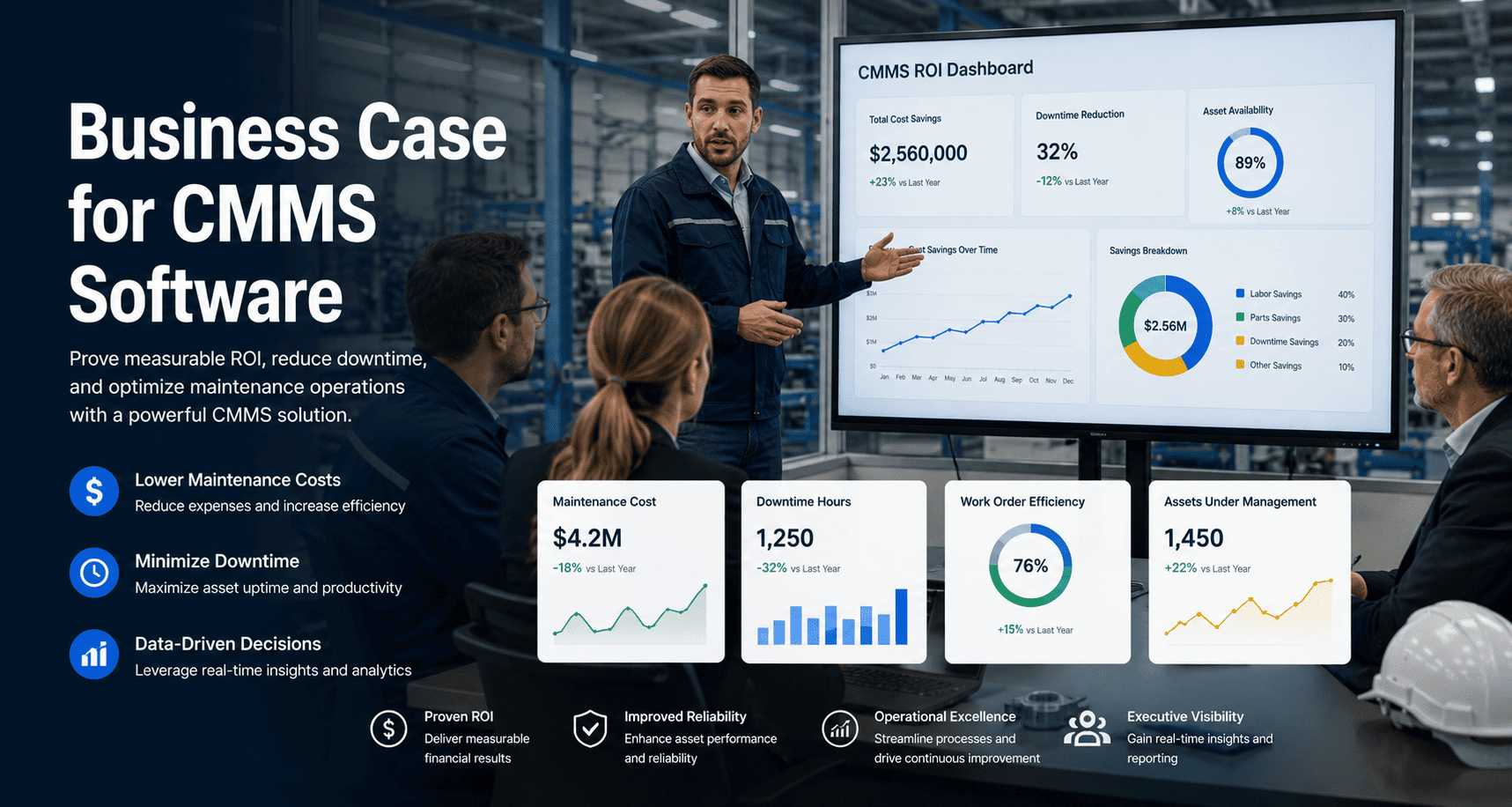
Manufacturing downtime costs a median $125,000 per hour. Yet 95% of companies implementing predictive maintenance report positive returns, with 27% achieving full payback within 12 months. As the predictive maintenance market accelerates toward $47.8 billion by 2029, manufacturing operations managers need a comprehensive guide to capture this opportunity. This article provides the definitive roadmap for 2025, covering everything from ROI calculations to implementation steps, backed by real-world data and proven strategies.
Understanding Predictive Maintenance and Its Transformative Benefits
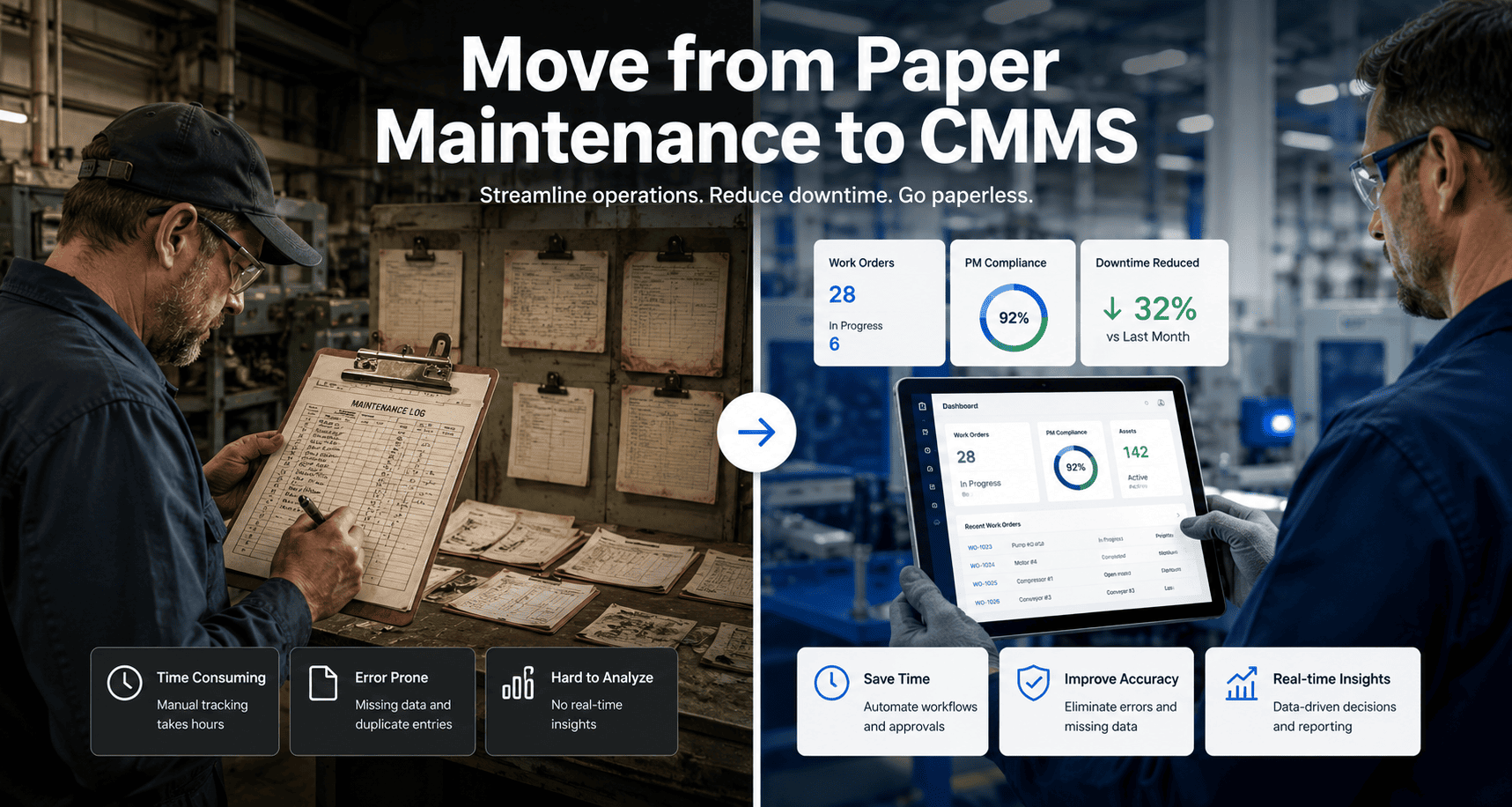
Predictive maintenance uses real-time monitoring, IoT sensors, and AI algorithms to predict equipment failures before they occur, enabling proactive repairs during planned downtime. Unlike preventive maintenance's fixed schedules or reactive maintenance's firefighting approach, predictive maintenance optimizes timing based on actual equipment condition.
The quantifiable benefits reshape manufacturing economics. The US Department of Energy documents even more dramatic results: 70-75% decrease in breakdowns, 35-45% reduction in downtime, and potential 10x ROI. Equipment lifespan extends 20-30%, while maintenance labor requirements drop 18-25%.
These aren't theoretical projections. Ford's commercial vehicle division saved 122,000 hours of downtime and $7 million on just one component type by predicting 22% of failures 10 days in advance. A medical device manufacturer cut maintenance costs 25% while significantly improving customer satisfaction. Tetra Pak saved a customer over 140 hours of downtime through accurate failure prediction.
ROI Calculation Methods Reveal Compelling Returns
Manufacturing leaders need concrete ROI calculations to justify predictive maintenance investments. The primary formula remains straightforward: ROI = (Financial Benefits - Investment Costs) / Investment Costs × 100. However, comprehensive analysis requires deeper frameworks.
The Total Cost of Ownership (TCO) approach captures full lifecycle value by combining initial purchase price, maintenance costs, operating costs, risk costs, training expenses, and downtime costs. Direct benefits include reduced unplanned downtime (often the largest component), lower maintenance labor, decreased spare parts inventory, and extended equipment life. Indirect benefits encompass improved production quality, enhanced safety, better resource allocation, and reduced insurance premiums.
Investment requirements vary by scale. Small implementations range $50,000-$200,000, medium deployments $200,000-$1 million, and enterprise rollouts exceed $1 million. Software licensing typically runs $50,000-$500,000, while sensors cost $200-$2,000 per asset. Despite these upfront costs, payback periods average 12-36 months, with critical assets often achieving ROI within 6-18 months.
Real-world returns validate these investments. IoT Analytics found 95% of adopters reporting positive ROI. Manufacturing companies routinely achieve 5-10x returns within 2-3 years, with mature programs reaching 40% maintenance cost reductions. Energy optimization alone can save 18% of total overhead, while spare parts inventory drops 15-25%.
Step-by-Step Implementation Delivers Systematic Success
Phase 1: Assessment and Planning (Months 1-2)
The journey begins with assessment and planning, evaluating current practices, identifying critical assets, and defining measurable objectives like "30% reduction in unplanned downtime." Asset prioritization focuses on high-impact equipment—rotating machinery like pumps, motors, and fans often provide quick wins through vibration analysis.
Phase 2: Pilot Program (Months 2-4)
The pilot program phase selects 3-5 critical assets representing different failure modes. Technology selection matches sensors to specific needs: accelerometers for vibration monitoring, infrared cameras for thermal analysis, ultrasonic sensors for leak detection, and oil analysis systems for contamination. Modern deployments leverage edge computing for real-time processing and choose connectivity options ranging from Wi-Fi for short-range applications to cellular networks for remote assets.
Phase 3: Full-Scale Rollout (Months 5-12)
Full-scale rollout expands systematically to additional assets while integrating with existing systems. Implementation typically requires 3-6 months for initial results, 6-12 months for validation, and 12-18 months for comprehensive ROI demonstration. Success depends on cross-functional teams including IT, operations, and maintenance, with strong executive sponsorship and comprehensive training programs.
Change management proves critical. Leading organizations invest $2,000-$5,000 per person in training, establish clear communication channels, celebrate early wins, and maintain continuous improvement programs consuming 10-15% of total implementation costs.
Common Challenges Require Proactive Solutions
Despite compelling benefits, predictive maintenance faces significant implementation challenges. Technical hurdles include data quality issues affecting 60% of implementations, legacy system integration complexities, and cybersecurity concerns. Only 29% of technicians feel "very prepared" for advanced maintenance technologies, creating a critical skills gap.
Organizational resistance poses equal challenges. Cultural shifts from reactive to proactive maintenance encounter skepticism, while 29% cite budget constraints despite clear ROI potential. Resource limitations affect 34% of implementations, causing delays or scope reductions.
Solutions exist for each challenge. Data governance frameworks, IoT infrastructure investments, and edge computing address technical barriers. Comprehensive training programs, educational partnerships, and knowledge capture from retiring workers close skills gaps. Phased implementations starting with pilot programs demonstrate value while managing costs. Cross-functional teams integrating business, IT, and operations ensure organizational alignment.
The automotive sector shows how challenges transform into opportunities. Toyota's AI-driven maintenance across plants reduced downtime through precise scheduling while improving safety. Coca-Cola Europacific Partners cut CO2 emissions 50% while monitoring energy consumption at granular levels, proving predictive maintenance supports broader sustainability goals.
Success Stories Demonstrate Transformative Impact
Manufacturing success stories provide blueprints for implementation. Siemens partnered with BlueScope Steel to deploy Senseye Predictive Maintenance with generative AI, creating conversational interfaces for maintenance decisions and enabling multilingual case analysis across global teams.
Industry-specific results showcase broad applicability. Aerospace companies like Lufthansa Technik reduced aircraft-on-ground situations from 14 annually to near zero through machine learning analysis of sensor data. Food and beverage manufacturers achieved 50% downtime reduction and 25% OEE improvement on bottling lines. Pharmaceutical companies enhanced compliance while reducing contamination risks.
Quantified benefits remain consistent across sectors. The US Department of Energy documents 10x ROI increases, while Deloitte studies show 70% breakdown reduction and 25-30% maintenance cost savings. Manufacturing facilities report 20% machine uptime improvements, 40% better detection accuracy, and 30% fewer false alarms.
Technology Platforms Enable Predictive Capabilities
The predictive maintenance technology landscape offers diverse solutions for different needs and scales. Enterprise platforms lead with comprehensive capabilities.
Enterprise Platforms
IBM Maximo Application Suite integrates AI-powered predictions through Watson ML, offering real-time monitoring for $39-65/user/month. SAP Asset Performance Management seamlessly integrates with S/4HANA systems, while Microsoft Azure IoT and AWS IoT provide cloud-native solutions with extensive machine learning capabilities.
Industrial IoT Platforms
GE Predix focuses on heavy industry with digital twin technology and SmartSignal analytics. PTC ThingWorx enables rapid application development with augmented reality integration. Siemens MindSphere delivers edge-to-cloud capabilities optimized for process industries.
Specialized Solutions
Augury excels at vibration and acoustic analysis for rotating equipment, while Uptake provides fleet management for transportation. C3.ai offers enterprise AI platforms for complex deployments. Platform selection depends on existing infrastructure, industry requirements, integration needs, and scalability plans.
Integration capabilities prove critical. Modern platforms connect with CMMS systems for automated work order generation, ERP systems for financial analysis, and MES platforms for production coordination. REST APIs, message queuing, and database connectors enable seamless data flow across enterprise systems.
Cost-Benefit Frameworks Guide Investment Decisions
Comprehensive cost-benefit analysis extends beyond simple ROI calculations. The TCO framework examines acquisition costs (software, hardware, installation), operating expenses (energy, maintenance, spare parts), maintenance costs (planned and unplanned), downtime impacts (production losses, labor inefficiency), and lifecycle factors (training, disposal, upgrades).
Implementation costs vary significantly. Sensors range $200-$2,000 per asset, IoT infrastructure requires $50,000-$200,000 for enterprise deployment, software licensing runs $10,000-$100,000+ annually, and integration services cost $25,000-$150,000. Ongoing expenses include $5,000-$25,000 monthly for cloud infrastructure and 15-20% of software costs for annual maintenance.
Benefits justify these investments through multiple channels. Equipment failure reductions of 70-75% eliminate emergency repairs and overtime costs. Maintenance cost savings of 25-30% accumulate through better planning and reduced parts usage. Downtime reductions of 35-45% directly impact production revenue. Equipment availability improves 30% while lifespan extends 20-25%.
KPIs and Metrics Enable Continuous Improvement
Effective predictive maintenance requires systematic measurement. Primary KPIs include Mean Time Between Failures (MTBF), targeting 500-2,000 hours depending on equipment type. Mean Time to Repair (MTTR) tracks response efficiency, while Overall Equipment Effectiveness (OEE) measures total productivity with 85% considered world-class.
Predictive maintenance effectiveness calculates hours of corrective work identified per hour invested in inspections, targeting 1.5-2.5 hours identified per hour spent. Leading organizations generate over 50% of maintenance work through predictive methods. Maintenance costs should remain below 2.5% of asset replacement value, with planned maintenance exceeding 90% of total activities.
Modern dashboards visualize these metrics in real-time, integrating with CMMS/EAM systems and providing mobile access for field teams. IoT sensors enable continuous monitoring while edge computing processes data instantly. Industry benchmarks guide performance: manufacturing typically achieves 10-15% cost reduction, energy sectors reach 38% savings, and transportation cuts unplanned downtime by 50%.
Integration Strategies Maximize Existing Investments
Successful predictive maintenance enhances rather than replaces existing systems. CMMS integration automates the flow from sensor data through analytics platforms to work order generation. Real-time asset health updates inform maintenance scheduling while historical data trains machine learning models.
ERP integration enables financial impact analysis, procurement optimization based on predicted needs, and production planning coordination. Cost accounting captures true maintenance economics. Modern implementations use REST APIs for real-time exchange, ETL processes for batch synchronization, and message queuing for asynchronous processing.
MES integration delivers production benefits through real-time impact assessment, maintenance scheduling around production, and quality correlation with equipment health. Overall equipment effectiveness improves through coordinated optimization. Leading platforms like IBM Maximo, SAP PM, and Oracle EAM offer native predictive capabilities, while others integrate through middleware solutions.
Future Trends Reshape Maintenance Strategies
The predictive maintenance landscape evolves rapidly as technologies mature. AI and machine learning advance toward 85%+ prediction accuracy through deep learning and natural language processing of maintenance logs. Computer vision automates visual inspections while autonomous systems reduce human intervention needs.
Digital twin technology, growing at 46.3% CAGR, creates virtual replicas enabling scenario simulation and lifecycle planning. Organizations report 50% operational improvements through digital twin deployment. Edge computing reduces latency to sub-milliseconds while cutting bandwidth requirements in half. 5G networks enable massive IoT connectivity with ultra-low latency for time-critical operations.
Augmented reality transforms maintenance execution with diagnostic overlays and remote expert assistance. The industrial AR maintenance market grows 66% annually as technicians use guided procedures and virtual training. New sensor technologies incorporate AI-enabled edge processing, multi-parameter sensing, and extended battery life.
Sustainability increasingly drives adoption. Extended asset lifecycles reduce material consumption while optimal operation cuts energy use. By 2025, ESG assets will reach $35 trillion, with predictive maintenance supporting reporting requirements and circular economy initiatives.
Industry analysts project continued explosive growth. ARC Advisory Group emphasizes that 82% of assets have random failure patterns requiring predictive approaches. IoT Analytics forecasts $630 billion in annual savings potential by 2025. Forrester Research highlights the pivot back to predictive AI from generative AI as organizations focus on tangible operational improvements.
Conclusion
Predictive maintenance has evolved from experimental technology to essential manufacturing capability. With 95% of adopters reporting positive ROI and proven returns of 10x within 2-3 years, the business case is compelling. Success requires systematic implementation following proven frameworks, starting with pilot programs on critical assets and expanding based on demonstrated value.
Manufacturing operations managers should act decisively. Begin with assessment of current maintenance maturity and identification of high-impact assets. Select scalable technology platforms that integrate with existing systems. Invest in workforce development and change management. Most importantly, start now—early adopters gain competitive advantages that compound over time.
The convergence of AI, IoT, edge computing, and digital twins creates unprecedented opportunities to transform maintenance from cost center to value driver. Organizations that embrace predictive maintenance position themselves to capture their share of the $630 billion opportunity while building more reliable, efficient, and sustainable operations. The future of manufacturing maintenance is predictive, and that future is now.
Ready to See Predictive Maintenance in Action?
Get a Personalized Demo to see how leading manufacturers are transforming their maintenance operations with advanced analytics, IoT sensors, and AI-driven insights.