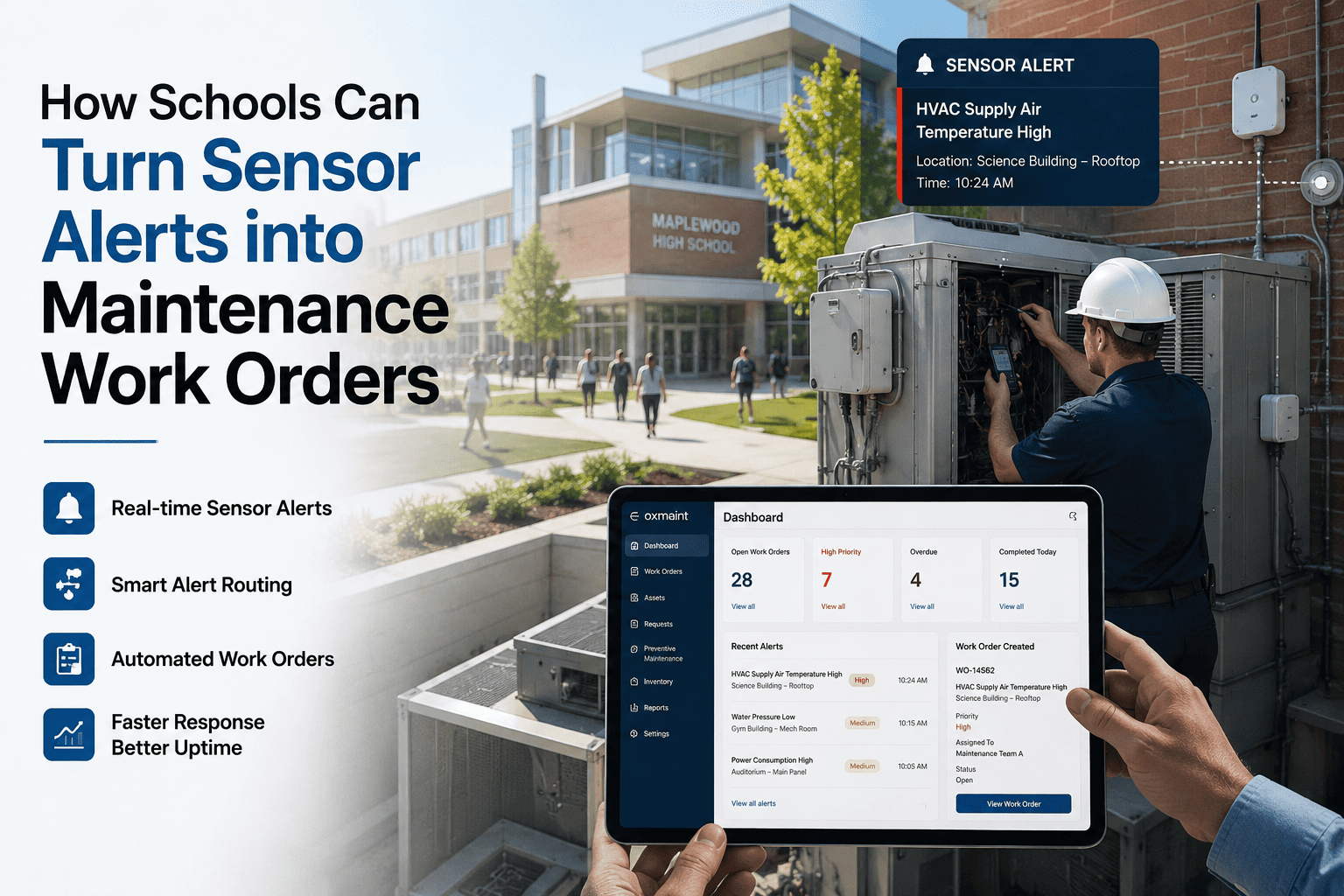
At 11:47 PM on a Wednesday, a PLC controlling a packaging line's fill station registered a torque overload fault on the primary drive motor — fault code F-0429. The alarm appeared on the SCADA screen in the control room for 6 seconds before the operator acknowledged it and resumed production. No work order was created. No maintenance notification was sent. Three shifts later, the drive failed completely, stopping the line for 14 hours. The fault data that predicted the failure had been generated, displayed, and dismissed because there was no connection between the PLC that captured it and the CMMS that could have acted on it. This is the IT/OT gap that exists in the majority of industrial facilities in 2025: control systems generating rich machine health data that never reaches the maintenance platform. Book a demo to see how Oxmaint connects your PLC and SCADA systems to automated maintenance workflows. OPC UA adoption for industrial connectivity grew by 40% between 2023 and 2025. The infrastructure for closing the IT/OT gap exists. What most facilities are missing is the CMMS that can receive, interpret, and act on that data automatically.
Your PLCs Already Know What Will Fail. Does Your CMMS?
Oxmaint connects directly to PLC and SCADA systems — turning real-time machine data, fault codes, and process alarms into automated maintenance work orders without manual intervention.
$260K
Average cost per hour of unplanned manufacturing downtime — preventable with real-time PLC data
70%
Of industrial facilities still manually transfer data between control systems and CMMS
40%
Growth in OPC UA industrial connectivity adoption between 2023 and 2025
4.8x
Cost of reactive emergency repair vs. maintenance triggered by real-time machine data
WHAT IS PLC AND SCADA CMMS INTEGRATION
Closing the IT/OT Gap: What Integration Actually Means
PLC and SCADA systems are the nervous system of every industrial operation — generating continuous data on machine speed, torque, temperature, cycle counts, fault codes, and process parameters. CMMS platforms manage maintenance workflows, work orders, asset records, and compliance documentation. In most facilities, these two systems operate in complete isolation. Integration means building a live, bidirectional data bridge between the OT layer (PLCs, SCADA) and the IT layer (CMMS) — so that machine-generated events automatically trigger maintenance responses without human mediation.
PLC/SCADA–CMMS Integration — Defined
A direct data connection between industrial control systems and the CMMS that enables real-time machine fault codes, alarm events, production counters, and condition thresholds to automatically generate, classify, and assign maintenance work orders — eliminating the human relay step that creates the delay between machine signal and maintenance action.
THE INTEGRATION ARCHITECTURE
How PLC and SCADA Data Reaches Your CMMS: Four Key Protocols
Industrial control systems communicate using specific protocols. Understanding which protocol your PLCs and SCADA systems use determines the integration pathway to Oxmaint. Most modern facilities use one or more of these four standards.
Primary Standard
OPC UA
OPC Unified Architecture is the dominant industrial connectivity standard for PLC-to-CMMS data exchange. Platform-independent, secure, and semantically rich — OPC UA transmits not just values but context about what those values mean. Supported by Siemens, Rockwell, ABB, Schneider, and all major PLC manufacturers. Oxmaint connects natively via OPC UA endpoints on port 4840.
IoT Standard
MQTT
Message Queuing Telemetry Transport is the lightweight publish-subscribe protocol used by IIoT gateways and modern SCADA systems. Ideal for high-frequency sensor data and alarm event streaming. MQTT brokers relay PLC telemetry to cloud or on-premise CMMS platforms at sub-second latency with minimal bandwidth overhead.
Legacy Systems
Modbus and EtherNet/IP
The two dominant fieldbus protocols for legacy PLCs still running in brownfield facilities. Modbus TCP and EtherNet/IP allow direct register-level reading of PLC data through industrial gateways. These protocols enable integration of 15–25 year old PLCs that have no native OPC UA or MQTT capability — critical for manufacturing environments where full equipment replacement is not viable.
API Layer
REST API and Webhooks
Modern SCADA platforms — including Ignition, WinCC, and FactoryTalk — expose REST APIs and webhook endpoints that allow external systems to subscribe to alarm events, process deviations, and threshold breaches. Oxmaint receives SCADA webhook payloads and maps them to maintenance event triggers with configurable classification rules per alarm type.
WHAT THE INTEGRATION ENABLES
Six Maintenance Capabilities That Only Become Possible with Live PLC Data
Connecting PLCs and SCADA to your CMMS does not just add a data feed. It unlocks six maintenance capabilities that are structurally impossible when control systems and maintenance platforms operate in isolation.
01
Alarm-Triggered Work Orders
When a PLC registers a fault code or SCADA alarm breaches a configured threshold, Oxmaint automatically generates a corrective work order — classified by fault type, assigned to the right technician, and populated with asset history. Zero human notification required. Time from alarm to work order: under 90 seconds.
02
Production-Based PM Triggers
PLCs count every cycle, unit, and operating hour with precision. Oxmaint reads these counters directly and triggers preventive maintenance tasks at exact production milestones — 50,000 cycles, 500 operating hours, 10,000 units — replacing fixed calendar intervals with triggers that reflect actual machine use.
03
Real-Time OEE Calculation
SCADA production data — actual vs. target throughput, downtime events, quality rejection rates — feeds Oxmaint's OEE dashboard in real time. Maintenance-caused downtime is automatically tagged and attributed to specific assets, creating the asset-level OEE view that drives reliability improvement decisions.
04
Condition Threshold Monitoring
SCADA systems monitor hundreds of process parameters continuously. Oxmaint subscribes to configurable condition thresholds — motor temperature above 85°C, vibration RMS above 12mm/s, pressure differential above 0.8 bar — and generates predictive maintenance alerts before values reach alarm levels.
05
Fault Code History per Asset
Every PLC fault code received by Oxmaint is stored against the relevant asset record with timestamp, operating conditions at time of fault, and resulting maintenance action. Over time, this builds a fault pattern database that AI uses to predict recurrence — turning isolated incidents into reliability intelligence.
06
Automated Compliance Logging
In regulated industries — pharmaceutical, food manufacturing, energy — SCADA process deviations must be documented with corrective action evidence. Oxmaint automatically logs every SCADA alarm event, links it to the resulting work order, and records resolution outcome — creating the complete audit trail that manual documentation can never reliably produce.
THE INTEGRATION GAP
Why 70% of Facilities Still Have Disconnected Control and Maintenance Systems
The majority of industrial facilities running PLCs and SCADA systems are not using that data to drive maintenance actions. These are the four barriers that keep control data and maintenance workflows in separate silos.
Barrier 01
CMMS Has No OT Connectivity
Legacy CMMS platforms were designed for work order management, not industrial data integration. They have no native OPC UA, MQTT, or Modbus connectivity. Connecting them to PLCs requires custom middleware development that most maintenance teams have neither the budget nor the engineering capacity to build and maintain.
Barrier 02
IT/OT Security Prevents Direct Connection
OT networks are deliberately isolated from IT networks for cybersecurity reasons — and correctly so. The PLC network cannot receive inbound connections from the CMMS. Integration requires a properly architected data diode or DMZ layer that allows OT data to flow to the CMMS without exposing control systems to IT network threats.
Barrier 03
Alarm Noise Without Classification
A large SCADA system can generate 500–2,000 alarm events per day. Without intelligent classification that distinguishes process nuisance alarms from genuine maintenance-triggering fault events, forwarding every alarm to the CMMS produces alert overload — overwhelming maintenance teams and causing the same dismissal behaviour that manual processes produce.
Barrier 04
No Asset Mapping Between Systems
The PLC knows "Drive Fault on Tag PMP-301." The CMMS knows "Pump 301 — Centrifugal Feed Pump, Asset ID 4427." Without a maintained mapping between PLC tag names, SCADA asset identifiers, and CMMS asset records, automated work order generation is impossible — the maintenance system does not know which physical asset the fault refers to.
HOW OXMAINT SOLVES IT
Oxmaint PLC and SCADA Integration: From Machine Signal to Maintenance Action
Oxmaint's integration architecture is designed specifically for industrial OT environments — addressing security, alarm classification, asset mapping, and protocol diversity in a single deployment framework.
01
Protocol Connection
Oxmaint connects to PLCs and SCADA via OPC UA, MQTT, Modbus TCP, EtherNet/IP, or REST API — covering all major control system vendors and both modern and legacy equipment without custom development.
02
Asset Tag Mapping
PLC tag names and SCADA asset identifiers are mapped to Oxmaint asset records in a configuration layer. When "PMP-301 Fault F-0429" fires, Oxmaint knows it refers to Asset ID 4427 — Centrifugal Feed Pump on Line 3 — and populates the work order accordingly.
03
Alarm Classification
Configurable rules classify incoming alarms by maintenance action type: corrective work order, predictive alert, compliance log entry, or dismiss as process nuisance. Classification rules are set per alarm code, per asset, and per operational context — reducing 2,000 daily alarms to 15–30 actionable maintenance events.
04
Automated Work Order
Classified maintenance events automatically generate work orders in Oxmaint with: asset ID, fault description, priority level, technician assignment, required parts from inventory, and safety procedure checklist. Work orders are created and assigned in under 90 seconds from the originating PLC fault.
BEFORE VS. AFTER
Disconnected vs. Integrated: The Full Operational Comparison
PLC/SCADA Disconnected from CMMS vs. Oxmaint Fully Integrated
SUPPORTED PLATFORMS
PLC and SCADA Platforms Oxmaint Integrates With
ROI AND RESULTS
What PLC and SCADA Integration Delivers in Production Operations
90sec
Alarm to Work Order
Oxmaint generates a fully classified, assigned work order from a PLC fault code in under 90 seconds — vs. the 2–6 hour average delay when human notification is required between control room and maintenance team.
60–70%
Fault-to-Repair Time Reduction
Integrated facilities document fault-to-repair time reductions of 60–70% from alarm-triggered work orders compared to manual notification processes — directly reducing the $260K/hour downtime cost exposure.
100%
Production-Triggered PM Accuracy
PLC cycle counters replace calendar-based PM intervals with exact production milestones. Over-servicing of lightly-used equipment and under-servicing of high-cycle assets both eliminated — documented maintenance cost reduction of 15–25%.
4.8x
Emergency Repair Cost Eliminated
Real-time machine data enables maintenance response before failures complete — converting 4.8x-cost emergency repairs into planned corrective work orders executed at standard cost rates with pre-staged parts and scheduled technician time.
FAQ
Frequently Asked Questions
Does Oxmaint connect to PLCs directly or does it require a separate OPC server or gateway?
Both options are supported depending on your PLC model and network architecture. Modern Siemens S7-1500 and Rockwell CompactLogix PLCs with native OPC UA servers can connect directly to Oxmaint via the OPC UA endpoint without additional middleware. Older PLCs running Modbus RTU, EtherNet/IP, or proprietary protocols require a gateway device or OPC server — such as Kepware, Matrikon, or a Ignition-based gateway — that translates the fieldbus protocol to OPC UA or REST API before the connection reaches Oxmaint.
Sign up free to review your specific PLC models with our integration team, or
book a demo for a guided connectivity assessment.
How does Oxmaint handle the IT/OT security boundary when connecting to SCADA systems?
Oxmaint's OT integration architecture maintains strict IT/OT network separation. The integration operates in a unidirectional data flow — OT data is pushed to Oxmaint through a DMZ or data diode layer. Oxmaint never initiates inbound connections to the OT network, never writes values back to PLCs, and processes all OT data in a segregated integration tier. This architecture aligns with IEC 62443 industrial cybersecurity standards and the Purdue Model network segmentation requirements mandated by most industrial security frameworks. No PLC or SCADA system is exposed to IT network traffic as a result of the integration.
How are SCADA alarms classified so only genuine maintenance events create work orders?
Oxmaint's alarm classification engine applies configurable rules to every incoming SCADA alarm before determining whether to generate a maintenance action. Rules are defined per alarm code, per asset, per alarm severity level, and per operational context — for example, a temperature alarm on a furnace during normal heating cycles is classified as process nuisance, while the same alarm outside the heating cycle generates a corrective work order. Classification rules are built during the integration configuration phase using historical alarm data to identify nuisance alarm patterns. The result is typically 15–30 actionable maintenance events per day from a SCADA system generating 500–2,000 raw alarms.
Book a demo to see the alarm classification configuration tool, or
start free and begin your asset tag mapping today.
Can Oxmaint use PLC production counters to trigger PM tasks instead of calendar intervals?
Yes — this is one of the most impactful capabilities enabled by PLC integration. Oxmaint reads production counters, cycle counts, and operating hour registers directly from connected PLCs and uses these values as PM triggers. When a press completes 50,000 die cycles, a compressor reaches 2,000 operating hours, or a conveyor accumulates 1 million metres of belt travel, the corresponding PM task triggers automatically — regardless of how many calendar days have elapsed. This production-based trigger approach eliminates the over-servicing of underutilised equipment and the under-servicing of high-intensity assets that calendar-based PM systems systematically produce. Oxmaint tracks current counter values against PM thresholds in real time and projects upcoming PM due dates based on current production rate.
Your PLCs Are Already Generating the Data. Connect It to Maintenance Action.
Oxmaint integrates with Siemens, Rockwell, Schneider, ABB, and all major PLC and SCADA platforms via OPC UA, MQTT, and Modbus — turning real-time machine data into automated work orders, production-based PM triggers, and real-time OEE tracking. Deploy in days. No custom development required.